Enoki Brain Health
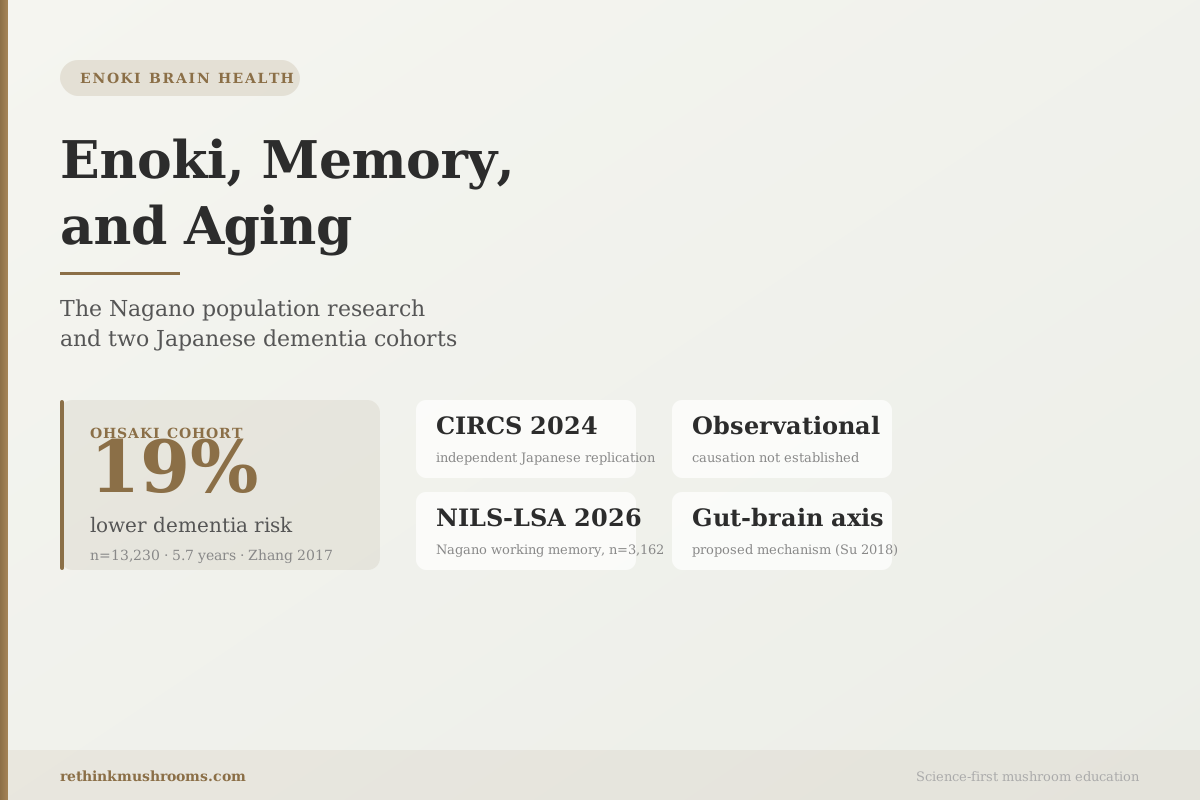
19% lower dementia risk
In 13,230 elderly Japanese followed over 5.7 years, eating mushrooms three or more times per week was associated with a 19% lower risk of developing dementia versus eating them less than once weekly.
Zhang et al., Journal of the American Geriatrics Society, 2017
CIRCS 2024
independent Japanese cohort replicated the protective dementia association (Aoki et al.)
Digit span test
2026 NILS-LSA study found mushroom intake positively associated with working memory in 3,162 aging Japanese adults
Observational only
all population evidence is associational; causation from mushroom eating has not been established
Zhang et al., Journal of the American Geriatrics Society, 2017
 View as image ↗
Nagano Prefecture in central Japan grows more than 60 percent of Japan's commercial enoki mushroom supply. It also consistently ranks first among Japan's 47 prefectures for life expectancy, in both male and female populations. The combination makes for a compelling story, and it has circulated in health media in various forms for decades.
The honest version of that story requires separating two different bodies of research. The original Nagano epidemiology work in the 1970s and 1980s was about cancer mortality, not cognitive aging. Researchers, including the physician Hiroshi Kono, documented unusually low rates of stomach cancer in Nagano-area enoki farmers and connected this to enoki consumption through dietary surveys. That research was about cancer, and the evidence it produced should be understood in that context.
A separate question, examined more recently, is whether regular mushroom consumption tracks with better cognitive outcomes in aging Japanese adults. Two large cohort studies now address this question directly, and a 2026 study from Nagano-region participants adds memory-specific data that makes the regional connection genuinely meaningful for the first time. For the full enoki species background, what is enoki mushroom provides the broader context.
Key Takeaways
- In 13,230 elderly Japanese followed for 5.7 years (Ohsaki Cohort), eating mushrooms three or more times per week was associated with a 19% lower risk of incident dementia versus eating them less than once per week (Zhang et al., 2017); the association held after excluding early-onset cases
- A second independent Japanese cohort (CIRCS) replicated the direction of the association: higher mushroom intake associated with lower risk of disabling dementia (Aoki et al., 2024)
- A 2026 study from the NILS-LSA project specifically in Nagano-region adults found positive associations between mushroom consumption and digit span performance (a measure of working memory) over a 10.5-year follow-up in 3,162 participants (mean age 57.9)
- Enoki polysaccharides improved memory in scopolamine-impaired mice through gut microbiota modulation, reducing neuroinflammatory cytokines; fecal microbiota transplant from treated mice reproduced the benefit (Su et al., 2018), providing a plausible mechanism
- The Nagano story is specifically about cancer research from the 1970s-80s, not dementia; the cognitive aging connection comes from newer, separate population studies
- All population evidence is observational; mushroom-eating populations may differ from non-eating populations in other ways; causation has not been established
The Nagano Story: What It Actually Shows, and What It Doesn't
Nagano Prefecture's health reputation rests primarily on longevity statistics and, separately, on the enoki cancer work from the late twentieth century. The two facts often get conflated in consumer health content, so the separation matters.
Nagano's longevity is real and among the highest in Japan. Its residents eat above-average quantities of mushrooms, particularly enoki, which is heavily cultivated there. The original health research connected these facts through cancer epidemiology: Kono and colleagues found that people in enoki-farming households had lower rates of certain cancers, and they attributed this partly to enoki consumption. This work helped establish enoki as a subject of medicinal interest and contributed to the broader research program on mushroom bioactives.
What the Nagano cancer research did not measure was cognitive aging, memory performance, or dementia incidence. Those are different health outcomes with different underlying mechanisms. The cognitive aging evidence that now exists for mushroom consumption comes from separate studies, conducted in different Japanese populations, using proper prospective methodology.
The 2026 NILS-LSA study specifically included adults from the Nagano area and measured cognitive outcomes. This is the first study that genuinely connects the Nagano regional context to brain health outcomes rather than just cancer. That study will be covered in the NILS-LSA section below.
The Ohsaki Cohort: 13,230 Elderly Japanese and the 19% Dementia Signal
Zhang and colleagues designed the Ohsaki Cohort 2006 study specifically to examine whether mushroom consumption tracked with dementia incidence in elderly Japanese adults.[1]
The cohort enrolled 13,230 participants aged 65 and older in Miyagi Prefecture and followed them for a median of 5.7 years, tracking dementia diagnoses through medical records and insurance claims. Mushroom consumption was assessed through dietary questionnaire at baseline.
Participants who ate mushrooms three or more times per week showed a 19% lower risk of developing dementia (hazard ratio 0.81, meaning 19% lower risk than the reference group) compared to those who ate mushrooms less than once per week. The trend was statistically significant.
The research team conducted several sensitivity analyses to test whether the association was robust. They excluded participants with lower baseline cognitive scores, in case people already developing early cognitive decline were eating less and driving a spurious association. The inverse relationship persisted after this exclusion, reducing the concern about reverse causation. They also excluded participants who developed dementia within the first two years of follow-up, to reduce the chance that early-stage, undiagnosed dementia was affecting dietary choices before diagnosis.
The Ohsaki study did not isolate enoki specifically. Mushroom consumption was measured as total intake across all species consumed, and the Japanese mushroom diet includes shiitake, maitake, oyster, king trumpet, and enoki, among others. The 19% lower dementia risk applies to mushroom consumers generally, not to enoki eaters specifically.
The CIRCS Cohort: Independent Replication From a Different Japanese Population
Aoki and colleagues published results from the Circulatory Risk in Communities Study (CIRCS) in the British Journal of Nutrition in 2024, adding a second, independent Japanese cohort to the dementia-mushroom evidence base.[2]
The CIRCS cohort drew from different communities than the Ohsaki study, providing geographic and methodological independence. Higher mushroom intake was associated with lower risk of incident disabling dementia in this population as well. The direction of association was consistent with Ohsaki's finding.
The existence of two independent Japanese cohort studies pointing in the same direction is a meaningful signal. When two studies with different participants, conducted in different regions, by different research teams, using different methods, converge on the same finding, the probability that the association reflects a genuine relationship rather than methodological artifact or chance increases substantially.
Neither study randomized participants to mushroom consumption. Both are observational data from real-world dietary patterns. People who eat more mushrooms may differ from people who eat fewer in other dietary and lifestyle dimensions that also affect cognitive aging risk. The dose-dependent pattern in Ohsaki (more mushrooms, lower risk) is more compelling than a binary comparison, but it still doesn't prove causation.
For the broader context of population studies on mushroom eating and dementia, see dietary mushroom intake and Alzheimer's risk: population studies.
The 2026 NILS-LSA Memory Study: Nagano Region, Digit Span, and Working Memory
The most directly relevant study for the Nagano-cognitive aging connection comes from the NILS-LSA project (National Institute for Longevity Sciences, Longitudinal Study of Aging), published in Food & Function in 2026 (DOI: 10.1039/D5FO04625D).
The NILS-LSA research enrolled 3,162 Japanese adults with a mean age of 57.9 years in and around the Nagano area and followed them over a 10.5-year period, measuring dietary patterns including mushroom consumption alongside repeated cognitive assessments. The cognitive outcome measured was digit span performance, a test of working memory and short-term memory that requires a person to repeat a sequence of numbers in the correct order.
Higher mushroom consumption was positively associated with better digit span performance over the follow-up period. This finding applies to a population in Nagano Prefecture specifically, which is both the region with Japan's highest mushroom consumption and the place where the original enoki health research was conducted.
This study is more specific than the Ohsaki and CIRCS cohorts in two ways: it measures a specific cognitive domain (working memory via digit span) rather than a broad dementia diagnosis, and it is anchored geographically in the enoki-cultivation heartland. It does not isolate enoki from other mushroom species, and it is observational like the other cohort studies. But the specific memory measurement and the geographic setting make it the most directly relevant connection between Nagano's enoki culture and cognitive aging outcomes.
The Mechanism Behind the Correlation: Why Might Mushroom Eating Affect Brain Aging?
Population data identifies an association. It does not explain how mushrooms might protect the aging brain. The mechanistic research provides plausible pathways.
Su and colleagues (2018) showed in a mouse model that enoki polysaccharides improved memory performance in animals with experimentally impaired memory, and traced the mechanism to gut microbiota modulation.[3] The polysaccharides shifted gut bacterial populations, which reduced neuroinflammatory cytokines (inflammatory signaling proteins: IL-1β, TNF-α, and IL-6) in the brain. A fecal microbiota transplant from the treated mice to untreated impaired mice partially reproduced the memory benefit, confirming that the bacteria change rather than a direct compound effect was responsible.
Zhang and colleagues (2018) found that enoki polysaccharides combined with ginsenosides improved spatial memory test performance in rats with Alzheimer's-like disease induced by D-galactose, with reduced apoptosis markers in the hippocampus.[4]
Tang's comprehensive 2016 review of F. velutipes biological activities documented neuroprotective properties as one of the established activities of the species, including protective effects on neural cells under oxidative and inflammatory stress.[5]
These mechanisms are preclinical, from animal and cell models. They don't confirm that eating enoki prevents dementia in humans. But they offer plausible biological explanations for why a population-level association between mushroom consumption and lower dementia risk might exist: enoki polysaccharides and other bioactives may reduce neuroinflammation through gut-mediated pathways, protect neurons from oxidative damage, and support neural growth signals.
For the full mechanistic research on enoki and brain biology, see enoki and brain health: neuroprotective research.
The Bottom Line
The Nagano connection to enoki and cognitive aging requires careful framing: the original Nagano epidemiology was about cancer mortality in enoki farmers, not dementia. The cognitive aging evidence comes from three separate population studies. The Ohsaki Cohort (13,230 elderly Japanese) found 19% lower dementia risk with frequent mushroom consumption. The CIRCS cohort independently replicated the protective direction. A 2026 NILS-LSA study specifically from Nagano-region adults linked mushroom consumption to better working memory over 10.5 years. All three are observational; causation is not established. Mechanistic research in animals suggests gut-mediated neuroinflammation reduction as a plausible pathway.
Frequently Asked Questions
Sources & References
- 1RTHM-00935·Zhang, Shu et al. (2017). “Mushroom Consumption and Incident Dementia in Elderly Japanese: The Ohsaki Cohort 2006 Study..” Journal of the American Geriatrics Society.Study breakdown →PubMed →↩
- 2RTHM-01849·Aoki, Shoko et al. (2024). “Mushroom intake and risk of incident disabling dementia: the Circulatory Risk in Communities Study (CIRCS)..” The British journal of nutrition.Study breakdown →PubMed →↩
- 3RTHM-01010·Su, Anxiang et al. (2018). “Flammulina velutipes polysaccharides improve scopolamine-induced learning and memory impairment in mice by modulating gut microbiota composition..” Food & function.Study breakdown →PubMed →↩
- 4RTHM-01023·Zhang, Yan et al. (2018). “Cognitive-enhancing effect of polysaccharides from Flammulina velutipes on Alzheimer's disease by compatibilizing with ginsenosides..” International journal of biological macromolecules.Study breakdown →PubMed →↩
- 5RTHM-00831·Tang, Calyn et al. (2016). “Golden Needle Mushroom: A Culinary Medicine with Evidenced-Based Biological Activities and Health Promoting Properties..” Frontiers in pharmacology.Study breakdown →PubMed →↩