Enoki Mushroom Brain Health
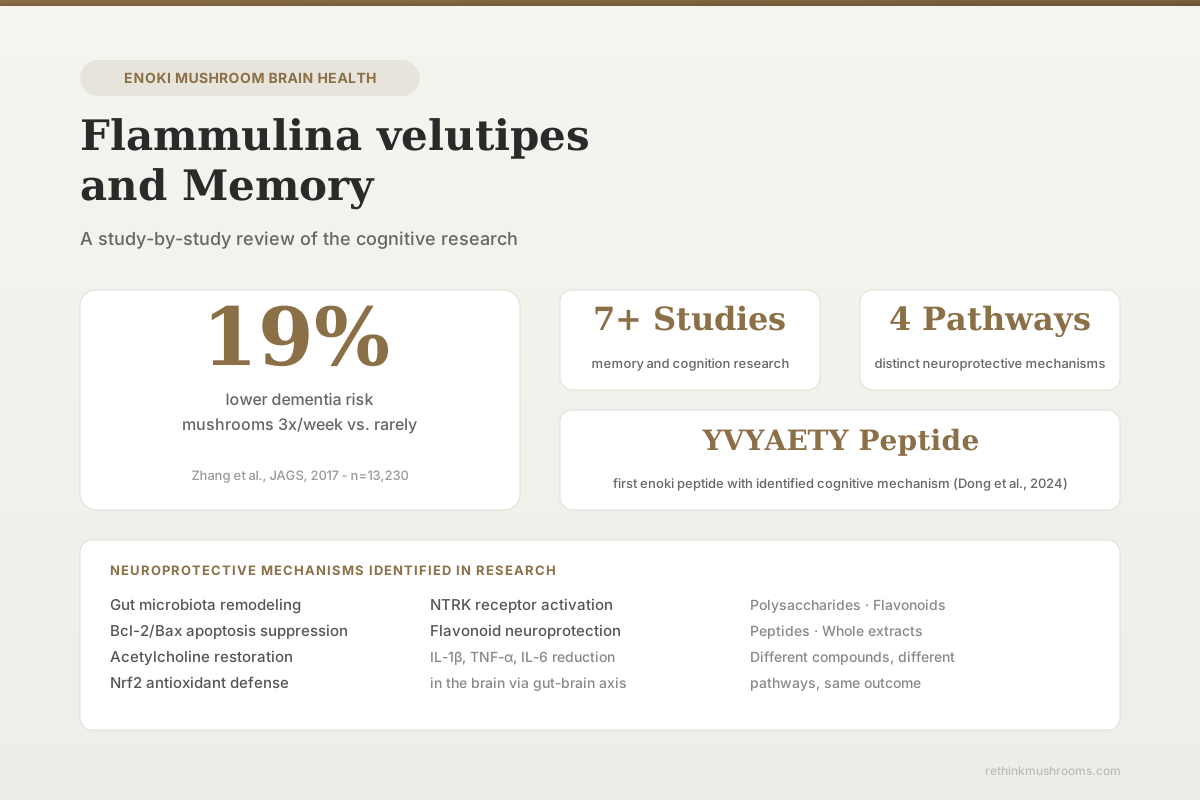
19% lower dementia risk
In 13,230 elderly Japanese adults followed for 5.7 years, eating mushrooms three or more times per week was associated with 19% lower dementia risk, the largest human dataset connecting Flammulina velutipes consumption to cognitive outcomes.
Zhang et al., Journal of the American Geriatrics Society, 2017
7+ studies
memory and cognition research on Flammulina velutipes
3 models
animal, cell, and population research designs
4 mechanisms
distinct pathways identified: gut-brain, flavonoid, peptide, NTRK
Zhang et al., Journal of the American Geriatrics Society, 2017
 View as image ↗
Flammulina velutipes (the scientific name for enoki mushroom) has accumulated a body of memory and cognition research that most people looking up "enoki" for a recipe have never encountered. The published evidence spans animal models testing specific memory impairment models, cell culture studies isolating individual neuroprotective compounds, and human population cohorts tracking tens of thousands of adults over years. No single editorial resource has synthesized it all.
This article is that synthesis. It covers every major published study on Flammulina velutipes memory research: what was tested, which model was used, what was found, and what the evidence honestly does and does not support. For a broader introduction to the mushroom and its biology, see what is enoki mushroom and why it has such deep research roots.
Key Takeaways
- Flammulina velutipes polysaccharides improved learning and memory in scopolamine-impaired mice by remodeling gut microbiota, reducing IL-1β, TNF-α, and IL-6 in the brain; fecal transplant from treated mice reproduced the memory benefit in untreated animals (Su et al., Food & Function, 2018)
- FV polysaccharides combined with ginsenosides improved cognitive performance in D-galactose Alzheimer's model rats on the Morris water maze; the combination outperformed either compound alone (Zhang et al., 2018)
- Methanolic extract of Flammulina velutipes enhanced neurite outgrowth and hippocampal neuronal survival under oxidative stress via NTRK receptor activation, the most recent and mechanistically precise cell study (Mitra et al., Nutrients, 2025)
- Six flavonoids from Flammulina velutipes (including kaempferol, epicatechin, and formononetin) protected PC12 neural cells from oxidative damage via Bcl-2/Bax pathway regulation (Hu et al., Food Chemistry, 2016)
- In 13,230 elderly Japanese adults, eating mushrooms three or more times per week was associated with 19% lower dementia risk (HR=0.81, p-trend<0.01) over 5.7 years of follow-up (Zhang et al., JAGS, 2017)
- The YVYAETY peptide identified from Flammulina velutipes protein hydrolysates protected hippocampal neurons from scopolamine-induced damage via Nrf2 pathway activation. It is the first enoki-specific neuroprotective peptide with an identified mechanism (Dong et al., Food & Function, 2024)
The Research Landscape: What Has Actually Been Studied
Before examining individual studies, the research architecture is worth mapping. The memory and cognition research on Flammulina velutipes falls into three distinct categories, and understanding which category a study belongs to matters for interpreting what it proves.
Animal model studies test specific interventions in animals with experimentally induced memory impairment. Two models dominate this literature. The scopolamine model induces memory deficits by blocking acetylcholine receptors, the neurotransmitter system involved in memory formation that degrades in early Alzheimer's disease. The D-galactose model induces oxidative stress and neurodegeneration that more broadly mimics aging-related cognitive decline. These are different problems. A compound that works in one model may not work in the other, and neither model guarantees human efficacy.
Cell culture studies isolate specific compounds and test their effects on neural cells, typically PC12 cells (a rat neural cell line used to model neuronal stress responses) or primary hippocampal neurons. These studies identify mechanisms and active compounds but cannot test cognitive outcomes.
Population studies track large cohorts of real humans eating real diets and look for associations between mushroom consumption and dementia incidence. These provide the strongest real-world signals but cannot isolate Flammulina velutipes specifically, since Japanese cohort participants ate multiple mushroom types.
The evidence base for Flammulina velutipes memory is strongest in animals and cells. The human data is promising but not specific to enoki. This distinction matters.
A comprehensive review by Tang and colleagues in 2016 documented the full range of bioactive activities in Flammulina velutipes, including neuroprotective, antioxidant, immunomodulatory, and anti-inflammatory properties, establishing the foundational framework that subsequent studies have built on.[5]
Animal Memory Studies: Three Models, Three Mechanisms
The Earliest Memory Study: Acetylcholine Restoration (Yang et al., 2015)
The first systematic study of Flammulina velutipes polysaccharides on memory came from Yang and colleagues in 2015, published in the Journal of Functional Foods (DOI:10.1016/j.jff.2015.08.003). Using the scopolamine rat model, they found that FVP improved memory deficits by restoring the cholinergic system in the hippocampus and cerebral cortex. The mechanism was specific: FVP upregulated choline acetyltransferase (the enzyme that makes acetylcholine) and inhibited acetylcholinesterase (the enzyme that breaks it down), effectively preserving the acetylcholine needed for normal memory formation. FVP also restored antioxidant enzyme activity including superoxide dismutase and glutathione peroxidase.
This study established polysaccharides as the primary active fraction, identified the cholinergic system as a target, and provided the mechanistic foundation for subsequent animal work.
The Gut-Brain Discovery: Su et al., 2018
Three years later, Su and colleagues published a study that reframed the mechanism entirely, in Food & Function.[1] Like Yang's study, it used scopolamine-impaired mice and Flammulina velutipes polysaccharides. But the researchers tracked something different: the gut microbiome.
FVP treatment changed the composition of the gut microbiota significantly. Beneficial bacteria in the Bacteroidia and Erysipelotrichia classes increased. Potentially problematic populations in the Clostridia and Bacilli classes decreased. And the downstream effect appeared in the brain: pro-inflammatory cytokines IL-1β, TNF-α, and IL-6 dropped, while the anti-inflammatory cytokine IL-10 rose.
The most compelling element of this study was the fecal microbiota transplant validation. Su's team transferred gut bacteria from FVP-fed mice into untreated scopolamine-impaired mice. The recipient mice showed the same memory improvements, without ever receiving FVP themselves. This is strong evidence that the gut microbiota changes were causally involved, not just correlated, with the cognitive benefit.
This gut-brain axis mechanism is covered in more depth in the companion article on enoki and neuroinflammation: brain protection research. For the broader context of how mushroom prebiotics modulate the gut-brain connection, see how mushroom prebiotics influence brain function through the gut.
The Alzheimer's Disease Model: Zhang et al., 2018
Zhang and colleagues tested Flammulina velutipes polysaccharides in a D-galactose rat model of Alzheimer's-like neurodegeneration, a different model from the scopolamine studies above.[2] The D-galactose model produces oxidative stress and mitochondrial dysfunction that mimic some aspects of aging-related neurodegeneration, rather than the cholinergic impairment of the scopolamine model.
Using the Morris water maze (a standard test of spatial memory and learning in rodents), the researchers found that FVP combined with ginsenosides significantly improved cognitive performance in impaired rats. The mechanism involved reducing hippocampal apoptosis: Bax, cytochrome C, and caspase-3 and -9 all decreased, while the anti-apoptotic protein Bcl-2 increased. Critically, the combination of FVP and ginsenosides produced better results than either compound alone, suggesting synergistic effects.
The model distinction matters here: Zhang 2018 tests a different aspect of memory impairment than the scopolamine studies. Where Yang 2015 and Su 2018 target cholinergic memory formation, Zhang 2018 targets apoptotic cell death in neurons, the mechanism more relevant to Alzheimer's pathology.
Cell Studies: Isolating the Active Compounds
Flavonoids and the Bcl-2/Bax Pathway: Hu et al., 2016
Hu and colleagues identified and characterized six flavonoids from Flammulina velutipes: arbutin, epicatechin, phillyrin, apigenin, kaempferol, and formononetin.[4] They then tested each compound's ability to protect PC12 neural cells against hydrogen peroxide-induced oxidative damage.
All six flavonoids demonstrated neuroprotective activity. All except apigenin inhibited neural cell apoptosis via the Bcl-2/Bax pathway: the pro-death protein Bax decreased, the survival protein Bcl-2 increased, and the downstream death mediator cytochrome C was reduced. This is the same apoptosis pathway that Zhang 2018 found FVP polysaccharides affecting in animal hippocampal cells. Two different compound classes converge on the same cell-death mechanism.
The practical significance: Flammulina velutipes contains multiple flavonoids that each independently protect neurons from oxidative damage. These compounds co-exist in the whole mushroom with the polysaccharides studied in animal models.
Hippocampal Neurite Growth: Mitra et al., 2025
The most recent and mechanistically detailed cell study came from Mitra and colleagues, published in Nutrients in 2025.[3] Unlike the PC12 oxidative stress model, Mitra's team worked with primary hippocampal neurons, specifically neurons cultured from rodent hippocampi, the brain region most critical to memory formation.
The methanolic extract of Flammulina velutipes significantly enhanced neurite outgrowth (the process of growing new neural connections) and improved hippocampal neuronal cytoarchitecture. It also promoted neuronal survival under oxidative stress. The mechanism involved NTRK receptor activation, a neurotrophic receptor pathway that supports neuron growth and survival.
NTRK (also called TrkA/TrkB/TrkC) is the receptor family through which nerve growth factors stimulate neurons to grow new connections and resist damage. The identification of NTRK as the mechanism places Flammulina velutipes extract in the same mechanistic category as lion's mane mushroom's hericenone/erinacine compounds, which promote nerve growth factor production via related pathways. Unlike lion's mane, where the NGF-pathway mechanism has received widespread coverage, the NTRK mechanism in enoki remains almost completely uncovered in consumer-facing content.
The YVYAETY Peptide: Dong et al., 2024
The newest entry in the Flammulina velutipes cognitive research literature is a peptide study by Dong and colleagues, published in Food & Function in 2024 (DOI:10.1039/D4FO00871E). The researchers screened protein hydrolysates from Flammulina velutipes and identified four neuroprotective peptides: YVYAETY, SDLKPADF, WNDHYY, and WFHPLF.
YVYAETY showed the strongest activity. In scopolamine-impaired mice, YVYAETY treatment improved cognitive impairment on behavioral tests and protected hippocampal neurons from two histological markers of damage: vacuolation and pyknotic nuclei (signs of dying cells). The mechanism involved Nrf2 pathway activation, the master switch for cellular antioxidant defense.
The significance of this study is that it identifies specific peptide sequences from Flammulina velutipes protein that have measurable neuroprotective activity. It moves the science from "extract protects neurons" to "this specific molecular sequence from enoki protein does this via this pathway." For more on enoki's full peptide profile, see enoki bioactive peptides and cognitive function.
All Published Flammulina velutipes Memory Studies: A Summary Table
| Study | Year | Model | Intervention | Key Memory Outcome |
|---|---|---|---|---|
| Yang et al. (JFF) | 2015 | Scopolamine rat | FVP polysaccharides | Restored ChAT/AChE; SOD/GSH-Px antioxidant defense |
| Hu et al. | 2016 | PC12 cells (oxidative stress) | Flavonoids (6 compounds) | Blocked apoptosis via Bcl-2/Bax; 5 of 6 protective |
| Su et al. | 2018 | Scopolamine mice | FVP polysaccharides | Gut microbiota remodeling → reduced IL-1β, TNF-α, IL-6; confirmed by fecal transplant |
| Zhang et al. | 2018 | D-galactose AD rats | FVP + ginsenosides | Morris water maze improvement; Bcl-2↑, Bax/caspase-3/9↓ |
| Mitra et al. | 2025 | Primary hippocampal neurons | Methanolic extract | Neurite outgrowth↑, NTRK activation, oxidative stress survival↑ |
| Dong et al. | 2024 | Scopolamine mice | YVYAETY peptide | Hippocampal protection; Nrf2 activation; behavioral improvement |
This table does not include the Ohsaki and CIRCS population studies (below), which are human cohort data on mushroom consumption broadly, not Flammulina velutipes specifically.
Human Population Data: Mushroom Consumption and Dementia Risk
Two large Japanese cohort studies provide the human context for this research, though both studied total mushroom consumption, not enoki specifically.
Zhang and colleagues analyzed data from 13,230 elderly Japanese adults in the Ohsaki Cohort 2006 Study, with 5.7 years of follow-up.[6] Participants who ate mushrooms three or more times per week had a 19% lower risk of dementia compared to those eating mushrooms less than once per week (HR=0.81, p-trend<0.01). The inverse association held after excluding early-onset dementia cases and those with lower baseline cognitive function at enrollment, suggesting the result was not driven by pre-existing impairment.
Aoki and colleagues replicated this direction of effect in the CIRCS (Circulatory Risk in Communities Study) cohort, published in the British Journal of Nutrition in 2024, finding higher mushroom intake associated with significantly lower risk of incident disabling dementia.[7]
Japan is relevant context here. Flammulina velutipes is one of the most commonly consumed mushrooms in Japanese cuisine, alongside shiitake and nameko. Enoki appears in nabemono hot pot dishes, miso soup, and sautéed preparations across Japanese households. When Japanese cohort participants report frequent mushroom consumption, enoki is often part of that pattern.
But the critical limitation: neither the Ohsaki study nor CIRCS asked about enoki consumption specifically. These are total mushroom intake studies. The neuroprotective compounds in these studies could come from any mushroom type, or from interactions between multiple mushroom types eaten in combination. The population data cannot establish that Flammulina velutipes specifically drives the effect.
For the population epidemiology context across Asian cohorts, see dietary mushroom intake and Alzheimer's risk: population studies.
What the Evidence Shows and What It Doesn't
The Flammulina velutipes memory research establishes several things clearly, and leaves others unanswered.
What is established: Multiple distinct compound classes from Flammulina velutipes, including polysaccharides, flavonoids, peptides, and whole extracts, protect neurons and improve memory in animal models and cell studies. The mechanisms differ by compound class: polysaccharides work via gut microbiota modulation and apoptosis suppression, flavonoids work via Bcl-2/Bax, peptides work via Nrf2, and whole extracts activate NTRK neurotrophic receptors. This mechanistic diversity is unusual and suggests the whole mushroom provides complementary protection across multiple pathways.
What remains unanswered: No human randomized controlled trial has tested Flammulina velutipes for memory outcomes. The animal models use pharmacological memory impairment (scopolamine, D-galactose) rather than naturally occurring Alzheimer's pathology, so translation to human disease is not guaranteed. The population data (Ohsaki, CIRCS) cannot attribute results to enoki specifically.
The honest bottom line: Flammulina velutipes has one of the more extensive and mechanistically diverse preclinical research profiles of any culinary mushroom. The population signals from Japan are interesting. Human RCT data does not yet exist.
For broader coverage of how enoki's compounds interact with immune and neuroinflammatory systems, see enoki and brain health: neuroprotective research and enoki bioactive compounds: flammulin, proflamin, and polysaccharides. For the Nagano population connection, see enoki and memory in aging populations: Nagano longevity study insights.
The Bottom Line
The published research on Flammulina velutipes and memory spans at least seven studies across three research models. Animal studies consistently show polysaccharides and peptides improve memory in pharmacologically impaired rodents, with mechanisms involving gut microbiota modulation, apoptosis suppression, acetylcholine restoration, and Nrf2 antioxidant defense. Cell studies identify specific neuroprotective compounds including six flavonoids and the YVYAETY peptide. A 2025 study found whole extract activates NTRK neurotrophic receptors in hippocampal neurons. Human population data from Japan (13,230 elderly adults) shows 19% lower dementia risk with frequent mushroom consumption, though not enoki specifically. No human RCT has tested Flammulina velutipes for memory outcomes.
Frequently Asked Questions
Sources & References
- 1RTHM-01010·Su, Anxiang et al. (2018). “Flammulina velutipes polysaccharides improve scopolamine-induced learning and memory impairment in mice by modulating gut microbiota composition..” Food & function.Study breakdown →PubMed →↩
- 2RTHM-01023·Zhang, Yan et al. (2018). “Cognitive-enhancing effect of polysaccharides from Flammulina velutipes on Alzheimer's disease by compatibilizing with ginsenosides..” International journal of biological macromolecules.Study breakdown →PubMed →↩
- 3RTHM-02150·Mitra, Sarmistha et al. (2025). “Neuroprotective and Neurotrophic Potential of Flammulina velutipes Extracts in Primary Hippocampal Neuronal Culture..” Nutrients.Study breakdown →PubMed →↩
- 4RTHM-00786·Hu, Qiuhui et al. (2016). “Identification of flavonoids from Flammulina velutipes and its neuroprotective effect on pheochromocytoma-12 cells..” Food chemistry.Study breakdown →PubMed →↩
- 5RTHM-00831·Tang, Calyn et al. (2016). “Golden Needle Mushroom: A Culinary Medicine with Evidenced-Based Biological Activities and Health Promoting Properties..” Frontiers in pharmacology.Study breakdown →PubMed →↩
- 6RTHM-00935·Zhang, Shu et al. (2017). “Mushroom Consumption and Incident Dementia in Elderly Japanese: The Ohsaki Cohort 2006 Study..” Journal of the American Geriatrics Society.Study breakdown →PubMed →↩
- 7RTHM-01849·Aoki, Shoko et al. (2024). “Mushroom intake and risk of incident disabling dementia: the Circulatory Risk in Communities Study (CIRCS)..” The British journal of nutrition.Study breakdown →PubMed →↩