Enoki Mushroom Brain Health & Cognitive Function
4 compound classes in Flammulina velutipes with brain-relevant preclinical evidence: peptides, polysaccharides, flavonoids, and FIP-fve protein
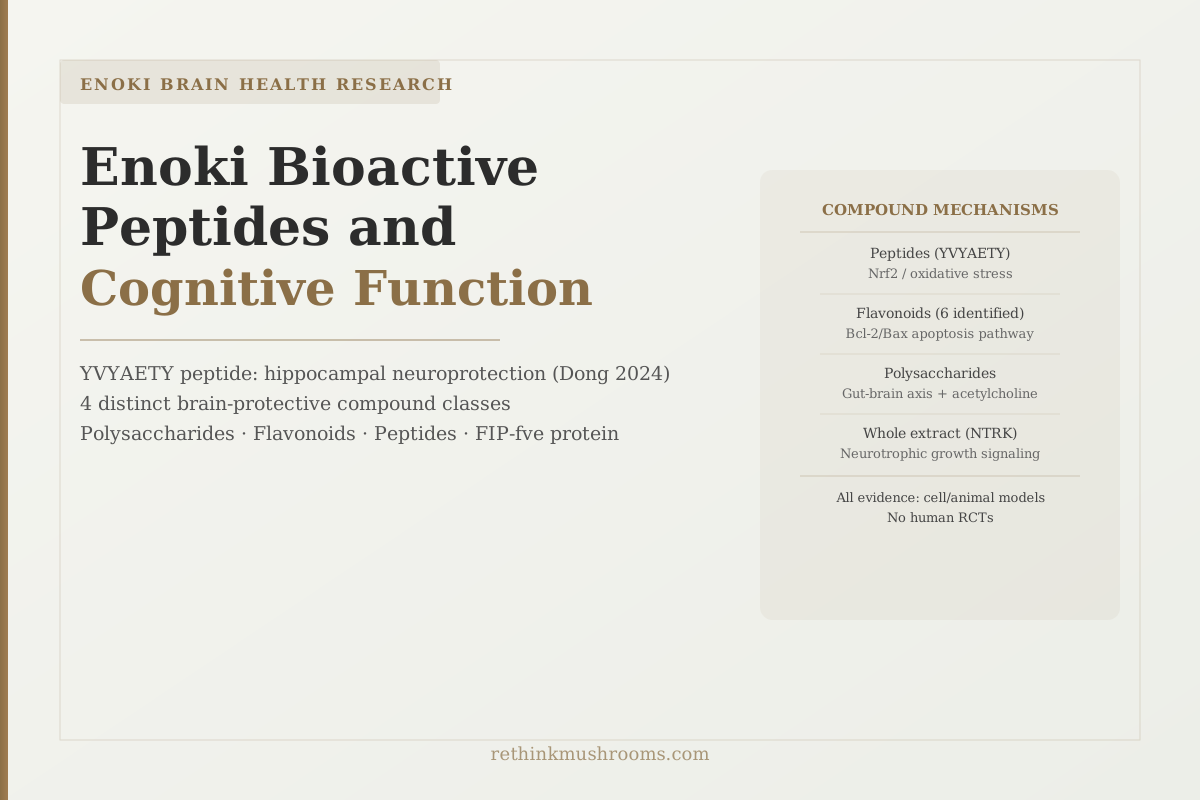
Dong et al. (2024) isolated four peptides from enoki protein hydrolysates and showed the strongest of them, YVYAETY, improved memory in scopolamine-impaired mice. Earlier work found antioxidant neuroprotection from enoki flavonoids in cell culture and memory benefits from enoki polysaccharides in mice. No human trial has tested any of it.
Dong et al., Food & Function, 2024; Hu et al., Food Chemistry, 2016; Su et al., Food & Function, 2018
4 peptides
identified from enoki protein hydrolysates by simulated digestion; YVYAETY improved cognition in scopolamine-impaired mice (Dong et al., 2024)
Fecal transplant
carried the memory benefit from polysaccharide-fed mice to untreated mice, pointing to a gut-brain route (Su et al., 2018)
0 human trials
have tested any isolated enoki compound for a cognitive endpoint; the only human data measures total mushroom intake, not enoki
Dong et al., Food & Function, 2024; Hu et al., Food Chemistry, 2016; Su et al., Food & Function, 2018
 View as image ↗
In 2024, researchers broke down enoki mushroom protein using simulated digestive enzymes, then screened the resulting fragments for brain-protective activity. Four peptides came out of that screen. One of them, a seven-amino-acid sequence written YVYAETY, protected hippocampal cells from oxidative damage and improved memory performance in mice with chemically induced cognitive impairment. The work has received essentially no coverage outside academic journals. It is also the newest layer in an enoki mushroom peptides brain research story that now spans four distinct compound classes, each studied in a different model system and each at a different stage of development. For a broader overview of enoki's research, see What Is Enoki Mushroom? The Tiny Mushroom with Big Research.
That last point matters more than the headline. "Four mechanisms" sounds like four converging lines of proof. It is closer to four separate starting points, three of which have never left the laboratory bench and one of which has never been tested in brain tissue at all.
Key Takeaways
- Dong et al. (2024, Food & Function, DOI:10.1039/d4fo00871e, PMID 38757389) identified four peptides in enoki protein hydrolysates — YVYAETY, SDLKPADF, WNDHYY, and WFHPLF — that reduced oxidative stress in hippocampal HT22 cells; YVYAETY then improved memory in scopolamine-impaired mice and reduced hippocampal neuron damage
- Hu et al. (2016) identified six flavonoids in enoki (arbutin, epicatechin, phillyrin, apigenin, kaempferol, formononetin) and showed the total flavonoid extract protected PC12 neural cells from hydrogen-peroxide damage through antioxidant action — the six were identified chemically, not tested one by one
- Su et al. (2018) showed enoki polysaccharides improved memory in scopolamine-impaired mice by shifting gut microbiota composition and regulating IL-1β, TNF-α, IL-6 and IL-10; a fecal microbiota transplant from polysaccharide-fed mice carried the memory benefit to untreated mice
- Zhang et al. (2018) found enoki polysaccharides reduced Bax, cytochrome C, and caspase activity while raising Bcl-2 in the hippocampi of Alzheimer's-model rats — but only in combination with ginsenosides, so the effect cannot be attributed to enoki alone
- Mitra et al. (2025) found methanolic enoki extract enhanced neurite outgrowth and hippocampal neuron survival via NTRK receptor activation, a growth-promoting rather than purely protective mechanism
- FIP-fve protein acts through p38 MAPK cytokine signaling (Wang et al., 2004), a pathway that also governs neuroinflammation — but FIP-fve has never been tested in a neurological model
- Every finding above is from cell culture or rodents. No human clinical trial has tested an enoki compound for a cognitive endpoint
Four Compound Classes, Four Model Systems
What Each Enoki Compound Was Actually Tested In
Enoki’s brain research is often summarized as “four mechanisms,” which is true but flattens an important difference: the four classes were studied in four different systems, and they are not equally far along. Only the peptide work has reached a whole animal after starting in neurons. The FIP-fve protein has never been tested in neural tissue at all.
Peptides
YVYAETY (+3)
Tested in: Hippocampal HT22 cell line, then scopolamine-impaired mice
Raised SOD and GSH-px activity, blocked apoptosis and mitochondrial membrane potential collapse; molecular docking against the Keap1-Kelch domain implicates Keap1/Nrf2/HO-1 regulation. Dong 2024
Flavonoids
Total extract (FVF)
Tested in: H2O2-stressed PC12 cells
Antioxidant action: raised cell survival, glutathione and superoxide dismutase; lowered lactate dehydrogenase release, intracellular ROS and malondialdehyde. Six flavonoids were identified in the extract, but the extract was tested as a whole. [1]
Polysaccharides
FVP
Tested in: Scopolamine-impaired mice, plus fecal microbiota transplant
Shifted gut microbiota (Clostridia and Bacilli down; Bacteroidia, Erysipelotrichia and Actinobacteria up) with regulation of IL-1B, TNF-a, IL-6 and IL-10, indicating suppressed neuroinflammation. [3]
FIP-fve protein
Flammulin
Tested in: Human peripheral blood lymphocytes — no brain model
Activates T cells to secrete interferon-gamma via p38 MAPK; the p38 inhibitor SB203580 fully abolishes it. p38 MAPK also governs neuroinflammatory cytokines, which is why the link is drawn — but that step has not been tested. [6]
This is a map of what was measured, not a claim that eating enoki produces any of these effects in people. Three of the four classes were delivered directly to cells or injected into animals at controlled doses; the fourth was never tested in neural tissue. Whether culinary enoki delivers any of these compounds to the human brain in active form is unresolved.
Mechanism synthesis; model systems from Dong 2024 and refs [1][3][6]
The YVYAETY Peptide: What Happens When Enoki Protein Is Digested
Most mushroom brain research focuses on polysaccharides, the complex carbohydrates that make up fungal cell walls and survive digestion to interact with gut bacteria and immune cells. Peptides are a different story. They are short protein fragments produced when digestive enzymes break larger mushroom proteins into chains of a few amino acids. Some of those short chains turn out to be biologically active in ways the intact protein was not.
Dong et al. (2024) applied exactly that approach to Flammulina velutipes protein. The protein was hydrolyzed by simulated gastrointestinal digestion, purified through ultrafiltration and gel chromatography, and the most protective fraction was analyzed by liquid chromatography-tandem mass spectrometry. Four peptides were identified: SDLKPADF, WNDHYY, YVYAETY, and WFHPLF.
The cell model was HT22, a hippocampal neuronal line, stressed with amyloid-beta 25-35 — the fragment used to model Alzheimer's-type toxicity in culture. All four peptides reduced excessive reactive oxygen species production by raising superoxide dismutase and glutathione peroxidase activity, and all four inhibited both apoptosis and the collapse of mitochondrial membrane potential that precedes it.
To find the mechanism, the researchers used molecular docking against the Keap1-Kelch domain. Keap1 is the protein that holds Nrf2 — the master switch for the cell's antioxidant gene program — in check. A compound that binds Keap1 can in principle release Nrf2 and turn that program on. The docking results showed the peptides interacting with that site, implicating regulation of the Keap1/Nrf2/HO-1 pathway.
Dong et al. (2024) · Food & Function
- Population
- Amyloid-beta-stressed HT22 hippocampal cells, then scopolamine-impaired mice
- Intervention
- Peptides from simulated gastrointestinal digestion of enoki protein; YVYAETY tested in vivo
- Finding
- All four peptides raised SOD and GSH-px and blocked apoptosis and mitochondrial membrane potential collapse in cells. YVYAETY performed best and, in mice, improved behavioral memory performance and reduced hippocampal neuron vacuolation and pyknotic nuclei.
preliminary A well-constructed screen with in vivo follow-through, but the endpoint is rodent behavior after a chemically induced deficit. Dose, route, and whether the peptides survive real digestion intact in humans are all unaddressed.
Dong et al., Food & Function, 2024 (DOI:10.1039/d4fo00871e, PMID 38757389)
YVYAETY, named by the single-letter abbreviations for its seven amino acids, was carried into the animal work. In scopolamine-impaired mice — a standard model for cholinergic memory deficits, the same system impaired in early Alzheimer's disease — YVYAETY improved performance on behavioral memory tests. Under the microscope, it reduced neuron vacuolation and pyknotic nuclei in the hippocampus, both signs of cells under severe stress heading toward death, and it significantly inhibited oxidative stress markers.
One nuance is worth stating plainly, because it cuts against the tidy version of this story. The Nrf2 pathway is implicated by the docking work, but the authors describe the in vivo Nrf2 signaling result as suppression of pathway activation rather than activation. The honest summary is that these peptides interact with the Keap1/Nrf2/HO-1 axis and reduce oxidative damage; the precise direction of Nrf2 signaling in the treated animals is not something a reader should take as settled.
The other nuance runs the opposite way, in enoki's favor. These peptides were generated by simulated gastrointestinal digestion — a protocol explicitly designed to mimic what human stomach and intestinal enzymes do to food protein. That makes it more plausible, not less, that eating enoki produces at least some of these fragments. What remains unknown is whether they are produced in meaningful quantities, whether they survive the intestinal wall intact, and whether any of them reach brain tissue in active form. None of that has been measured.
Flavonoids: Six Identified, One Extract Tested
Hu et al. (2016) took a different starting point — enoki's small-molecule flavonoid content rather than its proteins.[1] Flavonoids are polyphenol compounds found across plants and fungi, associated with antioxidant and anti-inflammatory activity. Using HPLC/MS, the researchers identified six in Flammulina velutipes: arbutin, epicatechin, phillyrin, apigenin, kaempferol, and formononetin.
Here the distinction between identified and tested matters, and it is routinely blurred in secondary coverage. The six compounds were identified chemically. What was then tested on cells was the total flavonoid extract, not the six compounds separately. There is no published ranking of which enoki flavonoid does the most work, and no evidence that one of them is the active ingredient while the others are passengers.
The extract was applied to PC12 cells — a research model for neurons derived from rat adrenal tissue — under hydrogen peroxide stress. Pretreatment significantly increased cell survival, glutathione levels and superoxide dismutase activity, while reducing lactate dehydrogenase release, intracellular reactive oxygen species and malondialdehyde. The authors attributed the protection to antioxidant action, consistent with the extract's strong performance in DPPH and ABTS radical-scavenging assays.
Kaempferol and epicatechin, two of the six, are also abundant in tea, apples and broccoli. Enoki is not an unusually rich source of either compared with common vegetables. Their presence contributes to a broader antioxidant profile that the comprehensive review by Tang et al. (2016) situates within enoki's wider compound catalog.[2]
Polysaccharides: The Best-Developed Line of Evidence
The polysaccharide fraction has been studied in memory contexts by multiple independent groups, and it is the only compound class here with a genuine causal experiment behind it.
Su et al. (2018) studied scopolamine-treated mice, in which blocked acetylcholine signaling produces amnesia-like deficits modeling early cognitive impairment.[3] Enoki polysaccharides improved memory performance. The mechanism the researchers traced ran through the gut rather than directly through brain tissue: polysaccharide treatment significantly decreased Clostridia and Bacilli while increasing Bacteroidia, Erysipelotrichia and Actinobacteria, and regulated the cytokines IL-1β, TNF-α, IL-6 and IL-10 in a pattern the authors read as suppression of neuroinflammation.
Then came the experiment that separates this study from most of the field. The researchers transplanted gut bacteria from polysaccharide-fed mice into other mice. Animals colonized with "FVP microbiota" showed improved learning and memory relative to animals colonized with microbiota from controls — more platform crossings and greater swimming distance in the probe test, shorter escape latency in the hidden platform test. The benefit travelled with the bacteria.
Su et al. (2018) · Food & Function
- Population
- Scopolamine-impaired mice, plus recipient mice in a fecal microbiota transplant arm
- Intervention
- Flammulina velutipes polysaccharides (FVP); transplanted 'FVP microbiota' in the second arm
- Comparator
- Control diet and 'common microbiota' from control animals
- Finding
- FVP shifted microbiota composition and regulated IL-1β, TNF-α, IL-6 and IL-10. Transplanting FVP-derived microbiota into untreated mice reproduced the learning and memory improvements.
positive The transplant arm is what elevates this above correlation. The authors still frame the conclusion as the microbiome 'may have a causal role' — appropriate hedging for a single rodent study.
Su et al., Food & Function, 2018 [3]
A separate group reached a similar behavioral endpoint in a different species. Yang et al. (2015, Journal of Functional Foods, DOI:10.1016/j.jff.2015.08.003) reported that enoki polysaccharides improved scopolamine-induced impairment of learning and memory in rats. That paper is not indexed in PubMed and its full abstract is not retrievable through standard bibliographic sources, so this article restricts its claim to the finding stated in the title itself: a second group, in a second species, using the same class of compound and the same deficit model, saw the same direction of effect. Independent replication in a second species is meaningful. The specific enzyme-level mechanisms sometimes attributed to this paper in secondary sources are not verifiable and are not asserted here.
A third study points at a different mechanism, with an important caveat attached. Zhang et al. (2018) treated D-galactose-induced Alzheimer's-model rats and found improved Morris water maze performance, raised superoxide dismutase, catalase and glutathione peroxidase, lowered malondialdehyde, and — in the hippocampus — reduced Bax, cytochrome C, caspase-3, caspase-9 and apoptosis-inducing factor alongside increased Bcl-2.[4] That is a clean anti-apoptotic signature in brain tissue. The caveat is decisive: the treatment was enoki polysaccharides combined with ginsenosides, and the study was explicitly designed to test that combination. Nothing in it isolates what enoki contributed on its own.
For a more detailed look at the gut-brain axis mechanism specifically, see Enoki and Neuroinflammation: Brain Protection Research.
Whole Extract and NTRK: Growth, Not Only Protection
Most neuroprotective research is defensive: block inflammation, prevent apoptosis, mop up oxidative stress. Mitra et al. (2025) reported something different — neurotrophic activity, meaning active promotion of neuronal growth.[5]
The researchers applied methanolic and ethanolic extracts of Flammulina velutipes to primary hippocampal neurons in culture and assessed viability, cytoarchitecture, neuritogenesis, maturation and protection under oxidative stress. The methanolic extract significantly enhanced neurite outgrowth — the projections neurons send out to connect with neighbors grew longer and more numerous — improved overall neuronal cytoarchitecture, and promoted survival under oxidative stress. The ethanolic extract produced moderate effects.
The mechanism was NTRK receptor activation, validated by both in vitro assays and molecular docking. NTRK receptors (also called Trk receptors) sit on the neuron surface and respond to nerve growth factor and brain-derived neurotrophic factor; activating them triggers pathways that support survival and stimulate new connections. The same signaling is an active target in neurodegenerative disease research.
The study did not stop at the whole extract. GC-MS was used to characterize the bioactive metabolites present, and molecular docking with MM-GBSA binding-energy analysis predicted which of those metabolites plausibly modulate NTRK. So candidate compounds have been named computationally — what has not happened is the experiment that isolates one of them and shows it reproduces the effect on its own. That remains the logical next step.
FIP-fve and the Neuroinflammatory Cytokine Layer
The fourth compound class is FIP-fve, also called flammulin — the fungal immunomodulatory protein characteristic of Flammulina velutipes. Wang et al. (2004) established its mechanism directly.[6] FIP-fve is a potent T-cell activator: in human peripheral blood lymphocytes it drove G1/G0 to S phase proliferation and induced significant interferon-gamma production. Adding SB203580, a p38 MAPK inhibitor, completely abolished the interferon-gamma response, which pins the effect to that pathway. Tang et al. (2016) places this within enoki's broader immunomodulatory profile.[2]
The bridge to brain function is where care is required. p38 MAPK is one of the primary regulators of neuroinflammatory cytokine production in brain tissue, and chronic neuroinflammation is implicated in neurodegeneration from Alzheimer's to Parkinson's disease. So a compound that modulates cytokine output through p38 MAPK could in principle affect brain inflammation. But that is an argument by pathway overlap, not an experimental result. FIP-fve has been tested in immune cells, allergy models and tumor models. It has not been tested in a neurological disease model. Whether dietary enoki delivers enough intact FIP-fve to modulate anything is also unknown — the protein research has used purified FIP-fve, not food-form enoki.
Of the four compound classes in this article, this is the weakest link to cognition, and it should be read as a hypothesis rather than a finding. For the fuller mechanistic picture in neuroinflammation contexts, see Enoki and Neuroinflammation: Brain Protection Research.
What Makes Enoki Unusually Multi-Modal
Most edible mushrooms studied for brain health have one headline mechanism. Lion's mane is known for stimulating nerve growth factor through hericenones and erinacines. Turkey tail's PSK and PSP compounds work through immune modulation. Reishi triterpenes are associated with anti-inflammatory and stress-response effects.
Enoki has at least four compound classes with brain-relevant activity, and they are not variations on a theme: polysaccharides acting through gut microbiota, flavonoids acting through direct antioxidant capacity, peptides acting on oxidative stress defenses via the Keap1/Nrf2 axis, and a protein acting through immune cytokine signaling. Breadth of that kind is genuinely unusual.
It is also not the same thing as strength. Breadth means four shallow lines rather than one deep one. Lion's mane, for all that it is a single-mechanism story, has small human trials behind it. Enoki has none for cognition. A reader comparing the two should weight depth of evidence, not count of mechanisms.
Reading the research correctly
Does eating enoki improve memory?
The claim
“Enoki contains peptides proven to protect the brain and improve memory, so eating enoki supports cognitive function.”
Compression of the 2024 peptide study, which used purified peptides administered to mice, into a claim about eating the mushroom.
What research shows
OverstatedDong et al. (2024) isolated peptides through simulated digestion and administered the best-performing one, YVYAETY, to scopolamine-impaired mice. The benefit was measured in rodent behavior, not human cognition, and the compound was delivered directly rather than eaten as food.
The digestion-based method makes it plausible that eating enoki generates some of these peptides — that is a real point in enoki's favor. But quantity produced, absorption across the gut wall, and delivery to brain tissue have not been measured in any species, including mice.
Dong et al., Food & Function, 2024 (PMID 38757389)
The Only Human Data Is About Mushrooms, Not Enoki
Two Japanese cohort studies are routinely cited in this context, and they are worth understanding precisely because of what they do not say.
The Only Human Data — And What It Measured
Total Mushroom Intake, Not Enoki Compounds
Two Japanese cohorts are routinely cited alongside enoki compound research, which invites a substitution the data does not support. Both measured how much mushroom people ate, as food, across all species. Neither separated enoki from shiitake or maitake, and neither measured a peptide, a flavonoid or a polysaccharide. They are real, sizeable and worth knowing — they are just answering a different question.
What they do show
A dose-dependent inverse association in both cohorts, holding after adjustment. In Ohsaki the association survived excluding dementia cases in the first two years and participants with lower baseline cognition, which argues against simple reverse causation. [7][8]
What they cannot show
Which species did the work, whether any of the four compound classes in this article were involved, and whether the effect is causal. In CIRCS the association appeared in women only, with no association in men — a split neither cohort explains. [8]
Observational cohorts cannot establish cause. People who eat more mushrooms differ from people who eat fewer in many ways, and statistical adjustment reduces but never removes that problem. Reading these hazard ratios as evidence that enoki peptides protect the human brain stacks two unproven steps — species attribution and compound attribution — on top of an association.
Hazard ratios as reported in refs [7][8]
Zhang et al. (2017) followed 13,230 adults aged 65 and over in the Ohsaki Cohort 2006 Study.[7] Over 5.7 years, dementia incidence was 8.7%. Compared with people eating mushrooms less than once a week, those eating them three or more times a week had a hazard ratio of 0.81 (95% CI 0.69–0.95), with a significant trend across intake levels. The association held after excluding cases occurring in the first two years and participants with lower baseline cognitive function — the standard checks against reverse causation.
Aoki et al. (2024) followed 3,739 adults aged 40 to 64 in the Circulatory Risk in Communities Study for a mean of 16 years, recording 670 cases of disabling dementia.[8] Among women, intake above 15 g/day carried a hazard ratio of 0.56 (95% CI 0.42–0.75) versus no intake. Among men, no association was observed at any intake level — a sex split the authors do not explain.
Neither study measured enoki. Both measured total mushroom consumption as a food, across all species, and neither measured a peptide, flavonoid or polysaccharide. Treating these hazard ratios as human evidence for enoki compounds requires two unproven steps in sequence: attributing the association to one species, then attributing it to specific molecules within that species. For the population-level evidence on enoki and memory in aging populations, see Enoki and Memory in Aging Populations: Nagano Longevity Study Insights.
For a broader comparison across mushroom species in cognitive function research, see Dietary Mushroom Intake and Alzheimer's Risk: Population Studies and Mushroom Consumption and Cognitive Decline: The Singapore Diet and Aging Study.
The Honest Evidence Assessment
- Cell studiescompleted
HT22 hippocampal cells (peptides), PC12 cells (flavonoid extract), primary hippocampal neurons (methanolic extract), human lymphocytes (FIP-fve).
- Animal studiescurrent
Scopolamine-impaired mice and rats for peptides and polysaccharides; D-galactose Alzheimer's-model rats for the polysaccharide-plus-ginsenoside combination. This is the frontier.
- Human case reportsmissing
None for cognitive endpoints.
- Small human trialsmissing
No trial has administered an isolated enoki compound and measured cognition. A 2025 randomized, placebo-controlled trial of enoki extract in Japanese men used Aging Males' Symptoms scores and testosterone as its endpoints — not cognition.
- Large RCTsmissing
None.
- Meta-analysismissing
Nothing to pool.
Four compound classes, all stalled at the animal stage or below. The only human data on mushrooms and dementia is observational and species-agnostic, which places it alongside this research rather than on top of it.
Dong et al., 2024; refs [1][3][4][5][6]
The compound-level research reviewed here is entirely preclinical. YVYAETY was tested in cells and mice. The flavonoid findings were in a PC12 cell line. The polysaccharide memory effects were in rodents with chemically induced deficits. The NTRK neurotrophic effects were in cultured neurons. FIP-fve has never been tested in a brain model. No human trial has administered any enoki compound and measured a cognitive outcome.
The gap between preclinical evidence and clinical recommendation is real and large. Compounds that look effective in cell cultures and rodent models fail routinely in human trials, and brain conditions are among the worst offenders — disease mechanisms are more complex than any animal model captures, and the blood-brain barrier turns delivery into a problem that a petri dish never poses.
Interpreting preclinical research
ModerateThis research does not support using enoki to treat or prevent cognitive decline
Concern
The mechanisms described here are specific and legitimate, which makes them easy to misread as clinical guidance. No dose, preparation, or duration of enoki consumption has been shown to affect cognition in humans, and no isolated enoki compound has entered a cognitive trial.
What the research says
Treat enoki as a nutritious culinary mushroom with an interesting and genuinely early research base. Cognitive symptoms — memory change, confusion, disorientation — warrant medical evaluation, because several treatable conditions present that way and delay costs more than it saves.
Particularly relevant for: Anyone considering enoki or enoki extracts for memory concerns, and anyone taking medication for a neurological or immune condition
What to do
Discuss any concentrated mushroom extract with a clinician or pharmacist before starting, particularly alongside immunosuppressants or anticoagulants. This article is educational and is not medical advice.
Evidence assessment across refs [1]–[8] and Dong et al., 2024
What the evidence does support is narrower and still worth stating. Enoki contains multiple biologically active compounds with plausible mechanisms for brain protection, detectable and reproducible under laboratory conditions. The mechanisms identified — Keap1/Nrf2 antioxidant signaling, gut-brain axis modulation, NTRK neurotrophic signaling, p38 MAPK cytokine regulation — are all relevant to neurodegenerative disease biology on the strength of established work in those disease areas. And the polysaccharide line has something most preclinical work lacks: independent replication across two species, plus a transplant experiment that tested the proposed mechanism rather than merely observing it.
Whether eating enoki delivers any of these compounds at doses that matter for human cognition remains unestablished. That is not a hedge added for caution. It is the actual state of the literature.
The Bottom Line
Enoki contains four compound classes with brain-relevant preclinical evidence: peptides (YVYAETY and three others, identified by Dong et al., 2024 through simulated digestion and validated in scopolamine-impaired mice), flavonoids (six identified by Hu et al., 2016, with the total extract protecting PC12 cells through antioxidant action), polysaccharides (a gut-brain mechanism confirmed by fecal transplant in Su et al., 2018, replicated in rats by Yang et al., 2015), and FIP-fve protein (p38 MAPK cytokine signaling per Wang et al., 2004, never tested in a brain model). Mitra et al. (2025) added NTRK-mediated neurite outgrowth, showing enoki extract can promote neuronal growth rather than only prevent damage. All of it is cell and animal work. The only human data — the Ohsaki and CIRCS cohorts — measured total mushroom intake, not enoki and not any isolated compound.
Frequently Asked Questions
Sources & References
- 1RTHM-00786·Hu, Qiuhui et al. (2016). “Identification of flavonoids from Flammulina velutipes and its neuroprotective effect on pheochromocytoma-12 cells..” Food chemistry.Study breakdown →PubMed →↩
- 2RTHM-00831·Tang, Calyn et al. (2016). “Golden Needle Mushroom: A Culinary Medicine with Evidenced-Based Biological Activities and Health Promoting Properties..” Frontiers in pharmacology.Study breakdown →PubMed →↩
- 3RTHM-01010·Su, Anxiang et al. (2018). “Flammulina velutipes polysaccharides improve scopolamine-induced learning and memory impairment in mice by modulating gut microbiota composition..” Food & function.Study breakdown →PubMed →↩
- 4RTHM-01023·Zhang, Yan et al. (2018). “Cognitive-enhancing effect of polysaccharides from Flammulina velutipes on Alzheimer's disease by compatibilizing with ginsenosides..” International journal of biological macromolecules.Study breakdown →PubMed →↩
- 5RTHM-02150·Mitra, Sarmistha et al. (2025). “Neuroprotective and Neurotrophic Potential of Flammulina velutipes Extracts in Primary Hippocampal Neuronal Culture..” Nutrients.Study breakdown →PubMed →↩
- 6RTHM-00146·Wang, Po-Hui et al. (2004). “Fungal immunomodulatory protein from Flammulina velutipes induces interferon-gamma production through p38 mitogen-activated protein kinase signaling pathway..” Journal of agricultural and food chemistry.Study breakdown →PubMed →↩
- 7RTHM-00935·Zhang, Shu et al. (2017). “Mushroom Consumption and Incident Dementia in Elderly Japanese: The Ohsaki Cohort 2006 Study..” Journal of the American Geriatrics Society.Study breakdown →PubMed →↩
- 8RTHM-01849·Aoki, Shoko et al. (2024). “Mushroom intake and risk of incident disabling dementia: the Circulatory Risk in Communities Study (CIRCS)..” The British journal of nutrition.Study breakdown →PubMed →↩