Turkey Tail & the Gut Microbiome
70% of immune cells
About 70% of your immune cells live in gut-associated lymphoid tissue, making the gut the primary site where Turkey Tail's beta-glucans interact with the immune system.
Liu et al., International Journal of Medicinal Mushrooms, 2020
Dectin-1
receptor activated by beta-glucans in gut epithelium
Vlassopoulou 2021
RCT systematic review confirms beta-glucan fermentation
2025 data
mushroom blend restores butyrate and gut barrier integrity
Liu et al., International Journal of Medicinal Mushrooms, 2020
 View as image ↗
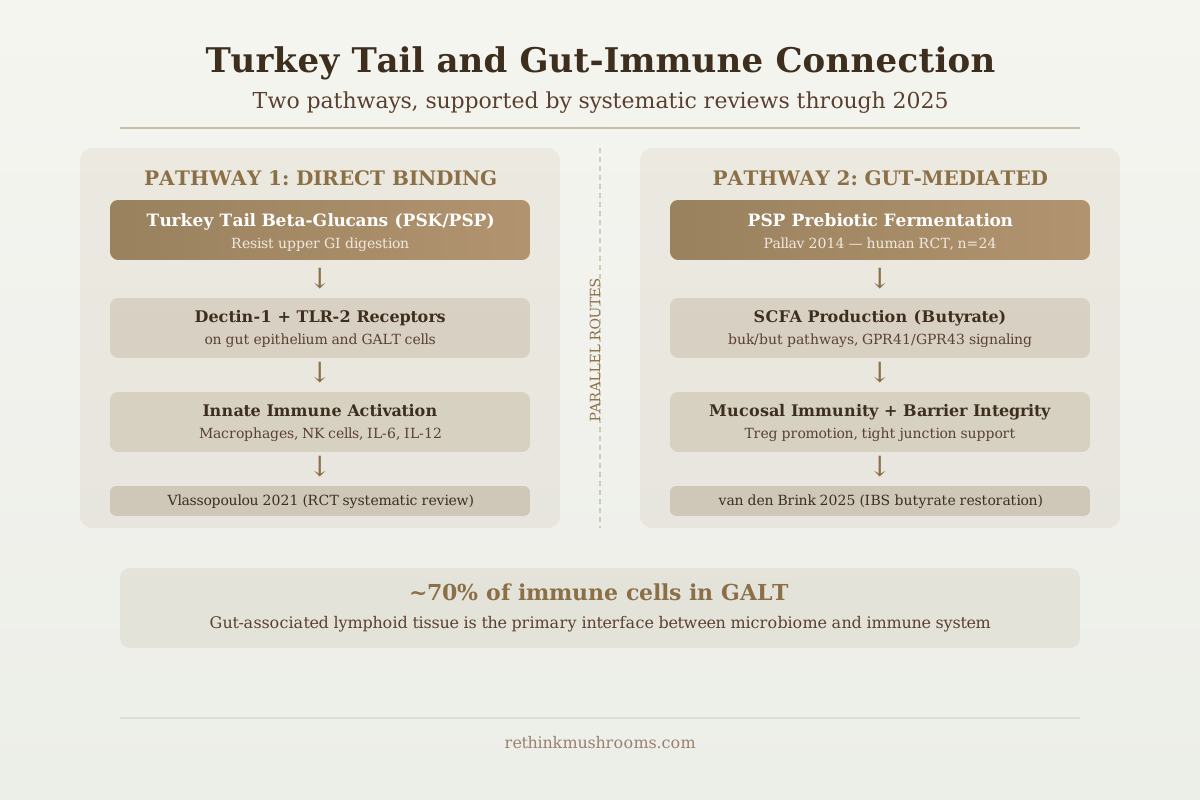
The turkey tail gut immune connection operates through two distinct but complementary pathways. The first is direct: Turkey Tail's polysaccharides (PSK and PSP) bind to immune cell receptors throughout the body and activate innate immune responses. The second runs through the gut: PSP acts as a prebiotic, feeding bacteria that produce short-chain fatty acids, which then signal to mucosal immune cells lining the intestinal wall.
Most coverage of Turkey Tail and immunity focuses on the first pathway. This article covers both, with specific focus on the gut-mediated route, where the most recent research is moving.
For background on Turkey Tail as a species and its primary compounds, see Turkey Tail: A Science-Based Introduction.
Key Takeaways
- About 70% of the body's immune cells are concentrated in gut-associated lymphoid tissue (GALT), making the gut the primary interface between microbiome and immune system
- Turkey Tail's beta-glucans resist digestion in the stomach and small intestine, arriving intact in the large intestine where both fermentation and immune receptor binding occur
- Beta-glucans from fungi bind to dectin-1 and TLR-2 receptors on gut epithelial cells and GALT immune cells, triggering innate immune activation
- Pallav et al. (2014) confirmed Turkey Tail's PSP modulates the human microbiome in a prebiotic pattern; a healthier microbiome produces more SCFAs that signal to mucosal immune cells
- Vlassopoulou et al. (2021) systematic review of RCTs found fungal beta-glucans reach the large intestine and undergo beneficial fermentation, supporting immune and metabolic effects
- A 2025 study by van den Brink et al. found a mushroom blend including Turkey Tail restored butyrate production in disrupted IBS microbiomes and promoted intestinal barrier integrity
The Gut-Immune Axis: Why What Happens in Your Gut Shapes Your Immune Response
Your gut and your immune system are not separate systems. They are co-located in a way that makes no distinction between them at the cellular level.
About 70% of the body's immune cells are concentrated in gut-associated lymphoid tissue (GALT), structures embedded throughout the intestinal wall that include Peyer's patches, intraepithelial lymphocytes, and lamina propria immune cells.[2] GALT cells are in constant contact with gut bacteria, their metabolites, and any compounds that survive digestion and reach the large intestine intact.
This proximity is not accidental. The gut is the largest surface area your body exposes to the outside world. At any given moment, it needs to distinguish between harmless food particles, beneficial bacteria, and actual pathogens. GALT is the immune checkpoint for that process. What lives in the gut, what those bacteria produce, and what compounds they interact with all have direct consequences for how GALT functions.
This is why the gut microbiome is not just a digestive matter; it is an immunological one. A microbiome disrupted by antibiotics, poor diet, or illness shifts the signals that GALT receives, which shifts immune tone. A microbiome stabilized by prebiotic compounds like Turkey Tail's PSP shifts those signals in the other direction.
How Turkey Tail's Beta-Glucans Reach the Immune System
Turkey Tail contains two families of polysaccharides with different biochemical structures: PSK (polysaccharide-K, also called krestin) and PSP (polysaccharopeptide). Both are beta-glucan-protein conjugates, meaning they are complex branched-chain polysaccharides with peptide chains attached.
The key property for the gut-immune connection is their resistance to upper GI digestion. Beta-glucans from fungi are not broken down by the pancreatic enzymes or the brush border of the small intestine. Vlassopoulou et al. (2021) conducted a systematic review of randomized controlled trials on fungal beta-glucans and confirmed this property across multiple species: fungal beta-glucans avoid upper GI digestion and reach the large intestine intact.[3]
Once in the large intestine, two things happen simultaneously:
Fermentation: Colonic bacteria break down the beta-glucans into short-chain fatty acids (SCFAs), primarily butyrate, propionate, and acetate. These act as fuel for colonocytes and as signaling molecules for immune cells.
Direct receptor binding: Beta-glucan fragments that reach the gut epithelium can bind directly to pattern recognition receptors on the surface of immune cells embedded in the intestinal wall. The two primary receptors are dectin-1 and Toll-like receptor 2 (TLR-2). Dectin-1 recognizes the beta-1,3-glucan structure that Turkey Tail's polysaccharides share with other fungal beta-glucans. TLR-2 recognizes broader molecular patterns associated with microbial compounds.
When dectin-1 binds beta-glucan, it activates a downstream signaling cascade in GALT macrophages and dendritic cells, cells that coordinate innate immune responses and present antigens to T cells. The result is increased production of cytokines including IL-6, IL-12, and TNF-alpha, and activation of natural killer cells.[3]
This is the immune effect that happens at the gut wall itself, before any systemic circulation of Turkey Tail's compounds.
The SCFA Connection: From Prebiotic Bacteria to Mucosal Immunity
The fermentation route to immune function is less direct but equally important.
Pallav et al. (2014) ran an 8-week human randomized trial in which 24 healthy volunteers took PSP from Turkey Tail or amoxicillin.[1] The PSP group showed consistent, directional microbiome shifts, a prebiotic-pattern change in gut bacterial community structure. A healthier, more diverse microbiome with a stronger population of SCFA-producing bacteria produces more butyrate, propionate, and acetate than a disrupted one.
Those SCFAs then function as immune signals. Butyrate is not only a fuel source for colonocytes; it is also an HDAC (histone deacetylase) inhibitor that directly regulates gene expression in immune cells. Butyrate promotes the differentiation of regulatory T cells (Tregs), which are the immune cells responsible for preventing overreaction and maintaining tolerance. Propionate and acetate signal through GPR41 and GPR43 receptors on immune cells, modulating inflammatory tone.
Liu et al. (2020) provided the immunological framework for this in a review in the International Journal of Medicinal Mushrooms: mushroom polysaccharides functioning as prebiotics connect gut microbiota modulation to immune, metabolic, neurological, and cancer-related health outcomes through this SCFA-mediated signaling chain.[2]
Ma et al. (2022) extended this to clinical populations in a review in Critical Reviews in Food Science and Nutrition, finding accumulating evidence that edible mushroom polysaccharides modulate gut microbiota in ways that show benefit against obesity, inflammatory bowel disease (IBD), and cancer.[5] The IBD application is particularly relevant to the gut-immune connection, since IBD is fundamentally a dysregulated mucosal immune response to gut bacteria.
For more on how Turkey Tail shifts specific bacterial populations, see How Turkey Tail Changes Gut Bacteria Composition.
Gut Barrier Integrity: The Physical Interface of Gut Immunity
The gut-immune connection is also a structural one. The intestinal epithelial barrier, the single-cell-thick lining of the large intestine, is the physical boundary between gut bacteria and the bloodstream. When that barrier is compromised (a state sometimes called "leaky gut" in consumer contexts), bacterial fragments and metabolites enter the bloodstream and drive systemic inflammation.
Butyrate is the primary molecule that maintains barrier integrity. It fuels the tight junction proteins that hold epithelial cells together and regulates the expression of mucin proteins that form the protective mucus layer.
Van den Brink et al. (2025) demonstrated this directly. Their study used ex vivo IBS gut microbiomes (fecal microbiota from IBS patients cultured in conditions that mimic the gut) and tested whether a mushroom blend including Turkey Tail could restore normal function.[6] The disrupted IBS microbiomes produced very little butyrate, and the mushroom blend restored butyrate production. The combination of triacetin (a glycerol ester that provides an alternative butyrate precursor) with the mushroom blend was superior to either alone, and to fiber supplementation alone.
This matters for the gut-immune connection because the gut barrier is the gut-immune interface. A restored barrier means fewer inflammatory signals entering the bloodstream, more controlled mucosal immune responses, and a better-functioning GALT environment.
For parallel data on a different mushroom with gut barrier research, see Poria and Gut Barrier Function: Reducing Intestinal Permeability.
What the Systematic Reviews Confirm
Three reviews across 2020-2021 provide the strongest evidence framing for Turkey Tail's gut-immune effects.
Vlassopoulou et al. (2021) reviewed RCTs specifically, which is the highest level of evidence for this topic. Their conclusion: fungal beta-glucans, when consumed, avoid upper GI digestion and undergo beneficial fermentation in the large intestine, and the downstream effects documented across RCTs include immune and metabolic outcomes.[3] This provides RCT-level anchor evidence for the mechanism, even though most of those RCTs were not specifically on Turkey Tail.
Yin et al. (2020) reviewed mushroom polysaccharides in Carbohydrate Polymers and confirmed the downstream immune effects: mushroom polysaccharides selectively reduce pathogens, stimulate beneficial bacteria, and the metabolic products of that fermentation drive immune, metabolic, and anti-cancer effects.[4]
Liu et al. (2020) provided the mechanistic framework: mushroom compounds as prebiotics function through the gut-microbiota-immune axis, with effects extending beyond digestion into neurological and cancer-related pathways.[2]
What none of these reviews establishes, and what the evidence doesn't yet show, is a randomized controlled trial specifically testing Turkey Tail supplementation against a placebo with immune function as the primary outcome, where the mechanism is gut-mediated rather than direct PSK/PSP binding. That gap is honest to name.
Two Pathways, Both Real: An Honest Framework
Turkey Tail's immune effects likely operate through two parallel routes, with different evidence bases for each.
Direct immunostimulation: PSK and PSP bind to dectin-1, TLR-2, and other pattern recognition receptors on immune cells throughout the body, not only in the gut. This activates macrophages, NK cells, and cytokine production. This pathway is the basis for PSK's regulatory approval as an adjunct cancer treatment in Japan and China, where its immune-enhancing effects have been studied extensively.
Gut-mediated immune support: PSP acts as a prebiotic, feeding gut bacteria that produce SCFAs, which signal to GALT, promote regulatory T cell differentiation, maintain barrier integrity, and reduce inflammatory tone. This pathway is the gut-immune connection this article covers.
Both pathways are mechanistically plausible and have supporting evidence. The direct pathway has more clinical data behind it. The gut-mediated pathway is supported by the prebiotic evidence (Pallav 2014 for human microbiome modulation), the mechanistic reviews (Liu 2020, Vlassopoulou 2021), and the barrier integrity data (van den Brink 2025). Treating them as competing explanations misses the point; Turkey Tail likely works through both routes simultaneously.
For the prebiotic effects in detail, see Turkey Tail and the Gut Microbiome: Prebiotic Effects and Turkey Tail Prebiotic Effects: Feeding Beneficial Gut Bacteria. For gut effects after antibiotic disruption, see Turkey Tail for Gut Health After Antibiotics.
For context on another mushroom with gut prebiotic and immune data, see Enoki for Gut Health: Prebiotic Fiber and Microbiome Effects.
The Bottom Line
The turkey tail gut-immune connection operates through two parallel routes: direct dectin-1/TLR-2 receptor binding on gut epithelial and GALT immune cells, and an indirect gut-mediated pathway via prebiotic fermentation, SCFA production, and barrier integrity maintenance. Both are mechanistically supported; the direct immunostimulatory route has more clinical data, while the gut-mediated route is supported by Pallav 2014's prebiotic evidence, three systematic reviews, and 2025 IBS butyrate restoration data. No large RCT has tested gut-mediated immune outcomes specifically from Turkey Tail supplementation.
Frequently Asked Questions
Sources & References
- 1RTHM-00630·Pallav, Kumar et al. (2014). “Effects of polysaccharopeptide from Trametes versicolor and amoxicillin on the gut microbiome of healthy volunteers: a randomized clinical trial..” Gut microbes.Study breakdown →PubMed →↩
- 2RTHM-01242·Liu, Xiaoxiao et al. (2020). “A Review on Linking the Medicinal Functions of Mushroom Prebiotics with Gut Microbiota..” International journal of medicinal mushrooms.Study breakdown →PubMed →↩
- 3RTHM-01451·Vlassopoulou, Marigoula et al. (2021). “Effects of fungal beta-glucans on health - a systematic review of randomized controlled trials..” Food & function.Study breakdown →PubMed →↩
- 4RTHM-01308·Yin, Chaomin et al. (2020). “The Impact of Mushroom Polysaccharides on Gut Microbiota and Its Beneficial Effects to Host: A Review..” Carbohydrate polymers.Study breakdown →PubMed →↩
- 5RTHM-01577·Ma, Gaoxing et al. (2022). “Health benefits of edible mushroom polysaccharides and associated gut microbiota regulation..” Critical reviews in food science and nutrition.Study breakdown →PubMed →↩
- 6RTHM-02197·Van den Abbeele, Pieter et al. (2025). “Triacetin and a Mushroom Blend Restore Butyrate Production by IBS Microbiomes Ex Vivo, Thus Promoting Barrier Integrity..” International journal of molecular sciences.Study breakdown →PubMed →↩