Turkey Tail & the Gut Microbiome
113% GPR43 upregulation
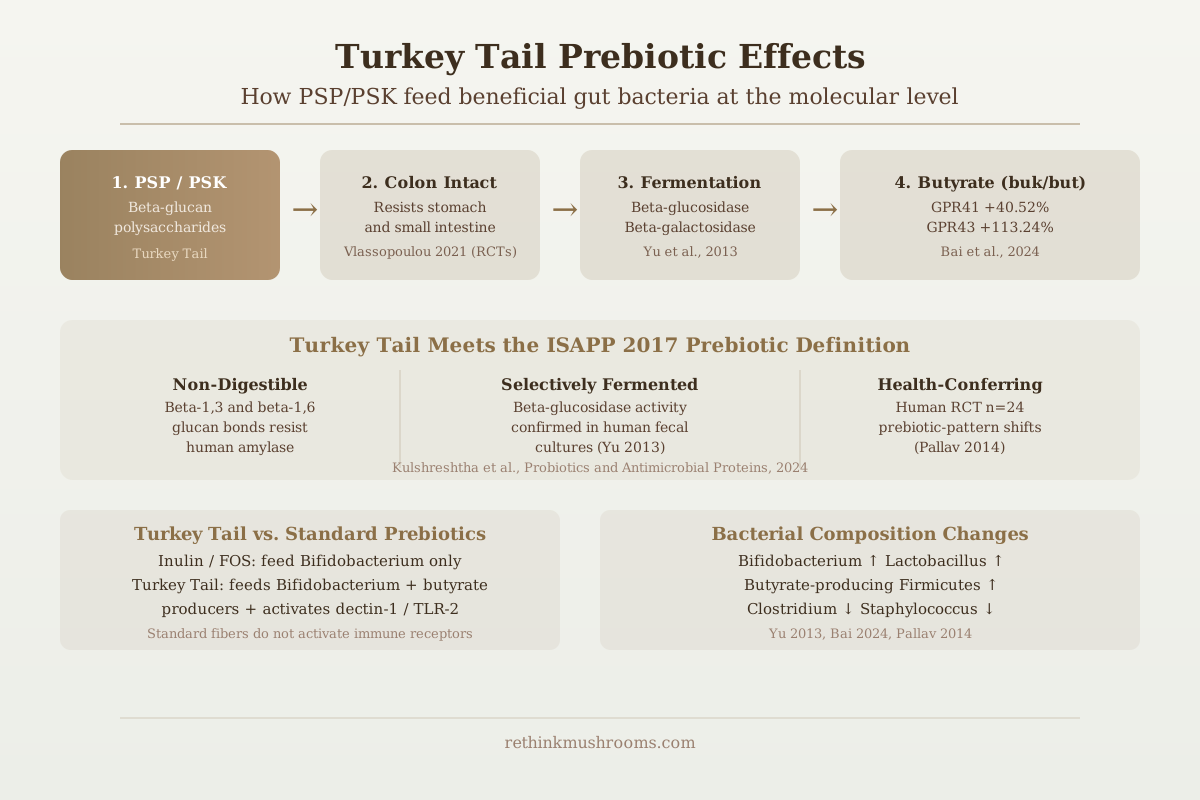
Bai et al. (2024) found Turkey Tail polysaccharides increased GPR43 SCFA receptor expression by 113.24% in mice, the receptor that detects butyrate produced by beneficial gut bacteria.
Bai et al., Microorganisms, 2024
buk + but
butyrate enzymatic pathways activated by Turkey Tail fermentation
ISAPP 2017
Turkey Tail meets current scientific prebiotic definition (Kulshreshtha 2024)
RCT anchor
Vlassopoulou 2021 systematic review confirms beta-glucan fermentation
Bai et al., Microorganisms, 2024
 View as image ↗
Turkey tail is a prebiotic. Its PSP and PSK polysaccharides resist human digestive enzymes in the stomach and small intestine, arrive in the colon intact, and are selectively fermented by beneficial gut bacteria including Bifidobacterium and butyrate-producing Firmicutes. The fermentation produces short-chain fatty acids, especially butyrate, which fuels colonocytes and signals through SCFA receptors to mucosal immune cells. Kulshreshtha et al. (2024) confirmed Turkey Tail meets the International Scientific Association for Probiotics and Prebiotics (ISAPP) definition as updated in 2017.
That is the answer to "is turkey tail a prebiotic." This article explains why at the chemical and molecular level, the part no competitor article covers.
For background on Turkey Tail's primary compounds, see Turkey Tail Bioactive Compounds: PSK, PSP, and Beta-Glucans and Turkey Tail: A Science-Based Introduction.
Key Takeaways
- Turkey tail's PSP (polysaccharopeptide) and PSK (polysaccharide-K) are branched beta-glucan polysaccharides that resist pancreatic amylase and small intestinal brush border enzymes
- Yu et al. (2013) detected beta-galactosidase and beta-glucosidase enzyme activity in human fecal cultures exposed to Turkey Tail extract, chemical proof that gut bacteria are fermenting it
- Bai et al. (2024) identified the downstream output: butyrate-producing bacteria enhanced via the buk and but enzymatic pathways; GPR41 expression +40.52%, GPR43 +113.24%
- Vlassopoulou et al. (2021) systematic review of RCTs confirmed fungal beta-glucans reach the large intestine intact and undergo beneficial fermentation
- Pallav et al. (2014) provided the human confirmation: PSP caused consistent prebiotic-pattern microbiome changes in 24 healthy adults over 8 weeks
- Kulshreshtha et al. (2024) confirmed Turkey Tail meets all three ISAPP prebiotic criteria: non-digestible, selectively fermented, health-conferring through microbiota modulation
What "Prebiotic" Actually Means (Not What Most Articles Say)
Most articles describe a prebiotic as "food for good bacteria." That's not wrong, but it's imprecise enough to be misleading. The current scientific definition, issued by the International Scientific Association for Probiotics and Prebiotics (ISAPP) in 2017, has three specific criteria.
A prebiotic is a substrate that is:
- Non-digestible: resistant to human digestive enzymes in the stomach and small intestine
- Selectively fermented: metabolized specifically by microorganisms in the gut (not all compounds that reach the colon qualify; they must be selectively used by beneficial species)
- Health-conferring: the fermentation must produce effects that benefit the host
Kulshreshtha et al. (2024) reviewed the evidence for multiple mushroom species against this definition and confirmed that Turkey Tail meets all three criteria.[7] This 2024 paper is the most recent direct confirmation in the peer-reviewed literature.
The distinction from "fiber" is also worth making. All prebiotics are dietary fiber, but not all dietary fiber is prebiotic. Standard fiber (like wheat bran) may reach the colon intact but not selectively feed beneficial species. Turkey Tail's beta-glucan polysaccharides do both, and they also activate immune receptors that standard dietary fibers don't.
The Chemical Reason PSP and PSK Are Prebiotics
Turkey Tail contains two main polysaccharide-protein conjugates: PSP (polysaccharopeptide) and PSK (polysaccharide-K, also called krestin). Both are built on a backbone of beta-glucan polysaccharides with side chains and peptide attachments, but their exact structures differ.
The key structural feature that makes both prebiotic is the beta-1,3 and beta-1,6 glucan linkage pattern. Human digestive enzymes (amylase, maltase, sucrase, and the brush border enzymes of the small intestine) are designed to break alpha-glucan bonds, which is how they digest starch and table sugar. Beta-glucan bonds have a different stereochemical configuration at the linking carbon (beta, or equatorial, rather than alpha, or axial). Human enzymes cannot efficiently break these bonds.
The result: PSP and PSK pass through the stomach and small intestine largely intact. They arrive in the colon in a form that colonic bacteria can access.
Vlassopoulou et al. (2021) confirmed this property in a systematic review of randomized controlled trials on fungal beta-glucans across multiple species: fungal beta-glucans avoid upper gastrointestinal digestion and reach the large intestine intact.[6] That's the first criterion of the prebiotic definition established with RCT-level evidence.
For a deeper look at the structural differences between PSK and PSP, see PSK vs. PSP: Comparing Turkey Tail's Two Star Compounds.
The Fermentation Evidence: Chemical Proof That Gut Bacteria Use It
Reaching the colon intact is necessary but not sufficient for prebiotic status. The compound also needs to be selectively fermented. Yu et al. (2013) provided direct chemical evidence that Turkey Tail extract is fermented by gut bacteria.
The experiment cultured human fecal microbiota with Trametes versicolor extract for 24 hours.[2] The researchers measured the chemical signatures of fermentation:
Enzyme activity: beta-galactosidase and beta-glucosidase activity was detected. These are the enzymes that colonic bacteria produce to break down complex polysaccharides with galactose and glucose units. Their presence confirms active microbial metabolism of Turkey Tail's polysaccharides.
Fermentation products: Organic acid concentrations increased. pH in the culture medium dropped. Acetaldehyde levels shifted. These are the measurable metabolic products of bacterial fermentation, not just passive bacterial growth.
Bacterial composition: Bifidobacterium and Lactobacillus populations increased. Clostridium and Staphylococcus populations decreased.
The enzyme activity data is the chemical proof. The bacterial composition shifts are the outcome. Together, they satisfy the second ISAPP criterion: selective fermentation by gut microorganisms.[2]
The selectivity matters. Not all gut bacteria produce beta-glucosidase efficiently. The bacteria that do, including Bifidobacterium, Lactobacillus, and certain butyrate-producing Firmicutes, gain a competitive food advantage when Turkey Tail's polysaccharides are present. Bacteria that don't produce these enzymes can't access the substrate and lose ground competitively.
What Bacteria Actually Produce: The Butyrate Pathway
Yu 2013 shows fermentation is happening. Bai et al. (2024) explains what the fermenting bacteria produce.
High-fat diet mice received Turkey Tail polysaccharides in two forms: EPTV (extracted) and IPTV (intact cell wall-associated), and the researchers measured gut microbiome changes with molecular precision.[3]
The primary finding: Turkey Tail polysaccharides enhanced the growth of butyrate-producing bacteria. Those bacteria express two enzymes, butyrate kinase (buk) and butyryl-CoA transferase (but), that convert fermentation intermediates into butyrate. These are the specific enzymes at the end of the beta-glucan fermentation chain.
The upstream-to-downstream flow:
- Turkey Tail PSP/PSK (beta-glucan polysaccharides) arrive in the colon
- Colonic bacteria with beta-glucosidase break them down into fermentable substrates
- Butyrate-producing bacteria (with buk/but enzymes) convert those substrates to butyrate
- Butyrate fuels colonocytes and signals through GPR41 and GPR43 receptors
Bai et al. measured the receptor expression directly. IPTV increased GPR41 expression by 40.52% and GPR43 expression by 113.24% above the high-fat diet control.[3]
GPR41 and GPR43 are pattern recognition receptors on gut epithelial cells and immune cells that detect short-chain fatty acids. When SCFAs bind these receptors, they trigger anti-inflammatory signaling, regulate gut motility, and influence regulatory T cell differentiation. A 113% increase in GPR43 expression is a large receptor-level effect, though this is in mice with induced metabolic disease, a different starting state than a healthy human gut.
The same study found the Firmicutes/Bacteroidetes ratio normalized in the dysbiotic mice, suggesting Turkey Tail's polysaccharides restructure the microbial ecosystem rather than just feeding one or two species.
For how these bacterial changes play out in the gut immune system, see Turkey Tail and Gut-Immune Connection: Research Review.
The Human Confirmation: Pallav 2014
Lab and animal data establish the mechanism. The question is whether any of it happens in people.
Pallav et al. (2014) ran an 8-week randomized trial in which 24 healthy volunteers took either PSP from Turkey Tail or amoxicillin, with 42 days of post-treatment observation.[1] The PSP group showed clear, consistent prebiotic-pattern microbiome changes over the 8 weeks. Microbiome clustering patterns shifted in a coordinated, directional way, which is the community-level signature of prebiotic activity.
This satisfies the third ISAPP criterion: health-conferring effects through gut microbiota modulation, confirmed in a randomized controlled trial with human participants.
The caveat: 22 of the 24 volunteers completed the study, which is a small sample. The Pallav study measured community-level patterns rather than reporting species-level counts with the granularity of the Yu 2013 in vitro data. But community-level microbiome shifts in humans are harder to achieve than in vitro, which makes the Pallav finding meaningful even at small n.
The Systematic Review Evidence: Broader Than Turkey Tail Alone
Turkey Tail is one species within a broader category of fungal beta-glucan prebiotics. Understanding the category helps contextualize Turkey Tail's specific effects.
Vlassopoulou et al. (2021) conducted the systematic review that provides the strongest evidence framework for this category. They reviewed RCTs specifically on fungal beta-glucans and found consistent evidence that fungal beta-glucans avoid upper GI digestion, reach the large intestine intact, and undergo beneficial fermentation with downstream immune and metabolic effects.[6] Most of those RCTs weren't on Turkey Tail specifically, but they confirm the mechanism applies to the beta-glucan structural class that Turkey Tail's PSP and PSK belong to.
Yin et al. (2020) in Carbohydrate Polymers reviewed mushroom polysaccharides across species and confirmed the consistent downstream effects: reduction of pathogens, stimulation of beneficial bacteria, and health consequences through prebiotic fermentation and SCFA production.[4]
Liu et al. (2020) in the International Journal of Medicinal Mushrooms provided the mechanistic framework connecting mushroom prebiotic function to immune, metabolic, neurological, and cancer-related outcomes through the gut microbiota.[5]
Jayachandran et al. (2017) identified the two most consistent findings across edible mushroom prebiotic studies: Bifidobacterium enrichment and Lactobacillus enrichment, combined with pathogen reduction, as the downstream effects of mushroom polysaccharide consumption.[8] Turkey Tail fits this pattern precisely.
Turkey Tail vs. Other Prebiotics: What's Different
The most common dietary prebiotics are inulin (from chicory root), fructooligosaccharides (FOS), and galactooligosaccharides (GOS). Turkey Tail's beta-glucan polysaccharides differ from all of these in two important ways.
Structural difference: Inulin and FOS are fructan polymers (built on fructose chains). GOS is built on galactose chains. Turkey Tail's PSP and PSK are beta-glucan polymers built primarily on glucose chains with specific beta-1,3 and beta-1,6 linkages. Different polysaccharide structures ferment differently and selectively feed different bacterial populations. Turkey Tail primarily enhances Bifidobacterium, Lactobacillus, and butyrate-producing Firmicutes. Inulin and FOS strongly promote Bifidobacterium but have less specific effects on butyrate-producing bacteria.
Immune receptor activation: Turkey Tail's beta-glucan polysaccharides also activate pattern recognition receptors (dectin-1 and TLR-2) on gut epithelial and immune cells. This is a property of fungal beta-glucans that inulin, FOS, and GOS don't share. Standard prebiotics feed bacteria. Turkey Tail's beta-glucans feed bacteria AND activate gut immune receptors. These are parallel effects.
This combination makes Turkey Tail functionally distinct from conventional prebiotic supplements, even when the downstream SCFA production is similar.
For comparison with another mushroom that produces prebiotics and SCFAs through its dietary fiber, see Enoki and Short-Chain Fatty Acid Production: Feeding Your Microbiome.
Practical: Prebiotic vs. Probiotic, Timing, and Combination
Prebiotic vs. probiotic: Turkey Tail feeds existing gut bacteria; it doesn't introduce new ones. This is a meaningful functional difference. If your microbiome has healthy populations of Bifidobacterium and butyrate-producing bacteria, Turkey Tail amplifies their activity. If those populations are severely depleted (after antibiotics, during illness, or in dysbiosis), a prebiotic alone may not be enough to restore them; you need live bacteria first.
Combining with probiotics: A prebiotic that selectively feeds the same species as a companion probiotic is sometimes called a synbiotic. Turkey Tail + a Bifidobacterium or Lactobacillus probiotic is a logical synbiotic combination, though it hasn't been tested in a dedicated trial.
Timeframe: The Pallav 2014 RCT ran 8 weeks and found consistent community-level shifts over that period. Shorter timeframes haven't been measured; 4-8 weeks appears to be the relevant window for observing meaningful microbiome-level changes based on the available data.
Turkey Tail vs. other prebiotic mushrooms: Turkey Tail is one of the most studied species for gut microbiome effects, but it isn't unique. Enoki, maitake, shiitake, and reishi all contain beta-glucan polysaccharides with prebiotic properties. Turkey Tail's advantage is the Pallav 2014 human RCT, which most other mushrooms lack.
For more on Turkey Tail's prebiotic effects in the gut microbiome context, see Turkey Tail and the Gut Microbiome: Prebiotic Effects, How Turkey Tail Changes Gut Bacteria Composition, and Turkey Tail for Gut Health After Antibiotics.
The Bottom Line
Turkey tail qualifies as a prebiotic by the 2017 ISAPP definition, confirmed by Kulshreshtha et al. (2024). Its PSP/PSK beta-glucan polysaccharides resist upper GI digestion (confirmed in the Vlassopoulou 2021 systematic review of RCTs), are selectively fermented by colonic bacteria (Yu 2013 fermentation chemistry), and produce health effects through SCFA production (Bai 2024 butyrate pathway; Pallav 2014 human RCT). Turkey Tail's beta-glucan structure also activates dectin-1 and TLR-2 immune receptors, an effect that standard prebiotics like inulin and FOS do not share.
Frequently Asked Questions
Sources & References
- 1RTHM-00630·Pallav, Kumar et al. (2014). “Effects of polysaccharopeptide from Trametes versicolor and amoxicillin on the gut microbiome of healthy volunteers: a randomized clinical trial..” Gut microbes.Study breakdown →PubMed →↩
- 2RTHM-00573·Yu, Zhuo-Teng et al. (2013). “Trametes versicolor extract modifies human fecal microbiota composition in vitro..” Plant foods for human nutrition (Dordrecht.Study breakdown →PubMed →↩
- 3RTHM-01857·Bai, Ming et al. (2024). “Polysaccharides from Trametes versicolor as a Potential Prebiotic to Improve the Gut Microbiota in High-Fat Diet Mice..” Microorganisms.Study breakdown →PubMed →↩
- 4RTHM-01308·Yin, Chaomin et al. (2020). “The Impact of Mushroom Polysaccharides on Gut Microbiota and Its Beneficial Effects to Host: A Review..” Carbohydrate polymers.Study breakdown →PubMed →↩
- 5RTHM-01242·Liu, Xiaoxiao et al. (2020). “A Review on Linking the Medicinal Functions of Mushroom Prebiotics with Gut Microbiota..” International journal of medicinal mushrooms.Study breakdown →PubMed →↩
- 6RTHM-01451·Vlassopoulou, Marigoula et al. (2021). “Effects of fungal beta-glucans on health - a systematic review of randomized controlled trials..” Food & function.Study breakdown →PubMed →↩
- 7RTHM-01921·Kulshreshtha, Shweta (2024). “Mushroom as Prebiotics: a Sustainable Approach for Healthcare..” Probiotics and antimicrobial proteins.Study breakdown →PubMed →↩
- 8RTHM-00878·Jayachandran, Muthukumaran et al. (2017). “A Critical Review on Health Promoting Benefits of Edible Mushrooms through Gut Microbiota..” International journal of molecular sciences.Study breakdown →PubMed →↩