Mushroom Cooking Methods
Microwave best for phenolics
Microwaving retained the highest total phenolic content across Boletus, Pleurotus, and Agaricus species, while boiling caused the greatest phenolic losses but increased beta-glucan extractability.
Roncero-Ramos et al., Int. J. Food Sci. Nutr., 2017
Grilling
highest antioxidant activity retention
Frying
worst method for beta-glucans
7 Studies
comparing cooking methods on mushrooms
Roncero-Ramos et al., Int. J. Food Sci. Nutr., 2017
 View as image ↗
Cooking mushrooms is not optional if you want the health benefits. Raw mushrooms contain chitin-locked cell walls that resist human digestion, trapping beta-glucans and other bioactive polysaccharides inside. Heat breaks down these cell walls, releasing the compounds that make mushrooms pharmacologically active. But not all cooking methods are equal. Grilling and microwaving preserve antioxidant capacity best. Boiling destroys phenolic compounds but paradoxically increases extractable beta-glucan content. Frying degrades nearly everything. The "best" cooking method depends entirely on which compounds you are trying to preserve. For a deeper look at what those compounds are, see the article on 1,3/1,6-beta-D-glucan structure and function.
Key Takeaways
- Grilling and microwaving produced the highest antioxidant activity across Agaricus bisporus, Lentinula edodes, Pleurotus ostreatus, and P. eryngii, while boiling and frying caused the greatest antioxidant losses (Roncero-Ramos et al., 2017)
- Microwaving retained the highest total phenolic content among five cooking methods tested on four Boletus species, while boiling reduced phenolics the most (Sun et al., 2014)
- Boiling increased beta-glucan and ergosterol concentrations in button and shiitake mushrooms, while frying reduced beta-glucan content through direct oil penetration into cell structures
- Oven baking shiitake mushrooms for 5 minutes preserved the highest total phenolics and total flavonoids, with the lowest losses of crude polysaccharides and eritadenine occurring at 5-15 minutes (Yao et al., 2023)
- All four cooking methods tested on Hypsizygus marmoreus soup (autoclaving, microwaving, sous vide, stewing) increased polysaccharide, polyphenol, and amino acid levels compared to uncooked controls (Sun et al., 2019)
- Deep frying oyster mushrooms reduced phenolic content by 54-70%, while blanching for 5 minutes preserved 85-90% of antioxidant capacity (Tan et al., 2015)
The Comprehensive Cooking Comparison
Roncero-Ramos et al. (2017) published the most complete head-to-head comparison, testing four cooking methods (boiling, microwaving, grilling, and deep frying) on four commercially important mushroom species: white button (Agaricus bisporus), shiitake (Lentinula edodes), oyster (Pleurotus ostreatus), and king oyster (Pleurotus eryngii).[1]
Frying induced the most severe nutritional losses across all species. Fat absorption increased caloric content while water-soluble nutrients leached into the cooking oil. Protein and carbohydrate content changed depending on species, but the antioxidant story was consistent: fried mushrooms had the lowest antioxidant activity of all methods tested.
Grilling and microwaving produced the highest residual antioxidant activity. Grilling in particular enhanced measured antioxidant capacity in some mushroom-method combinations, possibly because the concentration effect from water loss during grilling increased the per-gram density of antioxidant compounds. Microwaving, which applies heat rapidly with minimal water, preserved both phenolic compounds and antioxidant activity better than boiling.
Boiling showed a mixed profile. Water-soluble phenolic compounds leached into the cooking liquid, reducing the antioxidant capacity of the mushroom tissue itself. However, if the cooking liquid is consumed (as in soups or broths), these compounds are not lost, just relocated.[1] This distinction matters for medicinal mushroom preparations: traditional decoctions and hot water extracts intentionally use boiling to transfer bioactive compounds into the liquid.
Phenolics: Microwave Wins
Sun et al. (2014) focused specifically on phenolic compounds and antioxidant activities across five cooking methods (steaming, pressure-cooking, microwaving, frying, and boiling) applied to four Boletus species.[2]
Microwaving retained the highest total phenolic content across all four species. Boiling produced the greatest phenolic losses, consistent with the water solubility of most phenolic compounds. The ranking from best to worst for phenolic retention was: microwave > steam > pressure cook > fry > boil.
Antioxidant activity followed the same pattern but with an additional finding: some cooking methods increased specific antioxidant measures above raw mushroom values. This is not contradictory. Heat can break cellular structures to release bound phenolic compounds, convert precursor molecules into active antioxidants, and produce Maillard reaction products with their own antioxidant capacity. The net effect depends on the balance between release/conversion (which increases antioxidant activity) and thermal degradation/leaching (which decreases it).[2]
Beta-Glucans: The Boiling Paradox
Beta-glucans present a counterintuitive cooking response. While most bioactive compounds degrade with heat, beta-glucan extractability can increase with boiling.
Research on household cooking of button mushrooms and shiitake found that boiling increased measurable beta-glucan and ergosterol concentrations. The mechanism is cell wall disruption: beta-glucans are structural components of fungal cell walls, locked into a chitin-glucan matrix. Boiling breaks down this matrix, releasing beta-glucans into a more accessible form. Frying, by contrast, reduced beta-glucan content through direct oil penetration into tissue structures, possibly denaturing or complexing the polysaccharides.
This finding has practical implications. For immune-active beta-glucans, boiling or simmering (as in traditional mushroom broths and decoctions) may be the superior preparation method, even though it degrades phenolic antioxidants. The traditional Chinese and Japanese practice of simmering medicinal mushrooms for extended periods aligns with this biochemistry: long extraction in hot water maximizes beta-glucan solubilization.
Oven baking above 200 degrees C did not produce meaningful beta-glucan reduction, suggesting dry heat at culinary temperatures is insufficient to degrade these thermally stable polysaccharides. The critical variable is not temperature alone but the combination of temperature, water content, and cooking duration. For how extract ratios and processing methods affect final supplement potency, see the companion analysis.
Shiitake: Optimal Cooking Times
Yao et al. (2023) provided the most detailed time-course data, testing four cooking methods (steaming, boiling, air frying, and oven baking) at five time points (0, 5, 10, 15, and 20 minutes) on shiitake mushrooms.[3]
Oven baking for 5 minutes produced the highest total phenolic content. Total flavonoid content peaked at 10 minutes of oven baking. The lowest losses of crude polysaccharides occurred with 5-minute oven baking, while eritadenine (a compound unique to shiitake with cholesterol-lowering properties) was best preserved at 5-15 minutes of oven baking.
Steaming and boiling showed progressive losses of phenolics and flavonoids over time, but crude polysaccharide losses were moderate. Air frying produced intermediate results for most compounds.
The microstructure data was revealing. Scanning electron microscopy showed that all cooking methods disrupted the mushroom tissue structure, but the pattern differed: boiling caused cellular swelling and eventual collapse, while air frying and oven baking caused surface dehydration with internal structure partially preserved. These structural changes directly affect how efficiently the gastrointestinal tract can access bioactive compounds during digestion.[3]
Oyster Mushrooms: Deep Frying Destroys Phenolics
Tan et al. (2015) tested customized cooking methods on three Pleurotus species, including deep frying, blanching, and combinations thereof.[4]
Deep frying reduced total phenolic content by 54-70% depending on species. Blanching for 5 minutes followed by sauteing preserved 85-90% of antioxidant capacity. The blanch-then-saute approach combined brief water exposure (to soften cell walls and release compounds) with brief oil exposure (to cook without prolonged degradation).
Some cooking methods increased antioxidant activity above fresh mushroom levels for specific Pleurotus species. P. cystidiosus showed enhanced antioxidant capacity after blanching, suggesting this species contains heat-activatable precursor compounds that convert to active antioxidants upon brief thermal treatment.[4] For the full profile of culinary mushroom species and their best uses, see the companion guide.
Mushroom Soup: All Methods Beat Raw
Sun et al. (2019) tested four cooking methods for mushroom (Hypsizygus marmoreus) soup: autoclaving, microwaving, sous vide, and stewing.[5]
All four methods increased polysaccharide, polyphenol, and amino acid levels compared to uncooked soup. This finding is important because it demonstrates that the extraction effect of cooking (releasing compounds from cell walls into the liquid) can outweigh the degradation effect, at least for preparations where the cooking liquid is consumed.
Stewing increased protein content the most among the four methods. Microwaving preserved vitamin C best. Sous vide (low temperature, long time, sealed environment) provided an intermediate profile, preserving heat-sensitive compounds better than autoclaving while still achieving cell wall disruption.
The flavor profile also differed by method. Stewing produced the richest umami flavor through Maillard reactions and protein hydrolysis, while microwaving produced the mildest flavor change. This has practical relevance: if the goal is a concentrated medicinal broth, stewing extracts the most compounds and produces the strongest flavor, while microwaving offers a faster method with better retention of heat-sensitive nutrients.[5]
Cooking Naematelia: Method Matters for Digestion
Li et al. (2024) added an in vitro digestion component to the cooking comparison, testing how different methods affected not just the compound content of Naematelia aurantialba (golden ear mushroom) but how well those compounds survived simulated human digestion.[6]
Different cooking methods produced different nutrient profiles, and these differences were amplified by the digestion process. Compounds that survived cooking but were poorly bioaccessible after simulated digestion contributed less to actual nutritional value than compounds that survived both cooking and digestion. This study underscores that measuring compound retention after cooking alone overestimates bioavailability if the compounds are not absorbable from the cooked food.
Wood Ear: Cooking for Texture and Nutrition
Shamaruddin et al. (2021) compared cooking methods for black jelly mushroom (Auricularia polytricha), focusing on both physicochemical properties and sensory outcomes.[7]
Wood ear's gelatinous texture responds differently to cooking than the fibrous texture of most edible mushrooms. Boiling softened the texture while preserving the polysaccharide-rich gel matrix. Stir-frying maintained a chewier texture but produced more Maillard reaction products. The study demonstrates that optimal cooking for wood ear depends on whether the goal is textural preference or maximal polysaccharide extraction, since the gel-like polysaccharide matrix that gives wood ear its texture is also its primary bioactive component.
Practical Guidelines by Compound
The research converges on different optimal methods depending on the target compound:
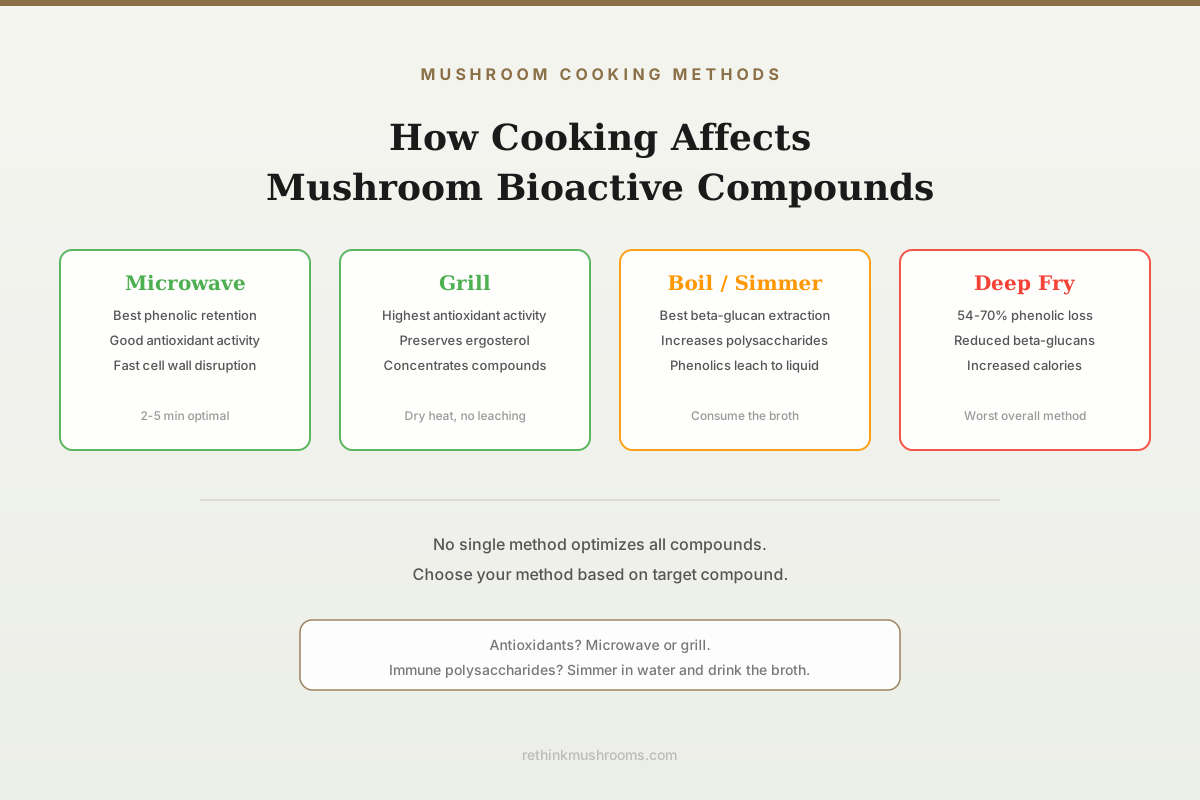
For beta-glucans and polysaccharides: Boiling or simmering in water extracts the most. Use the cooking liquid (soup, broth, tea). Extended simmering (30-60 minutes) increases extraction. This is why traditional medicinal mushroom decoctions use prolonged boiling.
For phenolic antioxidants: Microwave briefly (2-5 minutes) or grill. Avoid boiling unless consuming the liquid. Avoid deep frying, which degrades phenolics by 54-70%.
For ergosterol (vitamin D2 precursor): Boiling increases extractable ergosterol. Frying decreases it. Grilling preserves it.
For eritadenine (shiitake-specific): Oven bake for 5-15 minutes. Prolonged cooking at any method increases losses.
For maximum overall bioactive retention: Microwave for 2-5 minutes or grill. These methods apply heat quickly, disrupt cell walls for compound release, and minimize water-soluble compound leaching.
For immune-active preparations (broths, decoctions): Simmer in water for 30+ minutes. Accept phenolic losses in exchange for maximal polysaccharide extraction. This aligns with traditional medicinal mushroom preparation across Chinese, Japanese, and Korean traditions. For more on how raw vs. cooked mushrooms compare in bioavailability, see the dedicated article.
The Bottom Line
No single cooking method optimizes all mushroom bioactive compounds simultaneously. Microwaving and grilling best preserve phenolic antioxidants. Boiling reduces antioxidant capacity but increases beta-glucan and polysaccharide extractability, making it the preferred method for immune-active preparations when the cooking liquid is consumed. Frying degrades nearly all measured bioactive compounds. The optimal approach depends on the target compound: brief dry heat for antioxidants, prolonged wet heat for polysaccharides.
Frequently Asked Questions
Sources & References
- 1RTHM-00488·Roncero-Ramos, Irene et al. (2017). “Effect of different cooking methods on nutritional value and antioxidant activity of cultivated mushrooms..” International journal of food sciences and nutrition.Study breakdown →PubMed →↩
- 2RTHM-00350·Sun, Liping et al. (2014). “Effect of different cooking methods on total phenolic contents and antioxidant activities of four Boletus mushrooms..” Journal of food science and technology.Study breakdown →PubMed →↩
- 3RTHM-00859·Yao, Fen et al. (2023). “Effect of Different Cooking Methods on the Bioactive Components, Color, Texture, Microstructure, and Volatiles of Shiitake Mushrooms..” Foods (Basel.Study breakdown →PubMed →↩
- 4RTHM-00403·Tan, Yee-Shin et al. (2015). “Influence of customized cooking methods on the phenolic contents and antioxidant activities of selected species of oyster mushrooms (Pleurotus spp.)..” Journal of food science and technology.Study breakdown →PubMed →↩
- 5RTHM-00589·Sun, Yujing et al. (2019). “Domestic cooking methods affect nutrient, phytochemicals, and flavor content in mushroom soup..” Food science & nutrition.Study breakdown →PubMed →↩
- 6RTHM-00889·Li, Guangzhi et al. (2024). “The effects of different cooking methods on nutrients, bioactive components and antioxidant activities of Naematelia aurantialba were revealed by simulating in vitro digestion..” Food research international (Ottawa.Study breakdown →PubMed →↩
- 7RTHM-00718·Shamaruddin, Norsyazleen et al. (2021). “Comparison of Cooking Methods on Physicochemical and Sensory Properties of the Black Jelly Mushroom, Auricularia polytricha (Heterobasidiomycetes)..” International journal of medicinal mushrooms.Study breakdown →PubMed →↩