Culinary Mushrooms
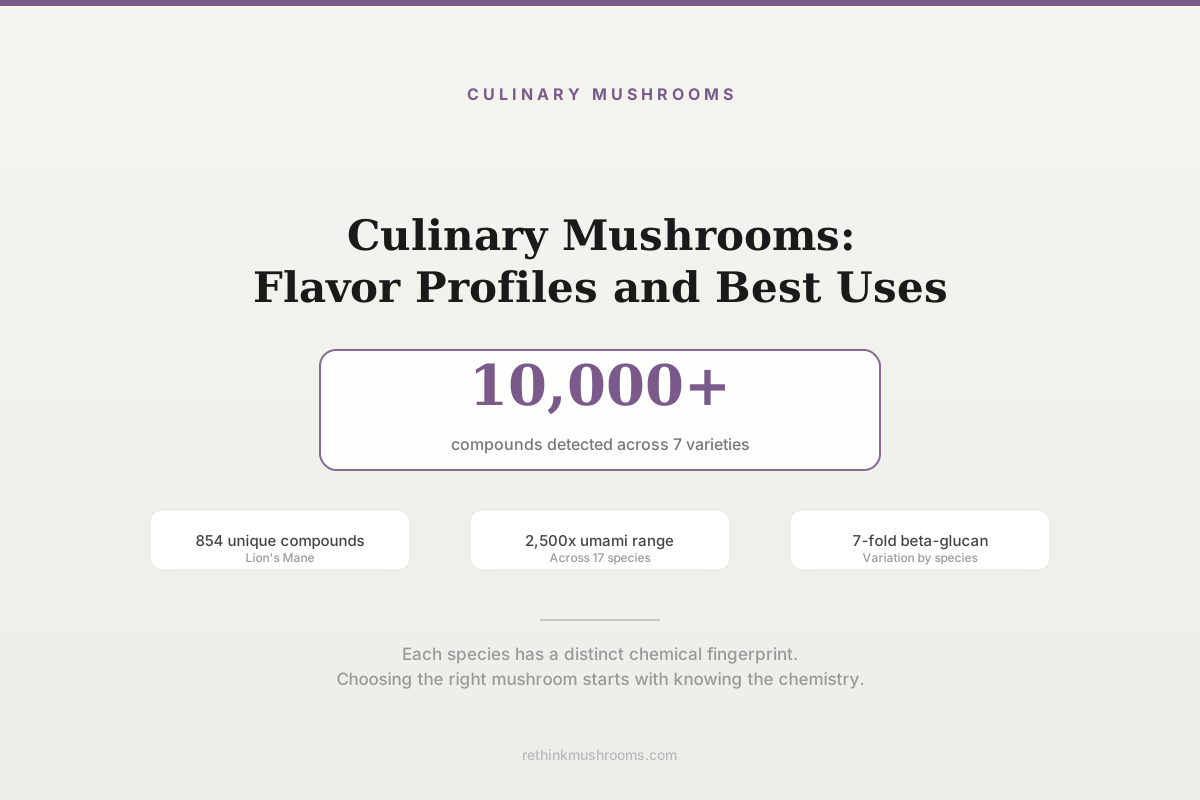
10,000+ Compounds
A 2023 metabolomics study detected more than 10,000 compounds across seven mushroom varieties. Lion's mane alone had 854 unique-to-variety compounds not found in any other species tested.
Uffelman et al., Foods, 2023
854 Unique
compounds in lion's mane alone
7-fold Range
in beta-glucan across species
17 Species
compared for umami intensity
Uffelman et al., Foods, 2023
 View as image ↗
Every mushroom in the grocery store has a different chemical fingerprint. A 2023 metabolomics study by Uffelman and colleagues compared white button, crimini, portabella, lion's mane, maitake, oyster, and shiitake mushrooms using untargeted liquid chromatography mass spectrometry.[1] They detected more than 10,000 compounds across the seven varieties. Each species had tens to hundreds of unique compounds, from 29 for crimini to 854 for lion's mane. These chemical differences are why a shiitake tastes nothing like an oyster mushroom. They also explain why different species have different nutritional and bioactive profiles. For a deeper look at the science of mushroom umami, that article covers the full flavor chemistry.
Key Takeaways
- Metabolomics detected over 10,000 compounds across 7 mushroom varieties, with lion's mane having 854 unique-to-variety compounds (Uffelman et al., Foods, 2023)
- Oyster mushroom (Pleurotus ostreatus) scored highest in human sensory evaluation for umami taste among 17 species tested (Phat et al., Food Chemistry, 2016)
- Beta-glucan content varies several-fold across mushroom species — Tricholoma portentosum topped the Megazyme assay at 34.97 g per 100 g dry mass and the species ranking shifted under the Congo red method (Mironczuk-Chodakowska et al., IJERPH, 2020)
- Lion's mane and oyster mushrooms had the highest concentrations of L-ergothioneine, a potential antioxidant not synthesized by plants or animals (Uffelman et al., 2023)
- UV exposure during drying converts ergosterol to vitamin D2 in mushrooms, reaching up to 184 micrograms per gram dry mass (Jiang et al., Trends in Food Science and Technology, 2020)
- Equivalent umami concentration (EUC) in edible fungi ranges from 37.7 to 1,317.72 g MSG per 100 g dry weight (Yang et al., Food Chemistry, 2022)
The Mild Everyday Varieties
White Button (Agaricus bisporus)
The most consumed mushroom worldwide. White buttons have a mild, slightly earthy flavor with low umami intensity compared to other species. Phat and colleagues measured umami compounds across 17 mushroom species in 2016 and found that Agaricus bisporus had the highest monosodium glutamate-like amino acid content (42.4 mg/g dry weight) but moderate overall umami when 5'-nucleotide synergy was factored in.[2]
Nutritionally, white buttons contain all nine essential amino acids and have a similar amino acid profile to crimini and portabella (they are all Agaricus bisporus at different maturity stages).[1] Best raw in salads, sauteed in butter, or added to soups where they absorb surrounding flavors.
Crimini (Brown Button)
Crimini mushrooms are white buttons that have matured slightly longer. They have a denser texture, lower moisture content, and a deeper, more earthy flavor. The metabolomics data showed crimini had the fewest unique compounds of any variety tested (29), confirming they are compositionally close to white button.[1]
Best sauteed with garlic, in risottos, or as a base for cream sauces where their firmer texture holds up.
Portabella
The fully mature form of Agaricus bisporus. Portabellas have a broad, flat cap that concentrates flavor through moisture loss during growth. Their meaty texture makes them the most common mushroom used as a meat substitute. The same underlying chemistry as button and crimini, but the larger size and longer growth period produce a richer, more concentrated taste.
Best grilled whole as a burger substitute, stuffed and baked, or sliced thick for steak-like preparations.
The Umami Powerhouses
Shiitake (Lentinula edodes)
Shiitake mushrooms have one of the most distinctive flavor profiles among culinary mushrooms: smoky, savory, with a pronounced umami depth. This comes from their 5'-nucleotide content, particularly guanosine monophosphate (GMP), which synergizes with free glutamic acid to amplify umami perception.
Dried shiitakes are more intensely flavored than fresh because the drying process concentrates glutamic acid and nucleotides while generating new flavor compounds through Maillard reactions. Mirończuk-Chodakowska and Witkowska measured beta-glucan in commercially cultivated mushrooms and found shiitake (Lentinula edodes) among the species with measurable bioactive polysaccharide levels.[3]
Jiang and colleagues showed in 2020 that shiitake mushrooms respond well to UV exposure during drying, converting ergosterol to vitamin D2 at levels that can meet adult daily requirements from just 5 grams of UV-exposed fresh shiitake.[4]
Best in stir-fries, dashi broth, noodle soups, or dried and reconstituted for concentrated flavor in sauces.
Maitake (Grifola frondosa)
Also called hen of the woods. Maitake has a woodsy, peppery flavor with firm, layered fronds that crisp well when cooked at high heat. The frilly structure creates more surface area, which means more browning and more flavor development during sauteing or roasting.
Maitake is one of the more studied species for bioactive polysaccharides. Cerletti and colleagues reviewed the evidence for mushroom beta-glucan health effects in 2021, noting that maitake beta-glucans (particularly the D-fraction) have been studied for immune modulation.[5] The Uffelman metabolomics data showed maitake formed a distinct metabolic cluster from all other varieties tested, with its own set of unique compounds.[1]
Best roasted at high heat until edges crisp, sauteed in butter with fresh herbs, or torn into pieces for tempura. For guidance on using dried mushroom powder in cooking, that article covers preparation methods.
Oyster (Pleurotus ostreatus)
Oyster mushrooms have a mild, slightly briny flavor that becomes more savory when cooked. Phat et al. found that Pleurotus ostreatus scored the highest in human sensory evaluation for umami taste among all 17 species tested.[2] The gap between the electronic tongue measurement (which favored enoki) and the human panel (which favored oyster) suggests that oyster mushrooms produce a more complex, palatable umami experience that goes beyond simple glutamate-nucleotide concentration.
The Uffelman team found that oyster mushrooms had among the highest concentrations of L-ergothioneine, a sulfur-containing amino acid with antioxidant properties that is not synthesized by plants or animals.[1] This compound is heat-stable and survives cooking.
Best pan-seared until golden, used as a seafood substitute in tacos or po'boys, or shredded and crisped for "pulled" preparations.
The Specialty Species
Lion's Mane (Hericium erinaceus)
Lion's mane looks nothing like a typical mushroom. Its cascading white spines resemble a pom-pom. The flavor is mild, sweet, and often described as similar to crab or lobster when seared in butter.
The metabolomics data from Uffelman et al. makes lion's mane the most chemically distinctive culinary mushroom: 854 unique-to-variety compounds, more than any other species tested.[1] Lion's mane also had the highest L-ergothioneine concentration alongside oyster mushrooms. These unique compounds include hericenones and erinacines, which have been studied for nerve growth factor stimulation, though that research falls outside the scope of a culinary guide.
Best sliced thick and seared in butter until golden brown on both sides (the Maillard browning is critical for flavor development), used as a crab cake substitute, or diced into seafood chowders.
Enoki (Flammulina velutipes)
Long, thin, white stems with tiny caps. Enoki mushrooms have a mild, slightly fruity flavor and a distinctive crunch. They are unique among culinary mushrooms in that they are often eaten raw. Phat et al. found that enoki scored the highest on the electronic tongue measurement for umami intensity, even though the human sensory panel preferred oyster mushrooms overall.[2]
Best added raw to salads or ramen at the last moment, lightly sauteed in sesame oil, or used in hot pot where they cook quickly in broth.
King Oyster (Pleurotus eryngii)
The largest species in the oyster mushroom family. King oysters have thick, dense stems and small caps. The stem is the prized part: its firm, meaty texture holds up to slicing and searing like scallops. Yang and colleagues measured umami compounds in nine edible fungi in 2022 and found that P. eryngii had the maximum concentration of total 5'-nucleotide content (42.72 mg/g).[6]
Best sliced into thick coins and seared until caramelized, scored and grilled like scallops, or shredded for "pulled pork" preparations.
Chanterelle (Cantharellus cibarius)
Golden, trumpet-shaped wild mushrooms with a delicate, peppery, slightly fruity flavor. Chanterelles are foraged, not cultivated at scale, which makes them seasonal and more expensive. Their flavor is subtle enough that simple preparations work best; heavy sauces overwhelm them. Check what mushrooms are in season when for timing on wild varieties.
Best gently sauteed in butter with thyme, served on toast, or folded into scrambled eggs or pasta at the last moment.
What Drives Flavor Differences Between Species
The flavor differences between mushroom species come from measurable chemical variation. Three compound classes matter most:
Free amino acids and 5'-nucleotides. These are the umami compounds. Glutamic acid provides the base umami taste. 5'-nucleotides (GMP, IMP, AMP) multiply umami perception through a synergistic effect. Phat et al. measured equivalent umami concentration (EUC) ranging from 1.51 to 3,890 mg MSG per gram dry weight across 17 species.[2] That is a 2,500-fold range in umami intensity from the mildest to the most intense species.
Volatile aroma compounds. Eight-carbon volatiles (1-octen-3-ol, known as "mushroom alcohol") contribute the characteristic mushroom aroma. Berger and colleagues noted in their 2022 review that volatile profiles differ between mycelium and fruiting bodies and vary by species, strain, and growth conditions.[7]
Species-specific metabolites. The Uffelman metabolomics study showed that each mushroom variety has a distinct chemical fingerprint. The 12 best culinary mushrooms guide covers individual species profiles in detail.
Cooking Tips That Preserve Bioactive Compounds
How you cook mushrooms affects what survives. Research on beta-glucan stability during cooking has shown:
- Boiling can increase measurable beta-glucan and ergosterol concentrations by breaking down cell walls and releasing these compounds into solution
- Sauteing and roasting preserve beta-glucans well because dry heat primarily affects outer layers
- Deep frying reduces beta-glucan content, likely because oil penetrates internal tissues and disrupts polysaccharide structures
- Drying concentrates flavor compounds and, with UV exposure, can convert ergosterol to vitamin D2[4]
L-ergothioneine, the antioxidant amino acid found at highest levels in lion's mane and oyster mushrooms, is heat-stable and survives normal cooking temperatures.[1]
The Bottom Line
Culinary mushrooms are not interchangeable. Metabolomics data shows each species has a unique chemical profile, with some varieties containing hundreds of unique compounds not found in any other mushroom. Umami intensity varies over 2,500-fold across species. Beta-glucan content varies sevenfold. L-ergothioneine concentrations differ by species, with lion's mane and oyster mushrooms containing the most. Choosing the right mushroom for a dish is a matter of matching flavor chemistry to cooking method and intended taste.
Frequently Asked Questions
Sources & References
- 1RTHM-00856·Uffelman, Cassi N et al. (2023). “Metabolomics Profiling of White Button, Crimini, Portabella, Lion's Mane, Maitake, Oyster, and Shiitake Mushrooms Using Untargeted Metabolomics and Targeted Amino Acid Analysis..” Foods (Basel.Study breakdown →PubMed →↩
- 2RTHM-00441·Phat, Chanvorleak et al. (2016). “Evaluation of umami taste in mushroom extracts by chemical analysis, sensory evaluation, and an electronic tongue system..” Food chemistry.Study breakdown →PubMed →↩
- 3RTHM-00637·Mirończuk-Chodakowska, Iwona et al. (2020). “Evaluation of Polish wild Mushrooms as Beta-Glucan Sources..” International journal of environmental research and public health.Study breakdown →PubMed →↩
- 4RTHM-00623·Jiang, Qiyong et al. (2020). “UV induced conversion during drying of ergosterol to vitamin D in various mushrooms: Effect of different drying conditions..” Trends in food science & technology.Study breakdown →PubMed →↩
- 5RTHM-00676·Cerletti, Chiara et al. (2021). “Edible Mushrooms and Beta-Glucans: Impact on Human Health..” Nutrients.Study breakdown →PubMed →↩
- 6RTHM-00803·Yang, Fan et al. (2022). “Determination of umami compounds in edible fungi and evaluation of salty enhancement effect of Antler fungus enzymatic hydrolysate..” Food chemistry.Study breakdown →PubMed →↩
- 7RTHM-00743·Berger, Ralf G et al. (2022). “Mycelium vs. Fruiting Bodies of Edible Fungi-A Comparison of Metabolites..” Microorganisms.Study breakdown →PubMed →↩