Mushroom Nutrition & Cooking
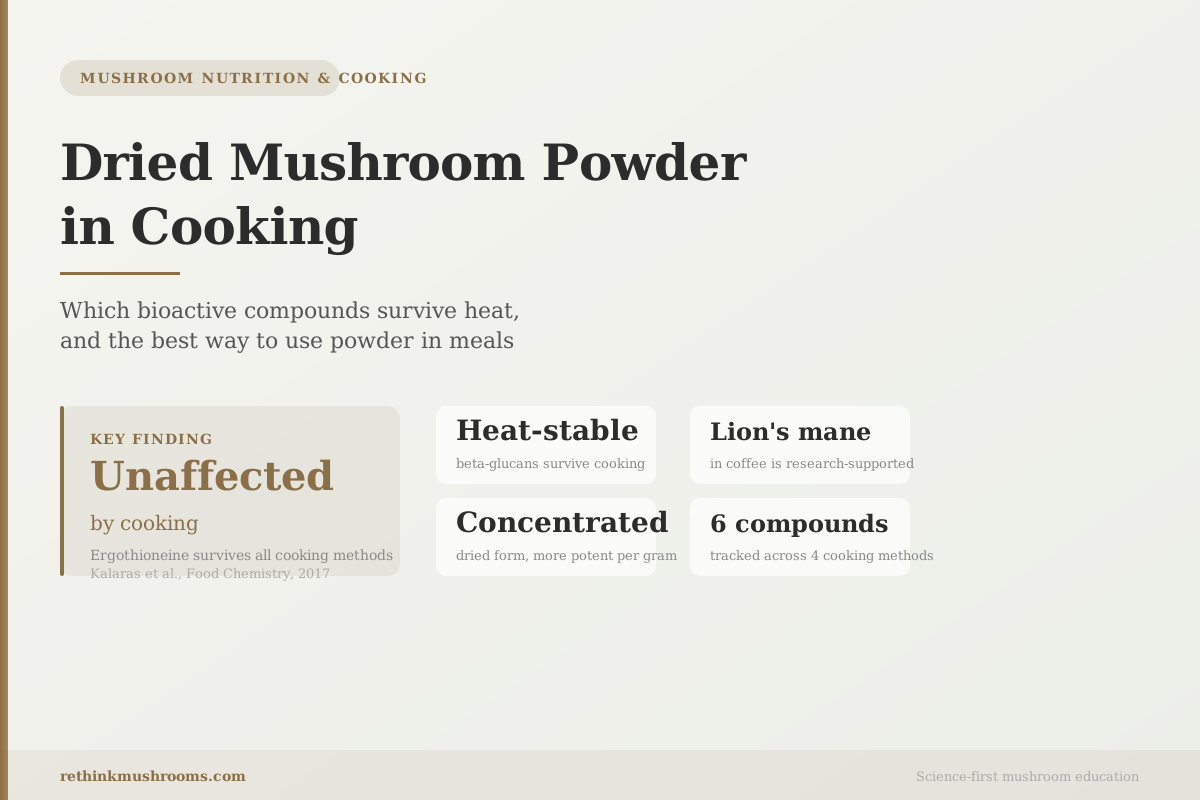
Unaffected by cooking
Mushrooms are the richest known food source of ergothioneine. Kalaras et al. (2017) confirmed that cooking does not reduce ergothioneine concentrations: one of mushroom powder's most clinically interesting compounds survives any preparation.
Kalaras et al., Food Chemistry, 2017
4 methods
boiling, steaming, grilling, microwaving compared in Roncero-Ramos 2017
Heat-stable
ergothioneine and glutathione retained after all cooking methods tested (Kalaras 2017)
Dried form
retains protein digestibility, minerals, and polysaccharides (dried oyster study, 2016)
Kalaras et al., Food Chemistry, 2017
 View as image ↗
When people buy a bag of lion's mane powder or reishi powder and stir it into their morning coffee, there is usually one question lurking underneath: does the heat kill whatever made it worth buying in the first place?
It is a reasonable question. Many health-relevant compounds in plants and other foods are sensitive to heat, water, or oxidation during cooking. If dried mushroom powder loses its bioactive content the moment it hits a hot pan or boiling water, the culinary convenience that makes mushroom powder appealing would be partly illusory.
The research gives a more nuanced answer than a blanket yes or no. Some compounds in dried mushroom powder are heat-stable in ways that surprise food chemists. Others are genuinely sensitive to cooking method. Knowing which is which changes how you use the powder. This article breaks down the evidence on dried mushroom powder cooking, which compounds survive, and how to add it to everyday meals for maximum retention of what makes mushrooms medicinally interesting. For a broader grounding in mushroom nutrition by species, the mushroom nutrition guide provides the full species-by-species context.
Key Takeaways
- Ergothioneine and glutathione, the two antioxidants that make mushrooms uniquely valuable in the diet, are unaffected by cooking; concentrations do not decrease with heat (Kalaras et al., 2017)
- Boiling causes more loss of other antioxidant compounds than steaming or microwaving; steaming and microwaving preserve more overall antioxidant activity in cooked mushrooms (Roncero-Ramos et al., 2017)
- Dried oyster mushroom retains protein digestibility, mineral availability, and polysaccharide content; dried form does not significantly reduce nutrient bioavailability (Regula et al., 2016)
- Beta-glucans, the polysaccharides responsible for most immune-related mushroom research, are structurally robust and heat-stable; cooking does not destroy them
- Culinary mushrooms including lion's mane, shiitake, oyster, and maitake contain bioactive compounds with documented relevance to neurological health (Phan et al., 2015)
- A large prospective cohort (Lee et al., 2019) found regular mushroom consumption associated with reduced cardiovascular disease and type 2 diabetes risk, providing clinical rationale for daily mushroom integration
What Heat Actually Does to Mushroom Bioactives: It Depends on the Compound
The honest answer to "does cooking destroy mushroom powder's benefits?" is: it depends on which benefit you're asking about.
Roncero-Ramos and colleagues ran a direct comparison of four cooking methods (boiling, steaming, grilling, and microwaving) across multiple cultivated mushroom species and measured what happened to nutritional value and antioxidant activity in each case.[2] The results showed significant differences. Steaming and microwaving retained substantially more antioxidant activity than boiling. Boiling caused greater losses because water-soluble antioxidant compounds leach into the cooking liquid rather than staying in the mushroom.
For mushroom powder stirred into soups or broths, this means the powder is releasing some of its water-soluble content into the liquid rather than keeping it concentrated. Consuming the broth recovers those compounds. Discarding it means a proportion of certain bioactives is lost.
Yao and colleagues (2023) extended this analysis specifically for shiitake, measuring how boiling, steaming, stir-frying, roasting, and microwaving affected bioactive compound levels, aroma compounds, color, and texture.[3] Different methods produced meaningfully different bioactive profiles. Water-based methods caused more leaching of water-soluble compounds. Dry-heat methods (roasting, stir-frying) produce more Maillard reaction compounds (the flavor-developing reactions from heat) that don't dramatically reduce water-soluble bioactives, because there is no water for them to leach into.
Two important points emerge from this research:
First, the cooking-method effect matters more for some compounds than others. Not everything in mushroom powder responds to heat the same way.
Second, the total bioactive loss from any cooking method is usually partial, not complete. Even boiling reduces some antioxidant compounds but does not eliminate them. Mushroom powder added to a boiling soup still contributes bioactives, just somewhat less of the water-soluble ones than if added cold.
The Mushroom Antioxidant That Cooking Cannot Destroy
The most practically important finding from the cooking stability research is about ergothioneine.
Ergothioneine is a sulfur-containing compound that humans cannot synthesize internally and must obtain from diet. Mushrooms are the richest known food source of ergothioneine by a wide margin compared to other foods. Kalaras, Richie, and colleagues measured ergothioneine and glutathione concentrations across multiple mushroom species before and after cooking and found that cooking did not significantly reduce concentrations of either compound.[1]
This is a notable finding. It means that whatever cooking method you use with mushroom powder (stirring it into hot soup, baking it into bread, adding it to a sauce on the stove), the ergothioneine content is essentially preserved. The compound that makes mushrooms uniquely valuable as a dietary antioxidant source is thermally stable.
Concentrations also varied meaningfully by species. Porcini (Boletus edulis) and oyster mushrooms were among the highest ergothioneine sources. The variation across species documented by Kalaras et al. means that choosing which mushroom powder to use affects the ergothioneine content you add to your cooking, even though cooking itself doesn't degrade it afterward.
Glutathione, the body's primary internally produced antioxidant, also showed thermal stability in Kalaras's measurements. Mushrooms are unusual among foods in containing significant dietary glutathione that survives cooking to the plate. This is a secondary but real advantage of using mushroom powder consistently in cooking.
The species variation in ergothioneine content documented by Kalaras et al. has practical implications for choosing which powder to use. Porcini (Boletus edulis) measured among the highest of the species tested, followed closely by oyster mushrooms. Shiitake and button mushrooms contain ergothioneine but at lower concentrations per gram than porcini or oyster. If ergothioneine intake is the primary goal, the species choice matters as much as whether you cook the powder or add it cold.
For those using lion's mane or reishi powders specifically, note that the Kalaras study did not focus on these species and their ergothioneine levels are not among the published benchmarks in that data. The heat-stability finding (cooking does not degrade what is there) still applies, but the baseline concentration in these species is a separate empirical question not directly addressed by this study.
Dried Powder vs. Fresh: Does the Drying Process Reduce Potency?
A related concern to heat stability is whether the drying process itself reduces bioactive potency before the powder even reaches the kitchen.
Regula and colleagues (2016) assessed bioavailability and digestibility of nutrients in dried oyster culinary-medicinal mushroom.[4] The findings supported the use of dried forms: protein digestibility was well-maintained, mineral availability was preserved, and polysaccharide content (including the beta-glucans responsible for most of the immune-related research on mushrooms) was intact.
This matters for practical use because mushroom powders are almost exclusively made from dried material. The concern that the drying process destroys the very compounds people are hoping to consume is not well-supported. The major functional components (beta-glucans, ergothioneine, proteins) survive drying with their bioavailability largely intact.
Drying also concentrates compounds per gram compared to fresh weight, because water is removed without proportionally reducing compound content. Dried mushroom powder is more potent per gram than fresh mushroom, which is why a teaspoon of dried powder in a recipe can meaningfully contribute bioactives that would require a much larger fresh portion to match.
How to Add Mushroom Powder to Meals: Method by Method
The cooking stability data from Roncero-Ramos, Yao, and Kalaras together support a practical framework for how mushroom powder fits best into different types of meals.
Smoothies and cold preparations. No heat, no leaching, no thermal impact on any compound. A teaspoon or two in a blender with cold liquids preserves all bioactives with zero loss from temperature. If compound retention matters most, cold applications require no trade-offs at all.
Coffee and tea. Water temperature in brewed coffee is typically around 90–96°C. This is below conditions that significantly degrade beta-glucans or ergothioneine. Stirring mushroom powder into hot coffee or tea, rather than brewing it through the machine, means the exposure time is short and the water volume is small. Water-soluble compounds dissolve into the drink rather than being discarded, so nothing is lost; you consume the whole liquid.
Soups and broths. Beta-glucans are structurally robust and heat-stable; they survive extended boiling without significant degradation. Ergothioneine is also preserved through boiling. The main concern with boiling is leaching of some other antioxidants into the cooking liquid, which is not a concern when the broth is the end product. Adding mushroom powder early in a broth-based soup means the compounds distribute throughout the liquid and are consumed in each spoonful.
Sauces and gravies. Similar logic to soups: powder added with a liquid base disperses compounds into the sauce. Heat affects more volatile aromatics but the polysaccharides and ergothioneine remain stable.
Baked goods. Oven temperatures (typically 160–220°C) are higher than stove-top cooking, but baking times are extended. Beta-glucans are robust enough to survive baking temperatures. Ergothioneine's thermal stability means meaningful amounts remain after baking. Substituting roughly 10–15 percent of flour volume with mushroom powder can be done without dramatically affecting texture while adding beta-glucans and ergothioneine to the finished product.
For a deeper treatment of how specific cooking methods compare across all mushroom species and compound types, see how cooking affects mushroom bioactives: what the research shows.
The Lion's Mane in Coffee Question, and What the Research Shows
The most common daily use of medicinal mushroom powder involves species like lion's mane, reishi, and chaga added to morning beverages. The question underneath the trend is whether these are marketing stories or whether culinary use of these mushroom species has genuine biological support.
For lion's mane specifically, the evidence base is substantive. Phan and colleagues reviewed the therapeutic potential of culinary-medicinal mushrooms for neurological health, covering the documented bioactivities of lion's mane, shiitake, oyster, and maitake mushrooms.[5] The review established that these mushrooms (which people eat as food, not just as supplements) contain bioactive compounds with documented relevance to neurodegenerative disease prevention. Lion's mane contains compounds that stimulate nerve growth factor synthesis, which has driven most of the clinical interest in the species.
The Phan review covered culinary species rather than concentrated pharmaceutical extracts, which matters for the mushroom powder context: the relevant bioactive research was conducted with whole mushroom material, not standardized isolates. This supports the idea that culinary-level use, including powder added to daily meals or drinks, is the same category of intervention as what produced the biological effects documented in the review.
The broader dietary picture comes from Lee, Giovannucci, and colleagues, whose prospective cohort study followed US adults and found that regular mushroom consumption was associated with reduced risk of cardiovascular disease and type 2 diabetes.[6] This was routine dietary consumption, the kinds of quantities and frequencies people achieve by incorporating mushroom powder into daily cooking, not clinical supplement protocols.
The clinical rationale for integrating mushroom powder into daily cooking is therefore not purely speculative. It aligns with population data on routine mushroom consumption and with mechanistic research on the bioactive compounds preserved through drying and standard cooking methods.
The Lee cohort study didn't isolate specific species or preparation methods, which is a limitation for making species-specific claims. What it does establish is that the consumption pattern most people who use mushroom powder are trying to achieve (regular, daily, varied-species mushroom intake as part of ordinary meals) is the same dietary pattern that showed cardiovascular and metabolic benefit in a large real-world population over time.
This creates an interesting convergence between the cooking science and the clinical evidence: the compounds that matter most for the health outcomes (beta-glucans for immune effects, ergothioneine for oxidative protection) are the same compounds shown to be most stable through cooking and drying. The parts of mushroom powder that survive standard kitchen use are also the parts with the strongest documented biological interest.
For the neurological evidence on lion's mane specifically, see the lion's mane section in the 12 best culinary mushrooms guide. For how preparation methods compare more broadly, see umami in mushrooms: the science of mushroom flavor.
The Bottom Line
The main concern about cooking with dried mushroom powder (that heat destroys the benefits) is partially supported and partially refuted by the research. Ergothioneine and glutathione, the antioxidants that make mushrooms uniquely valuable in the diet, are unaffected by cooking. Beta-glucans are structurally robust and heat-stable. Water-soluble antioxidant compounds do leach into cooking liquid during boiling, which favors consuming the broth or using dry-heat methods. Dried powder retains most of the bioavailability of fresh mushroom, and culinary species including lion's mane, shiitake, and oyster have documented biological relevance to neurological and cardiovascular health when consumed regularly.
Frequently Asked Questions
Sources & References
- 1RTHM-00476·Kalaras, Michael D et al. (2017). “Mushrooms: A rich source of the antioxidants ergothioneine and glutathione..” Food chemistry.Study breakdown →PubMed →↩
- 2RTHM-00488·Roncero-Ramos, Irene et al. (2017). “Effect of different cooking methods on nutritional value and antioxidant activity of cultivated mushrooms..” International journal of food sciences and nutrition.Study breakdown →PubMed →↩
- 3RTHM-00859·Yao, Fen et al. (2023). “Effect of Different Cooking Methods on the Bioactive Components, Color, Texture, Microstructure, and Volatiles of Shiitake Mushrooms..” Foods (Basel.Study breakdown →PubMed →↩
- 4RTHM-00443·Regula, Julita et al. (2016). “Bioavailability and Digestibility of Nutrients from the Dried Oyster Culinary-Medicinal Mushroom, Pleurotus ostreatus (Agaricomycetes): In Vivo Experiments..” International journal of medicinal mushrooms.Study breakdown →PubMed →↩
- 5RTHM-00397·Phan, Chia-Wei et al. (2015). “Therapeutic potential of culinary-medicinal mushrooms for the management of neurodegenerative diseases: diversity, metabolite, and mechanism..” Critical reviews in biotechnology.Study breakdown →PubMed →↩
- 6RTHM-00567·Lee, Dong Hoon et al. (2019). “Mushroom consumption, biomarkers, and risk of cardiovascular disease and type 2 diabetes: a prospective cohort study of US women and men..” The American journal of clinical nutrition.Study breakdown →PubMed →↩