Mushroom Nutrition & Cooking
90%+ of ergothioneine activity preserved
Ergothioneine from culinary-medicinal mushrooms retains over 90% of its antioxidant activity after steaming or pan-frying. Losses seen in boiling are from leaching into the water, not from heat destroying the compound.
Liu et al., Int J Med Mushrooms, 2020
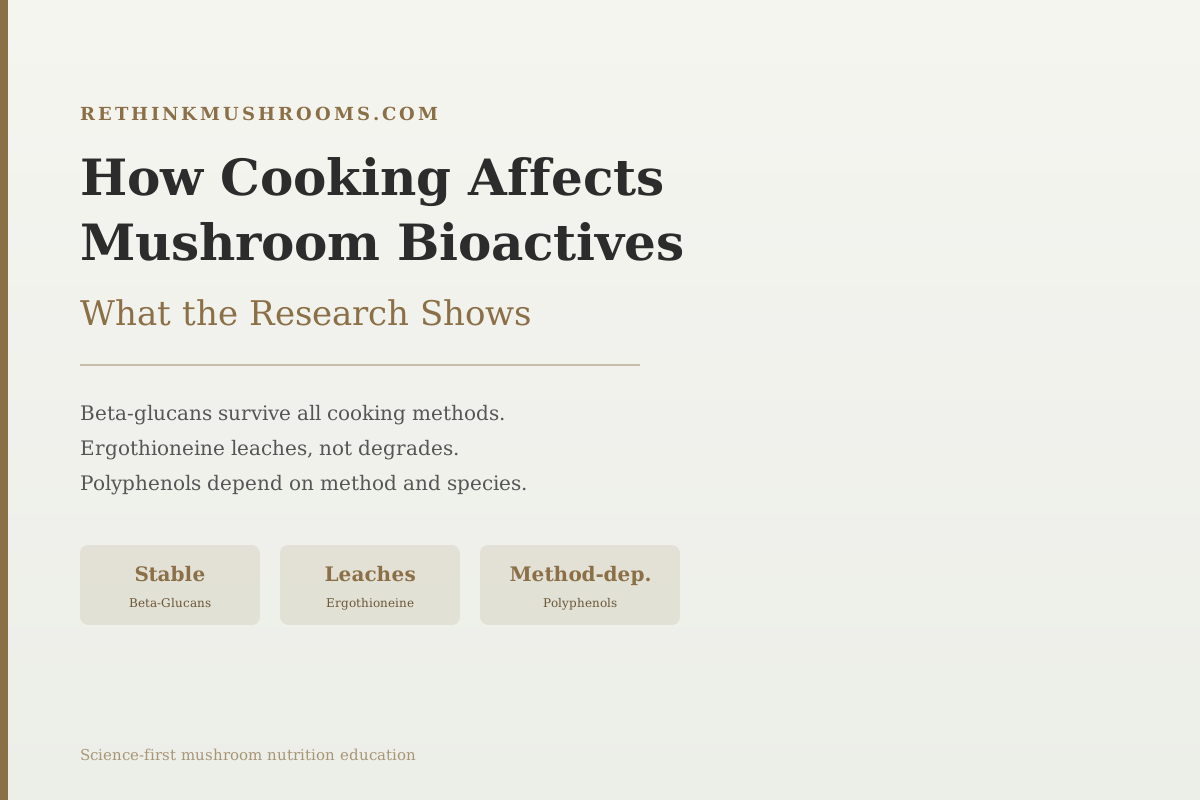
Stable
beta-glucans and immunomodulatory proteins survive all standard cooking temperatures
Leaches
ergothioneine is water-soluble and migrates into cooking liquid rather than being destroyed by heat
Method matters
polyphenol content rises with microwaving and grilling; falls sharply with boiling (Roncero-Ramos 2017)
Liu et al., Int J Med Mushrooms, 2020
 View as image ↗
"Does cooking destroy the health benefits of mushrooms?" is one of the most commonly Googled questions about mushroom nutrition, and most of the answers on the internet get it wrong in the same direction. They treat mushrooms as a category with a single answer, they conflate two completely different mechanisms (heat degradation versus leaching), and they miss the most important fact in the research: the immune-supporting compounds that most people care about are remarkably resistant to cooking heat.
The real picture is a story about three separate compound classes that behave differently, and about one practical distinction that changes what the right cooking advice actually is. For the complete mushroom nutrition context, see the mushroom nutrition facts guide. For a direct comparison of raw versus cooked mushrooms, see raw vs. cooked mushrooms: why heat matters.
Key Takeaways
- Beta-glucans and immunomodulatory proteins are heat-stable and survive all standard cooking methods including boiling; immunomodulatory proteins FIP-fve (enoki) and LZ-8 (reishi) retained biological activity after heating to 100°C (Tong et al., 2008)
- Ergothioneine is thermally stable, retaining more than 90% of antioxidant activity after steaming or pan-frying; losses during boiling are caused by water-soluble leaching into cooking liquid, not thermal degradation (Liu et al., 2020)
- Polyphenols and antioxidant activity increased significantly in four mushroom species after microwaving and grilling; boiling caused major losses across all species tested (Roncero-Ramos et al., 2017)
- For shiitake specifically, oven baking at short durations produced the highest total phenolics and flavonoids, outperforming microwave; steaming and air-frying decreased all four bioactive components (Yao et al., 2023)
- Significant bioactives from dried shiitake (including polysaccharides, lentinan, and phenolics) migrate into soaking and cooking water; consuming the broth recovers compounds that would otherwise be discarded (Zhu et al., 2019)
- The leaching-versus-degradation distinction is the most important practical concept: water-soluble compounds (ergothioneine, B vitamins, water-soluble polysaccharides) are lost via leaching in boiling water, not by heat; dry cooking methods preserve them
Beta-Glucans and Immune Proteins: The Good News First
The question most people are really asking when they search "does cooking destroy mushroom health benefits" is whether the immune-supporting polysaccharides survive. The answer is yes, and it is well-established.
Beta-glucans, the polysaccharide structures responsible for most of the immune-modulating activity attributed to medicinal mushrooms, are structurally robust. They are long-chain carbohydrate polymers that form part of the fungal cell wall. Standard cooking temperatures do not break the glycosidic bonds that give them their biological activity. This is part of why hot-water extraction has historically been the primary processing method for medicinal mushroom products: boiling releases beta-glucans from the cell wall into solution rather than destroying them.
Beyond beta-glucans, mushrooms contain proteins with direct immunomodulatory activity. Tong and colleagues examined two of the best-characterized examples: FIP-fve from enoki mushrooms (Flammulina velutipes) and LZ-8 from reishi (Ganoderma lucidum).[2] Both proteins retained their biological activity after heating to 100°C. The proteins are stable at standard cooking temperatures, meaning the immune-supporting compounds in cooked enoki and reishi are not being destroyed in the pot.
The Agaricus bisporus scoping review by Blumfield and colleagues, which examined the most widely consumed mushroom globally, reached a consistent conclusion: the beta-glucans and other structural polysaccharides in button mushrooms survive cooking across methods.[3] The primary cooking-related concern for button mushrooms is not compound destruction but compound redistribution, specifically where water-soluble compounds go when mushrooms are cooked in water.
Ergothioneine: Heat-Stable but Water-Soluble
Ergothioneine is the sulfur-containing amino acid found in high concentrations in mushrooms and almost nowhere else in the human diet. It accumulates in organs and tissues that face high oxidative stress (liver, kidney, brain, lens of the eye) and functions as a long-acting antioxidant. It is also water-soluble, and that distinction matters for how cooking affects it.
Liu and colleagues measured ergothioneine antioxidant activity in culinary-medicinal mushrooms after different cooking treatments.[4] After steaming and pan-frying, ergothioneine retained more than 90% of its antioxidant activity. The compound does not degrade under heat. What produces losses is boiling: when mushrooms are submerged in water, the water-soluble ergothioneine diffuses out of the mushroom tissue into the cooking liquid.
This is a mechanistically important distinction. If ergothioneine were destroyed by heat, the advice would be "cook at lower temperatures." Because it leaches into water rather than degrading, the advice is different: either avoid immersing mushrooms in large volumes of water during cooking, or consume the cooking liquid.
Zhu and colleagues documented exactly this redistribution for dried shiitake mushrooms.[5] Significant quantities of polysaccharides, lentinan (the beta-glucan most associated with shiitake's immune effects), and phenolics migrated into both the soaking water and the cooking water. Discarding the broth after cooking shiitake means discarding a portion of the bioactives. Consuming the broth, in soup or as a cooking liquid for rice or grains, recovers those compounds.
The same principle applies to ergothioneine in any boiled mushroom preparation. The mushroom broth is not waste. For a detailed guide on getting the most from dried mushroom preparations, see rehydrating dried mushrooms: best practices for flavor and nutrition.
For the full picture on what ergothioneine does and why preserving it matters, see ergothioneine and cardiovascular disease: the mushroom-exclusive antioxidant.
Polyphenols and Antioxidant Activity: Where Cooking Method Matters Most
The third compound class, polyphenols and phenolics, shows the most sensitivity to cooking method. This is where the well-known "microwave is best" finding comes from, and where the research shows genuine differences between methods.
Roncero-Ramos and colleagues tested four cultivated mushroom species (Agaricus bisporus, Lentinula edodes, Pleurotus ostreatus, and Pleurotus eryngii) across boiling, microwaving, and grilling.[1] Microwaving and grilling produced no significant losses in nutritional value; total polyphenol content and antioxidant activity actually increased significantly with both methods. Boiling caused major losses in nutritional value, polyphenols, and antioxidant activity across all four species tested.
The finding has been replicated. An independent study on four Boletus species showed the same pattern: microwaving was the best method for retaining total phenolics, while boiling showed the greatest decreases.[8] The consistency across two separate research groups, testing different mushroom genera, supports the generalizability of the recommendation.
Why does microwaving improve polyphenol content rather than merely preserving it? The proposed mechanism is that brief, intense heat disrupts cell wall structure, releasing phenolic compounds that were previously bound to cell wall components and unavailable for measurement. Cooking breaks them free. At the same time, microwaving involves minimal or no added water, so water-soluble compounds cannot leach out. The combination of cell wall disruption and no leaching produces the observed increase in measurable phenolics.
Boiling achieves the cell wall disruption but simultaneously provides a large volume of water for leaching. The result is compound release from the tissue into the water; if that water is discarded, the compounds are lost from the food. Sun and colleagues confirmed that mushroom soups and stews prepared with slow, lower-temperature methods retained more nutrients in the broth than high-heat boiling, and that the broth was the primary vehicle for nutrient delivery in soup preparations.[6]
The Shiitake Exception: When Oven Baking Outperforms Microwave
The Roncero-Ramos 2017 study covered four species and established the general pattern, but more recent species-specific research adds important nuance. For shiitake in particular, the picture is more complex.
Yao and colleagues tested nine cooking methods for shiitake (Lentinula edodes) in 2023, using more granular measurements than the earlier multi-species studies.[7] The results diverged from the general pattern in a meaningful way. For shiitake specifically, oven baking for 5-10 minutes produced the highest total phenolics and total flavonoids of any cooking method tested, outperforming microwave. Steaming and air-frying at the durations tested decreased all four bioactive components measured. Boiling, consistent with other studies, caused the greatest overall losses.
This does not invalidate the microwave recommendation from Roncero-Ramos; it complicates it in a species-specific way. The Yao 2023 data suggests that for shiitake, a short oven bake is the optimal phenolic-preserving method. For the other species tested in the 2017 study (button, oyster, king trumpet), the earlier microwave-first recommendation holds.
The practical implication: no single cooking method is universally optimal across all mushroom species. What is universally suboptimal is boiling mushrooms in large volumes of water and discarding the cooking liquid.
Species-Specific Responses: Why Generalization Has Limits
Beyond the shiitake exception, species-specific differences in cooking response appear across multiple studies.
Tan and colleagues found that oyster mushrooms showed species-level variation even within the Pleurotus genus.[9] Different Pleurotus species responded differently to the same cooking treatments, with some methods enhancing antioxidant activity in one species while reducing it in another. The overarching "cooking destroys nutrients" claim is an oversimplification at the species level, and the species-specific recommendation requires species-specific data.
Shamaruddin and colleagues examined black jelly mushroom (Auricularia polytricha), showing that its bioactives responded differently to cooking methods than button mushrooms or shiitake.[10] Auricularia is high in water-soluble polysaccharides including the beta-glucans responsible for its traditional use in cardiovascular health applications; the cooking water from Auricularia preparations is particularly bioactive-rich.
Chen and Xu's 2024 comprehensive review of chanterelle (Cantharellus cibarius) processing documented that cooking and drying methods affect the bioactive profile of this widely foraged species differently than cultivated mushrooms.[12] The species-level variation in response to processing is a consistent theme across the literature.
For a species-by-species overview of mushroom nutritional content, see the mushroom nutrition facts guide. For how drying methods compare to cooking for bioactive preservation, see dried vs. fresh mushrooms: do drying methods affect health benefits?.
Bioavailability After Digestion: The Most Practical Metric
A limitation of most cooking studies is that they measure what's present in the cooked mushroom, not what the body actually absorbs. Li and colleagues addressed this gap in a 2024 study that combined cooking treatment with a simulated in vitro digestion model.[11]
The gastrointestinal simulation showed that bioaccessibility (the fraction of a nutrient that becomes available for absorption) changes significantly depending on cooking method, and in ways that do not always parallel the simple "more compound present = better" logic of direct measurement studies. Some cooking treatments that appeared to reduce total compound content in the mushroom tissue actually improved the extractability of nutrients during digestion, as cooking had already broken down the cell wall barriers that would otherwise limit absorption.
This is the most important caveat for interpreting cooking studies generally: the question is not what is present in the food after cooking, but what the body can absorb from it. Cooking that disrupts chitin cell walls may reduce total measured compound content while simultaneously improving bioaccessibility. The 2024 digestion simulation data is currently the closest to answering the real-world question of which cooking method produces the most bioavailable mushroom nutrients.
The Framework: Leaching vs. Degradation
Pulling together the research, the most useful organizing principle is the distinction between leaching and degradation.
Heat degradation affects thermally sensitive compounds. For mushrooms, this category is narrower than commonly believed. Beta-glucans and immunomodulatory proteins are not in this category. Ergothioneine is not in this category. Some polyphenols are sensitive to heat, but the studies show that moderate dry heat (microwaving, grilling, roasting) does not destroy them and can actually increase their measured concentration by releasing bound forms.
Leaching affects water-soluble compounds when mushrooms are cooked in water. Ergothioneine, water-soluble B vitamins, water-soluble polysaccharides, and phenolics all migrate from mushroom tissue into cooking liquid. If that liquid is consumed as broth or soup, the compounds are not lost from the diet. If it is discarded, they are.
The practical synthesis from the research:
- Dry heat methods (microwaving, grilling, oven roasting, sauteing with minimal oil) preserve the most bioactives
- Boiling or simmering retains bioactives in the cooking liquid, which should be consumed rather than discarded
- Beta-glucans and immune proteins are stable regardless of cooking method
- Ergothioneine is stable to heat; protect it from leaching by limiting water-based cooking or using the cooking liquid
For more on which specific cooking methods produce the best outcomes for health-focused mushroom eaters, see best cooking methods for maximizing mushroom health benefits and best cooking methods for medicinal mushrooms: how heat affects bioactive compounds.
The Bottom Line
The cooking-and-mushroom-bioactives research separates into three stories by compound class. Beta-glucans and immunomodulatory proteins are heat-stable and survive all cooking methods; the immune activity associated with mushrooms is not destroyed in the pan or pot. Ergothioneine is thermally stable but water-soluble; it leaches into cooking water rather than being degraded by heat, making dry cooking or broth consumption the practical recommendation. Polyphenols and antioxidant activity are the most method-sensitive: microwave and dry heat increase measured antioxidant activity while boiling causes significant losses across species. For shiitake specifically, short oven baking outperforms microwave for phenolics. The cooking broth from any water-based mushroom preparation contains significant bioactives and should be consumed rather than discarded.
Frequently Asked Questions
Sources & References
- 1. Source details for this reference are not yet available.
- 2. Source details for this reference are not yet available.
- 3. Source details for this reference are not yet available.
- 4. Source details for this reference are not yet available.
- 5. Source details for this reference are not yet available.
- 6. Source details for this reference are not yet available.
- 7. Source details for this reference are not yet available.
- 8. Source details for this reference are not yet available.
- 9. Source details for this reference are not yet available.
- 10. Source details for this reference are not yet available.
- 11. Source details for this reference are not yet available.
- 12. Source details for this reference are not yet available.