Mushroom Drying Methods & Bioactive Preservation
20–60 min optimal soaking window (species-dependent)
Rehydration time and water temperature together determine how much of the mushroom's bioactive content stays in the mushroom versus migrates into the soaking liquid, and both fractions have nutritional value.
Roncero-Ramos et al., Int J Food Sci Nutr, 2017; Sun et al., J Food Sci Technol, 2014
Soaking liquid is nutritionally significant
water-soluble bioactives migrate from mushroom to water during soak
Dried mushroom nutrients are bioavailable
in vivo data confirmed absorption (Regula et al., 2016)
Processing method determines bioactive profile
rehydration is the final processing step (Chen & Xu, 2024)
Roncero-Ramos et al., Int J Food Sci Nutr, 2017; Sun et al., J Food Sci Technol, 2014
 View as image ↗
The standard advice for rehydrating dried mushrooms is to cover them with hot water, wait 20-30 minutes, squeeze them dry, and discard the soaking liquid. The first part is mostly right. The last part throws away a significant portion of what makes dried mushrooms worth buying.
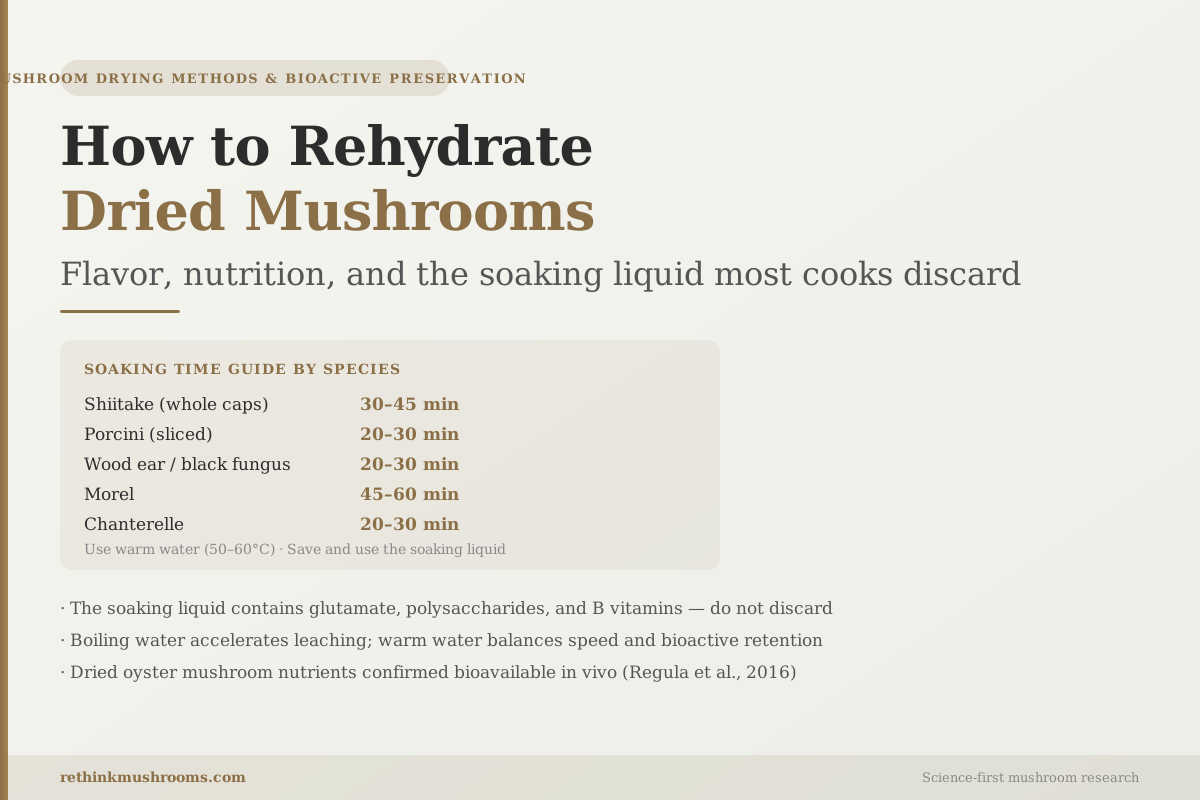
When dried mushrooms soak, water-soluble compounds migrate from the mushroom into the liquid: free amino acids including glutamate, water-soluble polysaccharides, and B vitamins. Research on water-based cooking of mushrooms shows the same mechanism that causes soaking liquid to turn dark brown also transfers phenolic compounds and other bioactives into the water.[1] The soaking liquid is not waste. It is, in culinary terms, a mushroom broth.
This article is part of the mushroom nutrition facts guide, covering the full processing and nutrition picture. For the science of what happens to mushroom bioactives before rehydration, during the drying process itself, the articles on how freeze-drying preserves mushroom bioactives and dried vs. fresh mushrooms: nutrient density and medicinal value cover that ground.
Key Takeaways
- The soaking liquid from dried mushrooms contains water-soluble bioactives including glutamate, polysaccharides, and B vitamins that migrated from the mushroom during rehydration; discard it and you lose a nutritionally significant fraction of what you soaked
- Boiling water causes greater bioactive leaching into the liquid and can toughen mushroom texture; room temperature or warm water (50-60°C) is preferable for most species (Roncero-Ramos et al., 2017)
- Soaking time varies by species: shiitake 30-45 minutes, porcini 20-30 minutes, wood ear 20-30 minutes, morel 45-60 minutes, chanterelle 20-30 minutes
- Nutrients from dried oyster mushrooms, including protein and iron, are biologically available after consumption, confirmed by in vivo research (Regula et al., 2016)
- Broth rehydration is a viable alternative that adds flavor; the trade-off is that the soaking liquid is less useful as a standalone ingredient since the broth flavors it
- Rehydrated dried mushrooms will not match fresh mushrooms in texture for every application, but the bioactive content is comparable; for species like shiitake, the umami intensity of dried and rehydrated often exceeds fresh
The Soaking Liquid Is Not Waste: Here Is What It Contains
When you cover dried mushrooms with water, two things happen simultaneously. The mushroom absorbs water and begins rehydrating, and water-soluble compounds in the mushroom diffuse outward into the soaking liquid.
The soaking liquid turns dark brown because colored phenolic compounds are moving from the mushroom into the water. The same mechanism transfers glutamate and other free amino acids, the compounds responsible for umami flavor, along with water-soluble polysaccharides including beta-glucan fractions and B vitamins. By the time the mushroom is fully rehydrated, a meaningful share of the water-soluble content has migrated into the liquid.
Research on water-based cooking of mushrooms confirms the leaching mechanism. Roncero-Ramos and colleagues found that boiling reduced mushroom phenolic content and antioxidant activity significantly, while also noting that the cooking water retained bioactives from the mushroom.[1] A parallel study on Boletus mushrooms found boiling caused greater phenolic losses than any other cooking method; these losses are primarily explained by leaching into the water, not destruction of the compounds.[2] Soaking is a low-temperature version of the same process.
The practical implication is straightforward: use the soaking liquid. Strain it through a fine mesh or paper towel to remove any grit that settled during soaking, then add it to soups, sauces, braises, or risottos. If you are making a dish where the mushroom liquid would be diluted into a large volume of water anyway, the nutritional difference is small. If you are making a concentrated sauce or a small-batch dish, discarding the liquid leaves a meaningful fraction of the mushroom's water-soluble content behind.
The flavor case for using the soaking liquid is even stronger than the nutritional one. Dried mushrooms, especially porcini and shiitake, release intense concentrations of glutamate and other umami compounds into the soaking water. For more on the flavor chemistry, the article on umami in mushrooms: the science of mushroom flavor covers the glutamate and nucleotide content in detail.
Hot Water vs. Cold: How Temperature Affects Texture and Bioactive Migration
The most common rehydration instruction is to use boiling or near-boiling water. It is also the instruction most likely to produce toughened mushrooms with more of their water-soluble content in the bowl than in the mushroom.
Boiling water does two things simultaneously. It accelerates rehydration: the mushroom takes up water faster at high temperatures. But it also drives faster and more complete diffusion of water-soluble compounds out of the mushroom into the liquid. And for species with delicate cell structure, very hot water can cause surface proteins to denature and toughen before the interior has fully rehydrated, producing mushrooms with a chewy, slightly rubbery exterior and a still-dense core.
Warm water, roughly 50 to 60°C (hot to the touch but well below a boil), provides a workable middle ground for most species. Rehydration takes a few minutes longer than with boiling water, but the mushroom ends up with better texture and somewhat less bioactive migration into the liquid (though migration happens regardless of temperature, slowed but not prevented by lower heat).
Cold or room-temperature water is the method that maximizes bioactive retention in the mushroom itself, since slower diffusion means less migration. Cold soaking takes significantly longer, often 1-2 hours for thick mushrooms. It is the method of choice when you plan to eat or cook the mushroom itself and discard or have limited use for the soaking liquid.
The practical rule: if you will use the soaking liquid (adding it to the dish), temperature matters less, since you are consuming both fractions. If you will discard the soaking liquid, use cool water and soak longer to minimize what leaves the mushroom.
Soaking Times by Species: A Practical Reference
Soaking time is the variable most people research, and the most underspecified in recipe sources. The correct time depends on the size and thickness of the mushroom pieces, not just the species, but species gives a useful starting point.
Shiitake: 30-45 minutes in warm water for whole caps; 20-30 minutes for sliced pieces. Shiitake caps are dense and the stem, if attached, stays woody regardless of soaking time. Remove and discard or reserve the stem for stock. The gills should soften to a silky texture when done.
Porcini (ceps): 20-30 minutes is generally sufficient. Porcini are often sold sliced thin, which speeds hydration. The soaking liquid from porcini is particularly flavorful and is used in many classic Italian recipes as a base for sauces.
Wood ear / black fungus (Auricularia): 20-30 minutes, though some sources suggest up to 45 minutes for very thick pieces. Research on Auricularia auricula processing confirms that processing method alters antioxidant capacity compared to fresh, but the nutrients remain present.[4] Wood ear doubles or triples in volume during rehydration.
Morel: 45-60 minutes. Morels have a complex honeycomb structure that traps grit. After soaking, lift the mushrooms out of the liquid rather than pouring through a strainer; sediment settles at the bottom and should not be disturbed. Check for hidden insects or debris inside the hollow stem.
Chanterelle: 20-30 minutes. A 2024 comprehensive review of chanterelle processing notes that how mushrooms are processed significantly determines which bioactives survive to the consumer.[5] Chanterelles have a fibrous, trumpet-like structure that rehydrates reasonably well, though fresh chanterelles have better texture for sautéed applications.
Black trumpet / horn of plenty: 15-20 minutes. These are thin-walled and rehydrate quickly.
Oyster mushrooms (dried): 15-25 minutes. Dried oyster mushrooms are less common commercially but appear in some Asian grocery contexts. In vivo research specifically on dried oyster mushrooms (Pleurotus ostreatus) found their nutrients, including protein and iron, were biologically available after consumption in animal models.[3]
Always check for full hydration by pressing the thickest part of a mushroom; it should yield with slight resistance and feel uniformly moist throughout, not firm in the center. A firm center means more time is needed.
Rehydrating in Broth, Wine, or Other Liquids
The soaking liquid does not have to be plain water. Rehydrating in chicken broth, vegetable stock, or warm white wine is a common technique for building additional flavor. It works well and produces a richer soaking liquid.
The trade-off: when you rehydrate in broth, the soaking liquid is already flavored from the broth and may be more concentrated than you want for some applications. This is generally a benefit: the resulting liquid is a mushroom-enriched broth you can use directly. But it is less useful as a neutral mushroom stock.
Alcohol, such as wine, sake, or sherry, can be used as part of the soaking liquid, typically mixed with water at a ratio of 1:3 or 1:4. The alcohol adds flavor compounds and may enhance extraction of certain lipid-soluble aromatic compounds. Keep the temperature low when using wine to avoid driving off volatile aromatics through rapid evaporation.
Milk rehydration is occasionally recommended for reducing bitterness in some mushroom species, particularly wild-harvested types with more assertive flavors. The proteins in milk bind to some bitter compounds. Whether this is worth the added complexity depends on the application.
Are Rehydrated Dried Mushrooms Nutritionally Equivalent to Fresh?
The honest answer is: they are different, not simply worse.
Drying concentrates nutrients. A 100g portion of dried mushrooms contains roughly 8-10 times the nutrient density (by weight) of the same species fresh, because water has been removed. After rehydration, the mushroom regains volume and approaches its original structure. The nutrient profile is then similar to fresh on a per-gram-of-mushroom basis, minus whatever leached into the soaking liquid and with any heat-sensitivity adjustments depending on the drying method.
The most comprehensive evidence for nutrient retention in dried and rehydrated mushrooms comes from bioavailability research rather than composition analysis alone. Research on dried oyster mushrooms found that protein, iron, and other nutrients from the dried form were measurably absorbed after consumption.[3] The dried-then-rehydrated format is nutritionally functional, not inert.
The processing method used before you receive the dried mushrooms matters significantly. A 2024 review of chanterelle processing found that the choice of processing treatment fundamentally determines which bioactives reach the consumer.[5] Freeze-dried mushrooms, which preserve more heat-sensitive compounds, produce a nutritionally distinct rehydrated product compared to those dried at high temperatures. The article on dried vs. fresh mushrooms: do drying methods affect health benefits? covers these upstream differences in detail.
Where fresh mushrooms clearly outperform rehydrated: texture in raw or lightly cooked preparations (salads, carpaccio), and applications where visual freshness matters. The structural damage from drying and rehydration is irreversible: cell walls rupture, and the mushroom will be softer and sometimes more uniform than a fresh specimen.
Where dried and rehydrated mushrooms match or outperform fresh: braised dishes, stocks, sauces, and applications where cooking time and moisture will affect fresh mushrooms anyway. Shiitake and porcini in particular develop more concentrated umami flavor through the drying process, producing a depth in rehydrated form that fresh equivalents rarely match.
For maximizing both what stays in the mushroom and what you extract from the soaking liquid, the approach is simple: use warm water, soak long enough for full hydration by the species guidelines above, strain the liquid carefully, and build it into the dish. The research on water-based mushroom processing supports what experienced cooks have always known: the liquid has flavor and nutrition worth keeping.
The article on dried mushroom powder in cooking: how to add medicinal benefits to meals covers an adjacent approach where the mushroom is used in powdered rather than rehydrated form.
The Bottom Line
The key insight missing from most rehydration guidance is that the soaking liquid from dried mushrooms contains a nutritionally significant share of the water-soluble bioactives: glutamate, polysaccharides, and phenolics that migrate from mushroom to water during soaking. Research on water-based mushroom cooking documents this leaching mechanism, which applies equally to soaking. Temperature and soaking time together determine the balance between mushroom and liquid. In vivo research confirms that nutrients from dried mushrooms are biologically available after rehydration and consumption. Using the soaking liquid in the dish makes both fractions available.
Frequently Asked Questions
Sources & References
- 1. Source details for this reference are not yet available.
- 2. Source details for this reference are not yet available.
- 3. Source details for this reference are not yet available.
- 4. Source details for this reference are not yet available.
- 5. Source details for this reference are not yet available.