Mushroom Nutrition & Cooking
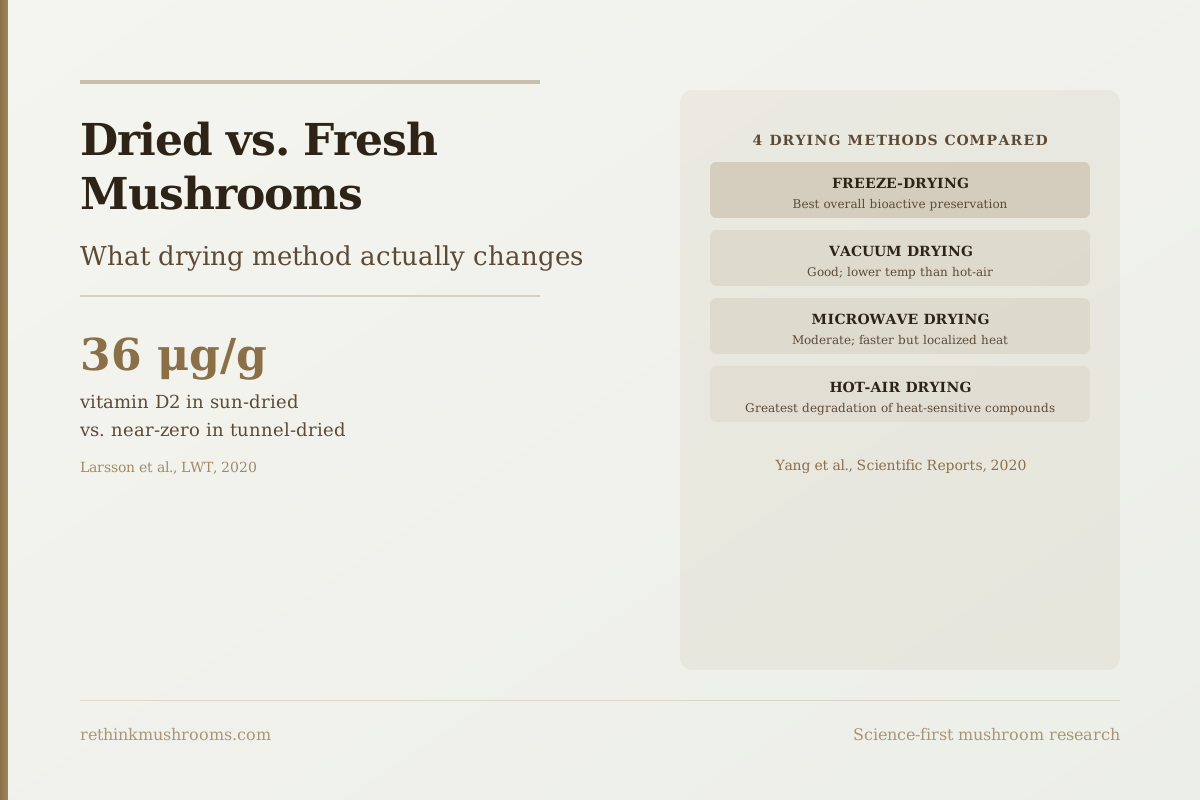
36 μg/g vitamin D2 in sun-dried vs near zero in tunnel-dried
The same mushroom, dried four different ways, produced dramatically different nutritional outcomes: freeze-drying best preserved bioactives while high-temperature hot-air drying caused the greatest compound loss.
Yang et al., Scientific Reports, 2020; Larsson et al., LWT, 2020
4 methods
compared head-to-head by Yang et al. 2020 on the same mushroom batch
~100°C
threshold where ergothioneine, a rare mushroom amino acid, stays intact
Stable
beta-glucans (immune polysaccharides) survive most drying methods
Yang et al., Scientific Reports, 2020; Larsson et al., LWT, 2020
 View as image ↗
In 2020, a lab at the Chinese Academy of Sciences took one batch of king oyster mushrooms (Pleurotus eryngii) and dried it four different ways: hot air, microwave, vacuum, and freeze-drying. Everything else was identical. The results showed that drying method alone produced dramatically different nutritional profiles from the same starting material. Freeze-drying preserved the most: free amino acids, nutritional components, and cellular microstructure. High-temperature hot-air drying caused the greatest degradation across the board.
The question "are dried mushrooms as healthy as fresh?" cannot be answered with a single yes or no. Drying method matters. Compound matters. And the answer for beta-glucans (the immune polysaccharides) is different from the answer for vitamin D, which is different again from the answer for ergothioneine, the sulfur-containing amino acid found almost exclusively in fungi. This article is part of the complete guide to mushroom nutrition by species and covers what the comparative research actually shows.
Key Takeaways
- Yang et al. 2020 (Scientific Reports) compared four drying methods on the same Pleurotus eryngii batch; freeze-drying best preserved nutritional components, free amino acids, and microstructure; hot-air drying at high temperatures caused the greatest degradation
- Ergothioneine, a rare sulfur-containing amino acid found in high concentrations in mushrooms, is thermostable up to approximately 100°C but degrades significantly under acidic conditions (pH below 3); Liu et al. 2020
- Boiling caused the greatest phenolic losses through leaching into cooking water; sautéing and grilling preserved antioxidant activity better (Roncero-Ramos et al. 2017), a parallel finding to high-heat, high-moisture drying
- Processing significantly altered antioxidant capacity in Auricularia auricula in a method-dependent way; the difference between fresh and processed was not uniform; Kho et al. 2009
- Sun-dried mushrooms yielded 36 μg/g dry matter of vitamin D2, far exceeding tunnel-dried samples where vitamin D content approaches zero; Larsson et al. 2020
- Beta-glucans, the polysaccharide chains in mushroom cell walls that drive documented immune activity, are relatively heat-stable and survive most drying methods, making dried mushrooms a reliable source of this specific compound
The Short Answer: Method Matters More Than Fresh vs. Dried
Drying method affects health benefits significantly. Low-temperature methods, specifically freeze-drying and air-drying below 45°C, preserve most of the bioactives that researchers study: beta-glucans, ergothioneine, polysaccharides, and most phenolics. High-heat drying, particularly hot-air drying above 70°C, degrades heat-sensitive compounds including certain vitamins, some phenolics, and free amino acids. Beta-glucans are the exception to heat sensitivity and survive most drying methods. Vitamin D is a special case that goes in the opposite direction: mushrooms dried outdoors in direct sunlight produce dramatically more vitamin D2 than any indoor method.
The implication for mushroom buyers: a freeze-dried mushroom extract and a hot-air-dried one labeled identically do not contain the same bioactive profile. The label "dried mushroom" does not specify the compound outcome.
Four Drying Methods, One Mushroom Batch: What Yang 2020 Found
The Yang et al. 2020 paper is the best direct evidence on this question because it eliminated the variable that makes most comparisons difficult: species variation and batch variation. By drying the same source material four ways, it isolated method as the single variable.[1]
The four methods tested on Pleurotus eryngii (King Oyster mushroom):
Hot-air drying at elevated temperatures produced the greatest overall nutritional degradation. Free amino acid content dropped most severely. Microstructure analysis showed collapsed cell walls and disrupted tissue architecture. The researchers noted that high-temperature exposure drove the most significant compound losses across all categories measured.[1]
Microwave drying fell between hot-air and the lower-temperature methods. Its speed advantage creates localized heat that can affect heat-sensitive compounds, though less systematically than sustained hot-air exposure.
Vacuum drying performed better than hot-air, primarily because it reduces water removal temperature below the normal boiling point by operating under reduced pressure. This spares heat-sensitive compounds that would otherwise degrade at atmospheric hot-air temperatures.
Freeze-drying produced the best preservation across nutritional components, free amino acids, and cellular microstructure. The freeze-drying process removes water by sublimation: the mushroom is frozen first, then water converts directly from ice to vapor without passing through liquid phase. Because the mushroom is never heated, and because it stays structurally intact through the process, heat-sensitive and structure-dependent compounds survive at higher concentrations.[1]
This is the study that the 90-97% nutrient retention claims cited by freeze-drying manufacturers are based on, though those figures are for specific compounds under specific conditions. The actual retention advantage varies by compound.
Which Compounds Survive Drying and Which Don't
The answer differs substantially by compound:
Beta-Glucans: Good News
Beta-glucans are the polysaccharide chains in mushroom cell walls most associated with documented immune activity. They are heat-stable, meaning they survive typical drying temperatures including hot-air methods. For buyers specifically interested in beta-glucan content, most commercial drying methods will preserve the compound. The main risk with beta-glucans is not temperature but extraction: beta-glucans in whole dried mushroom versus hot-water extracted powder have different bioavailability, but within comparable dried forms, the compound itself is durable.
Ergothioneine: Stable Until Acidic
Ergothioneine is an amino acid found in unusually high concentrations in mushrooms and in only trace amounts in other foods. Its potential role in antioxidant defense and cellular protection has attracted increasing research interest. Liu et al. 2020 found that ergothioneine is thermostable up to approximately 100°C, meaning standard drying temperatures, whether hot-air or freeze-dried, do not destroy it.[3]
The exception is acidic conditions. At pH below 3 (comparable to a strongly acidic marinade or stomach acid exposure during transit), ergothioneine degrades significantly.[3] This means that drying method matters less for ergothioneine than the acidity of the preparation environment after drying. Standard drying at typical pH preserves ergothioneine well.
Phenolics: Vulnerable to Heat and Water
Phenolics are plant-derived compounds with antioxidant properties found in meaningful concentrations in mushrooms. Both heat and water contact degrade them. Roncero-Ramos et al. documented this in a cooking context that is directly parallel to drying: boiling caused the greatest phenolic losses through leaching into the water, while sautéing and grilling preserved antioxidant activity better because they reduced water contact.[4]
The drying parallel: high-temperature hot-air drying is the rough equivalent of sustained heat with no water contact, while boiling is heat plus water. Hot-air drying degrades phenolics through heat; any wet-processing step degrades them through leaching. Low-temperature drying (freeze-drying, air-drying below 45°C) preserves phenolics at higher concentrations than hot-air methods.
Nuance from the literature: high heat can release some bound phenolics through Maillard reactions, temporarily increasing measured antioxidant values before eventually degrading the compounds at sustained temperatures. This is why very short high-heat treatments sometimes show paradoxical antioxidant improvements in lab assays. The long-duration heat exposure of commercial drying generally falls past this transient improvement phase.
Vitamin D: The Opposite Problem
Vitamin D is the one case where conventional drying definitively produces less than a specific alternative. Larsson et al. measured vitamin D2 content in the same mushroom species dried by different methods and found that sun-dried samples yielded 36 μg/g dry matter of vitamin D2, while solar-dried (using reflective concentrators) reached 39 μg/g DM.[5] Tunnel-dried samples using indoor machinery with no UV-B component yielded near-zero vitamin D2.
Vitamin D in mushrooms comes from UV-B conversion of ergosterol, a compound in mushroom cell membranes. UV-B light converts ergosterol to pre-vitamin D2, which then stabilizes into D2. Standard drying machines provide no UV-B. Sun or UV-lamp exposure before or during drying is the only way to produce significant vitamin D2 in mushrooms. The detailed mechanism and how to achieve it at home is covered in Sun-Dried vs. Machine-Dried Mushrooms: Vitamin D and Nutrient Differences.
What Processing Does to Auricularia: A Direct Comparison
Kho et al. 2009 provides one of the few direct fresh-versus-processed comparisons for a commonly dried mushroom: Auricularia auricula, the wood ear mushroom.[2] Wood ear is almost always sold and used in dried form, making this comparison particularly relevant.
The findings showed that processing (including drying) significantly altered antioxidant capacity, with the magnitude and direction of change depending on the specific processing method used. Fresh fruiting bodies and processed forms did not show uniformly better or worse antioxidant activity. Method determined the outcome.[2]
This is the research that most directly refutes the simple "fresh is better" claim. For wood ear mushroom specifically, fresh may not be better or worse. The comparison depends entirely on which processing method and which compound you're measuring. The question is not "fresh vs. dried" but "fresh vs. which-dried-method for which compound."
The Water Contact Problem During Rehydration
When dried mushrooms are rehydrated, water-soluble bioactives migrate out of the mushroom and into the soaking liquid. This is a parallel finding to Roncero-Ramos et al.'s boiling data: water-soluble phenolics and polysaccharides leach into any aqueous environment they contact.[4]
Practically, this means the soaking liquid from rehydrated dried mushrooms is not nutritionally neutral water. It contains a meaningful portion of the water-soluble bioactives from the dried mushroom. Whether this matters depends on how the liquid is used. The same principle applies to cooking dried mushrooms directly in water or broth: compounds that survived drying can then leach into the cooking liquid.
For specifics on how to rehydrate dried mushrooms to preserve both nutrition and flavor, see Rehydrating Dried Mushrooms: Best Practices for Flavor and Nutrition.
What Clinical Research Actually Uses
There is an underused data point that shifts the "fresh vs. dried" debate substantially: virtually all human clinical research on the health effects of mushrooms uses dried or extracted mushroom preparations, not fresh. The reason is standardization. Fresh mushrooms vary enormously in bioactive content based on species, growing conditions, substrate, and harvest timing. Dried and extracted preparations allow researchers to standardize dose by compound concentration.
This means the documented immune effects, anti-inflammatory properties, and beta-glucan activity that appear in clinical literature were measured using dried preparations. Fresh mushroom consumption has not been the primary vehicle for clinical evidence. The validated evidence base, for most health applications, was built on dried and extracted forms.
For the supplement buyer, this same logic applies to why extraction method matters as much as the mushroom species itself: see How Extraction Methods Determine Supplement Quality. And for applying dried mushrooms in cooking while preserving their bioactives: see Dried Mushroom Powder in Cooking: How to Add Medicinal Benefits to Meals.
What Changes by Species
Yang et al. studied Pleurotus eryngii specifically, and Kho et al. studied Auricularia auricula. Different mushroom species have different cell wall compositions, water content, and compound profiles, which means the drying method that produces optimal outcomes for one species may not be identical for another.[1]
The general hierarchy (freeze-dry > vacuum > microwave > high-temperature hot-air) holds broadly across species because the mechanisms of degradation are physical and chemical, not species-specific. But the magnitude of difference between methods varies. Thin, delicate mushrooms like enoki may show less drying-method sensitivity than dense, thick-fleshed species like lion's mane, because moisture removal rate and internal temperature gradient differ with cell structure.
For species-specific processing comparisons, see Dried vs. Fresh Shiitake: How Cooking Method Affects Bioactive Compound Availability and Dried vs. Fresh Mushrooms: Nutrient Density, Shelf Life, and Medicinal Value Compared. For the freeze-drying mechanism in detail, see How Freeze-Drying Preserves Mushroom Bioactives.
The Bottom Line
Drying method determines the bioactive outcome of dried mushrooms more than the fresh-versus-dried distinction itself. Yang et al. 2020 showed freeze-drying best preserved nutritional components in a direct four-method comparison on the same Pleurotus eryngii batch. Liu et al. 2020 confirmed ergothioneine survives up to 100°C but degrades in acidic conditions. Roncero-Ramos et al. 2017 documented phenolic leaching under water contact, a parallel to high-moisture drying losses. Vitamin D is the exception: sun-drying produces 36 μg/g DM versus near-zero in tunnel-dried (Larsson et al. 2020). Beta-glucans survive most methods. For most bioactives, low-temperature methods (freeze-drying, air-drying below 45°C) outperform high-heat drying.
Frequently Asked Questions
Sources & References
- 1. Source details for this reference are not yet available.
- 2. Source details for this reference are not yet available.
- 3. Source details for this reference are not yet available.
- 4. Source details for this reference are not yet available.
- 5. Source details for this reference are not yet available.