Mushroom Drying Methods & Bioactive Preservation
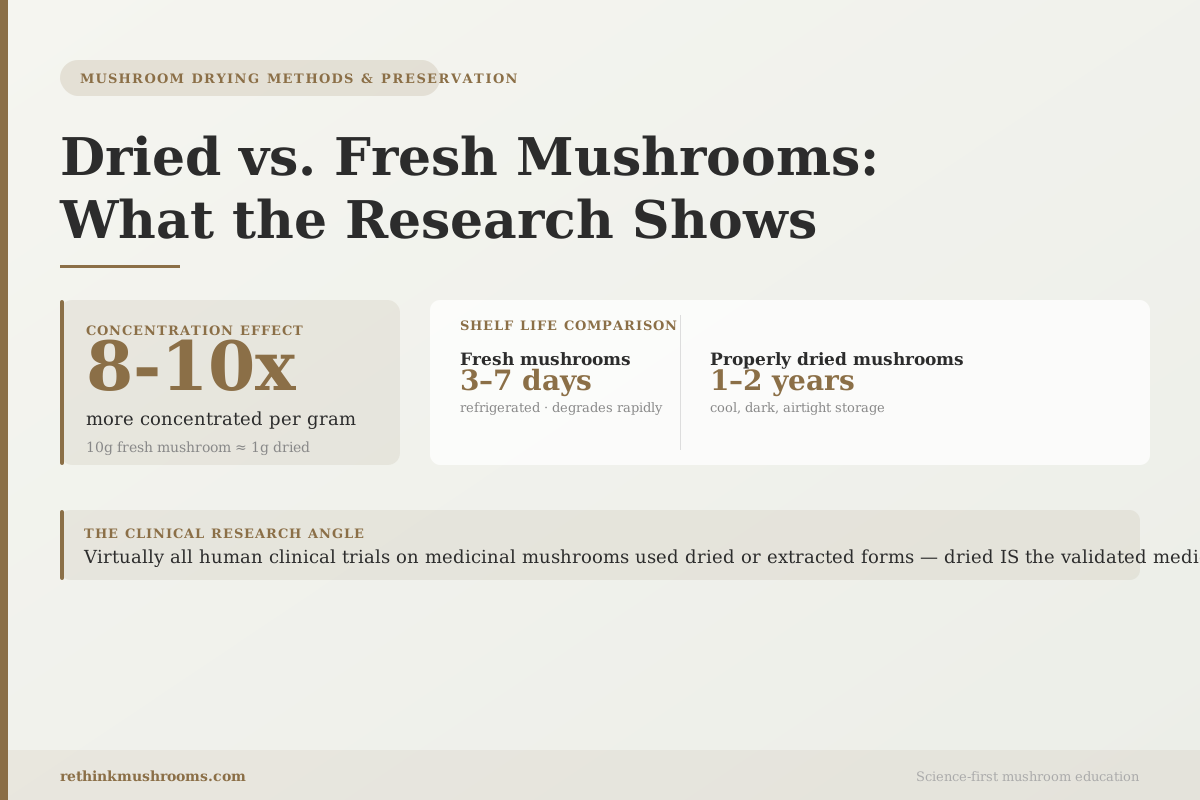
8–10x more concentrated by weight
Drying removes roughly 88-92% of a fresh mushroom's water content, concentrating protein, fiber, beta-glucans, and minerals into a much smaller mass. Virtually all clinical research on medicinal mushrooms uses dried or extracted forms.
Yang et al., Scientific Reports, 2020 / Regula et al., Int J Medicinal Mushrooms, 2016
3–7 days
typical fresh mushroom shelf life refrigerated
1–2 years
dried mushroom shelf life in cool, dark storage
~10g = 1g
approximate fresh-to-dried conversion (10g fresh mushroom yields ~1g dried)
Yang et al., Scientific Reports, 2020 / Regula et al., Int J Medicinal Mushrooms, 2016
 View as image ↗
The question "are dried mushrooms as nutritious as fresh?" has a more interesting answer than most food content provides. Dried mushrooms are not a nutritional compromise; they are the form in which mushroom bioactives are most studied, most concentrated, and most shelf-stable. The relevant questions are not whether dried is inferior, but which drying method was used and whether the nutrients in dried mushrooms are actually absorbed.
This article covers the nutrient concentration data, shelf life, the bioavailability evidence, and what the clinical research record implies about dried versus fresh for medicinal purposes.
For a complete nutritional overview of specific mushroom species, see Mushroom Nutrition Facts: The Complete Species-by-Species Guide.
Key Takeaways
- Drying concentrates mushroom nutrients approximately 8-10x by weight; 100g of dried mushroom corresponds to roughly 800-1000g of fresh
- In vivo research found that protein, iron, and other nutrients from dried oyster mushroom are absorbed and biologically available after consumption (Regula et al., 2016)
- A four-method comparison (hot air, microwave, vacuum, freeze-drying) on Pleurotus eryngii found freeze-drying best preserved nutritional components and microstructure; high-heat methods caused the greatest compound degradation (Yang et al., 2020)
- Fresh mushrooms last 3-7 days refrigerated; properly dried and stored mushrooms maintain quality for 1-2 years
- A 2025 review of chanterelle (Cantharellus cibarius) confirmed that processing method is a primary determinant of which bioactives reach the consumer (Kumar et al., 2025)
- Virtually all human clinical trials on medicinal mushrooms used standardized dried or extracted forms, not fresh, which means dried is the form validated by the evidence base
The Concentration Effect: Why Dried Mushrooms Pack More Per Gram
Fresh mushrooms are mostly water. Depending on species, fresh mushroom water content ranges from 85% to 94% by weight. Drying to a stable state removes the majority of that water, concentrating everything else: protein, polysaccharides, fiber, beta-glucans, minerals, B vitamins, and ergothioneine.
The practical implication: 100 grams of dried mushroom roughly corresponds to 800-1000 grams of fresh mushroom in terms of non-water nutrient content. This is why supplement labels specify doses in grams of dried mushroom equivalent, and why recipe conversions run at approximately 10:1 fresh-to-dried by weight.
This concentration effect applies consistently across nutrients that survive the drying process. Protein content rises from roughly 2-4% in fresh mushrooms to 18-28% in dried forms, depending on species. Dietary fiber, which includes the beta-glucan fraction most studied for immune effects, concentrates proportionally. Minerals including potassium, phosphorus, and selenium similarly increase per gram.
What doesn't necessarily increase proportionally: water-soluble vitamins including some B vitamins and, importantly, vitamin D if the mushrooms weren't UV-exposed before or during drying. Vitamin C, which mushrooms contain in modest amounts, can be partly lost during heat-intensive drying.
The nutrient profile of commercially available dried mushrooms varies considerably by species and growing conditions. A USDA analysis of 10 retail mushroom types documented wide variation in sterol composition and vitamin D content depending on species and sun exposure history, establishing that not all dried mushrooms are nutritionally equivalent even after drying.[5]
Are the Nutrients in Dried Mushrooms Actually Absorbed?
Concentrating nutrients in dried form is only useful if those nutrients remain bioavailable after rehydration and digestion. Regula and colleagues specifically tested this question in an in vivo study of dried oyster mushroom.[1]
The findings: protein, iron, and other nutrients from dried Pleurotus ostreatus were absorbed and biologically available after consumption. The drying process did not eliminate bioavailability for these components. This is significant because critics of dried mushrooms sometimes suggest that drying degrades the food matrix in ways that impair nutrient absorption. The Regula 2016 data from an in vivo model shows that, at least for oyster mushroom, dried form nutrients are absorbed at measurable rates.
Bioavailability data for specific compounds in dried mushrooms is limited to animal models for the most part, with the exception of vitamin D. Human clinical trials have confirmed that vitamin D2 from UV-irradiated dried mushrooms raises serum 25-hydroxyvitamin D levels in deficient adults, which is direct evidence for the bioavailability of one key dried mushroom compound in human physiology.
For beta-glucans, the primary immune-relevant compound class in medicinal mushrooms: beta-glucans are relatively structurally stable during conventional drying and are absorbed from the gut. The evidence base for beta-glucan immune effects is built almost entirely on studies using dried or extracted preparations, which implicitly validates their bioavailability.
The Clinical Research Angle: Why Medicinal Mushroom Studies Use Dried Forms
This point appears nowhere in consumer content, but it changes the framing of the dried-vs-fresh question significantly.
Virtually every peer-reviewed human clinical trial on medicinal mushroom health effects used dried, extracted, or powdered mushroom preparations. Not fresh mushrooms. The immune studies on Turkey Tail's PSK fraction, the Mori 2009 cognitive improvement RCT with Lion's Mane, the Spim 2021 cardiovascular trial with shiitake, the Dai 2015 immune RCT. All used standardized dried or extracted preparations.
This isn't incidental. Dried and extracted preparations are used in research because they allow standardized dosing, reproducibility across trial arms, and consistent compound concentrations. Fresh mushrooms vary too much by lot, growing conditions, and age to serve as a research-grade intervention.
The implication for consumers: when the label on a medicinal mushroom product says the dose was validated in research, that research almost always used dried or extracted material. Fresh mushrooms have not been tested as medicinal interventions. Dried is not just acceptable; it is the validated form.
A 2025 review by Kumar and colleagues on the nutritional and medicinal potential of Cantharellus cibarius (chanterelle) reinforces this principle: processing method choice fundamentally determines which bioactives reach the consumer, and dried preparations have dominated the research evidence base because they allow controlled dosing.[4]
How Drying Method Changes the Outcome
The comparison "dried versus fresh" is incomplete without specifying the drying method, because different methods produce significantly different products.
Yang and colleagues conducted a direct four-method comparison on the same mushroom species (Pleurotus eryngii), testing hot air drying, microwave drying, vacuum drying, and freeze-drying.[2] The results showed meaningful differences across all nutritional and structural parameters. Freeze-drying best preserved nutritional components, free amino acids, and cellular microstructure. Hot air drying at high temperatures caused the greatest degradation of heat-sensitive compounds. Microwave and vacuum drying fell between the two extremes depending on the parameter.
The practical takeaway: "dried mushroom" is not a single category. A freeze-dried shiitake mushroom and a hot-air-dried shiitake mushroom at high temperature are nutritionally different products, even if both are labeled "dried."
A direct comparison of fresh and processed Auricularia auricula (wood ear mushroom) found that processing significantly altered antioxidant capacity, with the specific outcome depending on the processing method used.[6] This mushroom species, commonly sold dried and reconstituted, shows measurable differences between fresh and various processed forms, reinforcing the principle that method specificity matters for honest nutritional comparison.
For a dedicated look at how freeze-drying specifically preserves mushroom bioactives, see How Freeze-Drying Preserves Mushroom Bioactives.
Shelf Life: From Days to Years
Fresh mushrooms have a short window. At typical refrigerator temperatures (2-4°C), most fresh mushroom varieties remain in good condition for 3-7 days. Delicate species like morels and chanterelles are closer to 3 days. More robust species like shiitake and oyster mushrooms may last 5-7 days under optimal conditions.
Beyond the freshness window, fresh mushrooms deteriorate rapidly: they lose moisture, develop off-flavors, and the bioactive compound profile degrades as the mushroom continues metabolic activity post-harvest.
Dried mushrooms extend this window dramatically. Properly dried and stored mushrooms maintain quality for 1-2 years at room temperature, longer under refrigeration or in sealed, oxygen-reduced packaging. The key conditions: low moisture content (below 12% water activity), low light exposure, and moderate temperature. High humidity is the primary enemy of stored dried mushrooms; any moisture uptake can trigger microbial growth.
This shelf life extension has practical consequences for both culinary and medicinal use. A supply of dried medicinal mushrooms doesn't require the same freshness management as fresh produce. Dosing consistency is easier to maintain with a stable product.
What Dried Mushrooms Lose Compared to Fresh
Honest accounting of what drying changes matters for people choosing between forms.
Cooking methods that involve high heat or water contact reduce phenolic content and antioxidant activity in fresh mushrooms through two mechanisms: heat degradation of sensitive compounds and leaching of water-soluble bioactives into cooking liquid. Roncero-Ramos and colleagues found that boiling reduced phenolics and antioxidant activity, while sautéing and grilling better preserved nutritional value in cultivated mushrooms.[3] High-temperature drying produces similar effects; the mushroom never enters water, but sustained heat still degrades some heat-sensitive compounds.
What conventional hot-air drying can reduce:
- Some heat-sensitive B vitamins (particularly B1/thiamine)
- Certain polyphenols and antioxidant compounds at the surface
- Ergothioneine: thermostable up to approximately 100°C but sensitive to acidic conditions; well-preserved in most drying methods
- Aroma compounds (volatile terpenoids): significant losses during drying, which is why dried mushrooms have a more concentrated but different flavor profile than fresh
What conventional drying preserves well:
- Beta-glucans (primary immune polysaccharides): structurally stable and resistant to typical drying temperatures
- Minerals: concentrated rather than lost
- Non-volatile polysaccharides and fiber
- Protein content per gram (concentrated)
The compound that differs most between fresh and dried depending on how the mushroom was handled is vitamin D2, which requires UV-B light exposure to form. Mushrooms grown in the dark contain ergosterol (the precursor) but minimal vitamin D2. Sun-dried or UV-irradiated mushrooms can contain substantial vitamin D2. Conventionally dried mushrooms grown indoors have very little.
For the specific comparison of sun-drying versus machine drying for vitamin D content, see Sun-Dried vs. Machine-Dried Mushrooms: Vitamin D and Nutrient Differences.
The Practical Conversion: Fresh to Dried
The 10:1 conversion ratio is an approximation. More precisely, the ratio varies by species and how thoroughly the mushrooms were dried:
- Shiitake: approximately 7-10:1 (fresh to dried)
- Oyster mushroom: approximately 8-10:1
- Porcini (cep): approximately 8-9:1
- Wood ear: approximately 9-12:1 (wood ear contains more structural polysaccharide and dries to a particularly dense form)
- Morel: approximately 7-9:1
These ratios apply to weight, not volume. Dried mushrooms rehydrate back toward their original volume when soaked, though the reconstituted mushroom is not identical to fresh in texture; the cell wall structure has changed during drying, which affects mouthfeel and cooking behavior.
A practical note from the nutrient perspective: the soaking liquid from dried mushrooms contains water-soluble bioactives that leached out of the mushroom tissue during rehydration. These include water-soluble polysaccharides, free amino acids, B vitamins, and glutamate (which gives the liquid its rich umami flavor). Using this soaking liquid in cooking preserves compounds that would otherwise be discarded. For guidance on how to use dried mushrooms in the kitchen while preserving their nutritional value, see Dried Mushroom Powder in Cooking: How to Add Medicinal Benefits to Meals.
The Bottom Line
Dried mushrooms are 8-10x more concentrated by weight than fresh, with protein, fiber, beta-glucans, and minerals all rising proportionally per gram. In vivo research confirms that nutrients from dried mushroom are biologically absorbed. Drying method matters: freeze-drying best preserves heat-sensitive compounds; high-temperature hot-air drying causes greater degradation. The clearest practical distinction: virtually all clinical research on medicinal mushroom health effects used standardized dried or extracted preparations, making dried form the evidence-backed medicinal standard rather than a compromise.
Frequently Asked Questions
Sources & References
- 1RTHM-00443·Regula, Julita et al. (2016). “Bioavailability and Digestibility of Nutrients from the Dried Oyster Culinary-Medicinal Mushroom, Pleurotus ostreatus (Agaricomycetes): In Vivo Experiments..” International journal of medicinal mushrooms.Study breakdown →PubMed →↩
- 2RTHM-00665·Yang, Rui-Lin et al. (2020). “Physicochemical properties, microstructures, nutritional components, and free amino acids of Pleurotus eryngii as affected by different drying methods..” Scientific reports.Study breakdown →PubMed →↩
- 3RTHM-00488·Roncero-Ramos, Irene et al. (2017). “Effect of different cooking methods on nutritional value and antioxidant activity of cultivated mushrooms..” International journal of food sciences and nutrition.Study breakdown →PubMed →↩
- 4RTHM-00931·Kumar, Ajay et al. (2025). “Nutritional, Nutraceutical, and Medicinal Potential of Cantharellus cibarius Fr.: A Comprehensive Review..” Food science & nutrition.Study breakdown →PubMed →↩
- 5RTHM-00230·Phillips, Katherine M et al. (2011). “Vitamin D and sterol composition of 10 types of mushrooms from retail suppliers in the United States..” Journal of agricultural and food chemistry.Study breakdown →PubMed →↩
- 6RTHM-00158·Kho, Y S et al. (2009). “Antioxidant capacity of fresh and processed fruit bodies and mycelium of Auricularia auricula-judae (Fr.) Quél..” Journal of medicinal food.Study breakdown →PubMed →↩