Mushroom Cooking
Microwave + Grill
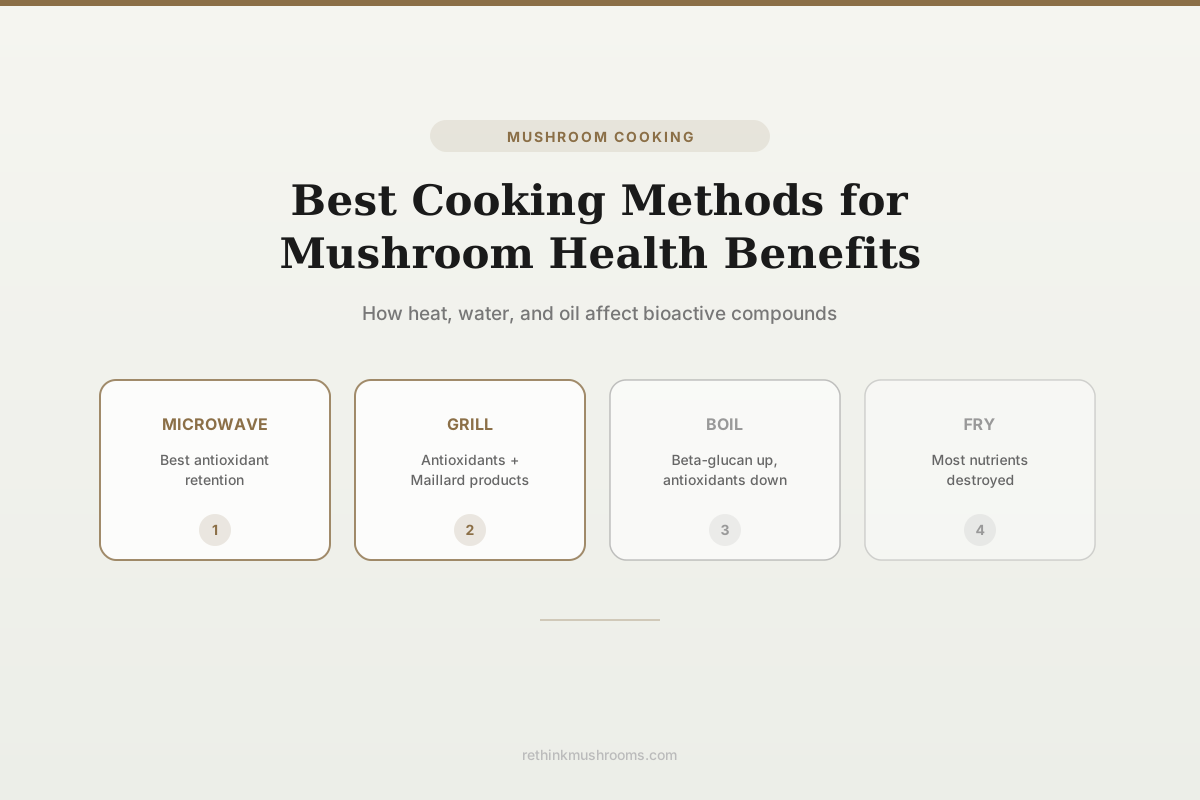
Microwaving and grilling preserved the highest antioxidant activity in mushrooms across four species tested, while boiling and frying caused the largest losses.
Roncero-Ramos et al., International Journal of Food Sciences and Nutrition, 2017
4 methods tested
boiling, microwaving, grilling, deep frying
4 species tested
button, shiitake, oyster, king trumpet
Boiling paradox
increases beta-glucans but destroys antioxidants
Roncero-Ramos et al., International Journal of Food Sciences and Nutrition, 2017
 View as image ↗
The answer to "what is the healthiest way to cook mushrooms" depends on which compounds you care about. Microwaving and grilling preserve the most antioxidant activity. Boiling concentrates beta-glucans and ergosterol. Frying destroys nearly everything except phenolic compounds. No single cooking method maximizes all bioactive compounds simultaneously, because the compounds respond differently to heat, water, and oil.[1]
This matters because mushrooms are not nutritionally interchangeable with other vegetables. Their cell walls are made of chitin, not cellulose, and chitin requires heat to soften enough for human digestive enzymes to access the nutrients locked inside. Eating mushrooms raw means most of their bioactive compounds remain trapped behind an indigestible wall. But cooking introduces its own tradeoffs: some compounds are released by heat while others are degraded by it.
Key Takeaways
- Microwaving and grilling preserved the highest antioxidant activity across Agaricus bisporus, Lentinula edodes, Pleurotus ostreatus, and Pleurotus eryngii (Roncero-Ramos et al., 2017)
- Boiling increased beta-glucan and ergosterol concentrations in button and shiitake mushrooms by removing water-soluble components that dilute these compounds
- Deep frying caused the greatest losses in protein, ash, and carbohydrate content while increasing fat absorption (Roncero-Ramos et al., 2017)
- Ergothioneine shows excellent thermal stability at temperatures below 100 degrees Celsius but degrades when combined with high moisture and extended heating above pasteurization temperatures (Liu et al., 2020)
- Frying protected phenolic compounds that boiling destroyed, creating a direct tradeoff between antioxidant types depending on cooking method
- The total phenolic content of four Boletus species increased significantly after boiling at 100 degrees Celsius for 20 minutes (Sun et al., 2014)
The landmark cooking comparison: Roncero-Ramos et al. 2017
The most comprehensive study comparing household cooking methods on mushroom nutrition tested four methods (boiling, microwaving, grilling, and deep frying) on four commercially important species: white button mushroom (Agaricus bisporus), shiitake (Lentinula edodes), oyster mushroom (Pleurotus ostreatus), and king trumpet (Pleurotus eryngii).[1]
Grilling and microwaving: best for antioxidants
Grilled and microwaved mushrooms retained the highest antioxidant activity across all four species. The improvement was not marginal. Antioxidant capacity values after grilling and microwaving were measurably higher than those after boiling or frying.[1]
For microwaving, the mechanism is straightforward: short cooking times and minimal water contact preserve heat-sensitive antioxidant compounds. Mushrooms cooked in a microwave lose less to leaching because there is no surrounding liquid to extract water-soluble molecules.
For grilling, dry direct heat caramelizes surface compounds and generates Maillard reaction products that themselves have antioxidant properties. The absorbance values at 420 nm (a marker of Maillard browning) increased after grilling, suggesting that some of the measured antioxidant activity came from these newly formed compounds rather than preservation of original ones.[1]
Boiling: a mixed picture
Boiling produced the most paradoxical results. Antioxidant activity dropped, but beta-glucan and ergosterol concentrations actually increased in the remaining mushroom tissue.[1]
The explanation is concentration rather than creation. Hot water extracts water-soluble components from mushroom tissue (sugars, some proteins, water-soluble vitamins, phenolics), reducing total mass while leaving the water-insoluble beta-glucans and lipophilic ergosterol behind in higher proportions. The absolute amount of beta-glucan in the mushroom does not increase; its percentage of remaining dry weight does.
This creates a practical decision. If the goal is beta-glucan intake, boiling mushrooms and eating the solid portion concentrates these compounds. If the goal is total antioxidant intake, the cooking water contains valuable water-soluble antioxidants that boiling extracts. Drinking the broth recovers what the mushroom lost. For more on beta-glucan structure and function, see 1,3/1,6-beta-D-glucan: structure, function, and health effects.
Frying: worst for most bioactives, best for phenolics
Deep frying caused the greatest overall nutritional losses. Protein, ash, and carbohydrate content decreased substantially, while fat content increased as oil was absorbed into the mushroom's sponge-like tissue.[1]
However, frying preserved phenolic compounds better than boiling. The oil matrix appears to protect certain phenolics from the thermal degradation and leaching that occurs in water-based cooking. This creates a direct tradeoff: boiling protects beta-glucans but leaches phenolics, while frying protects phenolics but degrades beta-glucans and introduces excess dietary fat.
The deep penetration of oil into internal mushroom tissues is the key variable. Unlike dry heat methods (oven, grill) that primarily affect the mushroom surface, oil achieves direct contact with bioactive molecules deep within the tissue structure, simultaneously protecting some compounds and degrading others.[1]
Phenolic compounds and Boletus: the species factor
Sun et al. (2014) tested four cooking methods on four wild Boletus mushroom species and found a different pattern than Roncero-Ramos observed in cultivated mushrooms.[2]
Total phenolic content increased after boiling at 100 degrees Celsius for 20 minutes in all four Boletus species. DPPH radical scavenging activity also increased after boiling. This contradicts the pattern seen in button mushrooms and shiitake, where boiling reduced antioxidant capacity.[2]
The likely explanation is that heat releases bound phenolic compounds from Boletus cell wall matrices, making them measurable in assays where they previously were not. Different mushroom species have different cell wall compositions, and the balance between phenolic release and phenolic degradation during cooking varies by species. This means cooking method recommendations from studies on button mushrooms do not necessarily apply to wild Boletus, maitake, or other species with different tissue architectures.
Ergothioneine: the heat-stable exception
Ergothioneine is an unusual amino acid found in high concentrations in mushrooms that functions as a cellular antioxidant and cytoprotectant. Unlike most antioxidant compounds, ergothioneine is remarkably heat-stable under standard cooking conditions.
Liu et al. (2020) confirmed that ergothioneine from culinary-medicinal mushrooms shows excellent thermal stability at temperatures below boiling, maintaining its antioxidant properties through typical cooking processes.[3]
The stability breaks down under industrial processing conditions. Canning procedures involving prolonged high-temperature exposure reduced ergothioneine concentrations, with thermal bleaching causing approximately 33% loss and pasteurization causing up to 59% loss in some mushroom preparations. Standard home cooking (sauteing, grilling, microwaving, short boiling) operates well below these thresholds.
Weigand-Heller et al. (2012) measured ergothioneine bioavailability from cooked Agaricus bisporus in humans and found that plasma ergothioneine levels rose after consumption of cooked mushrooms, confirming that the compound survives both cooking and digestion to reach the bloodstream.[4] This makes ergothioneine one of the few mushroom bioactives with confirmed oral bioavailability from a cooked food source in human subjects. For how ergothioneine relates to other mushroom supplement considerations, see 10:1 extract ratios: what they mean (and what they don't).
Why raw mushrooms are not the answer
The chitin problem makes raw mushrooms a poor choice for nutrient extraction. Chitin, the structural polymer of fungal cell walls, is chemically stable up to approximately 380 degrees Celsius, far beyond any cooking temperature. Heat does not destroy chitin. Instead, cooking softens the chitin matrix through moisture penetration and partial depolymerization, creating gaps that allow digestive enzymes and stomach acid to access nutrients trapped inside the cells.
Humans produce acidic mammalian chitinase (AMCase) in the stomach and saliva, which can hydrolyze chitin under acidic conditions. But the rate of enzymatic chitinolysis is slow relative to gut transit time, meaning that much of the chitin in raw mushrooms passes through the digestive tract intact, taking its cargo of beta-glucans, ergothioneine, and other intracellular compounds with it.
Cooking for at least 10 minutes with moisture (sauteing, boiling, steaming) softens the chitin enough to dramatically improve nutrient accessibility. The combination of heat and moisture is more effective than dry heat alone, which is why brief high-heat grilling may caramelize the surface while leaving interior cells intact.
This creates an important distinction: the goal of cooking mushrooms is not to destroy chitin (which is itself a prebiotic fiber with potential gut health benefits) but to disrupt it enough to release the compounds behind it.
The chitin content varies by species and growth stage. Young button mushrooms have thinner cell walls than mature shiitake or king trumpet mushrooms, which means cooking time requirements differ. Thick-walled species like reishi and chaga require prolonged hot water extraction (typically 1-4 hours of simmering) to release meaningful amounts of beta-glucans, which is why these species are consumed almost exclusively as teas or extracts rather than as culinary mushrooms. The cooking times that work for button mushrooms (10-15 minutes) are insufficient for woody, thick-walled medicinal species.
Oil choice matters for fat-soluble compound absorption
Ergosterol, the precursor to vitamin D2 in mushrooms, is fat-soluble. Cooking mushrooms with a small amount of oil or butter improves absorption of ergosterol and other lipophilic compounds like certain triterpenoids. The Roncero-Ramos study showed that deep frying increased fat content through oil absorption, but even a light saute with minimal oil provides enough lipid to enhance fat-soluble compound bioavailability without the drawbacks of deep frying.[1]
This is why many traditional mushroom preparation methods across East Asian cuisines involve brief stir-frying or sauteing in oil before adding to soups or rice dishes. The oil contact liberates fat-soluble compounds while the subsequent liquid cooking (in broth or sauce) extracts water-soluble ones. The combination captures both classes of bioactive molecules, a more complete nutritional extraction than any single method achieves alone. For how supplement extraction methods compare to cooking, see Raw vs. cooked mushrooms: why heat matters.
Practical summary by cooking method
| Method | Antioxidant activity | Beta-glucans | Phenolics | Ergothioneine | Fat added |
|---|---|---|---|---|---|
| Microwave | Preserved | Preserved | Moderate loss | Stable | None |
| Grill | Preserved + Maillard products | Preserved | Moderate loss | Stable | Minimal |
| Boil | Decreased (leached to broth) | Concentrated in solids | Lost to water | Stable | None |
| Deep fry | Decreased | Decreased | Protected | Stable | High |
| Raw | N/A | Locked in chitin matrix | Locked in chitin matrix | Poorly accessible | None |
The table reflects patterns from Roncero-Ramos et al. (2017) across four cultivated species.[1] Species-specific variations apply. Boletus mushrooms showed increased phenolics after boiling (Sun et al., 2014), a pattern not observed in the cultivated species studied by Roncero-Ramos.[2]
No cooking method maximizes all bioactive compounds simultaneously. The optimal approach depends on which compounds are prioritized and which mushroom species is being prepared. A reasonable default for most culinary mushrooms is a brief saute in oil (5-8 minutes for thin species, 10-15 minutes for thick-fleshed species), which softens chitin, enables fat-soluble compound absorption, avoids the water-soluble nutrient leaching of boiling, and preserves most antioxidant activity. When using mushrooms in soups, consuming the broth recovers the water-soluble compounds that leach from the tissue. For how these cooking effects compare to supplement extraction methods, see Best cooking methods for medicinal mushrooms: how heat affects bioactive compounds. For a deeper dive into what happens to specific bioactive molecules during cooking, see How cooking affects mushroom bioactives: what the research shows. For the microwave research specifically, see Microwaving mushrooms: the surprising best method for nutrient retention.
The Bottom Line
Microwaving and grilling preserve the most antioxidant activity in cooked mushrooms, while boiling concentrates beta-glucans and ergosterol in the remaining tissue at the cost of leaching water-soluble antioxidants into the cooking liquid. Deep frying causes the largest overall bioactive losses while paradoxically protecting phenolic compounds. Ergothioneine is stable through all standard home cooking methods. The species being cooked matters: wild Boletus mushrooms gained phenolic content from boiling, the opposite of what cultivated button mushrooms showed. No single cooking method optimizes all bioactive compounds, and raw consumption is the worst option because chitin cell walls prevent nutrient access.
Frequently Asked Questions
Sources & References
- 1RTHM-00488·Roncero-Ramos, Irene et al. (2017). “Effect of different cooking methods on nutritional value and antioxidant activity of cultivated mushrooms..” International journal of food sciences and nutrition.Study breakdown →PubMed →↩
- 2RTHM-00350·Sun, Liping et al. (2014). “Effect of different cooking methods on total phenolic contents and antioxidant activities of four Boletus mushrooms..” Journal of food science and technology.Study breakdown →PubMed →↩
- 3RTHM-00633·Liu, Xinqi et al. (2020). “A Study on the Antioxidant Properties and Stability of Ergothioneine from Culinary-Medicinal Mushrooms..” International journal of medicinal mushrooms.Study breakdown →PubMed →↩
- 4RTHM-00270·Weigand-Heller, AuBrei J et al. (2012). “The bioavailability of ergothioneine from mushrooms (Agaricus bisporus) and the acute effects on antioxidant capacity and biomarkers of inflammation..” Preventive medicine.Study breakdown →PubMed →↩