Mushroom Nutrition & Cooking
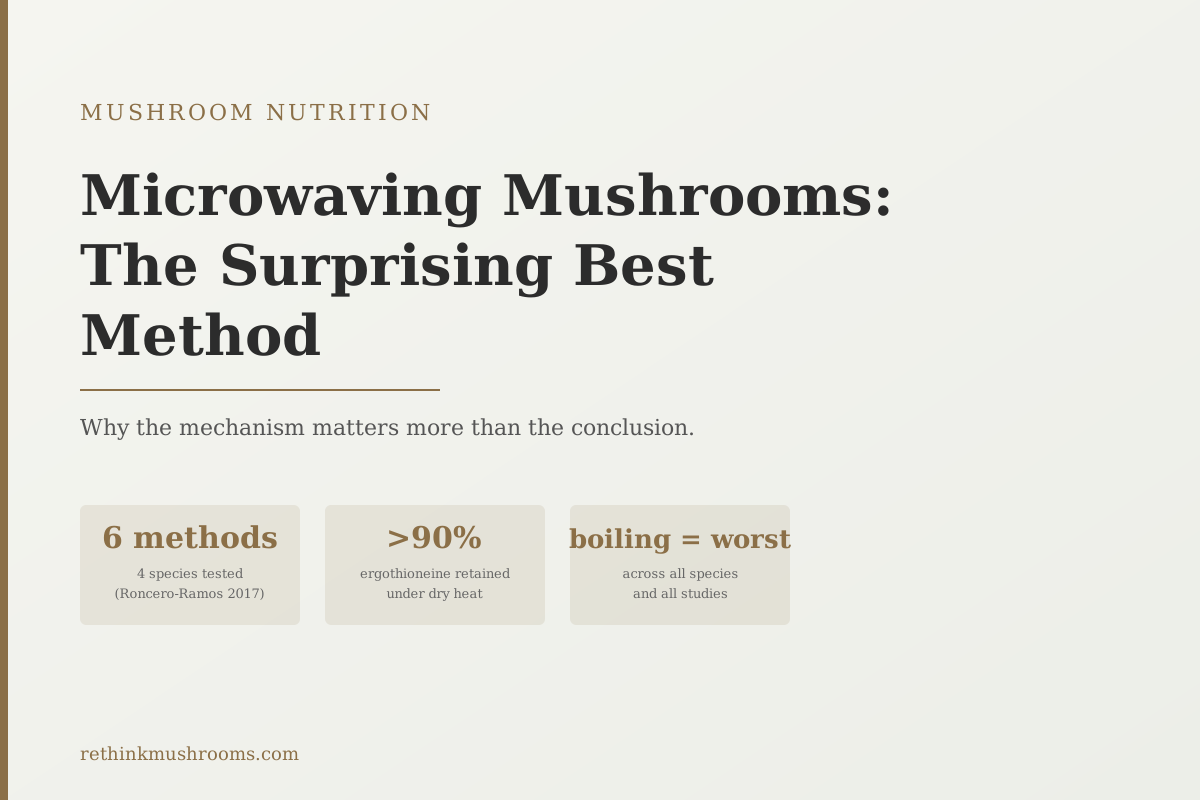
6 cooking methods tested
Across four cultivated mushroom species and six cooking methods, microwaving and grilling were the only methods that increased polyphenol content and antioxidant activity rather than reducing them.
Roncero-Ramos et al., Int J Food Sci Nutr, 2017
>90%
ergothioneine antioxidant activity retained under dry heat; losses in boiling come from water leaching, not heat damage (Liu 2020)
2 genera
independently confirm the microwave advantage: cultivated mushrooms and Boletus species (Roncero-Ramos 2017, Anon 2015)
shiitake caveat
oven baking outperforms microwave for phenolic retention in shiitake specifically (Yao 2023)
Roncero-Ramos et al., Int J Food Sci Nutr, 2017
 View as image ↗
In 2017, food scientists in Spain ran the most complete head-to-head test of mushroom cooking methods ever published. They took four cultivated species, applied six different cooking methods to each, and measured what happened to nutritional value, polyphenol content, and antioxidant activity. Microwaving and grilling were the only methods that left polyphenol content intact and actually increased antioxidant activity. Boiling was the worst method by every measure. Every article that covered the study reported the conclusion. Almost none explained why microwaving works.[1]
That mechanism is the actual useful information for anyone who eats mushrooms regularly and wants to preserve their health compounds. Understanding it also explains why the microwaving advantage doesn't apply equally to every species, a finding from 2023 that has been completely absent from popular coverage.
For how cooking methods fit within the full picture of mushroom nutrition and bioactive content, the pillar guide covers the species-by-species context. This article focuses specifically on microwaving mushrooms nutrient retention: what the research shows, what it doesn't, and what to do differently based on what you're cooking.
Key Takeaways
- Microwaving and grilling were the only cooking methods that produced no significant nutritional losses in a four-species, six-method study; both actually increased polyphenol content and antioxidant activity (Roncero-Ramos et al., 2017)
- Ergothioneine, the mushroom-exclusive antioxidant, is thermally stable and retains over 90% of its activity after steaming or dry heat; boiling losses are caused by water leaching, not heat damage (Liu et al., 2020)
- Dried shiitake mushrooms leach significant polysaccharides, lentinan, and phenolic compounds into soaking and cooking water; consuming the cooking broth recovers bioactives that would otherwise be discarded (Zhu et al., 2019)
- For shiitake specifically, oven baking for 5-10 minutes produced higher total phenolics and flavonoids than microwaving; microwave is not universally the best method (Yao et al., 2023)
- The microwave advantage replicates across a different mushroom genus: four Boletus species showed the same pattern, with microwaving best for phenolic retention and boiling causing the greatest losses (Anon, J Food Sci, 2015)
- When mushroom soup is the goal, slow stewing retains more nutrients in the broth than high-heat boiling; the broth itself becomes the nutrient-dense component (Sun et al., 2019)
The Benchmark Study: Six Methods, Four Species, One Clear Winner
Roncero-Ramos and colleagues published what remains the most-cited study on mushroom cooking methods in 2017.[1] The design was straightforward: take four widely consumed cultivated species (button mushroom, shiitake, oyster mushroom, and king oyster mushroom), apply six cooking methods to each (boiling, microwaving, grilling, deep-frying, sauteing in olive oil, and blanching), and measure what happens.
The four metrics: nutritional value, polyphenol content (the broader category of antioxidant plant compounds), antioxidant activity, and beta-glucan content (the immune-supporting polysaccharides that are mushrooms' most-studied health compound).
The results divided sharply.
Microwaving and grilling: No significant losses in nutritional value. Polyphenol content increased significantly. Antioxidant activity increased significantly.
Boiling: Major losses in nutritional value, polyphenols, and antioxidant activity across all four species. Worst outcome across the board.
Deep-frying and sauteing: Intermediate results depending on the species and metric.
Beta-glucans: Stable across all cooking methods. This finding is important for the large number of people who eat mushrooms specifically for immune support; the primary bioactive compound survives every cooking method tested.
The study's central finding became widely covered: microwave is best. What was not covered is why.
Why Microwave Works: The Mechanism Every Article Skips
Two things determine what happens to bioactive compounds when you cook a mushroom: heat exposure duration and water exposure.
Most of a mushroom's polyphenols are bound to the cell wall matrix rather than floating free in mushroom juice. Breaking those bonds and releasing the polyphenols requires heat. The question is whether you can apply that heat without also leaching the released compounds into surrounding water.
Microwaving delivers intense heat in a short time with no water involved (assuming you don't add liquid). The intensity breaks open cell wall structures and releases bound polyphenols. The short duration and absence of water means those polyphenols stay in the mushroom tissue rather than dissolving into a surrounding liquid that gets discarded.
Boiling does the opposite. Prolonged wet heat is effective at releasing cell wall-bound compounds, but it then gives them nowhere to go except the cooking water. If you pour that water down the drain, the compounds go with it.
Grilling achieves a similar result to microwaving through a different mechanism: direct dry heat with rapid moisture evaporation. The surface heat is intense, cooking time is short, and no water is involved. That combination also increased polyphenol content and antioxidant activity in the Roncero-Ramos data.
The practical takeaway from the mechanism, not just the conclusion: any dry-heat method with short duration should outperform wet heat for polyphenol retention. The microwave advantage is not about the microwave itself; it is about the absence of water and the brevity of heat exposure.
Ergothioneine Is Not Destroyed by Heat: It Dissolves in Your Cooking Water
Ergothioneine is an antioxidant amino acid found almost exclusively in mushrooms among common foods. It has attracted significant research attention for potential cardiovascular and neuroprotective effects. A common question about it is whether cooking destroys it.
The answer, based on Liu and colleagues' 2020 stability study, is that heat alone does not destroy ergothioneine.[2] After steaming or pan-frying, ergothioneine maintained over 90% of its antioxidant activity. It is thermally stable at typical cooking temperatures.
What does reduce ergothioneine is water. Ergothioneine is a water-soluble compound. When you boil mushrooms in water, ergothioneine dissolves into the cooking liquid. If you discard that liquid, you lose the ergothioneine. The compound was not degraded by heat; it was physically moved from the mushroom tissue into the water.
This distinction between heat degradation and leaching has a practical implication: the problem with boiling is not that heat destroys ergothioneine, but that water removes it from the food you eat and puts it into the water you discard. The solution is either to use a cooking method with minimal water (steaming, microwaving, sauteing, grilling) or to consume the cooking liquid.
Zhu and colleagues demonstrated in 2019 that this principle applies strongly to shiitake specifically.[3] Significant quantities of polysaccharides (including the immune-active lentinan), phenolic compounds, and other bioactives leached into the soaking and cooking water of dried shiitake. Mushrooms prepared by soaking or boiling and then discarding the liquid lost a substantial fraction of their bioactive content to the water. Drinking the broth or incorporating the soaking water into soups and sauces recovered those compounds.
The microwave advantage for nutrient retention is partly an ergothioneine advantage: no water means no leaching opportunity.
The Shiitake Exception: When Oven Baking Beats Microwave
The 2017 benchmark study used predominantly Agaricus bisporus (button mushroom) and Pleurotus species (oyster mushrooms). A 2023 study by Yao and colleagues specifically focused on shiitake, and its results introduced an important qualification.[4]
When Yao's team applied different cooking methods to shiitake and measured total phenolics, flavonoids, and other bioactive components, oven baking for 5-10 minutes produced the highest values. Microwaving performed well but did not reach the same peak phenolic levels that short-duration oven baking achieved for this species.
The steaming and air-frying results were notable in the other direction: both methods decreased all four bioactive components measured in shiitake. Boiling, again, caused the greatest losses.
This result does not overturn the general principle that dry heat outperforms wet heat. Oven baking at moderate temperature is also dry heat with relatively short duration, following the same mechanism that makes microwaving effective. What the Yao data shows is that for shiitake specifically, the particular heat intensity and duration that the microwave delivers may not be optimal.
The practical implication is species-specific. For button mushrooms, oyster mushrooms, and king oyster mushrooms, microwave appears to be among the best methods. For shiitake, 5-10 minutes of oven baking may preserve phenolics better. This nuance has not appeared in any popular article about mushroom cooking methods.
The Finding in a Second Genus: Boletus Confirms the Pattern
To be confident that the Roncero-Ramos 2017 finding reflects something real about mushrooms generally rather than a quirk of those four cultivated species, you want to see it replicate in different mushroom types.
A 2015 study in the Journal of Food Science tested cooking methods across four Boletus species (a different genus from the cultivated mushrooms in the benchmark study) and found the same pattern.[5] Microwaving was the best method for retaining total phenolics across all four Boletus species. Boiling produced the highest decrease in phenolic content.
The replication across genera strengthens the case that the microwave advantage is not species-specific and that the mechanism (dry heat preserves, wet heat leaches) applies broadly.
A 2024 study by Li and colleagues added methodological depth: they combined different cooking methods with an in vitro gastrointestinal digestion simulation, measuring not just what nutrients remained in the cooked mushroom but what fraction of those nutrients would actually be absorbed after digestion.[6] This is the most practically relevant kind of measurement, because nutrients that survive cooking but cannot be absorbed provide no health benefit. The digestion-simulation approach showed that bioaccessibility of nutrients changes significantly depending on cooking method, providing the most complete picture of what different cooking approaches actually deliver to the body.
Practical Guide: Time, Power, and What to Do With the Liquid
Based on the research findings, here is what the evidence supports for preserving nutrient content when cooking mushrooms:
For most cultivated species (button, oyster, king oyster): Microwave on full power for 2-3 minutes with no added water. A loose cover prevents splattering without creating steam pressure. Slicing mushrooms before microwaving increases the surface area exposed to heat and may improve the release of bound polyphenols from cell wall structures.
For shiitake: Based on the Yao 2023 data, 5-10 minutes in a preheated oven at moderate temperature outperforms microwave for phenolic retention. Grilling shiitake is also supported by the dry-heat mechanism.
For mushroom soups and broth-based dishes: Sun and colleagues found in 2019 that stewing or slow-cooking retained more nutrients in the broth than high-heat boiling.[7] When the cooking liquid is incorporated into the final dish, as in soups, the leaching concern largely disappears; the nutrients end up in the broth you eat rather than the drain water you discard. In this context, the relevant question shifts from "does boiling leach nutrients?" to "does high heat degrade compounds that have already leached into the broth?" Lower, slower heat answers that concern better than a hard boil.
For dried shiitake specifically: Consume the soaking water. The Zhu 2019 data showed that polysaccharides and lentinan leach into the rehydration liquid in significant quantities. Discarding it means losing a substantial fraction of the shiitake's immune-active compounds.
The method to avoid: Boiling with discarded water is the worst method across all species and all studies. It combines leaching (water-soluble compounds leave the mushroom) with the discarding of those compounds. Every study in this cluster consistently identified boiling as the lowest-performing cooking method for nutrient retention.
For the full picture of how different cooking approaches compare beyond microwaving, see best cooking methods for maximizing mushroom health benefits and best cooking methods for medicinal mushrooms. For how drying mushrooms affects bioactives before you cook them, see dried vs. fresh mushrooms: do drying methods affect health benefits? and rehydrating dried mushrooms: best practices for flavor and nutrition.
For a more complete look at why ergothioneine specifically is worth preserving, see ergothioneine and cardiovascular disease: the mushroom-exclusive antioxidant.
The Bottom Line
Research consistently shows microwaving is among the best methods for preserving mushroom polyphenols and antioxidant activity, primarily because it uses no water and applies heat briefly. Ergothioneine survives heat well but leaches into cooking water, making dry-heat methods or broth consumption the practical solution. The microwave advantage is not universal: shiitake phenolics peak with 5-10 minutes of oven baking rather than microwaving. Boiling with discarded water is consistently the worst method across all studies and species. Beta-glucans survive all cooking methods.
Frequently Asked Questions
Sources & References
- 1. Source details for this reference are not yet available.
- 2. Source details for this reference are not yet available.
- 3. Source details for this reference are not yet available.
- 4. Source details for this reference are not yet available.
- 5. Source details for this reference are not yet available.
- 6. Source details for this reference are not yet available.
- 7. Source details for this reference are not yet available.