Mushroom Nutrition & Cooking
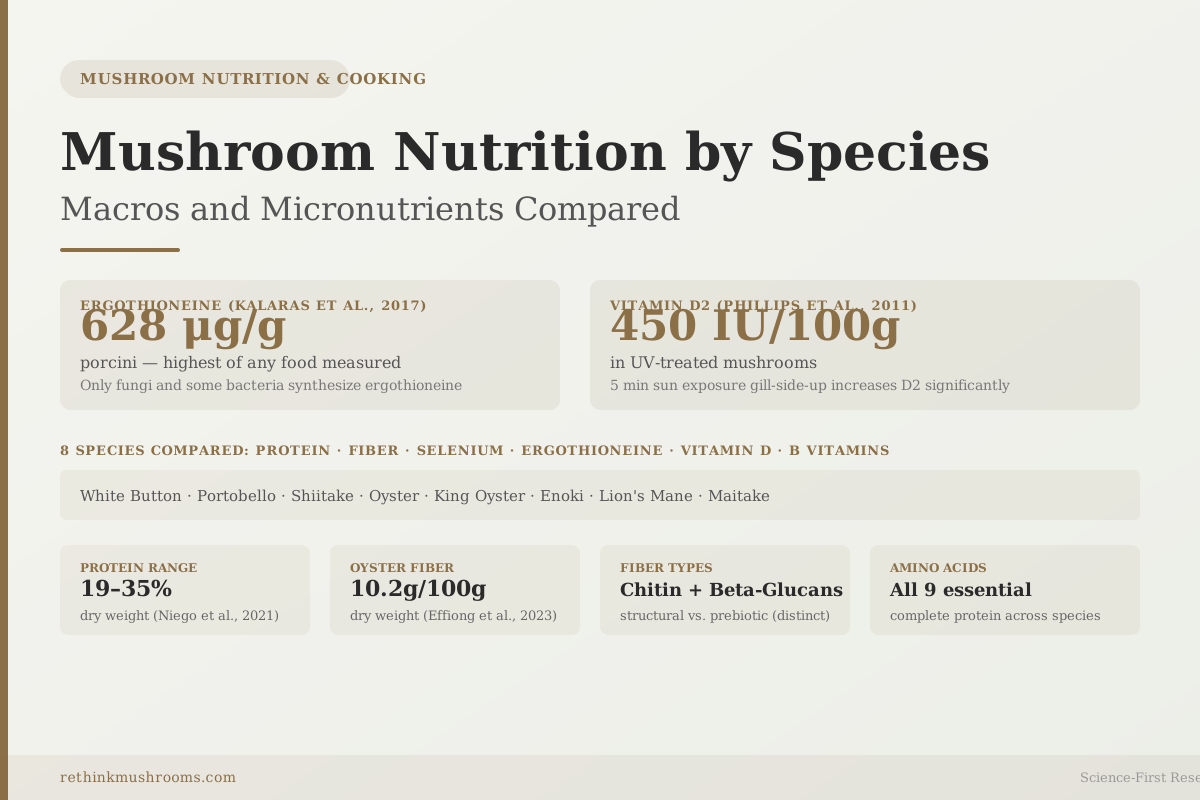
628 μg/g ergothioneine
Porcini mushrooms contain 628 micrograms of ergothioneine per gram — 10 to 100 times more than any other food measured. The compound is made only by fungi and some bacteria.
Kalaras et al., Food Chemistry, 2017
19–35%
protein content by dry weight (Niego et al., 2021)
450 IU/100g
vitamin D2 in UV-treated mushrooms (Phillips et al., 2011)
8 species
compared across 10 nutrients in this breakdown
Kalaras et al., Food Chemistry, 2017
 View as image ↗
Not all mushrooms have the same nutritional profile. Species differ substantially in protein concentration, fiber type, ergothioneine content, and vitamin D potential — sometimes by an order of magnitude. The choice of species matters whether you're eating mushrooms for their culinary qualities or their specific nutritional properties.
This article provides a species-by-species nutritional breakdown of eight commonly eaten mushrooms, drawing on peer-reviewed analytical chemistry studies rather than generic nutrition databases. For the broader context on what makes mushrooms nutritionally distinctive as a food group, see Mushroom Nutrition Facts: The Complete Species-by-Species Guide.
Key Takeaways
- Mushroom protein content is 19–35% by dry weight across species — but fresh mushrooms are ~90% water, so fresh-weight values read much lower; this comparison matters when reading labels
- Oyster mushroom (Pleurotus ostreatus) has a complete essential amino acid profile with 15.1g protein per 100g dry weight and 10.2g dietary fiber per 100g dry weight (Effiong et al., 2023)
- Ergothioneine — a compound made only by fungi and some bacteria — varies dramatically by species; porcini contains 628 μg/g, oyster and shiitake are high, while white button is substantially lower (Kalaras et al., 2017)
- UV-treated or sun-exposed mushrooms can contain up to 450 IU of vitamin D2 per 100g; untreated mushrooms contain very little (Phillips et al., 2011)
- Just 5 minutes of UV exposure gill-side-up substantially increases vitamin D2 in shiitake and oyster mushrooms (Hu et al., 2020)
- Mushroom fiber contains two distinct types: chitin (structural, non-fermentable) and beta-glucans (prebiotic, immune-active) — they have different effects in the gut
Why Species Choice Changes the Nutritional Picture
A white button mushroom and a maitake mushroom weigh the same but are not nutritionally equivalent. They differ in how much protein they contain per gram, what amino acids make up that protein, how much ergothioneine is present, and what their vitamin D potential is with or without UV exposure.
These differences are not minor. A 2021 review by Niego and colleagues in the Journal of Fungi found protein content ranging from 19% to 35% of dry weight across edible macrofungi species — a nearly twofold variation within the same food category.[2] Ergothioneine content, documented in 13 species by Kalaras and colleagues, varies by a factor of more than 200 between species.[4]
One critical note before the data: most published nutritional analyses of mushrooms use dry weight (DW) measurements, which remove the ~88–92% water content of fresh mushrooms. This is standard practice for accurate comparison between samples. To convert to fresh weight, divide dry weight values by roughly 10. A mushroom reported at 25g protein per 100g DW has approximately 2.5g protein per 100g fresh.
The Comparison Table: 8 Species, Key Nutrients
Data compiled from Gopal et al. (2022), Niego et al. (2021), Effiong et al. (2023), Kalaras et al. (2017), and Phillips et al. (2011). DW = dry weight. Fresh Wt = per 100g fresh mushroom (approximate). Vitamin D shown for untreated samples; UV-treated values addressed separately.[1][2][3][4][5]
| Species | Protein (DW) | Fiber (DW) | Ergothioneine | Vitamin D (untreated) | Notes |
|---|---|---|---|---|---|
| White button (A. bisporus) | 22–28g/100g | 8–10g/100g | Low | Low | Most studied; low ergothioneine vs. wild species |
| Portobello (A. bisporus mature) | 22–28g/100g | 8–10g/100g | Low–moderate | Low–moderate | Same species as button, more developed flavor |
| Shiitake (L. edodes) | 19–23g/100g | 8–12g/100g | High | Moderate when UV-treated | High ergothioneine; lentinan beta-glucan content |
| Oyster (P. ostreatus) | ~15g/100g | ~10g/100g | High | Moderate when UV-treated | Complete EAA profile confirmed; versatile nutrition |
| King oyster (P. eryngii) | 20–25g/100g | 10–14g/100g | Moderate–high | Moderate | High fiber; good protein quality |
| Enoki (F. velutipes) | 18–22g/100g | 7–9g/100g | Moderate | Low | Lower ergothioneine than oyster/shiitake |
| Lion's mane (H. erinaceus) | 22–28g/100g | 8–12g/100g | Moderate | Low | Distinct neuroactive compounds (hericenones, erinacines) |
| Maitake (G. frondosa) | 20–26g/100g | 10–15g/100g | Moderate–high | Low | Notably high beta-glucan fraction (D-fraction studied) |
Porcini (B. edulis), though not in the table above because it is rarely cultivated commercially, holds the ergothioneine record at 628 μg/g — included in the ergothioneine section below.
Protein: The Dry-Weight Confusion That Misled a Generation of Consumers
The statement "mushrooms are about 3% protein" became common in nutrition writing because it's true for fresh mushrooms. But it's misleading as a comparison point against other foods, most of which are measured in the same fresh-weight way.
The comparison that matters is dry-to-dry or calorie-to-calorie. On a dry weight basis, edible mushrooms range from 19% to 35% protein — above rice (8%), comparable to some legumes, and in a range that makes them one of the higher-protein plant-adjacent foods per dry gram.[2]
More important than quantity is quality. Mushroom protein contains all nine essential amino acids. Oyster mushroom (Pleurotus ostreatus) specifically has been analyzed for its complete essential amino acid profile, with Effiong and colleagues in a 2023 Frontiers in Nutrition study confirming 15.1g protein per 100g dry weight with a full essential amino acid complement.[3] The protein digestibility-corrected amino acid score (PDCAAS) — the standard measure of protein quality — approaches beef for some species, according to Niego et al.'s comprehensive review.
Practical implication: 100g of fresh oyster mushroom provides roughly 1.5–2g of high-quality complete protein with fewer than 40 calories. Per calorie, that's a better protein density than most non-animal foods.
Vitamin D: Up to 450 IU per 100g — But Only with Light Exposure
Mushrooms are the only non-animal food that naturally contains vitamin D. They accomplish this through the same mechanism human skin uses: ultraviolet light converts a precursor molecule into the active vitamin.
In mushrooms, the precursor is ergosterol. UV exposure converts ergosterol to ergocalciferol — vitamin D2. The key variable is light exposure: mushrooms grown entirely indoors with no UV exposure contain very little vitamin D2, regardless of species. The same mushrooms exposed to UV light can reach 450 IU or more per 100g fresh weight.
Phillips and colleagues analyzed vitamin D2 and ergosterol in 10 commercial mushroom species from US retail suppliers.[5] Sun-exposed or UV-treated samples had dramatically higher D2 than indoor-grown equivalents. The highest values reached 450 IU/100g in UV-treated samples across multiple species.
Hu and colleagues demonstrated the practical version of this in a 2020 ACS Omega study.[6] Just 5 minutes of UV irradiation converted sufficient ergosterol to provide a significant dose of vitamin D2 in both shiitake and oyster mushroom powders. The gill side of the mushroom — the inner surface — has higher ergosterol concentration and produces more D2 when exposed to sunlight.
Practical implication: placing fresh mushrooms gill-side-up on a windowsill or outside for 15–30 minutes before cooking substantially increases their vitamin D2 content. This effect is maintained after cooking because vitamin D compounds are heat-stable. No other food can be self-enriched in this way before preparation.
Species comparison for vitamin D potential: Species with higher natural ergosterol content have greater D2 conversion capacity. Among commercially available species, shiitake and oyster mushrooms show high D2 production after UV treatment. Portobello mushrooms — being the mature form of white button — also convert efficiently. Enoki, grown primarily in the dark, starts with lower ergosterol.
Ergothioneine: The Compound Only Fungi Make
No plant produces ergothioneine. No animal synthesizes it. The primary dietary source for humans, by a wide margin, is mushrooms.
Kalaras and colleagues measured ergothioneine in 13 mushroom species in a 2017 Food Chemistry study.[4] The range was striking:
- Porcini (B. edulis): 628 μg/g — highest of all species measured
- Oyster mushroom: among the highest of commercially available species
- Shiitake: also among the highest of widely sold species
- White button (A. bisporus): substantially lower than wild and gourmet species
The species hierarchy matters for anyone specifically seeking ergothioneine in their diet. Choosing oyster or shiitake over white button may deliver several times more ergothioneine per serving.
Ergothioneine's significance is underscored by a biological detail: humans have a dedicated transport protein for it. The OCTN1 transporter actively pulls ergothioneine from the blood and delivers it to tissues — especially the liver, kidneys, bone marrow, and mitochondria in high-oxidative-stress tissues. No other antioxidant has this transporter. Its existence implies that ergothioneine was abundant enough in the ancestral diet to warrant dedicated uptake machinery.
The mushroom-ergothioneine story extends into population-scale health data. A 2021 NHANES analysis found that mushroom consumers had lower odds of depression, with ergothioneine content proposed as one mechanism. A 2022 NHANES study found mushroom consumers scored higher on cognitive tests. These associations are observational — they cannot prove causation — but the biological plausibility is supported by ergothioneine's documented neuroprotective properties in preclinical work.
For a deep dive on ergothioneine's mechanisms and full evidence base, see Ergothioneine: The Most Selective Antioxidant in Your Body.
Fiber: Two Types, Two Different Jobs
Mushrooms contain dietary fiber, but the fiber is not homogeneous. Two types are present with distinct physiological effects, and conflating them produces incorrect claims about mushroom fiber's role in the gut.
Chitin is the structural fiber in mushroom cell walls. It is the same material in insect exoskeletons. Human gut bacteria cannot ferment chitin efficiently — it passes through largely intact, contributing bulk but not the prebiotic effects associated with fermentable fiber.
Beta-glucans are a separate fiber component with well-documented prebiotic and immune-modulating properties. They are fermented by gut bacteria, producing short-chain fatty acids and stimulating immune cell activity. The immune effects of medicinal mushroom beta-glucans have been studied extensively, particularly the beta-1,3/1,6-glucans found in maitake, shiitake, and oyster mushrooms.
Effiong and colleagues found total dietary fiber of 10.2g per 100g dry weight in oyster mushrooms.[3] King oyster (P. eryngii) and maitake (G. frondosa) are among the highest-fiber species in the table, with fiber ranging from 10–15g per 100g dry weight.
The practical fiber contribution from fresh mushrooms is smaller — roughly 1–2g per 100g fresh — but the beta-glucan fraction retains its prebiotic and immune properties regardless of fresh vs. dried form, as long as cooking does not completely denature the polysaccharide structure.
For detail on how mushroom beta-glucan fiber differs from other prebiotic sources, see How Mushroom Fiber Differs from Other Prebiotic Sources. For the broader evidence on beta-glucans and immunity, see What Are Beta-Glucans? The Most Important Compound in Medicinal Mushrooms.
Other Key Micronutrients: Selenium, Copper, B Vitamins, Potassium
Selenium. Mushrooms are a reliable selenium source. Oyster mushroom specifically was documented with high selenium content by Effiong and colleagues.[3] Shiitake, white button, and oyster mushrooms consistently rank among higher selenium sources in the vegetable-adjacent food category. Selenium is a trace mineral required for thyroid hormone synthesis, DNA repair, and antioxidant enzyme function.
B vitamins. Riboflavin (B2), niacin (B3), and pantothenic acid (B5) are consistently present across mushroom species and represent one of the category's strongest micronutrient contributions. The B vitamin content is largely retained after cooking. Gopal and colleagues' 2022 review of Asian mushroom species confirmed high B vitamin density across shiitake, oyster, lion's mane, and enoki.[1]
Copper. Often overlooked, mushrooms are a good source of copper — a trace mineral involved in iron metabolism, collagen synthesis, and neurotransmitter production. Copper deficiency is not rare in developed countries, and mushrooms are one of the better non-liver dietary sources.
Potassium. Multiple species contribute meaningful potassium — particularly oyster mushroom, which Effiong and colleagues confirmed as high in potassium per dry weight. Potassium supports cardiovascular function and blood pressure regulation.
How Fresh, Cooked, and Dried Mushrooms Differ Nutritionally
The same mushroom presents different numbers depending on its preparation state. This is worth understanding before interpreting any nutritional label.
Fresh mushrooms are approximately 88–92% water. Nutritional values per 100g fresh weight reflect mostly water weight. The numbers appear low but the nutrient density per calorie is actually high, because calories are also low.
Cooked mushrooms have less water. Sautéing reduces volume by roughly 50–70%, concentrating nutrients per gram. A cup of raw mushrooms becomes roughly a third of a cup cooked. The nutrient contribution per serving is higher after cooking, not lower — you're likely to eat more mushrooms when they're cooked simply due to volume reduction.
Dried mushrooms have lost nearly all moisture. Dry weight nutrient values (DW) apply here. Dried shiitake, for example, deliver protein, B vitamins, and selenium in a highly concentrated form per gram.
Vitamin D is worth a specific note: the ergosterol-to-D2 conversion occurs before cooking, when UV exposure happens. Once converted, vitamin D2 is heat-stable and survives normal cooking temperatures.
Water-soluble vitamins (B2, B3, B5) leach into cooking liquid. Boiling and discarding the water reduces B vitamin retention. Sautéing or roasting retains more B vitamins than boiling.
The Bottom Line
Mushroom nutritional profiles vary substantially by species. Protein ranges from 19–35% of dry weight, with all species providing complete essential amino acids. Ergothioneine — synthesized only by fungi and some bacteria — is highest in porcini (628 μg/g) and significantly higher in oyster and shiitake than in white button. Vitamin D2 content in any species can be dramatically increased by 5–30 minutes of UV or sunlight exposure before cooking. Fiber includes both non-fermentable chitin and prebiotic beta-glucans, which are physiologically distinct.
Frequently Asked Questions
Sources & References
- 1. Source details for this reference are not yet available.
- 2. Source details for this reference are not yet available.
- 3. Source details for this reference are not yet available.
- 4. Source details for this reference are not yet available.
- 5. Source details for this reference are not yet available.
- 6. Source details for this reference are not yet available.