Mushroom Nutrition & Cooking
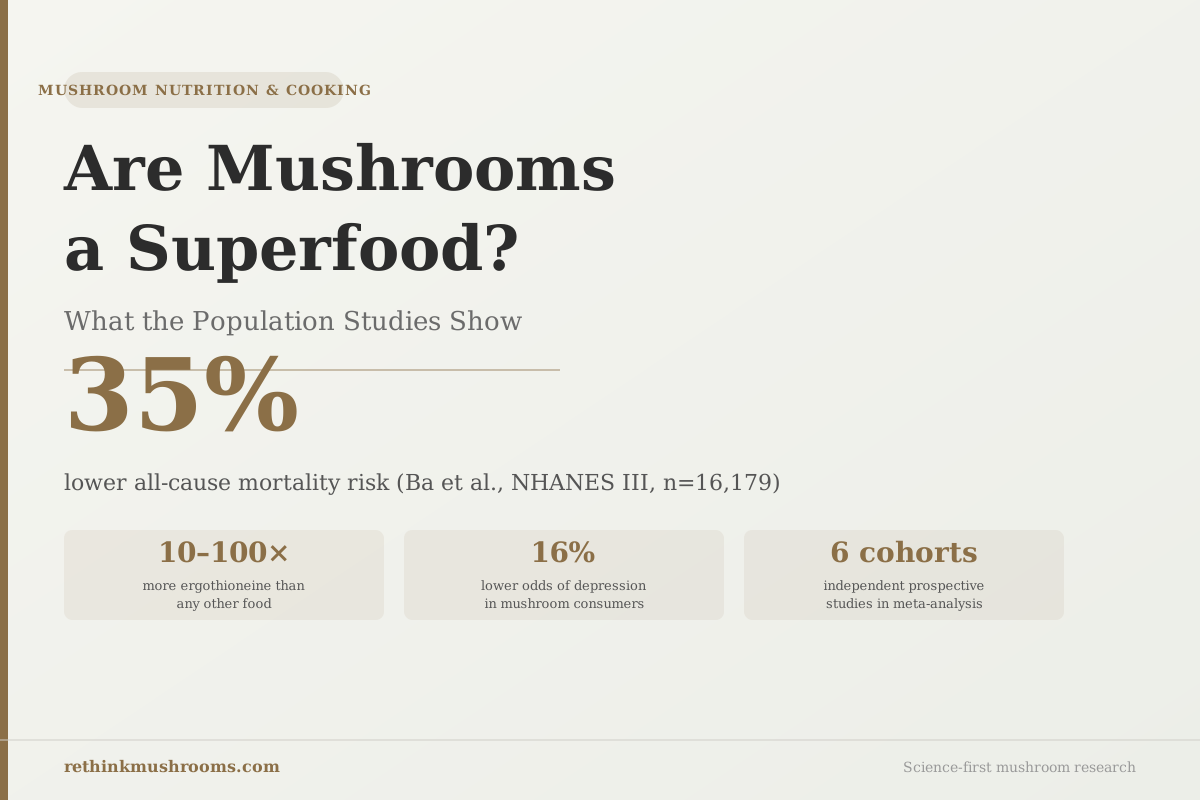
35% lower mortality risk
Replacing one daily serving of processed or red meat with mushrooms reduced all-cause mortality risk by 35% in a prospective cohort of 16,179 Americans followed for a median of 19.3 years.
Ba et al., Nutrition Journal, 2021
10–100×
more ergothioneine in mushrooms than in any other commonly eaten food
16%
lower odds of depression among mushroom consumers across 24,699 Americans
6 studies
independent prospective cohorts pooled in the mortality meta-analysis
Ba et al., Nutrition Journal, 2021
 View as image ↗
No plant makes ergothioneine. No animal does either. The compound is synthesized only by fungi and a small number of soil bacteria, and mushrooms contain it at concentrations 10 to 100 times higher than any other food humans regularly eat.[4]
The question of whether mushrooms are a superfood usually gets answered by listing vitamins they contain. A more honest test is population data: when people eat mushrooms regularly, do measurable health outcomes improve? Three large prospective cohorts say yes. In the most comprehensive, Ba and colleagues tracked 16,179 Americans for a median of 19.3 years and found that replacing one daily serving of processed or red meat with mushrooms reduced all-cause mortality risk by 35%.[1]
That kind of evidence is rare for a single food. This article looks at what drives it, and where the limits of the evidence lie.
For species-by-species nutritional data across all key nutrients, see the complete mushroom nutrition guide.
Key Takeaways
- Replacing one daily serving of processed meat with mushrooms reduced all-cause mortality risk by 35% in Ba et al.'s 19-year follow-up of 16,179 Americans (NHANES III)
- A meta-analysis pooling 6 independent prospective studies found each additional 10g per day of mushrooms associated with a 6% lower all-cause mortality risk (pooled RR 0.94)
- Mushrooms contain ergothioneine at 10 to 100 times the concentration of any other commonly eaten food, a compound no plant can synthesize (Kalaras et al., Food Chemistry, 2017)
- Eating white button mushrooms acutely raised plasma ergothioneine and reduced two blood markers of inflammation within hours in 10 healthy volunteers (Weigand-Heller et al., 2012)
- Among 24,699 Americans in NHANES 2005–2016, mushroom consumers had 16% lower odds of depression versus non-consumers
- Mushrooms are fungi, not vegetables; they produce vitamin D2 from UV light the same way human skin produces vitamin D3 from sunlight, a capability no vegetable has
Fungi, Not Vegetables: Why the Kingdom Difference Changes the Nutritional Story
Mushrooms belong to the kingdom Fungi. They split from animals roughly 1 billion years ago and from plants even earlier. That biological separation is not just taxonomy. It means mushrooms evolved a completely different set of biochemical pathways, and those pathways produce compounds no plant can make.
Plants build vitamin C, beta-carotene, folate, and a broad array of flavonoid antioxidants. Mushrooms produce essentially none of those in meaningful amounts. What they produce is a different list entirely.
Ergothioneine. This sulfur-containing amino acid derivative is synthesized only in the fungal kingdom and by a small number of soil bacteria. No plant makes it. No plant-based food contains it at any detectable level. Mushrooms are its only meaningful dietary source for the vast majority of humans. The significance of this becomes clear when you discover that humans have a dedicated protein transporter for ergothioneine. The body evolved specific machinery to absorb this compound from food.
Vitamin D2. Human skin contains a compound called 7-dehydrocholesterol. UV light from the sun converts it to vitamin D3. Mushroom cell walls contain a related compound called ergosterol. UV light converts ergosterol to vitamin D2 by the same photochemical reaction. This means a mushroom left gills-up in direct sunlight for 15 minutes will substantially increase its vitamin D content before cooking. No vegetable does this. The vitamin D capacity of mushrooms is unique in the entire plant-and-fungi food supply.
Beta-glucans. The fiber in mushrooms includes specific molecules called beta-glucans that bind directly to immune receptors on cells lining the gut. One of the key receptors, called Dectin-1, recognizes the beta-glucan structure and triggers immune signaling. Plant fiber feeds gut bacteria through fermentation, but mushroom beta-glucans interact with the immune system through a distinct pathway that plant fiber doesn't activate.
Chitin and B vitamins. Mushroom cell walls are made of chitin (the same structural compound found in crustacean shells) rather than the cellulose found in plant cell walls. Mushrooms are also high in riboflavin (B2), niacin (B3), and pantothenic acid (B5) at concentrations that are more typical of animal foods than vegetables. They also contain meaningful amounts of selenium, copper, and potassium.
The comparison to vegetables is genuinely apples and oranges. Mushrooms don't replace what vegetables provide, and vegetables don't replace what mushrooms provide. The practical question is whether the compounds unique to mushrooms, ergothioneine especially, produce measurable outcomes in people who eat them regularly.
For a complete breakdown of specific macros and micronutrients by mushroom species, see the complete nutritional breakdown by species.
The Mortality Findings: What Three Independent Cohorts Found
The most compelling case for mushrooms as a superfood comes not from nutrient tables but from tracking real people over decades and measuring who lives longer.
NHANES III prospective cohort (Ba et al., 2021). Ba and colleagues followed 16,179 adult Americans for a median of 19.3 years using data from the National Health and Nutrition Examination Survey's third cohort. Compared to people who ate no mushrooms, regular mushroom consumers had significantly lower all-cause mortality. The substitution analysis was the headline result: replacing one daily serving of processed or red meat with mushrooms reduced the risk of dying from any cause by 35%.[1]
This is nearly 20 years of actual mortality tracking across a nationally representative US sample. The effect size is large.
NHANES meta-analysis (Ba et al., 2021). The same research group then combined this finding with five other independent prospective studies in a quantitative meta-analysis. The pooled result: each additional 10 grams of mushrooms consumed per day was associated with a 6% reduction in all-cause mortality risk, expressed as a relative risk of 0.94 per 10g/day increment.[2] Cardiovascular mortality and cancer mortality were also reduced in the pooled analysis. Six independent studies, different populations, different follow-up periods, consistent direction.
Korean Genome and Epidemiology Study cohort (Jung et al., 2023). Jung and colleagues used the KoGES cohort to independently replicate the mortality association in a non-American population. Higher mushroom intake was significantly associated with lower all-cause mortality, with particularly strong effects for cardiovascular disease mortality.[3] The Korean and American diets are substantially different. The mushroom species most commonly eaten in each country differ. The confounding variables are different. The fact that the association holds in both populations makes a confounding explanation harder to sustain as the complete story.
Three prospective cohorts. Two countries. Six studies in the meta-analysis. The direction is consistent across all of them.
How Mushrooms Compare to Vegetables: A Category-by-Category Look
The most useful comparison between mushrooms and vegetables is honest about what each provides and what each cannot.
| Nutrient or Feature | Mushrooms | Most Vegetables |
|---|---|---|
| Ergothioneine | 10–100× more than any other food [4] | None |
| Vitamin D (via UV exposure) | Yes (ergosterol converts to D2) | No |
| Beta-glucans (immune-activating fiber) | High | Absent or minimal |
| Vitamin C | Very low | High (broccoli, peppers, leafy greens) |
| Beta-carotene | Trace | High (carrots, dark greens, sweet potato) |
| Folate | Low to moderate | High (leafy greens, legumes) |
| B vitamins (B2, B3, B5) | Moderate to high | Low |
| Selenium | Moderate to high (species-dependent) | Low |
| Mortality cohort association | 3 independent cohorts [1][2][3] | Limited prospective cohort data |
The pattern: mushrooms and vegetables have genuinely different strengths. Mushrooms win on ergothioneine (absent from all plants), specific B vitamins associated with animal foods, selenium, and the vitamin D conversion capacity. Vegetables win on vitamin C, carotenoids, and folate.
The gap that matters most, given the research, is ergothioneine. No vegetable contains it. No amount of vegetables replaces the ergothioneine that comes from eating mushrooms. And given that humans have a dedicated transport protein to absorb it, the absence of ergothioneine in plant-heavy diets is a genuine nutritional distinction, not just a rounding error.
For a detailed analysis of protein, fiber, and specific micronutrients in mushrooms, see the comprehensive breakdown article.
The mortality data adds a dimension that nutrient tables alone miss. The NHANES III substitution analysis measured outcomes, not individual nutrients. The 35% mortality risk reduction reflects the net effect of everything mushrooms provide: all the ergothioneine, all the beta-glucans, all the B vitamins, and likely compounds that haven't been fully characterized yet. That kind of net-effect signal is hard to replicate by sourcing equivalent individual nutrients from other foods, because mushrooms contain things that simply aren't in other foods.
The practical picture from the evidence: mushrooms complement vegetables rather than compete with them. The mortality benefit appears strongest when mushrooms replace processed or red meat, not when they replace vegetables. Eating both is consistently the best-supported pattern.
Ergothioneine: The Compound Only Fungi Make, and Why the Body Prioritizes It
In 2017, Kalaras and colleagues at Penn State measured ergothioneine and glutathione levels in 13 mushroom species. The results were striking: porcini (king bolete) contained 628 micrograms of ergothioneine per gram of fresh weight, the highest of any tested species. Oyster and shiitake were also substantially high. Even white button mushrooms, the lowest-scoring of the common edible species, contained ergothioneine at concentrations 10 to 100 times higher than any other regularly consumed food.[4]
The next question: does eating mushrooms actually get ergothioneine into the body in useful form?
Weigand-Heller and colleagues answered that directly in 2012. They gave 10 healthy volunteers white button mushrooms and measured what happened in their blood. Plasma ergothioneine increased. Total antioxidant capacity increased. Two standard blood markers of inflammation, C-reactive protein and interleukin-6, decreased acutely after mushroom consumption.[5] The ergothioneine in mushrooms wasn't destroyed by cooking or digestion. It was absorbed, reached the bloodstream, and produced measurable anti-inflammatory effects within hours.
Why the body absorbs ergothioneine so efficiently is itself informative. A dedicated protein transporter called OCTN1 actively moves ergothioneine from the gut into circulation and then from circulation into target tissues. Transporters don't evolve for no reason. They're metabolically expensive structures the body maintains only when consistent delivery of the transported compound provides enough evolutionary benefit to justify the cost. The existence of OCTN1 is strong evidence that the body has relied on ergothioneine from the diet for a very long time.
Ergothioneine accumulates specifically in tissues under the highest oxidative stress: the liver, bone marrow, kidneys, and the lens of the eye. The working hypothesis is that it functions as a targeted antioxidant, concentrating where reactive oxygen species do the most damage and neutralizing them before they cause lasting injury to cells and DNA.
Lam-Sidun and colleagues reviewed the cardiometabolic evidence in 2021. In animal and cell studies, ergothioneine reduced oxidative stress in cardiovascular tissue, improved markers of insulin sensitivity, and reduced inflammatory signaling.[8] These are preclinical findings, not human clinical trials. But they offer a biologically plausible pathway for why the NHANES mortality data shows particularly strong protective effects for cardiovascular disease specifically.
For the full evidence on ergothioneine's role in the body, see ergothioneine: the most selective antioxidant in your body.
Depression and Cognition: Two NHANES Analyses That Go Beyond Mortality
Ba and colleagues returned to NHANES data for two additional analyses that extended the picture from mortality into mental and cognitive health.
Depression. Using NHANES 2005 to 2016, they examined 24,699 adults and compared mushroom consumers to non-consumers on the Patient Health Questionnaire, a standardized depression screening tool. Mushroom consumers had 16% lower odds of scoring positive for depression. The association was strongest among adults aged 20 to 39, and it remained after adjusting for age, sex, income, physical activity, and other dietary factors.[7] The proposed mechanism was ergothioneine, which accumulates in neural tissue and may reduce oxidative damage to neurons that contributes to depressive symptoms.
Cognitive performance. Using NHANES 2011 to 2014, a separate analysis found that older adults who consumed mushrooms performed better on standardized tests of cognitive function. The association held after adjusting for age, education, income, physical activity, and prevalent chronic disease, the standard set of confounders for cognitive studies.[6]
Both analyses come from the same research group. Independent replication of these specific findings, from a group unconnected to Ba and colleagues, is limited compared to the mortality data. And both are observational: mushroom consumers may differ from non-consumers in ways that statistical adjustments don't fully capture. These findings deserve honest treatment as preliminary evidence pointing in a consistent direction, not as established facts.
Taken alongside the mortality data from multiple independent cohorts, though, the pattern is consistent enough to be worth noting: across multiple NHANES analyses and independent prospective cohort studies in two countries, people who eat mushrooms regularly tend to live longer, report less depression, and perform better cognitively. Whether mushrooms drive those differences or partly reflect broader health-conscious patterns is the unanswered question.
For the full evidence on mushrooms and brain health, see mushrooms and cognitive aging: can they protect your brain.
The Superfood Question: What the Cohort Data Can and Cannot Prove
All three mortality studies are observational. This needs to be said plainly before drawing any conclusions.
Observational cohorts track what people choose to eat and what happens to their health. They can't assign people randomly to eat or avoid mushrooms for two decades. That means confounding. The possibility that mushroom eaters differ from non-eaters in other health-relevant ways can't be eliminated, even with careful statistical adjustment.
The Ba 2021 NHANES III study adjusted for age, sex, smoking, income, physical activity, total caloric intake, and several other dietary variables. The Jung 2023 Korean cohort used a different population with different dietary baselines. Both found the same direction of effect. A pure confounding explanation requires that mushroom consumers in both the US and Korea share some unmeasured characteristic that explains their lower mortality, and that this characteristic wasn't captured by the broad set of adjustments both studies used. That's possible, but it becomes less plausible as independent replications accumulate.
What the data can say: across multiple independent prospective cohorts, people who eat more mushrooms have lower rates of death from all causes, lower rates of depression, and better cognitive test scores. The consistency across different populations, different study designs, and different dietary contexts is the strongest feature of this evidence.
What the data cannot say: eating mushrooms will extend your life. No randomized controlled trial of long-term mushroom consumption on mortality exists. The biology offers plausible mechanisms: ergothioneine's antioxidant effects in cardiovascular tissue, beta-glucan immune activation, and selenium and B vitamin adequacy. But biological plausibility alongside observational associations still isn't proof of causation.
The honest middle position: the evidence for mushrooms as a health-promoting food is stronger than most general nutrition coverage suggests, and its limits are more significant than most superfood coverage admits. Three prospective cohorts, six studies in a meta-analysis, two countries, two additional NHANES analyses on mood and cognition. None of this proves causation. But for a single food, it's an unusually consistent body of evidence.
The Bottom Line
Three independent prospective studies link regular mushroom consumption to lower all-cause mortality across US and Korean populations, with a 35% risk reduction when substituting mushrooms for processed or red meat in the largest cohort. Mushrooms hold a unique nutritional position as the only meaningful dietary source of ergothioneine, a compound no plant produces and for which humans have a dedicated absorption transporter. The evidence is observational, the mechanisms are biologically plausible, and the consistency across independent populations makes this one of the more compelling dietary associations in nutrition research.
Frequently Asked Questions
Sources & References
- 1. Source details for this reference are not yet available.
- 2. Source details for this reference are not yet available.
- 3. Source details for this reference are not yet available.
- 4. Source details for this reference are not yet available.
- 5. Source details for this reference are not yet available.
- 6. Source details for this reference are not yet available.
- 7. Source details for this reference are not yet available.
- 8. Source details for this reference are not yet available.