Mushroom Nutrition
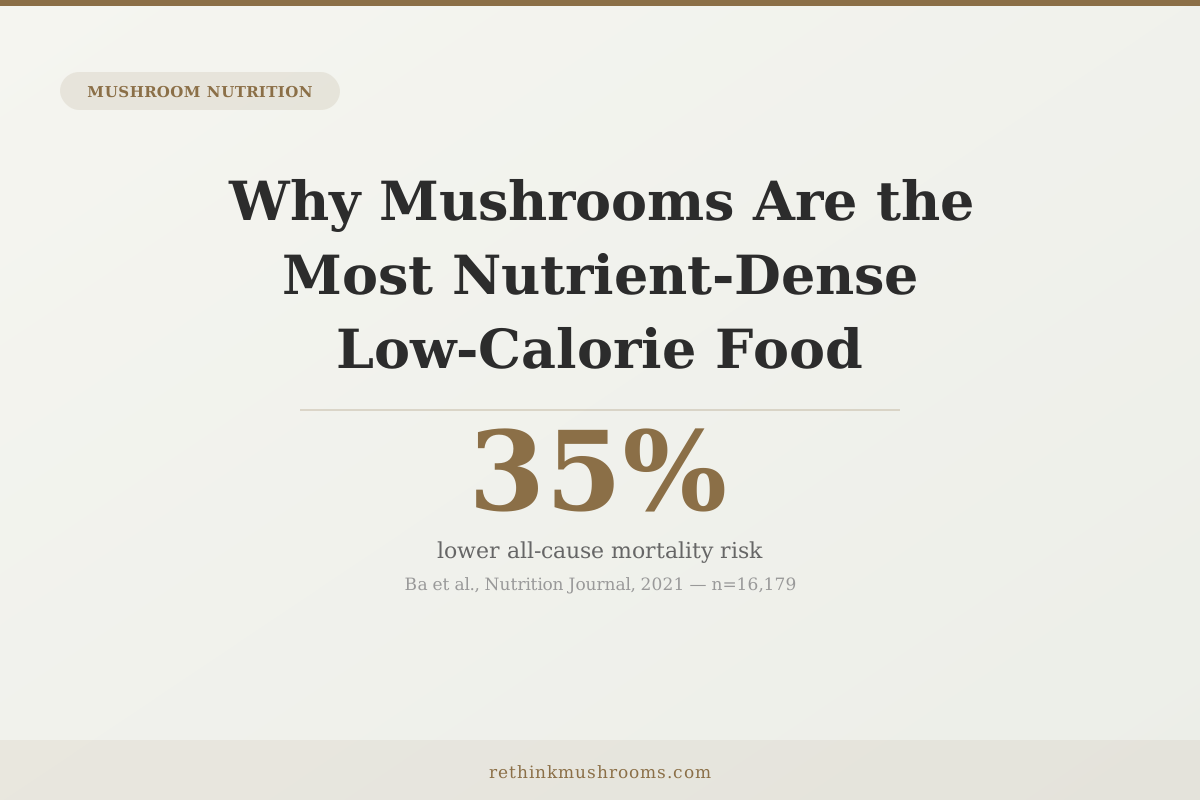
35% lower mortality risk
Replacing one daily serving of processed or red meat with mushrooms was associated with a 35% reduction in all-cause mortality risk over a mean 19.5-year follow-up in a prospective cohort of 15,546 American adults.
Ba et al., Nutrition Journal, 2021
22 kcal
per 100g fresh white button mushrooms
100g
UV-treated mushrooms = 1 day's vitamin D intake
42 μg
selenium per 100 calories — 77% of daily value
Ba et al., Nutrition Journal, 2021
 View as image ↗
A 15,546-person study tracked American adults for a mean of 19.5 years. People who reported any mushroom consumption had lower all-cause mortality than non-consumers; in a substitution analysis, replacing one daily serving of processed or red meat with mushrooms was associated with a 35% reduction in the risk of dying from any cause.[1] That result comes from population data, not a laboratory.
The nutrition behind that finding is what this article covers. Mushrooms are unusually nutrient-dense for a low-calorie food. At just 22 calories per 100g, white button mushrooms deliver more selenium, copper, and B vitamins per calorie than broccoli, spinach, or most other vegetables, plus compounds that no plant food can produce. For a full species-by-species breakdown, see the complete mushroom nutrition guide.
Key Takeaways
- White button mushrooms contain approximately 22 calories per 100g fresh weight — comparable to spinach (23 kcal) and lower than broccoli (34 kcal) per gram
- Replacing one daily serving of processed or red meat with mushrooms was associated with a 35% reduction in all-cause mortality risk over a mean 19.5-year follow-up in a cohort of 15,546 American adults (Ba et al., Nutrition Journal, 2021)
- A meta-analysis pooling that NHANES 2003-2014 cohort with four other prospective cohort studies (601,893 participants total) found mushroom consumption associated with approximately 6% lower all-cause mortality risk vs. non-consumption (Ba et al., Nutrition Journal, 2021)
- Per 100 calories, mushrooms deliver more than a full day's supply of copper and riboflavin and a full day's supply of niacin — micronutrients that are scarce in most plant foods
- A single serving of white button mushrooms contains ergothioneine, an antioxidant only fungi produce; in a pilot trial in 10 healthy men, mushroom-derived ergothioneine reached red blood cells within hours and was associated with a blunted postprandial triglyceride response (Weigand-Heller et al., Preventive Medicine, 2012)
- UV-treated white button mushrooms raise serum 25-hydroxyvitamin D as effectively as a vitamin D2 supplement at matched doses in healthy adults with low vitamin D status (Urbain et al., European Journal of Clinical Nutrition, 2011)
The 35% Mortality Finding That Changes How You Read a Nutrition Label
In 2021, Ba and colleagues published results from a prospective analysis of the third National Health and Nutrition Examination Survey (NHANES III). The cohort: 15,546 American adults followed for a mean of 19.5 years (SD 7.4), during which 5,826 deaths were documented. Participants who reported any mushroom consumption had a 16% lower risk of all-cause mortality compared with non-consumers (adjusted HR 0.84, 95% CI 0.73–0.98) after adjusting for demographics, lifestyle, and overall diet quality. In a substitution analysis, swapping one daily serving of processed or red meat for one daily serving of mushrooms was associated with a 35% lower risk of all-cause mortality (adjusted HR 0.65, 95% CI 0.50–0.84).[1]
This is observational data. Researchers adjusted for smoking, physical activity, and diet quality, but no observational study can fully rule out confounding. People who eat mushrooms regularly may differ from non-consumers in ways the data doesn't capture. The same NHANES III paper also looked at cause-specific mortality (cardiovascular and cancer) separately and did not find statistically significant associations for either — the headline result is all-cause mortality, not a specific cause of death.
What the study does show is that the all-cause association was large, persisted after adjustment, and held across demographic groups. It also didn't arrive in isolation — Ba and colleagues followed it with a prospective analysis of continuous NHANES 2003-2014 (30,378 participants) combined with a meta-analysis pooling that cohort with four other prospective cohort studies (601,893 participants total). The pooled estimate: mushroom consumption was associated with approximately 6% lower all-cause mortality risk compared with non-consumption (pooled risk ratio 0.94, 95% CI 0.91–0.98).[2]
This is the context that makes mushroom nutrition data more than a food chart exercise. For a broader look at how mushrooms compare to vegetables across multiple health outcomes, see mushrooms as a superfood: nutritional density compared to vegetables.
Selenium, B Vitamins, and Copper: The Nutrient-Dense Side of a Low-Calorie Food
Mushrooms are low in calories and high in specific micronutrients that are genuinely hard to find in the plant world. The numbers below use USDA FoodData Central reference values, comparing what each food delivers per 100 calories.
| Nutrient per 100 calories | Mushrooms (white button) | Broccoli | Spinach |
|---|---|---|---|
| Calories per 100g | 22 kcal | 34 kcal | 23 kcal |
| Protein | 14g | 8g | 12g |
| Fiber | 4.5g | 7.6g | 9.6g |
| Selenium | 42 μg (77% DV) | 7 μg (13% DV) | 4 μg (8% DV) |
| Copper | 1.45 mg (161% DV) | 0.14 mg (16% DV) | 0.57 mg (63% DV) |
| Riboflavin (B2) | 1.8 mg (138% DV) | 0.34 mg (26% DV) | 0.82 mg (63% DV) |
| Niacin (B3) | 16 mg (103% DV) | 1.9 mg (12% DV) | 3.1 mg (19% DV) |
| Ergothioneine | Present (fungi only) | None | None |
| Vitamin D (UV-treated) | Up to 400+ IU | None | None |
Mushrooms lose on fiber. Broccoli and spinach both deliver more fiber per calorie, and that matters for gut health. On selenium, copper, and B vitamins, mushrooms are in a different category entirely.
Selenium is scarce in most plant foods. The soil concentration varies, but mushrooms consistently accumulate it at levels that can meaningfully shift a day's intake. At 42 μg of selenium per 100 calories, a single serving of white button mushrooms covers the majority of the daily value in approximately 60 calories' worth of food.
Riboflavin and niacin are B vitamins most people associate with meat and dairy. Mushrooms deliver them at per-calorie concentrations that rival animal foods, which is useful context for people eating less meat.
For a detailed breakdown of how these nutrients vary by species and what the differences mean in practice, see protein, fiber, and micronutrients in mushrooms: a comprehensive analysis.
Why Low-Calorie Mushrooms Still Keep You Full
The practical question that matters most for most people: will 100 calories of mushrooms actually satisfy you?
Three factors combine to answer yes, more effectively than the calorie count alone would suggest.
Volume. At 22 calories per 100g, 100 calories of white button mushrooms is roughly 450g of food. That is a substantial physical portion that occupies real stomach space.
Fiber. Mushroom fiber comes in two main forms: chitin (the structural material in their cell walls, which the body cannot digest) and beta-glucans (a soluble fiber that ferments in the gut and slows gastric emptying, meaning food leaves the stomach more gradually). Beta-glucan fiber extends the feeling of fullness well beyond the meal itself. For a full explanation of how mushroom fiber differs from the fiber in vegetables, see how mushroom fiber differs from other prebiotic sources.
Protein. At roughly 14g of protein per 100 calories, mushrooms provide more protein per calorie than most vegetables. Protein has the highest satiety effect per calorie of any macronutrient, and mushrooms deliver it at concentrations that compare favorably to many plant protein sources.
These three factors help explain why culinary studies substituting mushrooms for meat in standardized meals consistently find reduced caloric intake without increased hunger ratings.
Ergothioneine: The Longevity Compound That Only Mushrooms Provide
The comparison table above includes one entry that cannot be reduced to a number: ergothioneine.
Ergothioneine is an antioxidant produced only by fungi and a small number of bacteria. Plants cannot make it. Animals cannot make it. Yet the human body has a dedicated transporter protein that actively pulls ergothioneine out of food and concentrates it in tissues facing the most cellular stress — the liver, kidneys, bone marrow, and eyes. The existence of this specialized transporter, built specifically to collect a compound only found in fungi and some soil bacteria, is one of the more striking hints in nutritional biology that the human relationship with mushrooms is evolutionarily old.
In 2012, Weigand-Heller and colleagues ran a randomized, crossover pilot trial of whether ergothioneine from food mushrooms actually reaches human tissue.[4] Ten healthy men consumed test meals containing 8 g and 16 g of mushroom powder. Ergothioneine was bioavailable — postprandial red blood cell ergothioneine concentrations rose after the mushroom meals — and the researchers also observed a blunted postprandial triglyceride response at both doses compared with the no-mushroom control meal. One unexpected finding: total antioxidant capacity as measured by ORAC actually decreased after the mushroom meals despite ergothioneine's known antioxidant properties, which the authors flagged as a paradox for further investigation. The study was small (n=10, healthy men only) and short, but it established the central fact: dietary ergothioneine from Agaricus bisporus enters circulation and reaches tissue.
Lam-Sidun and colleagues reviewed the cellular and preclinical evidence for ergothioneine's cytoprotectant role in cardiometabolic health.[5] Ergothioneine accumulates preferentially in tissues exposed to oxidative stress, and the cellular and in-vitro evidence consistently supports anti-oxidative and anti-inflammatory effects. The review authors are explicit that in-vivo organism-level data are limited and that there are still no well-controlled clinical prevention or intervention trials of ergothioneine in chronic disease. The compound is a plausible mechanism for the mortality associations seen in epidemiology — not a proven one.
For a complete treatment of how ergothioneine works and which mushroom species contain the most, see ergothioneine: the most selective antioxidant in your body.
One Serving a Day of Vitamin D: The UV Conversion Nobody Talks About
Vitamin D is among the hardest nutrients to obtain from food, especially for people who don't eat fatty fish or fortified dairy products. Mushrooms are the only non-animal food that can provide meaningful amounts. The mechanism is nearly identical to the one human skin uses.
Mushroom cells contain ergosterol, a compound in the cell membrane that converts to vitamin D2 when exposed to ultraviolet light. Human skin contains a similar compound (called 7-dehydrocholesterol) that converts to vitamin D3 under the same UV exposure. Both reactions are driven by the same wavelengths of sunlight. Mushrooms can synthesize vitamin D in a way no plant can.
Most mushrooms sold in supermarkets are grown indoors without UV exposure and contain minimal vitamin D as a result. The conversion potential is there, but it hasn't been activated.
Two complementary lines of evidence support this pathway. Koyyalamudi and colleagues first quantified the chemistry: exposing fresh white button mushrooms to UV-C light increased vitamin D2 content from negligible to 40–141 μg per typical serving depending on dose, and the vitamin D2 produced was well absorbed and metabolized in a rat feeding study (serum 25-hydroxyvitamin D rose proportionally).[6] Urbain and colleagues then tested the same pathway in humans in a 5-week single-blinded randomized controlled trial: 26 adults with low baseline vitamin D status (serum 25(OH)D ≤ 50 nmol/L) received either UV-irradiated mushroom soup, a matched vitamin D2 supplement, or placebo. Serum 25-hydroxyvitamin D rose significantly and similarly in the mushroom and supplement groups — by roughly 3.9 and 4.7 nmol/L per week, respectively — and was higher than placebo by week 2.[7] Bioavailability from UV-treated mushrooms was statistically indistinguishable from a supplement at matched dose.
The practical outcome of those findings: setting mushrooms gill-side up in direct sunlight or under a UV lamp for 15 to 30 minutes before cooking activates the conversion and dramatically increases their vitamin D content.
Two Independent Cohorts Agree: The Mortality Data Holds Up
Ba's NHANES III analysis, showing 35% lower mortality risk associated with replacing meat with mushrooms, was a striking result from a single dataset. Two subsequent analyses asked whether the finding replicates.
First, Ba and colleagues conducted a prospective analysis of continuous NHANES 2003-2014 data alongside a formal meta-analysis pooling that cohort with four other prospective cohort studies — 601,893 participants in total.[2] The pooled estimate confirmed the direction: mushroom consumption versus none was associated with approximately 6% lower all-cause mortality risk (pooled risk ratio 0.94, 95% CI 0.91–0.98). In the continuous-NHANES analysis on its own, the association did not reach statistical significance — the meta-analysis is what carries the signal.
Second, Jung and colleagues published results from the Korean Genome and Epidemiology Study (KoGES), a prospective cohort of 152,828 Korean adults over a mean 11.6-year follow-up.[3] The pattern was non-monotonic: in both men and women, consuming under 1 serving per week and 1–3 servings per week was associated with significantly lower all-cause mortality compared with non-consumption (HRs roughly 0.86–0.90), but consumption of 3 or more servings per week was not significantly associated with lower mortality — the benefit appears to plateau or fade at higher intakes. Cardiovascular mortality reductions reached significance only in men, not women. This is a different population, a different dietary context, and an entirely separate research group — and at low-to-moderate intakes, the direction of the finding matched the American data.
- Cell & mechanistic studiescompleted
Ergothioneine cytoprotection, beta-glucan immunomodulation, vitamin D2 biosynthesis from ergosterol
- Animal modelscompleted
Preclinical cardiometabolic effects of ergothioneine; rat bioavailability of UV-treated mushroom vitamin D2
- Small human trialscompleted
Weigand-Heller (n=10, ergothioneine bioavailability); Urbain (n=26 RCT, vitamin D2 bioavailability)
- Large RCT on mortality endpointmissing
No randomized controlled trial of mushroom consumption with mortality as a primary endpoint exists or is feasible
- Meta-analysis of cohortscurrent
Ba 2021 pooled five prospective cohorts (601,893 participants); RR 0.94 (95% CI 0.91–0.98) for any vs. no mushroom consumption
The strongest evidence is a meta-analysis of observational cohorts — large in aggregate but limited by the inability of any individual study to randomize diet. Mechanistic and bioavailability data support plausibility; a definitive RCT on a mortality endpoint will likely never be run because of cost and follow-up duration.
Synthesis of references [1]–[7] cited in this article
Three independent cohort analyses, two countries, and four other pooled cohort studies all point the same direction at low-to-moderate consumption. Consistency across independent populations doesn't establish causation, but it makes the confounding explanation harder to maintain. Something about the nutritional profile of regular mushroom consumption appears to translate into better survival outcomes across meaningfully different settings — though the effect size is modest at the population level (a single-digit percentage in pooled estimates) and the substitution finding (35% with processed/red meat replacement) is the strongest single-cohort signal.
Getting the Most From Your Mushrooms: What the Research Suggests
Three practical choices affect how much nutrition you actually get from mushrooms.
Don't peel them. The outer surface concentrates ergothioneine and B vitamins. Peeling or aggressively scrubbing it away removes the most nutrient-dense tissue. A damp cloth to clear surface debris is enough.
Sun-expose them before cooking. Sufficiently UV-treated white button mushrooms can deliver a full day's vitamin D2 intake or more per ~100g serving, with bioavailability in healthy adults statistically equivalent to a vitamin D2 supplement at matched dose.[7] Setting mushrooms gill-side up in direct outdoor sun for 15 to 30 minutes before cooking activates the ergosterol-to-vitamin-D2 conversion.[6] The same works under a UV lamp. Most grocery store mushrooms will benefit — they've had no UV exposure since harvest.
Cook them, but don't overcook them. Mushroom cell walls contain chitin, which is the same structural polymer found in the shells of crustaceans and insects. Heat breaks it down and improves the body's access to nutrients inside the cells. Prolonged high heat degrades the B vitamins that are among mushrooms' strongest nutritional arguments. Sautéing to tender, not soft and waterlogged, preserves the most.
For a detailed analysis of what different cooking methods do to specific mushroom bioactives, see how cooking affects mushroom bioactives: what the research shows.
The Bottom Line
Mushrooms occupy an unusual nutritional position: genuinely low in calories while delivering selenium, copper, B vitamins, and ergothioneine at per-calorie levels that outpace most vegetables. The mortality evidence from three independent cohort analyses — a 15,546-person American prospective study (Ba 2021, NHANES III), a pooled meta-analysis of five cohorts totaling 601,893 participants (Ba 2021, NHANES 2003-2014 + meta), and a 152,828-person Korean cohort (Jung 2023, KoGES) — consistently shows lower all-cause mortality associated with low-to-moderate mushroom consumption, with effect sizes ranging from ~6% in pooled estimates to 35% in a substitution analysis swapping mushrooms for processed or red meat. Proposed mechanisms include ergothioneine bioavailability (confirmed in a pilot trial showing measurable postprandial red blood cell uptake) and vitamin D production via UV exposure (confirmed in a randomized controlled trial showing serum 25-hydroxyvitamin D rises equivalent to a vitamin D2 supplement). The findings are observational and causation cannot be established, but the replication across independent populations and the confirmation of specific biological mechanisms makes the nutritional case for mushrooms stronger than most vegetables can claim.
Frequently Asked Questions
Sources & References
- 1RTHM-00673·Ba, Djibril M et al. (2021). “Association of mushroom consumption with all-cause and cause-specific mortality among American adults: prospective cohort study findings from NHANES III..” Nutrition journal.Study breakdown →PubMed →↩
- 2RTHM-00674·Ba, Djibril M et al. (2021). “Prospective study of dietary mushroom intake and risk of mortality: results from continuous National Health and Nutrition Examination Survey (NHANES) 2003-2014 and a meta-analysis..” Nutrition journal.Study breakdown →PubMed →↩
- 3RTHM-00833·Jung, Hyein et al. (2023). “Edible mushroom intake and risk of all-cause and cause-specific mortality: results from the Korean Genome and Epidemiology Study (KoGES) Cohort..” Food & function.Study breakdown →PubMed →↩
- 4RTHM-00270·Weigand-Heller, AuBrei J et al. (2012). “The bioavailability of ergothioneine from mushrooms (Agaricus bisporus) and the acute effects on antioxidant capacity and biomarkers of inflammation..” Preventive medicine.Study breakdown →PubMed →↩
- 5RTHM-00696·Lam-Sidun, Daniel et al. (2021). “Mushroom-Derived Medicine? Preclinical Studies Suggest Potential Benefits of Ergothioneine for Cardiometabolic Health..” International journal of molecular sciences.Study breakdown →PubMed →↩
- 6RTHM-00159·Koyyalamudi, Sundar Rao et al. (2009). “Vitamin D2 formation and bioavailability from Agaricus bisporus button mushrooms treated with ultraviolet irradiation..” Journal of agricultural and food chemistry.Study breakdown →PubMed →↩
- 7RTHM-00237·Urbain, P et al. (2011). “Bioavailability of vitamin D₂ from UV-B-irradiated button mushrooms in healthy adults deficient in serum 25-hydroxyvitamin D: a randomized controlled trial..” European journal of clinical nutrition.Study breakdown →PubMed →↩