Ergothioneine Antioxidant Biology & Mitochondrial Protection
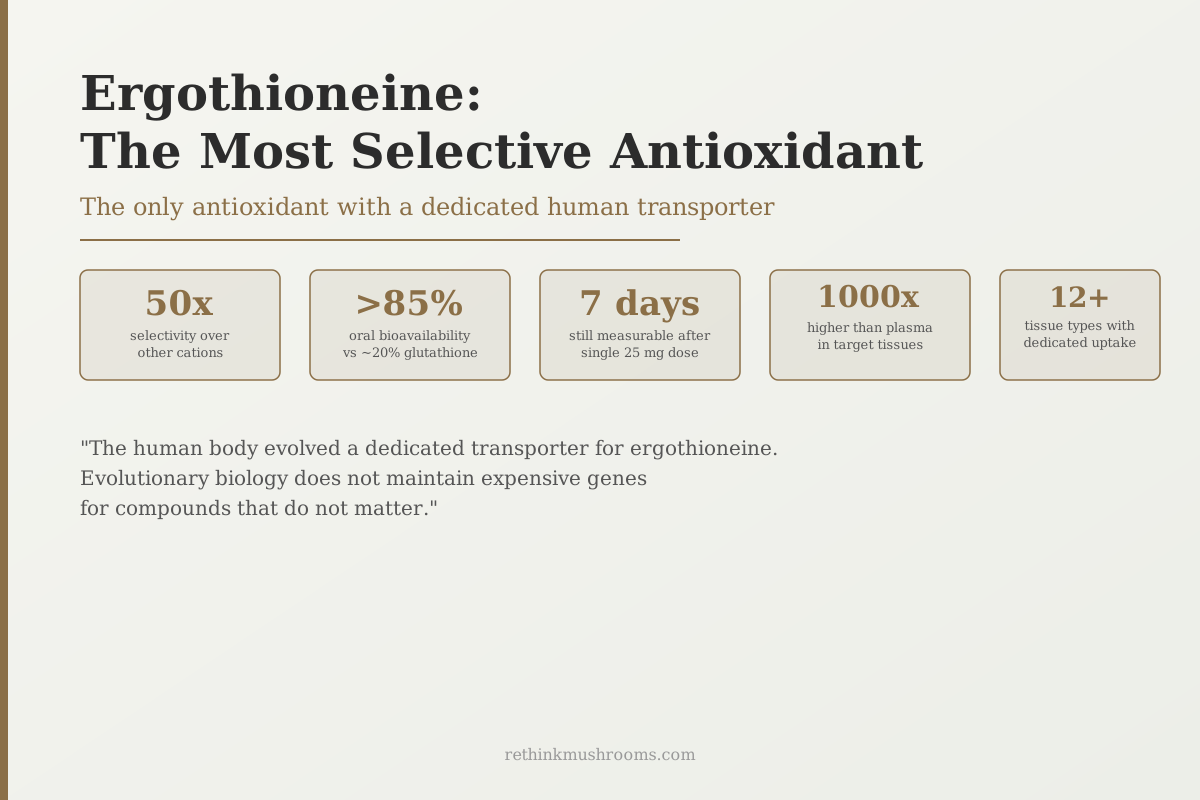
50x selectivity
The ergothioneine transporter shows approximately 50-fold selectivity for ergothioneine over other organic cations in human cells, the biochemical mechanism behind why it is called the most selective antioxidant.
Taubert et al., Biochemical Pharmacology, 2019
>85%
oral bioavailability, vs ~20% for oral glutathione (Chen et al., Food & Function, 2025)
7 days
ergothioneine still measurable after a single 25 mg dose, unusual retention (Cheah et al., 2017)
12+
tissue types where the dedicated transporter concentrates ergothioneine, all high oxidative-stress sites
Taubert et al., Biochemical Pharmacology, 2019
 View as image ↗
In 2005, a team led by Dirk Gründemann at the University of Cologne published a finding in PNAS that most of the nutrition world missed: the human body has a dedicated transporter protein, called OCTN1 or SLC22A4, that exists for a single purpose.[1] That purpose is to absorb ergothioneine from food, ferry it through the intestinal wall, and deliver it to specific tissues where it stays for weeks.
No other dietary antioxidant has anything like this. Vitamin C rides shared transporters. Vitamin E dissolves into fat. Glutathione supplements are largely broken down in the gut before absorption. Ergothioneine, a sulfur-containing amino acid found almost exclusively in mushrooms, has a dedicated molecular escort the human genome devoted real genetic space to building and maintaining across millions of years of evolution.
That is why it is called the most selective antioxidant. For a broader introduction to what ergothioneine is and what the research covers, see what ergothioneine is and why the body hoards it.
Ergothioneine is called the most selective antioxidant because the human body evolved a dedicated transporter, OCTN1 (SLC22A4), that accumulates it specifically in tissues with the highest oxidative stress exposure. No other dietary antioxidant, including vitamin C, vitamin E, or glutathione, has an exclusive transport protein. The selectivity is not a chemical property of ergothioneine itself; it is a property that the human body has built over evolutionary time to confer on ergothioneine specifically.
Key Takeaways
- Gründemann et al. (2005) identified OCTN1 as a dedicated human transporter for ergothioneine, the only amino acid with a transport protein evolved exclusively for its uptake
- Only fungi and certain bacteria can synthesize ergothioneine; humans and animals cannot make it, yet evolved a high-affinity transporter to acquire it from food
- OCTN1 shows ~50-fold selectivity for ergothioneine over other organic cations and concentrates it at 10-1000x plasma levels in target tissues
- After a single 25 mg oral dose, ergothioneine blood levels remain measurable 7 days later, unusual for any dietary antioxidant
- Oral ergothioneine has >85% bioavailability; oral glutathione supplements have approximately 20% bioavailability, a large practical difference
- In the Singapore Chinese Health Study, higher ergothioneine levels were associated with 68% lower cardiovascular mortality risk after confounding adjustment
The Evolutionary Argument: A Dedicated Protein Takes Millions of Years to Build
Human genes encode roughly 20,000 proteins. Every one of those genes represents evolutionary investment, the costs of maintaining, copying, and repairing that genetic code across generations. When a gene persists for millions of years in a population, there is a strong inference that the protein it encodes confers meaningful fitness advantage.
Jones and colleagues (2014) traced the evolutionary history of ergothioneine and reached a striking conclusion: only fungi and certain bacteria have the genes needed to synthesize ergothioneine.[2] Animals and plants cannot make it at all. Humans have always depended on dietary intake from fungi to obtain ergothioneine.
Yet the human genome contains OCTN1, a high-affinity transporter evolved exclusively to acquire this compound the body cannot synthesize. That is the evolutionary argument in its clearest form: if ergothioneine were not critically important, the selective pressure that created and maintained a dedicated transporter for a compound we cannot make would not exist. Evolutionary biology does not sustain expensive genes for compounds that do not matter.
Bruce Ames, the biochemist best known for the Ames test and decades of antioxidant research, named ergothioneine a "longevity vitamin" in his 2018 PNAS paper, explicitly on the basis of this transporter argument.[7] His framing: ergothioneine is not required for immediate survival (hence "not essential" in the classical sense) but appears critical for long-term health optimization, which explains why the transporter persists even when evolutionary pressure would otherwise eliminate costly metabolic machinery.
For the deep evolutionary story behind why only fungi synthesize this compound, see why only fungi make ergothioneine and why that matters.
How Selective Is "Most Selective"? The 50-Fold Data
The claim of selectivity requires a measurement, not just a label. Taubert and colleagues (2019) provided one of the most specific measurements, testing the ergothioneine transporter natively expressed in HeLa human cells against a panel of organic cations commonly transported by related proteins.[5] The transporter showed approximately 50-fold greater affinity for ergothioneine than for the next-best substrate tested.
For context: most transport proteins accept multiple substrates and are named for their promiscuity. OCTN1 belongs to the organic cation transporter family, most members of which handle a wide range of compounds. The fact that this particular family member concentrates its activity on ergothioneine by a factor of 50 represents an unusual degree of substrate specificity.
Tamai and colleagues (2008) characterized the same transporter and found it explains how the body achieves tissue ergothioneine concentrations 10 to 1000 times higher than plasma levels.[3] The range is large because it varies by tissue: brain, erythrocytes, and kidney accumulate more aggressively than, say, fat tissue. This is not passive pooling, it is active pumping by a protein with a structural preference for ergothioneine built into its binding site.
Nakamura and colleagues (2015) extended the story to the intestine: OCTN1 mediates ergothioneine absorption in intestinal epithelial cells at far higher efficiency than other dietary antioxidants are absorbed.[4] The selectivity begins before ergothioneine even reaches the bloodstream, the gut preferentially pulls it from food.
The Tissue Map: 12 Sites, All Under Oxidative Siege
If the transporter's job is to deliver ergothioneine to places that need it most, then its expression pattern should map onto tissues with the highest oxidative stress. That is exactly what Cheah and Halliwell documented in their 2022 inventory of OCTN1 (ETT) distribution.[6]
ETT (the ergothioneine transporter) is expressed in 12 or more distinct tissue types. The list reads like a map of the body's highest-demand environments: liver (constant drug metabolism and detoxification), kidney (continuous blood filtration), brain (high oxygen consumption, limited antioxidant backup), eye (ultraviolet radiation exposure), and erythrocytes (daily oxygen loading and unloading). The transporter's distribution does not appear to be random or incidental, it concentrates ergothioneine precisely where free radicals are generated most aggressively.
Cheah and Halliwell, writing in Antioxidants and Redox Signaling (2022), catalogued the full picture of how ETT expression maps onto oxidative stress sites and proposed ergothioneine as a "stress vitamin" that the body directs to highest-need locations, a targeted defense system rather than a general-purpose antioxidant pool.[9]
For the full story on OCTN1's specificity and why it is considered proof of ergothioneine's biological importance, OCTN1: the dedicated transporter that proves ergothioneine matters covers this in depth.
Bioavailability: The Practical Comparison
The selectivity story reaches its most practical point in bioavailability comparisons. Chen and colleagues' 2025 review in Food & Function integrated all known data on ergothioneine's pharmacokinetics and compared it to other antioxidants.[14]
The key finding: oral ergothioneine achieves greater than 85% bioavailability, meaning more than 85% of an oral dose enters systemic circulation intact. Oral glutathione supplements, by contrast, achieve approximately 20% bioavailability because glutathione is largely cleaved in the gut before absorption.
Cheah and colleagues (2017) confirmed ergothioneine's unusual body behavior in a small human pharmacokinetic study.[8] After a single 25 mg oral dose in 10 healthy volunteers, blood ergothioneine levels peaked at 2-3 hours and remained measurable 7 days later without toxicity. No antioxidant supplement widely sold achieves this kind of long-duration tissue retention from a single dose.
The following table compares ergothioneine to four commonly discussed antioxidants across the dimensions that determine practical effectiveness in the body:
| Antioxidant | Dedicated Transporter | Tissue Concentration vs. Plasma | Oral Bioavailability | Notable Limitation |
|---|---|---|---|---|
| Ergothioneine | Yes (OCTN1/SLC22A4) | 10-1000x in target tissues | >85% | Cannot be synthesized, diet-only |
| Glutathione | None | General intracellular synthesis | ~20% (oral supplement) | Largely cleaved in gut before absorption |
| Vitamin C | Shared SVCTs | Moderate accumulation | High, but saturates rapidly | Rapidly excreted; high doses mostly lost |
| Vitamin E | None | Fat-soluble, lipoprotein-mediated | Moderate | Non-specific distribution in lipid compartments |
| CoQ10 | None | Lipoprotein-mediated | Low (~5-10% standard form) | Lipid solubility limits absorption; requires oil formulation |
The comparison is not to argue ergothioneine is "better" than all others, these antioxidants serve distinct biochemical roles. The table shows why ergothioneine's distribution is genuinely unusual: no other common dietary antioxidant combines a dedicated uptake transporter with sustained tissue retention and high oral bioavailability.
For an in-depth head-to-head comparison of ergothioneine and glutathione specifically, see ergothioneine vs. glutathione: comparing master antioxidants.
How Four Mechanisms Work Once Ergothioneine Arrives
Once OCTN1 delivers ergothioneine to a tissue, how does it protect cells? Cheah and colleagues' 2020 comprehensive review documented four distinct antioxidant mechanisms.[12]
The first is direct free-radical scavenging: ergothioneine neutralizes hydroxyl radicals, peroxyl radicals, superoxide, and singlet oxygen, the major species that damage DNA, proteins, and membrane lipids.
The second is metal chelation: ergothioneine binds pro-oxidant metal ions including copper (Cu²⁺) and iron (Fe²⁺), preventing them from driving Fenton reactions that generate highly damaging hydroxyl radicals.
The third is Nrf2 pathway activation: Nrf2 is a master transcription factor that, when activated, upregulates the body's own antioxidant enzyme production, including superoxide dismutase and catalase.
The fourth, and perhaps most mechanistically specific: ergothioneine concentrates inside mitochondria and protects mitochondrial DNA from oxidative damage. For detail on the mitochondrial mechanisms including the 2025 MPST discovery, see ergothioneine and mitochondrial protection.
The full picture, including how ergothioneine's thione-form chemistry makes it self-renewing in a way glutathione is not, is covered in detail in how ergothioneine protects cells from oxidative damage. The downstream consequences for aging and longevity are covered in ergothioneine: preserving your cellular powerhouses.
What Does the Body Think Ergothioneine Is? The Reclassification Argument
Cheah and Halliwell, writing in the British Journal of Nutrition in 2023, made an argument that the nutrition science community has not yet fully acted on: ergothioneine should be reclassified from a nutraceutical to an essential micronutrient.[11]
The argument follows from the pattern. Classical vitamins and minerals are defined by: (1) the body cannot make them, (2) they have dedicated uptake mechanisms, (3) levels decline in the absence of dietary intake, and (4) deficiency predicts disease. Ergothioneine meets criteria 1, 2, and progressively accumulating evidence for 4. Whether it meets criterion 3 fully is complicated by the fact that most studies measure blood levels in existing populations rather than tracking controlled dietary depletion.
The 2023 paper positions the dedicated transporter as the decisive argument: the body does not build exclusive molecular machinery for compounds it does not consider essential. Cheah and Halliwell's earlier (2023) Antioxidants paper had already documented ergothioneine as "uniquely special among diet-derived antioxidants" on the basis of its exclusive transporter, weeks-long tissue retention, and targeted distribution.[10]
The history behind how the longevity vitamin debate developed, including the Gründemann discovery and Ames' proposal, is covered in the history of ergothioneine: from discovery to longevity vitamin debate.
Americans May Be Severely Deficient
If ergothioneine is genuinely important for long-term health, the intake question matters. Borodina and colleagues (2020) estimated that most Americans consume less than 1 mg per day of ergothioneine, compared to 5 or more mg per day in populations with high mushroom consumption such as parts of Asia.[13] This is a hypothetical threshold, not an established deficiency cutoff, but the size of the gap, fivefold or more, is striking.
Borodina's paper raised the hypothesis that widespread low ergothioneine intake in Western diets is a driver of higher rates of aging-related disease in those populations compared to high-mushroom-consumption populations. This is correlation, not causation, and confounding factors are substantial.
What Low Levels Predict
The payoff for the selectivity story is what happens in human populations when ergothioneine levels are low. In the Singapore Chinese Health Study of approximately 2,000 participants, after adjusting for confounders, those with the highest plasma ergothioneine levels had 68% lower cardiovascular mortality risk and significantly lower all-cause mortality.[15]
This is an observational association, not a clinical trial. People with high ergothioneine levels eat more mushrooms, and high mushroom diets correlate with healthier dietary patterns broadly. The association does not establish that ergothioneine itself causes the mortality difference.
But the size of the association, 68% risk reduction, is substantial for an observational finding. And the proposed mechanism is coherent: ergothioneine targets the tissues (heart, vascular endothelium, liver) where cardiovascular risk originates, through a dedicated transporter that no other dietary antioxidant has.
The most selective antioxidant label is, in the end, a description of a biological arrangement rather than a marketing claim. The human body invested in a dedicated molecular escort for ergothioneine. That investment accumulated over evolutionary time. The outcome of that selectivity, measured in tissue concentrations and cardiovascular outcomes, is what makes the arrangement worth understanding.
The Bottom Line
Ergothioneine earns the "most selective antioxidant" label not through its chemistry alone but through the human body's evolutionary investment in OCTN1, a dedicated transporter protein with 50-fold preference for ergothioneine over other organic cations. This transporter delivers ergothioneine to 12 or more tissue types corresponding to high oxidative stress sites, maintains tissue concentrations 10-1000x higher than plasma, and achieves greater than 85% oral bioavailability, data points no other common dietary antioxidant can match simultaneously. Whether these attributes translate into clinical benefit remains under investigation, but the 68% cardiovascular mortality association in 2,000 Singapore participants is the most compelling human correlate.
Frequently Asked Questions
Sources & References
- 1. Source details for this reference are not yet available.
- 2. Source details for this reference are not yet available.
- 3. Source details for this reference are not yet available.
- 4. Source details for this reference are not yet available.
- 5. Source details for this reference are not yet available.
- 6. Source details for this reference are not yet available.
- 7. Source details for this reference are not yet available.
- 8. Source details for this reference are not yet available.
- 9. Source details for this reference are not yet available.
- 10. Source details for this reference are not yet available.
- 11. Source details for this reference are not yet available.
- 12. Source details for this reference are not yet available.
- 13. Source details for this reference are not yet available.
- 14. Source details for this reference are not yet available.
- 15. Source details for this reference are not yet available.