Ergothioneine Antioxidant Biology & Mitochondrial Protection
21% lower CV mortality per SD
In the Malmö Diet and Cancer study (3,236 participants, median 21.4-year follow-up), each one-standard-deviation increase in plasma ergothioneine was associated with a 21% lower risk of cardiovascular mortality after multivariable adjustment.
Smith et al., Heart, 2020
2024
first controlled study showing ergothioneine extends lifespan in male mice (Katsube et al.)
21.4 yr
median follow-up in the Swedish cohort linking ergothioneine to lower mortality
0 RCTs
randomized trials testing ergothioneine against a human aging endpoint
Smith et al., Heart, 2020
 View as image ↗
Mitochondrial dysfunction is the common thread running through Parkinson's disease, Alzheimer's disease, heart failure, and age-related frailty. When mitochondria, the organelles that generate cellular energy, lose function over decades, the consequences follow in every tissue that depends on them. Ergothioneine, a sulfur-containing amino acid found almost exclusively in mushrooms, is one of the few dietary compounds with direct mammalian evidence of mitochondrial preservation, and a cluster of studies published in 2024 and 2025 now connects that preservation to measurable longevity and healthspan outcomes in animals.
For a foundation on what ergothioneine is and why the human body evolved dedicated machinery to accumulate it, see what ergothioneine is and why the body hoards it. This article focuses on what mitochondrial preservation means for aging, frailty, exercise capacity, and lifespan, rather than the underlying molecular mechanisms. For the mechanistic details (MPST activation, cGPDH persulfidation), see ergothioneine and mitochondrial protection.
Key Takeaways
- Male mice given 4-5 mg/kg/day of ergothioneine in drinking water from 7 weeks of age showed markedly extended lifespan, with lower age-related decline in weight, fat mass, and movement velocity — the first direct longevity evidence in a mammalian model (Katsube et al., GeroScience, 2024)
- A 2025 Cell Metabolism study found ergothioneine improved healthspan in aged animals by acting as an alternative substrate for the enzyme CSE, driving persulfidation of over 300 proteins including the cGPDH electron shuttle (Petrovic et al.)
- Ergothioneine-rich shiitake extract restored mitochondrial membrane potential and ATP levels in senescent neural cells in 2025, following the same group's 2024 screen that identified shiitake as the highest-ergothioneine species of 14 tested (Apparoo et al.)
- In a Swedish cohort of 3,236 adults followed a median of 21.4 years, each standard-deviation increase in plasma ergothioneine was associated with 21% lower cardiovascular mortality and 14% lower overall mortality
- Whole blood ergothioneine levels decline significantly beyond age 60, and elderly individuals with mild cognitive impairment had significantly lower plasma levels than age-matched peers
- Nearly all longevity data comes from animal models; the human evidence is observational only, and no randomized trial has tested ergothioneine against an aging endpoint in people
When Mitochondria Fail: The Health Consequences That Follow
Cells that depend on mitochondria for energy, neurons, cardiomyocytes, muscle fibers, are the most vulnerable to mitochondrial decline. As mitochondria accumulate damage over decades, their ability to produce ATP falls. When ATP supply cannot meet demand, cells begin to malfunction before they die.
The consequences of this process are visible at the organ level. Parkinson's disease shows preferential destruction of the substantia nigra neurons, which have among the highest energy demands in the brain. Alzheimer's pathology is consistently associated with reduced mitochondrial function in hippocampal tissue. Heart failure often involves mitochondria that can no longer sustain the ATP output cardiac muscle requires.
This is the context in which ergothioneine's mitochondrial evidence matters. The question is not whether it is an antioxidant, it clearly is, but whether accumulating in mitochondria and protecting them translates into the outcomes that matter: living longer, thinking clearly for longer, and maintaining physical function as decades pass.
The following table summarizes the specific mitochondrial threats that ergothioneine counters, based on the studies cited in this article:
| Mitochondrial Threat | How Ergothioneine Counteracts It | Key Study |
|---|---|---|
| Reactive oxygen species from electron transport chain | Direct scavenging plus MPST enzyme activation | Sprenger et al., Cell Metabolism, 2025 |
| Oxidative stress and hippocampal neuronal injury | Lower MDA, higher T-SOD via the Nrf2/HO-1 pathway | Chen et al., Food & Function, 2024 |
| Cellular senescence and mitochondrial dysfunction | Restored membrane potential and ATP levels | Apparoo et al., Neuroscience, 2025 |
| Electron shuttle inefficiency in aging | CSE-dependent persulfidation activates cGPDH | Petrovic et al., Cell Metabolism, 2025 |
| Age-related decline in lifespan and physical function | Extended lifespan with preserved body composition and mobility | Katsube et al., GeroScience, 2024 |
Evidence Hierarchy
Ergothioneine and Longevity — Solid in Animals, Correlational in People
The longevity case is built bottom-up: consistent cell data, two species of invertebrate and rodent evidence, one mouse lifespan study, and human data that is observational only. Bar width reflects how much direct evidence sits at each tier — narrower toward the top means closer to human aging but less data.
Cell & in-vitro models
evidenceFong 2024 · Apparoo 2024 · Apparoo 2025 · Leow 2023
Shiitake extract restores membrane potential and ATP in senescent neurons; ergothioneine uptake into mitochondria confirmed by mass spectrometry
C. elegans (invertebrate)
evidenceKatsube 2024 · Petrovic 2025
Two independent groups report extended lifespan, longer non-frailty span, and improved mobility
Rodent healthspan & function
evidencePetrovic 2025 · Sprenger 2025 · Chen 2024
Aged rats gain exercise endurance, muscle mass and muscle NAD+; mice show better mitochondrial respiration and preserved memory
Mouse lifespan (mammalian)
evidenceKatsube 2024
4-5 mg/kg/day from 7 weeks of age extended lifespan in male mice, with less decline in fat mass and movement velocity at 88 weeks
Human observational
evidenceSmith 2020 · Cheah 2016
Higher plasma ergothioneine tracks with lower cardiovascular mortality over 21.4 years; blood levels fall after age 60
Human trial vs an aging endpoint
gapDoes not yet exist
No randomized trial has tested whether raising ergothioneine changes mortality, frailty, or mitochondrial function in people
How to read it: the lower tiers are unusually strong for a dietary compound — ergothioneine has a confirmed mitochondrial target and a controlled mammalian lifespan result, which most supplements marketed for mitochondrial support do not. The human tier is where the case narrows: an association across 3,236 people is not the same as an intervention, and the trial that would settle it has never been run.
Sources: Fong 2024 [1]; Katsube 2024 [2]; Petrovic 2025 [3]; Apparoo 2025 [4]; Apparoo 2024 [5]; Sprenger 2025 [6]; Chen 2024 [8]; Cheah 2016 [9]; Smith 2020 [10]; Leow 2023 [12]. Bar widths are illustrative of evidence depth per tier, not quantitative effect sizes.
The 2024 Mouse Lifespan Study: First Direct Longevity Evidence
In 2024, Katsube and colleagues published in GeroScience the first controlled lifespan study of ergothioneine in a mammalian model.[2] Male mice received ergothioneine dissolved in drinking water at roughly 4 to 5 mg/kg/day, starting at 7 weeks of age and continuing to the end of their lives. That intake extended lifespan substantially compared with untreated controls.
The study did not stop at survival curves. At 88 weeks of age, the ergothioneine group showed significantly smaller age-related declines in body weight, fat mass, and both average and maximum movement velocity. Plasma biomarkers that normally climb with age, including chemokine ligand 9, creatinine, symmetric and asymmetric dimethylarginine, urea, quinolinic acid, and kynurenine, were dramatically suppressed. The researchers also observed a parallel extension of lifespan and non-frailty span in Caenorhabditis elegans, an independent model organism, which strengthens the case that the effect is not a mouse-specific artifact.
This remains animal data. Mouse lifespan results do not reliably predict human longevity outcomes, and the study was conducted in male mice only, leaving open whether the effect holds in females. But it is the first direct evidence in any mammal that ergothioneine supplementation shifts survival curves, a finding previously only suggested by correlational human data.
The 2024 study by Fong and colleagues supplies part of the biochemical foundation.[1] Using mass spectrometry, that group demonstrated for the first time that ergothioneine is genuinely taken up into isolated mitochondria, and confirmed its presence in mitochondria from ergothioneine-treated cells and animals. Notably, mitochondria from OCTN1 knockout mice showed impaired but still detectable uptake, which suggests OCTN1 is a major but not exclusive route and that alternative transporters may exist. Before this work, whether ergothioneine actually reached the mitochondrial compartment at all was an open question.
Healthspan in Aged Animals: The cGPDH Finding
Petrovic and colleagues, publishing in Cell Metabolism in 2025, reported improved healthspan through a mechanism distinct from simple antioxidant activity.[3] Ergothioneine acts as an alternative substrate for cystathionine gamma-lyase (CSE), stimulating hydrogen sulfide production, which in turn increases protein persulfidation across more than 300 protein targets. Among those targets is cGPDH, an electron shuttle whose efficiency normally falls with age. Restoring it improved cellular energy output.
The functional results spanned two species. In C. elegans, ergothioneine extended lifespan and improved mobility, alongside better stress resistance and reduced age-associated biomarkers. In aged rats, it enhanced exercise endurance, muscle mass, and vascularization, accompanied by higher NAD+ levels in muscle.
The distinction between "lifespan" and "healthspan" matters here. Lifespan is simply how long an animal lives. Healthspan is how long it lives well, maintaining physical function, metabolic health, and cognitive capacity. The Petrovic data addresses healthspan specifically, which is arguably the more relevant outcome for most people thinking about aging.
The full mechanistic description of how cGPDH persulfidation works is covered in ergothioneine and mitochondrial protection.
Reversing Senescence: What Shiitake Extract Did to Aging Brain Cells
Cellular senescence is the state where a cell stops dividing and begins secreting inflammatory signals. Senescent cells accumulate with age and are considered active drivers of tissue aging. In 2025, Apparoo and colleagues tested whether ergothioneine-rich shiitake (Lentinula edodes) extract could protect mitochondrial function in senescent neural HT22 cells challenged with tert-butyl hydroperoxide.[4]
The shiitake extract restored mitochondrial membrane potential, improved ATP levels, and reduced mitochondrial toxicity in cells that had lost those capacities. The researchers traced the protection to both antioxidant activity and mitochondrial biogenesis signalling, meaning the extract appeared to support the creation of new mitochondria rather than only shielding existing ones.
The caveat is significant: the researchers used whole mushroom extract, not isolated ergothioneine. Shiitake contains multiple bioactive compounds including lentinan and beta-glucans, and the effects cannot be attributed exclusively to ergothioneine. This is honest science. The study establishes a connection between an ergothioneine-rich mushroom and senescent-cell mitochondrial rescue, but the specific contribution of ergothioneine remains to be isolated.
The 2025 work builds directly on the same group's 2024 study.[5] There, the researchers used HPLC to quantify ergothioneine across 14 mushroom species, identified Lentinula edodes as the highest-ergothioneine species of the group, and then showed that its extract acted as an antioxidant and antisenescence agent in the same HT22 neuronal model. Read together, the pair form one continuous line of work in a single cell type rather than independent confirmation across different tissues, which is a real limitation on how far the finding currently generalizes.
Exercise Performance: When Muscle Mitochondria Respond
The Cell Metabolism paper by Sprenger and colleagues (2025) documented something practically useful: ergothioneine accumulates specifically in muscle mitochondria during exercise training, and the researchers identified 3-mercaptopyruvate sulfurtransferase (MPST) as its direct molecular target.[6] Activating MPST improved mitochondrial respiration and, in mice, exercise performance. This work resolved a long-standing question about what ergothioneine actually binds to in the cell.
A bioRxiv preprint from the year before had reported the same core finding ahead of peer review.[7] The 2025 journal publication is the peer-reviewed version of that work, not an independent replication, and should be read as one body of evidence rather than two.
For readers interested in mitochondria as a practical target, the implication is straightforward: exercise drives ergothioneine into muscle mitochondria, and ergothioneine activates machinery that makes those mitochondria more efficient. Whether this holds in humans, and whether dietary ergothioneine amplifies exercise-induced mitochondrial adaptation, has not been tested in a clinical trial.
Cognitive Aging: Mitochondria and the Hippocampus
Chen and colleagues (2024), publishing in Food & Function, used a D-galactose-induced accelerated aging model in mice to test ergothioneine's cognitive effects.[8] Ergothioneine significantly improved recognition memory. It also increased neuron numbers, raised brain cAMP and BDNF levels, and increased the density and expression of PSD95, a marker of synaptic integrity.
The mitochondrial link was explicit. Ergothioneine reduced oxidative stress, lowering malondialdehyde and raising total superoxide dismutase activity through the Nrf2/HO-1 pathway, and improved mitochondrial function by regulating the AMPK/SIRT1/PGC-1alpha pathway, a central regulator of mitochondrial biogenesis. Together these changes attenuated hippocampal neuronal injury and improved learning and memory.
One qualification matters: D-galactose induces an accelerated aging phenotype chemically rather than allowing animals to age naturally, so it models some features of aging but not the full process. The naturally-aged mice in the Katsube lifespan study provide a useful complement here, since that work also found rescued learning and memory alongside preserved hippocampal neurogenesis and reduced TDP-43 protein aggregation.[2]
Leow and colleagues (2023) added a blood-brain-barrier dimension: ergothioneine protected human brain endothelial cells from mitochondrial damage caused by 7-ketocholesterol, an oxidized cholesterol species found in atheromatous plaques, suggesting protection at the barrier separating brain tissue from the bloodstream.[12]
The Age Depletion Problem: Blood Levels Drop After 60
The longevity studies are most relevant when read alongside an uncomfortable fact about aging: ergothioneine blood levels decline measurably in later life.
Cheah and colleagues (2016) examined how ergothioneine levels change with age in an elderly population and found that whole blood levels decline significantly beyond age 60.[9] Within that group, a subset with mild cognitive impairment had significantly lower plasma ergothioneine than age-matched subjects without impairment. The authors proposed that ergothioneine deficiency may be a risk factor predisposing individuals to neurodegenerative disease.
Two limits deserve emphasis. This comparison is cross-sectional, not a longitudinal tracking of decline rates, so it cannot establish that low ergothioneine precedes cognitive impairment rather than resulting from it. And an association of this kind cannot demonstrate causation in either direction. Halliwell and Cheah's 2024 hypothesis paper formalized the observation into a proposed mechanism, suggesting that low body ergothioneine predisposes people to significantly increased risk of cognitive impairment, dementia, Parkinson's disease, and possibly frailty, cardiovascular disease, and eye disease.[11] That paper is explicitly framed as a proposal, not a demonstrated finding.
The source of the age-related decline is not established. Reduced mushroom consumption in older populations, declining OCTN1 transporter efficiency, or increased ergothioneine consumption during elevated oxidative stress are all plausible contributors. None has been confirmed.
For a deeper exploration of what declining ergothioneine with age means for health, ergothioneine declines with age: what this means for health covers this topic directly.
The Human Evidence: What the Mortality Data Actually Shows
The strongest human evidence comes from the Malmö Diet and Cancer study, a population-based Swedish cohort.[10] Smith and colleagues (2020) measured 112 plasma metabolites in 3,236 participants who were free of cardiovascular disease and diabetes at baseline, then followed them for a median of 21.4 years. Over that period 603 participants developed cardiovascular disease, 362 developed diabetes, and 843 died.
Human Observational Data
What Plasma Ergothioneine Actually Predicted — Malmö Cohort, 3,236 Adults
Adjusted hazard ratios per one standard-deviation increase in plasma ergothioneine, over a median 21.4 years of follow-up. A bar reaching left of the dashed line means lower risk. These are associations in an observational cohort, not the effect of taking a supplement.
Cardiovascular mortality
~21% lower risk per SD
Overall mortality
~14% lower risk per SD
Coronary disease (incident)
~15% lower risk per SD
How to read it: these are per-standard-deviation hazard ratios, not the result of giving anyone ergothioneine. Ergothioneine was the metabolite most strongly tied to a health-conscious food pattern in this cohort, so some of the signal almost certainly reflects the rest of a healthier diet rather than the molecule itself. The association is real and durable across 21.4 years; the causal step is the part no observational study can supply.
Source: Smith et al., Heart, 2020 [10] — Malmö Diet and Cancer study, n=3,236, median 21.4-year follow-up (603 incident CVD, 843 deaths). Point estimates shown as published; confidence intervals were not reported in the source abstract and are therefore not drawn.
Ergothioneine was the metabolite most strongly connected to a health-conscious food pattern, and it independently predicted outcomes. Per one standard-deviation increase in plasma ergothioneine, the adjusted hazard ratios were 0.79 for cardiovascular mortality (p=0.002), 0.86 for overall mortality (p=4e-5), and 0.85 for coronary disease (p=0.01). In plain terms, roughly a 21% lower risk of cardiovascular death and a 14% lower risk of death from any cause, per standard deviation.
These are meaningful associations, and the long follow-up and large event counts make them reasonably robust. But the interpretation has to stay proportional. The finding is an association, not a demonstrated cause. The authors themselves identified ergothioneine as a marker of a healthy dietary pattern, which is precisely the confounding problem: people with higher ergothioneine eat more mushrooms, and mushroom consumption travels with a broader set of healthier habits that are difficult to fully adjust away. A per-standard-deviation hazard ratio is also not the same as the effect of taking a supplement, since nobody in this cohort was assigned to take anything.
What the data supports is that higher ergothioneine levels track with lower cardiovascular death risk in a large, long-followed population, that a plausible biological mechanism exists in mitochondrial protection of cardiac tissue, and that no controlled trial has yet tested whether raising ergothioneine changes those outcomes.
For comparisons to other mushroom compounds working through overlapping aging mechanisms, how cordyceps may slow biological aging covers a well-studied companion genus.
What the Evidence Supports, and What It Does Not
The longevity case for ergothioneine rests on animal data with human correlation. The strongest animal evidence is the 2024 Katsube lifespan extension study in mice, the 2025 Petrovic healthspan findings in worms and aged rats, and the 2024-2025 Apparoo senescence work in neural cells. Three research groups, three distinct mechanisms, converging on the conclusion that ergothioneine preserves healthy biological function in aging models.
The human evidence is observational. The Malmö cohort provides the most compelling correlation, and the Cheah 2016 data adds a neurodegenerative dimension. No randomized controlled trial has tested ergothioneine supplementation against a mitochondrial or aging endpoint in humans.
The honest summary: ergothioneine has a stronger and more specific evidence base for mitochondrial preservation than most compounds marketed for mitochondrial support, and its direct molecular target is now identified. The animal evidence for longevity outcomes is recent, consistent, and mechanistically grounded. The human evidence remains correlational. That gap is meaningful and represents the frontier of current research.
This article summarizes published research and is not medical advice. Mitochondrial disease, neurodegenerative conditions, and cardiovascular disease require diagnosis and management by a qualified clinician. Anyone considering a supplement, particularly alongside existing medication or a diagnosed condition, should discuss it with their physician first.
The Bottom Line
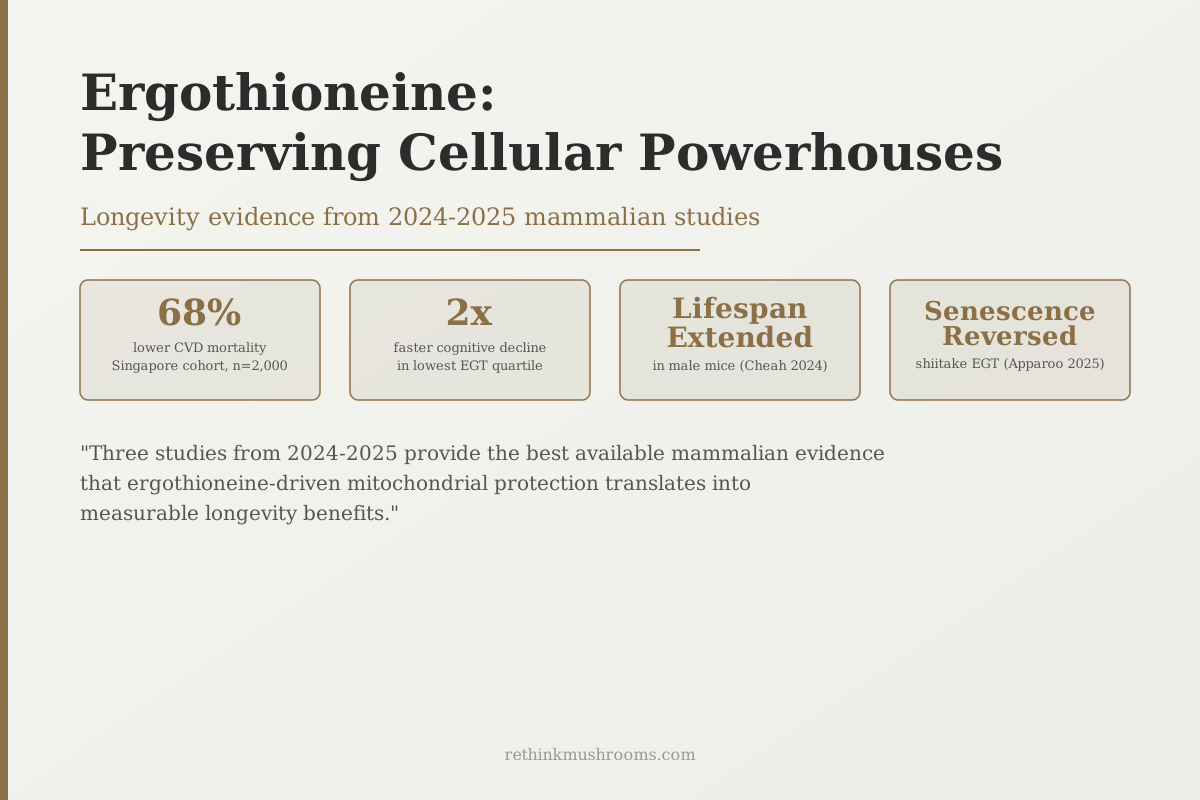
Studies published in 2024 and 2025 provide the best available mammalian evidence that ergothioneine-driven mitochondrial protection translates into longevity and healthspan benefits: Katsube et al. demonstrated lifespan extension in male mice given 4-5 mg/kg/day, Petrovic et al. found healthspan improvement via CSE-dependent persulfidation of cGPDH in worms and aged rats, and Apparoo et al. showed ergothioneine-rich shiitake extract restored mitochondrial membrane potential and ATP in senescent neural cells. Human observational data from a 3,236-person Swedish cohort associates each standard-deviation increase in plasma ergothioneine with 21% lower cardiovascular mortality over 21.4 years of follow-up, but no controlled trial has established causation.
Frequently Asked Questions
Sources & References
- 1RTHM-01889·Fong, Zachary Weijie et al. (2024). “Ergothioneine and mitochondria: An important protective mechanism?.” Biochemical and biophysical research communications.Study breakdown →PubMed →↩
- 2RTHM-00884·Katsube, Makoto et al. (2024). “Ergothioneine promotes longevity and healthy aging in male mice..” GeroScience.Study breakdown →PubMed →↩
- 3RTHM-02162·Petrovic, Dunja et al. (2025). “Ergothioneine improves healthspan of aged animals by enhancing cGPDH activity through CSE-dependent persulfidation..” Cell metabolism.Study breakdown →PubMed →↩
- 4RTHM-02052·Apparoo, Yasaaswini et al. (2025). “Ergothioneine-rich Lentinula edodes mushroom extract restores mitochondrial functions in senescent HT22 cells..” Neuroscience.Study breakdown →PubMed →↩
- 5RTHM-01850·Apparoo, Yasaaswini et al. (2024). “Potential role of ergothioneine rich mushroom as anti-aging candidate through elimination of neuronal senescent cells..” Brain research.Study breakdown →PubMed →↩
- 6RTHM-02185·Sprenger, Hans-Georg et al. (2025). “Ergothioneine controls mitochondrial function and exercise performance via direct activation of MPST..” Cell metabolism.Study breakdown →PubMed →↩
- 7RTHM-01996·Sprenger, Hans-Georg et al. (2024). “Ergothioneine boosts mitochondrial respiration and exercise performance via direct activation of MPST..” bioRxiv : the preprint server for biology.Study breakdown →PubMed →↩
- 8RTHM-01866·Chen, Fangyang et al. (2024). “Ergothioneine improves cognitive function by ameliorating mitochondrial damage and decreasing neuroinflammation in a D-galactose-induced aging model..” Food & function.Study breakdown →PubMed →↩
- 9RTHM-00420·Cheah, Irwin K et al. (2016). “Ergothioneine levels in an elderly population decrease with age and incidence of cognitive decline; a risk factor for neurodegeneration?.” Biochemical and biophysical research communications.Study breakdown →PubMed →↩
- 10RTHM-00655·Smith, Einar et al. (2020). “Ergothioneine is associated with reduced mortality and decreased risk of cardiovascular disease..” Heart (British Cardiac Society).Study breakdown →PubMed →↩
- 11RTHM-01898·Halliwell, Barry et al. (2024). “Are age-related neurodegenerative diseases caused by a lack of the diet-derived compound ergothioneine?.” Free radical biology & medicine.Study breakdown →PubMed →↩
- 12RTHM-01725·Leow, Damien Meng-Kiat et al. (2023). “Protective Effect of Ergothioneine against 7-Ketocholesterol-Induced Mitochondrial Damage in hCMEC/D3 Human Brain Endothelial Cells..” International journal of molecular sciences.Study breakdown →PubMed →↩