Ergothioneine Antioxidant Biology & Mitochondrial Protection
>85% oral bioavailability
Ergothioneine achieves greater than 85% oral bioavailability via its dedicated OCTN1 transporter, compared to approximately 20% for oral glutathione supplements, one of the most significant pharmacokinetic differences between any two antioxidants.
Chen et al., Food & Function, 2025
Both
ergothioneine and glutathione are richly concentrated in mushrooms, the only common food combining both at high levels (Kalaras 2017)
610 mg/kg
ergothioneine in porcini mushrooms, highest dietary source of any food analyzed (Kalaras et al., 2017)
Non-depleting
ergothioneine's thione chemistry neutralizes radicals without forming a depleted disulfide, unlike glutathione (Servillo 2017)
Chen et al., Food & Function, 2025
 View as image ↗
In 2017, researchers at Penn State analyzed 13 mushroom species and found something unusual: porcini mushrooms (Boletus edulis) contained up to 610 mg/kg dry weight of ergothioneine while also ranking among the richest food sources of glutathione.[1] No other commonly consumed food comes close to matching mushrooms as a source of both antioxidants simultaneously.
That pairing is not coincidental. Ergothioneine and glutathione are both sulfur-containing antioxidants. Nature, in this case, fungi, packages them together. That observation is a useful starting point for understanding their relationship: these are not competing molecules with opposite purposes. They are complementary molecules with different specializations, and the evidence suggests eating mushrooms may deliver both in the same meal.
For background on what makes ergothioneine unusual as a dietary compound, see what ergothioneine is and why the body hoards it. This article focuses on what distinguishes the two antioxidants and what the research suggests about whether they work together.
Key Takeaways
- Porcini mushrooms contain up to 610 mg/kg dry weight of ergothioneine AND rank among the richest food sources of glutathione, the only common food high in both
- Ergothioneine's thione-form sulfur chemistry neutralizes free radicals without forming a depleted disulfide product; glutathione forms GSSG and must be actively recycled by the cell
- Oral ergothioneine achieves greater than 85% bioavailability; oral glutathione supplements achieve approximately 20% because the tripeptide is largely cleaved in the gut before absorption
- Ergothioneine concentrates in specific tissues via OCTN1 (brain, liver, erythrocytes, mitochondria); glutathione is synthesized inside virtually every cell and distributes intracellularly
- Ergothioneine activates Nrf2, a master regulator that upregulates glutathione recycling enzymes, suggesting ergothioneine may secondarily increase effective glutathione activity
- The two are functionally complementary: ergothioneine provides targeted extracellular and mitochondrial defense; glutathione provides broad intracellular defense
The Chemistry Difference: Why One Depletes and One Does Not
The most practically important distinction between ergothioneine and glutathione is chemical, and it starts with the sulfur atom each molecule contains.
Glutathione (GSH) is a tripeptide whose antioxidant activity depends on a thiol sulfur group (-SH). When glutathione scavenges a free radical, two glutathione molecules join together at their sulfur atoms to form glutathione disulfide (GSSG). GSSG is the oxidized, depleted form. To restore antioxidant capacity, the cell must use glutathione reductase, an enzyme that uses NADPH energy, to convert GSSG back to active GSH. This is the glutathione cycle, and it works well but is not costless: it requires enzyme activity and metabolic energy.
Ergothioneine exists primarily in a different sulfur form called the thione. In the thione configuration, the sulfur adopts a different oxidation state that reacts differently with radicals. Servillo and colleagues (2017) characterized this chemistry in a cardiovascular pharmacology review: ergothioneine scavenges free radicals without forming a stable depleted disulfide analogous to GSSG.[2] The practical consequence is that ergothioneine's antioxidant activity is self-renewing in a sense that glutathione's is not, it does not require enzymatic recycling to restore capacity after radical neutralization.
This does not make ergothioneine "better" than glutathione in every context. Glutathione's intracellular synthesis gives it a fundamental advantage: every cell in the body makes it. Ergothioneine must be obtained from food, then transported to specific tissues via OCTN1. They occupy different positions in the cellular antioxidant architecture.
Ergothioneine vs Glutathione: Two Molecules, Two Different Strategies
Glutathione is primarily an intracellular antioxidant. Cells synthesize it from three amino acids (glutamate, cysteine, glycine) and maintain it at millimolar concentrations inside the cell. It serves as the cell's broad-spectrum internal defense, detoxifying drugs, recycling vitamins C and E, protecting proteins, and maintaining redox balance. It does not accumulate to high concentrations in the extracellular space or in specific tissue compartments the way ergothioneine does.
Ergothioneine's strategy is almost the inverse: it cannot be made inside the body at all. Only fungi and certain bacteria have the genes to synthesize it, animals completely lack the biosynthetic pathway, as Jones and colleagues established in their 2014 evolutionary genetics paper.[9] The human body has responded to this limitation by evolving a dedicated transporter (OCTN1/SLC22A4) that concentrates ergothioneine from food into specific tissues, identified by Gründemann and colleagues in 2005.[3]
The result of these different strategies is a natural division of antioxidant labor. Glutathione handles broad intracellular defense. Ergothioneine provides targeted protection in mitochondria, erythrocytes, liver, brain, and eye, the tissues where OCTN1 concentrates it. Together, they cover different cellular compartments with different chemical tools.
Bioavailability: The 85% vs. 20% Gap
The practical difference between ergothioneine and glutathione becomes starkest when considering oral supplements.
Chen and colleagues' 2025 comprehensive review in Food & Function compiled all available bioavailability data for ergothioneine and compared it directly to glutathione.[4] The numbers: ergothioneine achieves greater than 85% oral bioavailability via OCTN1-mediated intestinal uptake. Oral glutathione achieves approximately 20% because the tripeptide is largely broken down into its component amino acids by peptidases in the gut before it reaches the bloodstream intact.
Cheah and colleagues (2017) confirmed ergothioneine's absorption in humans directly: in a 10-person pharmacokinetic study, a single 25 mg oral dose produced blood level peaks at 2-3 hours and remained measurable 7 days later without toxicity.[5] This 7-day persistence is the result of OCTN1 actively retaining ergothioneine in tissues rather than allowing it to be rapidly eliminated. The full OCTN1 selectivity story, including the ~50-fold preference data and 12-tissue distribution map, is covered in ergothioneine: the most selective antioxidant in your body.
This bioavailability gap matters for anyone considering supplementation. Oral glutathione has been used clinically but requires relatively high doses to achieve meaningful systemic increases, and the gut degradation problem has driven interest in alternative forms (liposomal, sublingual, N-acetylcysteine precursors). Oral ergothioneine faces none of these absorption barriers because it has a dedicated intestinal transporter built for the job.
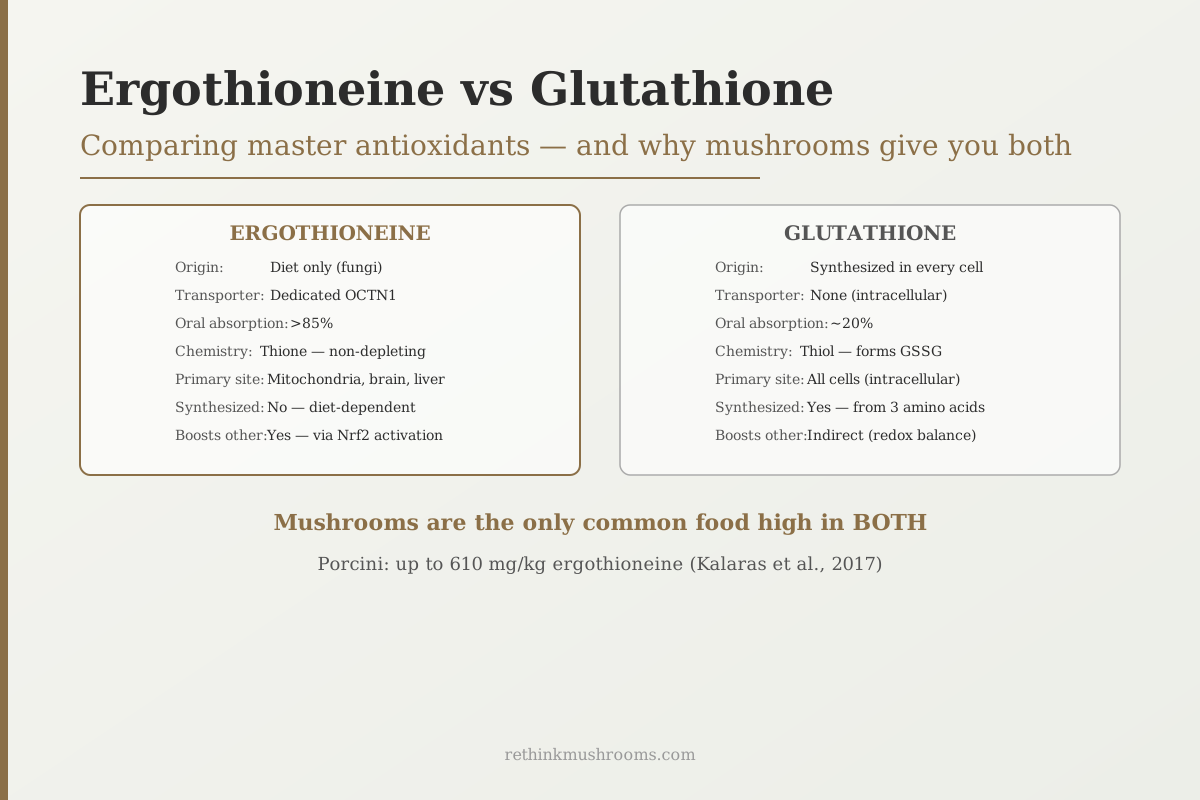
The Comparison Table
| Property | Ergothioneine | Glutathione |
|---|---|---|
| Origin | Diet only, fungi and bacteria can synthesize it; the human body cannot | Synthesized in every cell from glutamate, cysteine, and glycine |
| Dedicated transporter | Yes, OCTN1/SLC22A4, with ~50-fold selectivity | No, general intracellular production |
| Oral bioavailability | >85% via OCTN1 intestinal uptake | ~20%, largely cleaved by gut peptidases |
| Radical scavenging chemistry | Thione form, non-depleting, does not require enzymatic recycling | Forms GSSG disulfide, must be recycled by glutathione reductase |
| Primary concentration site | Mitochondria, brain, liver, erythrocytes, mapped to high-oxidative-stress tissues | Intracellular, millimolar concentrations in virtually every cell |
No single row in this table establishes either molecule as universally superior. They serve different functions in different compartments, with different trade-offs. The table's value is showing that these trade-offs are systematic, not random, each molecule is optimized for its niche.
Which Scavenges Free Radicals More Effectively? The Data
If the question is pure radical-scavenging capacity, the available evidence leans toward ergothioneine at equivalent concentrations. Cheah and Halliwell's 2022 review in Frontiers in Pharmacology found ergothioneine showed superior free radical scavenging activity compared to glutathione, Trolox (a vitamin E analogue used as a benchmark), and uric acid in head-to-head comparisons.[6]
This superiority is partly attributable to the thione chemistry described above. Ergothioneine is also effective against a broader range of reactive species: hydroxyl radicals, peroxyl radicals, superoxide, singlet oxygen, and hypochlorous acid, in addition to providing metal chelation of copper and iron ions that would otherwise catalyze Fenton reactions.[7]
The important context: in vitro scavenging comparisons do not necessarily translate to in vivo protection. Glutathione operates at millimolar intracellular concentrations; ergothioneine, despite its potency, operates at lower concentrations in most tissues. At physiological concentrations in different compartments, the comparison changes depending on which compartment you are measuring.
The Surprising Synergy: Does Ergothioneine Boost Glutathione?
The most underreported finding in this space is that the ergothioneine vs. glutathione framing may be the wrong framing. Evidence suggests they may not compete, and ergothioneine may actively support glutathione's function.
Cheah and Halliwell's 2022 Antioxidants and Redox Signaling paper identified that ergothioneine activates Nrf2 (nuclear factor erythroid 2-related factor 2), a master transcription factor that controls the expression of dozens of antioxidant and detoxification genes.[8] Among the genes Nrf2 upregulates: glutathione reductase (the enzyme that recycles GSSG back to active GSH), glutamate-cysteine ligase (the rate-limiting enzyme in glutathione biosynthesis), and glutathione peroxidase.
The implication is straightforward: by activating Nrf2, ergothioneine may secondarily increase the body's endogenous glutathione production and recycling capacity. This is a mechanism no supplement company has highlighted, it means that adequate mushroom consumption might simultaneously provide ergothioneine directly and upregulate glutathione metabolism indirectly.
This Nrf2 connection also appears in the 2023 paper by Cheah and Halliwell in Antioxidants,[10] and is consistent with the 2023 British Journal of Nutrition paper's argument that ergothioneine behaves more like an essential micronutrient than a simple supplement: its downstream effects extend beyond direct radical scavenging into regulation of the broader antioxidant network.[11]
The Longevity Vitamin Angle: Why Ergothioneine Gets Special Status
Bruce Ames' 2018 PNAS paper proposing ergothioneine as a "longevity vitamin" made a distinction that implicitly applies to the vs. glutathione comparison.[12] Ames' longevity vitamin framework identifies compounds that are not essential for immediate survival (short-term health is maintained without them) but that are required for long-term health optimization (inadequate intake leads to progressive damage that manifests over decades). Glutathione, because the body synthesizes it endogenously, is not a longevity vitamin candidate in Ames' framework. Ergothioneine is, precisely because the body cannot make it.
Cheah and Halliwell's 2023 Antioxidants review operationalized this distinction: ergothioneine is "uniquely special among diet-derived antioxidants" because its dedicated transporter and long tissue retention distinguish it qualitatively from compounds like vitamin C or E that distribute and clear rapidly.[10]
For the metabolic disease context, where both ergothioneine and glutathione play roles in endothelial protection against oxidative stress from glucose, mushroom antioxidants and advanced glycation end products in diabetes covers the intersection of mushroom antioxidants and metabolic health.
Taking Both Together: What the Research Suggests
No randomized controlled trial has tested co-supplementation of ergothioneine and glutathione. The mechanistic argument for taking both is that they target different compartments: ergothioneine concentrates in mitochondria and specific high-stress tissues; glutathione manages intracellular redox balance in all cells. If the Nrf2 synergy holds, ergothioneine supplementation may also raise endogenous glutathione levels, making it the more upstream intervention.
The practical answer for most people is the same as the biological answer: eat mushrooms. Mushrooms, particularly porcini, shiitake, oyster, and cremini, provide substantial amounts of both antioxidants in the form they naturally co-occur. The Penn State analysis that opened this article found that mushrooms contain the highest levels of both ergothioneine and glutathione of any common food tested, including foods like avocado and asparagus that are often cited as glutathione sources.[1]
For a detailed breakdown of which mushroom species deliver the most ergothioneine per serving, ergothioneine content by mushroom species: a complete ranking covers the species-by-species data.
For the full mitochondrial evidence on ergothioneine, both the mechanism and the longevity implications are covered in ergothioneine and mitochondrial protection and ergothioneine: preserving your cellular powerhouses.
The Bottom Line
Ergothioneine and glutathione are both sulfur-containing antioxidants, but they operate through different strategies: ergothioneine uses a dedicated transporter (OCTN1) to concentrate in specific high-stress tissues, achieves greater than 85% oral bioavailability, and uses thione chemistry that does not deplete on radical neutralization; glutathione is synthesized endogenously in every cell, distributes broadly intracellularly, but achieves only ~20% oral bioavailability as a supplement. The most underreported finding is that ergothioneine activates Nrf2, which upregulates glutathione recycling and biosynthesis enzymes, suggesting the two are not competing antioxidants but complementary ones, with ergothioneine potentially supporting the broader glutathione system.
Frequently Asked Questions
Sources & References
- 1. Source details for this reference are not yet available.
- 2. Source details for this reference are not yet available.
- 3. Source details for this reference are not yet available.
- 4. Source details for this reference are not yet available.
- 5. Source details for this reference are not yet available.
- 6. Source details for this reference are not yet available.
- 7. Source details for this reference are not yet available.
- 8. Source details for this reference are not yet available.
- 9. Source details for this reference are not yet available.
- 10. Source details for this reference are not yet available.
- 11. Source details for this reference are not yet available.
- 12. Source details for this reference are not yet available.