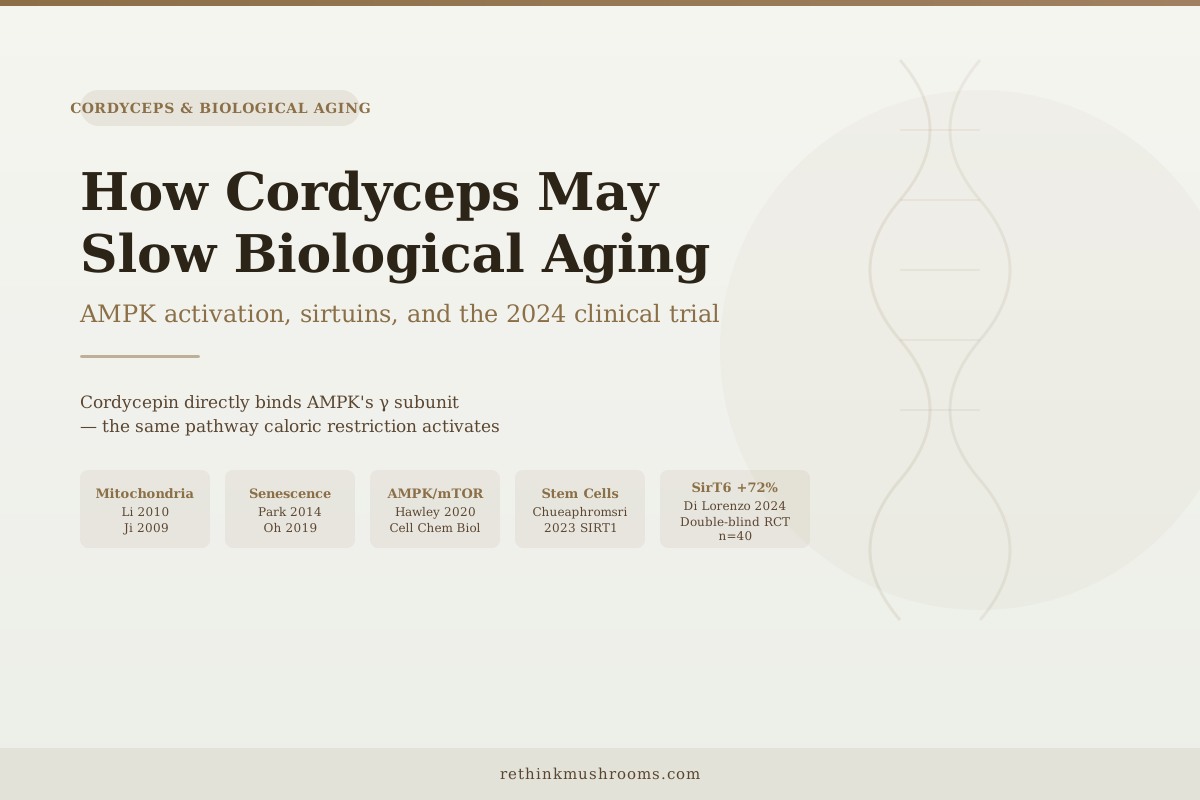
Cordyceps & Biological Aging
+72% SirT6 increase
A 2024 double-blind clinical trial found Cordyceps sinensis extract raised SirT6 (the sirtuin governing DNA repair and genomic stability) by 72% after 28 days, alongside SirT1 +33%, NAD+ +20%, ATP production +68%, and wrinkle reduction of 28%.
Di Lorenzo et al., International Journal of Molecular Sciences, 2024
AMPK
cordycepin directly binds AMPK's γ subunit, the same pathway activated by caloric restriction (Hawley 2020, Cell Chemical Biology)
5 hallmarks
preclinical studies map cordyceps to five recognized Hallmarks of Aging across different mechanisms
1 RCT
one double-blind clinical trial exists (Di Lorenzo 2024, n=40) measuring sirtuin biomarkers in human skin
Di Lorenzo et al., International Journal of Molecular Sciences, 2024
 View as image ↗
In 2020, a team publishing in Cell Chemical Biology proved that cordycepin, the primary bioactive compound in Cordyceps mushrooms, directly binds the γ subunit of AMPK. AMPK is the cell's master energy sensor, the same molecular switch that caloric restriction and exercise activate to produce longevity-related effects in organisms from yeast to mammals. The paper by Hawley and colleagues was not written about mushrooms. It was written about basic cellular biochemistry. Cordycepin happened to activate one of the most studied longevity pathways in biology.
That mechanistic finding is one of eleven data points this article covers. Together they map a picture that no competitor article on cordyceps has assembled: cordyceps compounds address multiple recognized hallmarks of biological aging through distinct molecular mechanisms, and as of 2024, there is one controlled human trial measuring the outcomes.
Key Takeaways
- Cordycepin directly binds and activates AMPK's γ subunit (Hawley et al., Cell Chemical Biology, 2020), the same cellular energy sensor that caloric restriction activates, establishing a precise molecular basis for cordyceps' longevity-related effects
- A 2024 double-blind RCT (Di Lorenzo et al., n=40) found Cordyceps sinensis extract increased SirT1 +33%, SirT3 +10%, SirT6 +72%, NAD+ +20%, and ATP production +68% in 28 days; wrinkle reduction of 28% was the clinical endpoint
- Cordyceps addresses at least five Hallmarks of Aging in preclinical models: mitochondrial dysfunction (Li 2010, Ji 2009), cellular senescence (Park 2014), deregulated nutrient sensing (Hawley 2020, Chen 2021), stem cell exhaustion (Chueaphromsri 2023), and epigenomic alterations (Di Lorenzo 2024 SirT6)
- Park et al. (2014, Nutrients) showed C. militaris extract reduced SA-β-galactosidase-positive senescent cell accumulation in human dermal fibroblasts, with ROS reduction exceeding 55%, providing direct senescence biomarker data in human cells
- Oh et al. (2019) found cordycepin accumulates in C. militaris fruiting bodies specifically during the fungal senescence stage; the mushroom itself produces more of its primary anti-aging compound when it is under cellular stress
- All mechanistic anti-aging evidence is preclinical (animal models and cell cultures); Di Lorenzo 2024 is the only human RCT, and it measured skin biomarkers in 40 people, not longevity endpoints
Biological vs. Chronological Aging: What Research Measures
Chronological age is the number of years a person has been alive. Biological age is a different measure: the accumulated cellular damage, functional decline, and molecular deterioration that drive aging-related disease and death. Two people who are both 60 years old can have very different biological ages depending on genetics, lifestyle, environment, and cellular repair capacity.
Modern aging biology, particularly since the publication of the Hallmarks of Aging framework in Cell in 2013, has moved away from asking "how do we stop aging" toward asking "which specific cellular processes drive biological aging, and how can we slow them?" The original framework identified nine hallmarks; they have since been updated and expanded. Among the most consistently supported are mitochondrial dysfunction, cellular senescence, deregulated nutrient sensing, stem cell exhaustion, and epigenomic alterations.
Cordyceps research touches each of these hallmarks through distinct but mechanistically overlapping pathways. This article uses that framework to organize what the evidence shows.
Hallmark 1: Mitochondrial Dysfunction
Mitochondria are the cell's energy factories, converting nutrients into ATP, the molecule that powers most cellular processes. As cells age, mitochondria accumulate damage, their membrane potential drops, and they produce less ATP while generating more reactive oxygen species (ROS), the unstable molecules that damage surrounding cellular machinery. Mitochondrial dysfunction is now understood as both a cause and a consequence of biological aging.
Li and colleagues demonstrated in 2010 that Cordyceps militaris polysaccharides directly inhibited mitochondrial injury in aged mice.[2] The polysaccharides scavenged superoxide anions, one of the primary ROS species generated by dysfunctional mitochondria, and increased the activity of antioxidant enzymes in the treated animals. The net effect was measurable reversal of age-associated mitochondrial decline markers.
Ji and colleagues' 2009 study in D-galactose-induced aging mice showed similar results: Cordyceps sinensis extract improved superoxide dismutase (SOD), glutathione peroxidase (GPx), and catalase activity while reducing lipid peroxidation and monoamine oxidase (MAO) activity.[1] D-galactose administration produces an accelerated aging state that mirrors natural aging at the biochemical level; reversing its effects with Cordyceps extract demonstrates the compound class can act against aging-associated oxidative damage.
SOD, GPx, and catalase are the cell's own antioxidant defense enzymes. When they decline with age, ROS accumulate, and cellular damage accelerates. When they increase under Cordyceps treatment, the cell's internal repair capacity improves.
Hallmark 2: Cellular Senescence, Including a Fascinating Meta-Story
Cellular senescence occurs when a cell permanently stops dividing without dying. Senescent cells accumulate with age, release inflammatory signals that damage neighboring tissue, and consume cellular resources without contributing to tissue function. Senescent cell accumulation is now recognized as a primary driver of age-related decline across multiple organ systems.
Park and colleagues demonstrated in 2014 that Cordyceps militaris extract directly addresses cellular senescence in human dermal fibroblasts.[3] The study used SA-β-galactosidase staining, the standard laboratory marker for senescent cells, and found that C. militaris extract inhibited the accumulation of SA-β-gal-positive cells under oxidative stress conditions. The extract also reduced ROS levels by more than 55% and prevented H2O2-induced apoptosis in the same cell line.
This was not rodent data. Park's experiment used human dermal fibroblasts, the connective tissue cells of human skin, which are the same cell type used to model skin aging. The senescence biomarker finding is among the most directly relevant to human biology of any Cordyceps aging study.
Then there is the meta-story that makes this biology more interesting than a dry mechanism summary.
In 2019, Oh and colleagues conducted metabolomic profiling of C. militaris fruiting bodies at different stages of development and found something unexpected: cordycepin accumulates specifically during the senescence stage of the fungus itself.[4]
The mushroom, as it undergoes its own cellular senescence, upregulates production of the very compound that counteracts senescence in other organisms. This is not anthropomorphism. It likely reflects an evolutionary cellular stress response: when the fungus's own cells are under senescence pressure, they ramp up production of a compound that originally served as a defensive metabolite. That compound happens to be, by the same logic, anti-senescent in mammalian cells.
Hallmark 3: Deregulated Nutrient Sensing: Mimicking Caloric Restriction
Deregulated nutrient sensing refers to the age-related failure of the cellular systems that respond to available energy. In a young organism, the cell can rapidly switch between growth mode (when nutrients are abundant) and survival/maintenance mode (when nutrients are scarce). The survival mode activates repair processes, mitochondrial maintenance, and autophagy. As organisms age, this switching becomes less efficient, and cells remain locked in growth mode even when repair is more adaptive.
AMPK is the central regulator of this switching. When AMPK is active, it suppresses the growth-promoting mTOR complex, activates autophagy, promotes mitochondrial biogenesis, and shifts cellular metabolism toward fat burning and energy conservation. Caloric restriction activates AMPK; so does exercise. Both are among the most reliably lifespan-extending interventions known in biology.
In 2020, Hawley and colleagues published the mechanistic paper that explained precisely how cordycepin fits into this picture.[5] Using biophysical methods in Cell Chemical Biology, they demonstrated that cordycepin directly binds the γ (gamma) subunit of AMPK, which is the regulatory domain that normally senses AMP levels and activates the kinase when cellular energy is low. By binding the same site, cordycepin activates AMPK even when cellular energy is adequate, producing the same downstream effects as caloric restriction without the caloric restriction itself.
This is a specific molecular mechanism, not a general "antioxidant" claim. Cordycepin binds a specific protein domain and produces specific downstream cellular responses.
One of those downstream responses is autophagy. Chen and colleagues' 2021 review in Molecules synthesized the evidence showing cordycepin promotes autophagy through AMPK-mediated inhibition of mTOR.[6] Autophagy, the cell's internal recycling system for damaged proteins and organelles, declines with age and is one of the primary mechanisms by which caloric restriction and rapamycin extend lifespan in model organisms. Cordycepin activates the same autophagy axis through AMPK.
For the full mechanistic picture of cordycepin's upstream adenosine signaling, see How Cordycepin Enhances Adenosine Signaling.
Hallmark 4: Stem Cell Exhaustion: SIRT1 and the Preservation of Regenerative Capacity
As organisms age, the pool of stem cells that replenish tissues diminishes. The remaining stem cells lose their regenerative capacity (called stemness), and tissues become progressively less able to repair damage. This is stem cell exhaustion, one of the most directly observable hallmarks of biological aging.
Sirtuins are a family of NAD+-dependent proteins that regulate gene expression, DNA repair, and cellular metabolism. SIRT1, the most studied sirtuin, directly supports stem cell maintenance. As NAD+ levels decline with aging, SIRT1 activity drops, and stem cell function degrades.
Chueaphromsri and colleagues demonstrated in 2023 that cordycepin treatment significantly enhanced SIRT1 expression in human mesenchymal stem cells and preserved their stemness markers.[8] Mesenchymal stem cells are multipotent progenitor cells involved in tissue repair throughout the body. When their SIRT1 expression declines, their ability to differentiate and replenish damaged tissue decreases.
Cordycepin reversed this pattern in human stem cells. Treated cells maintained higher SIRT1 expression and preserved their characteristic stemness markers, suggesting a molecular mechanism for slowing the loss of regenerative capacity that is one of biological aging's most clinically significant consequences.
This connects to the Chai and colleagues 2022 study, which found that cordycepin activates the TIGAR/SIRT1/PGC-1α signaling cascade in the context of muscle fatigue research.[7] PGC-1α is a master regulator of mitochondrial biogenesis; it governs the production of new mitochondria and the maintenance of existing ones. SIRT1 activates PGC-1α, and cordycepin activates SIRT1. The pathway produces the same downstream benefit as NAD+ supplementation strategies (like NMN or NR) that have attracted significant longevity research attention, but through a different upstream mechanism.
For a full comparison of how cordyceps positions against NMN/NR approaches, see Cordyceps and NAD+ Metabolism: The Anti-Aging Energy Connection.
Hallmark 5: Epigenomic Alterations: SirT6 and DNA Repair
Epigenomic alterations (changes in how genes are expressed without changes to the DNA sequence itself) are now recognized as a primary driver of biological aging. As cells age, the pattern of gene expression shifts in ways that promote inflammation, reduce DNA repair capacity, and impair metabolic regulation. One of the key enzymes governing this regulation is SirT6.
SirT6 is a sirtuin with a specific role in DNA repair and genomic stability. It deacetylates histone proteins (the proteins around which DNA is wound), regulating access to the DNA for repair machinery. When SirT6 is active, DNA damage is more efficiently detected and repaired. When SirT6 activity declines with age, unrepaired DNA damage accumulates and genome integrity degrades. Overexpressing SirT6 extends lifespan in male mice; it is one of the most compelling sirtuin longevity targets in modern geroscience.
The Di Lorenzo 2024 clinical trial found that Cordyceps sinensis extract increased SirT6 by 72% in 28 days.[9] That is a larger increase than the SirT1 finding (33%) and SirT3 finding (10%) from the same trial, and it targets the epigenomic hallmark most directly. SirT6 is the reason the Di Lorenzo 2024 finding is particularly interesting to aging researchers rather than just general wellness audiences.
The Clinical Evidence: What the 2024 Double-Blind Trial Actually Found
The Di Lorenzo 2024 paper is the only controlled human trial measuring sirtuin biomarkers after Cordyceps supplementation, and it warrants a detailed reading.
Study design: double-blind, placebo-controlled, randomized trial. Population: 40 participants. Duration: 28 days. The intervention was a proprietary Cordyceps sinensis extract standardized for NAD+ synthesis support.
Primary biological outcomes at day 28 compared to baseline:
- SirT1: +33%
- SirT3: +10%
- SirT6: +72%
- NAD+ synthesis: +20%
- ATP production: +68%
- Skin energy: +52%
In vitro assays on skin cell models run alongside the trial:
- ROS reduction: 30%
- Collagen synthesis: +69% in treated fibroblasts
Clinical skin endpoint measured by dermatological assessment:
- Wrinkle reduction: 28%
The trial has limitations that should be stated clearly. Forty participants is a small sample. The 28-day duration is short. The extract is proprietary, which means the results may not generalize to all Cordyceps products. Sirtuin levels measured in skin cells or in blood may not reflect sirtuin activity in other tissues. And wrinkle reduction, while a clinically visible endpoint, is not a longevity endpoint.
What it does establish: Cordyceps sinensis extract produced measurable, statistically significant changes in sirtuin biomarkers and skin aging markers in a controlled human trial. That is more than most natural compounds with anti-aging claims can demonstrate.
For the broader clinical and preclinical skin aging data, see Cordyceps and Skin Aging: Antioxidant Research. For the full longevity research landscape including animal model data, see Cordyceps and Anti-Aging: Research on Longevity.
Cross-Species Confirmation: The Mechanism Holds Across Cordyceps
One potential concern with any Cordyceps research is that C. militaris and C. sinensis are different species with overlapping but not identical compound profiles. A 2025 study by Liao and colleagues addressed this directly by testing Cordyceps cicadae (a third species) in a D-galactose-induced aging rat model.[10]
Liao's results confirmed the AMPK/SIRT1 pathway activation across the species boundary: C. cicadae extract elevated SOD and GPx activity while reducing malondialdehyde (MDA, a lipid peroxidation marker), and the upstream pathway driving these effects was the AMPK/SIRT1 axis.
The consistency across three Cordyceps species suggests the anti-aging mechanism is not specific to a single species' unique compound profile but reflects a broader property of the Cordyceps genus, likely driven by cordycepin's AMPK-activating mechanism combined with polysaccharide-mediated antioxidant effects.
For how Cordyceps anti-aging mechanisms compare to those of reishi, which approaches senescence differently through ganoderic acids rather than AMPK, see Ganoderma lucidum and Cellular Senescence and Reishi and Longevity: Why It's Called the Mushroom of Immortality.
What the Evidence Cannot Yet Claim
The case that cordyceps addresses multiple biological aging hallmarks through specific molecular mechanisms is well-supported at the preclinical level. A 2020 comprehensive review by Ashraf and colleagues in Molecules established cordycepin as the primary bioactive driving these effects, synthesizing the antioxidant, immunomodulatory, and metabolic evidence across dozens of studies.[11]
What the evidence cannot yet claim:
Lifespan extension in humans. No human clinical trial has measured whether Cordyceps supplementation extends human lifespan or healthspan. The Di Lorenzo 2024 trial measured biomarkers over 28 days, not clinical aging endpoints over years. The absence of long-term human trials is the defining gap between the compelling mechanistic picture and clinical certainty.
Equivalence across products. Cordycepin content varies dramatically between Cordyceps products depending on species, cultivation method, and processing. Research conducted on whole extract may not translate to standardized cordycepin capsules. Research conducted on fresh fruiting bodies may not translate to mycelium-on-grain products.
Dose-response clarity. The Di Lorenzo 2024 trial used a proprietary standardized extract. The animal model studies used various doses and preparations. There is no established minimum effective dose for any specific aging-related outcome in humans.
Specificity of mechanism. Activation of AMPK and SIRT1 has broad downstream consequences that are generally understood as beneficial for longevity. But the same pathways also operate in cancer biology, immune regulation, and other systems. The effects of chronic Cordyceps supplementation on these interconnected pathways in human beings over years has not been studied.
The honest summary: Cordyceps is among the most mechanistically interesting natural compounds in aging biology, precisely because cordycepin was independently discovered to bind AMPK's γ subunit through rigorous biochemistry published in a top-tier journal. The clinical picture is small but real. The mechanistic picture is detailed but almost entirely preclinical. The gap between those two levels of evidence is where the meaningful scientific work on Cordyceps and biological aging still needs to happen.
For the full picture of how Cordyceps protects against oxidative stress at the cellular level, see Cordyceps and Cellular Aging: Oxidative Stress Protection.
The Bottom Line
Cordyceps addresses multiple Hallmarks of Aging through distinct mechanisms: AMPK activation (cordycepin binds AMPK's γ subunit, per Hawley 2020 in Cell Chemical Biology), sirtuin upregulation (SIRT1 in stem cells, SirT6 +72% in the 2024 clinical trial), cellular senescence prevention (SA-β-gal reduction in human fibroblasts, Park 2014), mitochondrial protection (Li 2010, Ji 2009), and autophagy promotion (Chen 2021). The 2024 Di Lorenzo double-blind RCT (n=40) provides the only human evidence, showing measurable sirtuin biomarker changes and 28% wrinkle reduction in 28 days. All mechanistic evidence is animal or in vitro; no human longevity trial exists.
Frequently Asked Questions
Sources & References
- 1RTHM-00156·Ji, Deng-Bo et al. (2009). “Antiaging effect of Cordyceps sinensis extract..” Phytotherapy research : PTR.Study breakdown →PubMed →↩
- 2RTHM-00191·Li, Xing-Tai et al. (2010). “Protective effects on mitochondria and anti-aging activity of polysaccharides from cultivated fruiting bodies of Cordyceps militaris..” The American journal of Chinese medicine.Study breakdown →PubMed →↩
- 3RTHM-00633·Park, Jun Myoung et al. (2014). “Cordyceps militaris extract protects human dermal fibroblasts against oxidative stress-induced apoptosis and premature senescence..” Nutrients.Study breakdown →PubMed →↩
- 4RTHM-00582·Oh, Junsang et al. (2019). “Metabolomic profiling reveals enrichment of cordycepin in senescence process of Cordyceps militaris fruit bodies..” Journal of microbiology (Seoul.Study breakdown →PubMed →↩
- 5RTHM-00618·Hawley, Simon A et al. (2020). “Mechanism of Activation of AMPK by Cordycepin..” Cell chemical biology.Study breakdown →PubMed →↩
- 6RTHM-00680·Chen, Yu-Ying et al. (2021). “The Role of Autophagy in Anti-Cancer and Health Promoting Effects of Cordycepin..” Molecules (Basel.Study breakdown →PubMed →↩
- 7RTHM-00749·Chai, Xiaoming et al. (2022). “Cordycepin exhibits anti-fatigue effect via activating TIGAR/SIRT1/PGC-1α signaling pathway..” Biochemical and biophysical research communications.Study breakdown →PubMed →↩
- 8RTHM-00820·Chueaphromsri, Phongsakorn et al. (2023). “Cordycepin Enhances SIRT1 Expression and Maintains Stemness of Human Mesenchymal Stem Cells..” In vivo (Athens.Study breakdown →PubMed →↩
- 9RTHM-00873·Di Lorenzo, Ritamaria et al. (2024). “NAD-Driven Sirtuin Activation by Cordyceps sinensis Extract: Exploring the Adaptogenic Potential to Promote Skin Longevity..” International journal of molecular sciences.Study breakdown →PubMed →↩
- 10RTHM-02130·Liao, Yangzhen et al. (2025). “Cordyceps cicadae Extracts Exert Antiaging Effects by Activating the AMPK/SIRT1 Pathway in d-Galactose-Induced Aging Rats..” Journal of medicinal food.Study breakdown →PubMed →↩
- 11RTHM-00605·Ashraf, Syed Amir et al. (2020). “Cordycepin for Health and Wellbeing: A Potent Bioactive Metabolite of an Entomopathogenic Cordyceps Medicinal Fungus and Its Nutraceutical and Therapeutic Potential..” Molecules (Basel.Study breakdown →PubMed →↩