Reishi Anti-Aging & Longevity
2025 Nature Commun.
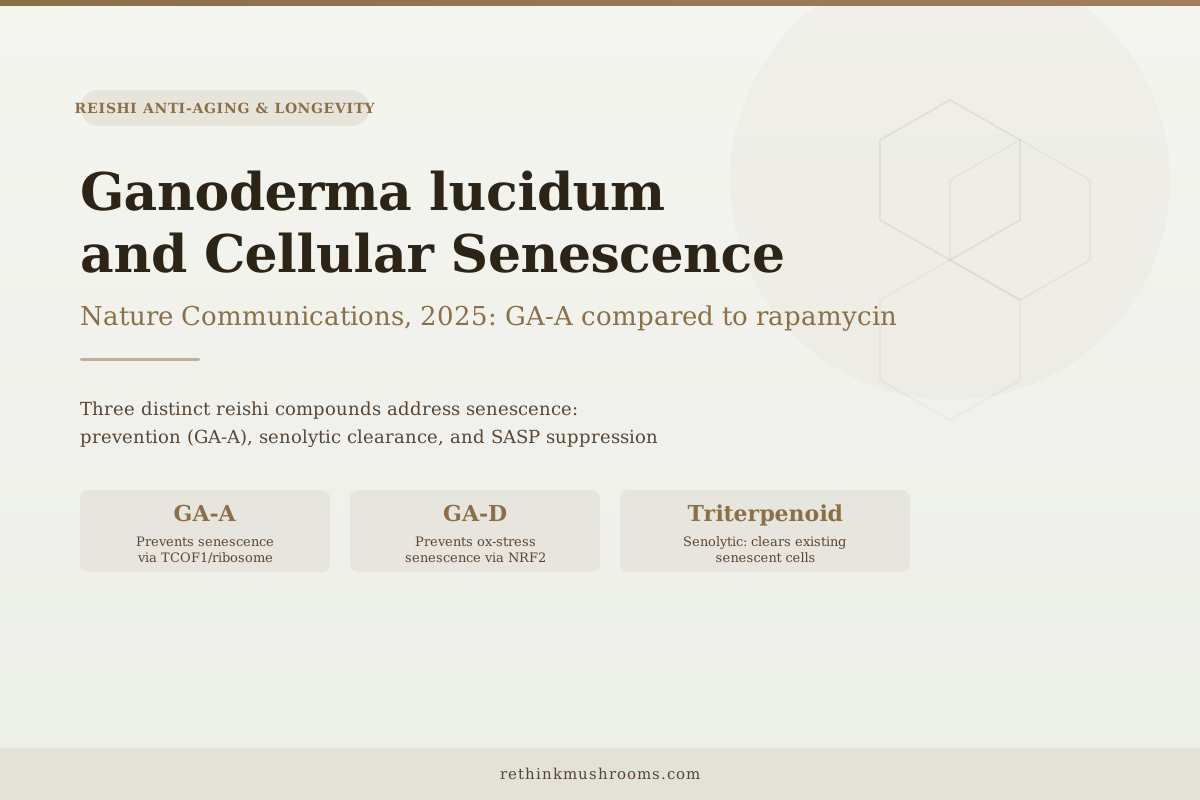
A 2025 Nature Communications study identified ganoderic acid A from reishi as a senotherapeutic that prevents cellular senescence and extends healthspan in mice as effectively as rapamycin.
Chen et al., Nature Communications, 2025
GA-A
ganoderic acid A prevents senescence by targeting TCOF1 to maintain ribosome homeostasis
p16/p21
senescence markers downregulated by Ganoderma extract in human dermal fibroblasts (Kuhnel 2025)
Senolytic
reishi triterpenoid complex selectively clears already-senescent cells via caspase-dependent apoptosis
Chen et al., Nature Communications, 2025
 View as image ↗
In 2025, researchers published a study in Nature Communications identifying a specific compound in reishi mushrooms as a senotherapeutic, a substance that prevents cells from entering the damaging state known as cellular senescence. The compound, ganoderic acid A, extended healthspan in mice and roundworms as effectively as rapamycin, one of the best-studied longevity drugs in modern biology.
No competitor article on reishi mushroom and aging has covered this finding. The cellular senescence angle of reishi research is, as of this writing, entirely unaddressed by every supplement site, wellness publication, and mushroom blog that covers the topic.
This article explains what cellular senescence is, what multiple reishi compounds do to it, and what the evidence actually shows and doesn't show.
Key Takeaways
- A 2025 Nature Communications study found that ganoderic acid A (GA-A) from reishi prevents cellular senescence across multiple cell types and extends healthspan in roundworms and mice comparably to rapamycin; the mechanism involves binding a protein called TCOF1 to maintain ribosome function
- A 2025 study by Kuhnel et al. found that Ganoderma extract downregulates the senescence-driving genes p16 (CDKN2A), p21 (CDKN1A), and TP53 in human primary dermal fibroblasts, representing human cell data for reishi's anti-senescence effects
- Abdelmoaty et al. (2024) demonstrated that a reishi triterpenoid complex acts as a senolytic: it selectively clears already-senescent cells via caspase-driven programmed cell death while blocking SASP (the inflammatory signals senescent cells release) through NF-kB/TFEB/mTOR suppression
- Yuan et al. (2022, Aging Cell) showed that ganoderic acid D (GA-D) prevents oxidative stress from triggering senescence in human stem cells by binding a regulatory protein (14-3-3 epsilon) to activate the CaM/CaMKII/NRF2 anti-oxidant signaling chain
- Peng et al. (2021) found that Ganoderma extract activates autophagy (the cell's self-cleaning system) through DAF-16/FOXO and SKN-1/Nrf2 pathways in both roundworms and human cells, extending lifespan via the same mechanism
- All senescence evidence is preclinical; no human clinical trials have tested reishi compounds against cellular senescence as a primary endpoint
What Cellular Senescence Is and Why It Accelerates Aging
Cellular senescence is what happens when a cell stops dividing but does not die. A senescent cell sits in the body in a kind of suspended state, biologically active but no longer contributing to tissue function. On their own, a few senescent cells would be manageable. The problem is what they do to their neighbors.
Senescent cells secrete a set of inflammatory proteins, growth factors, and enzymes called the SASP, which stands for senescence-associated secretory phenotype. Think of SASP as a distress signal broadcast continuously by cells that are damaged but won't clear themselves. The surrounding tissue picks up this signal, and over time, neighboring cells begin to deteriorate. Chronic SASP accumulation is now understood to drive a range of age-related conditions including chronic inflammation, tissue stiffness, immune dysfunction, and the structural deterioration of organs.
The biology of cellular aging has two distinct challenges: first, preventing healthy cells from entering senescence prematurely; second, clearing the senescent cells that have already accumulated. Compounds that address the first problem are called senotherapeutics. Compounds that address the second are called senolytics.
Reishi (Ganoderma lucidum) has now been shown in preclinical models to contain compounds with both activities, through different mechanisms. The research is entirely preclinical, but the specificity and convergence of the findings across several independent research groups is unusual.
For the broader reishi anti-aging landscape, Wang and colleagues' 2017 review in Aging & Disease mapped how Ganoderma lucidum addresses multiple hallmarks of aging simultaneously, including oxidative stress, mitochondrial dysfunction, immune senescence, and telomere attrition.[6]
The 2025 Nature Communications Discovery: Ganoderic Acid A as a Senotherapeutic
The most significant senescence-related finding in the reishi literature comes from Chen and colleagues, published in Nature Communications in 2025.[1]
Chen's team used a high-content screening method, testing a large number of compounds for their ability to prevent cells from entering senescence, measured through the cellular markers that senescent cells express. Ganoderic acid A (GA-A) emerged from this screen as a senotherapeutic, a compound that prevents senescence from occurring across multiple cell types.
The key mechanistic finding: GA-A works by binding a protein called TCOF1.
TCOF1 is a protein that plays a central role in maintaining the health of the cell's ribosomes, the molecular machines responsible for manufacturing proteins. When TCOF1 function is disrupted by cellular stress, the ribosomes become unstable, which triggers a cascade that pushes the cell toward senescence. GA-A prevents this by stabilizing TCOF1's activity, preserving ribosome homeostasis, and thereby blocking the entry point into senescence.
The in vivo results were striking. GA-A extended healthspan in Caenorhabditis elegans (a widely used roundworm model for aging research) and in mice. The magnitude of the healthspan extension was comparable to rapamycin, a drug originally developed as an immunosuppressant that has since become one of the most-studied longevity interventions in biology, with documented lifespan extension across multiple model organisms.
The comparison to rapamycin is not a marketing claim. It is the direct comparison made in the Chen 2025 paper. Whether this comparison will translate to human benefit cannot be determined from the study. What it demonstrates is that GA-A produces effects on a par with the most potent longevity compound currently under active study in aging biology.
For deeper reading on the specific compound, see Ganoderic Acid A, B, and Beyond: Individual Compound Research.
Human Fibroblast Data: How Reishi Affects Senescence Marker Genes
The Chen 2025 study is the headline, but a second 2025 paper provides evidence in a more immediately human-relevant model.
Kuhnel and colleagues tested a standardized Ganoderma lucidum extract on human primary dermal fibroblasts, the connective tissue cells of human skin and a well-established model for studying cellular aging.[2] They measured changes in gene expression using quantitative PCR, looking specifically at genes associated with senescence.
The results: Ganoderma extract downregulated CDKN2A (the gene encoding p16), CDKN1A (the gene encoding p21), and TP53: three of the most important senescence-driving proteins in human biology.
Plain language: p16 and p21 are proteins that force cells into a permanent stop. When either protein accumulates, the cell locks itself out of the cell cycle and becomes senescent. TP53, known as the guardian of the genome, activates both p16 and p21 in response to cellular damage. All three were less active in the Ganoderma-treated fibroblasts.
Kuhnel's team also found upregulation of cytoprotective gene sets, meaning the cells were better equipped to handle stress without entering senescence in the first place. The extract did not simply suppress senescence markers in isolation. It appeared to shift the cells' overall stress response in a direction that favors resilience over senescent arrest.
This is human cell data, not roundworm or mouse data, which moves it one step closer to clinical relevance while remaining, fundamentally, a preclinical finding.
The Senolytic Finding: Clearing Already-Senescent Cells
Prevention is one half of the senescence problem. The other half is what to do about senescent cells already present in tissue.
In 2024, Abdelmoaty and colleagues tested a reishi triterpenoid complex for senolytic activity (the ability to selectively eliminate senescent cells) using adriamycin-induced senescent hepatocellular carcinoma (liver cancer) cells, first in vitro and then in an in vivo tumor model.[3]
The triterpenoid complex showed two distinct effects:
First, it selectively killed senescent cells via caspase-dependent apoptosis. Caspases are a family of proteins that execute programmed cell death in an orderly fashion. The senescent cells activated their caspase cascade and died; non-senescent cells were relatively unaffected. This is the defining characteristic of a senolytic.
Second, the complex suppressed SASP by blocking NF-kB, TFEB, and mTOR signaling pathways. These are the molecular switches that senescent cells use to produce and broadcast their inflammatory signals. By blocking them, the reishi compounds reduced the inflammatory damage that senescent cells would otherwise cause.
A senolytic that also suppresses the damage mechanism of surviving senescent cells is, conceptually, addressing the problem from two angles simultaneously. The senolytic mechanism itself was characterized in cell culture; the paper's in vivo work tested tumor growth in a cancer model, not senescent-cell burden in aging tissue. The clinical significance for human aging remains unknown, but the mechanistic picture is coherent.
For background on the broader triterpene compound class, see Ganoderic Acids: The Unique Triterpenes in Reishi.
GA-D's Mechanism: How a Second Ganoderic Acid Blocks Oxidative Senescence
Ganoderic acid D (GA-D) is a different compound from GA-A, and it prevents senescence through a completely different molecular route.
In 2022, Yuan and colleagues published research in Aging Cell showing that GA-D prevents oxidative stress from triggering senescence in human mesenchymal stem cells, a type of multipotent cell involved in tissue repair throughout the body.[4]
The mechanism begins with a regulatory protein called 14-3-3 epsilon (14-3-3ε). This protein acts as a molecular gatekeeper inside cells, controlling the activity of other proteins. Under oxidative stress, 14-3-3ε dysfunction contributes to the cascade that drives cells into senescence.
GA-D binds directly to 14-3-3ε. This binding activates a signaling chain: GA-D binds 14-3-3ε, which activates calmodulin (CaM, a calcium-sensing protein), which activates CaMKII (a kinase that calmodulin triggers), which activates NRF2 (the master switch for antioxidant gene expression). When NRF2 is active, the cell turns on a battery of antioxidant enzymes that neutralize the oxidative stress before it can push the cell into senescence.
In plain terms: GA-D interrupts the path from oxidative stress to cellular aging by activating the cell's own antioxidant defenses through a specific protein binding sequence.
Yuan's team tested this in human mesenchymal stem cells specifically. Stem cells are particularly relevant to aging because they are responsible for tissue renewal throughout the body. Senescence in the stem cell pool is a well-established contributor to age-related tissue decline. Preventing stem cell senescence is not peripheral to aging biology; it is central to it.
For the broader NRF2 antioxidant story in reishi, see Reishi and Oxidative Stress: The Anti-Aging Antioxidant Connection.
Autophagy: The Self-Cleaning Mechanism That Prevents Senescent Accumulation
A third pathway connects reishi to senescence biology: autophagy.
Autophagy is the cell's internal recycling system. When cellular components become damaged, autophagy packages them and delivers them to lysosomes (the cell's waste-processing centers) for breakdown and disposal. When autophagy works well, damaged proteins and organelles are cleared before they can accumulate into the kind of dysfunction that drives senescence. When autophagy declines, as it does with aging, the debris builds up.
In 2021, Peng and colleagues tested Ganoderma extract in both C. elegans and human cells and found that the extract extends lifespan specifically by activating autophagy.[5] The mechanisms involved were the DAF-16/FOXO pathway (the roundworm/human longevity gene switch) and SKN-1/Nrf2 (the antioxidant master regulator). Both pathways converged on enhanced autophagic activity.
When the researchers blocked autophagy pharmacologically, the lifespan-extending effect of the Ganoderma extract disappeared. This confirms that autophagy is not a side effect but the actual mechanism driving the benefit.
The connection to senescence is direct: cells with higher autophagic activity are better at clearing the damaged components that would otherwise trigger senescence entry. Peng's finding positions autophagy as the biological mechanism bridging reishi exposure to reduced senescent cell accumulation.
In 2024, Okoro and colleagues extended this picture by identifying methyl ganoderate E as a specific reishi compound that extends C. elegans median lifespan via DAF-16/FOXO nuclear translocation and upregulation of stress resistance genes.[7] The compound-level specificity now covers multiple distinct ganoderic acids with distinct targets: GA-A on ribosome homeostasis, GA-D on the CaM/CaMKII/NRF2 axis, methyl ganoderate E on the FOXO pathway.
For the broader longevity picture across reishi compounds, see Reishi and Longevity: Why It's Called the "Mushroom of Immortality".
Compound Map
One Mushroom, Several Compounds, Two Jobs
Reishi’s anti-senescence evidence is not one finding but several distinct compounds, each hitting a different molecular target. They split across the two halves of the senescence problem: most prevent healthy cells from becoming senescent; one clears cells that already are. Every row is a separate preclinical study.
Ganoderic acid A (GA-A)
preventsBinds TCOF1 to preserve ribosome homeostasis
Ganoderma extract
preventsDownregulates p16 / p21 / TP53 senescence genes
Triterpenoid complex
clearsCaspase-driven apoptosis + SASP block (NF-κB / TFEB / mTOR)
Ganoderic acid D (GA-D)
preventsBinds 14-3-3ε to fire CaM / CaMKII / NRF2 antioxidant chain
Extract + methyl ganoderate E
preventsActivates autophagy via DAF-16/FOXO and SKN-1/Nrf2
How to read it: the breadth is the point — several independent compounds, several targets, both halves of the senescence problem covered. Every box is preclinical (cells, worms, or mice). Convergent, mechanism-specific findings raise plausibility; none has been tested against senescence in a living person.
Sources: Chen 2025 [1]; Kuhnel 2025 [2]; Abdelmoaty 2024 [3]; Yuan 2022 [4]; Peng 2021 [5]; Okoro 2024 [7]. Grouping is illustrative of mechanism and model system, not quantitative effect sizes.
What the Research Cannot Yet Tell Us
The cellular senescence data for Ganoderma lucidum is some of the most mechanistically specific and scientifically current in the medicinal mushroom literature. The Chen 2025 Nature Communications paper represents a level of research rigor uncommon in the mushroom science space. The convergence of findings across four independent research groups (Chen, Kuhnel, Abdelmoaty, Yuan), using different compounds (GA-A, GA-D, triterpenoid complex, whole extract) and different cellular models (fibroblasts, stem cells, liver cancer cells, worm models), is striking.
None of it involves human subjects with measured senescence outcomes.
Cellular senescence research in humans is genuinely difficult: measuring senescent cell burden in living people requires tissue biopsy and specialized markers; randomized trials would need to be long and large to detect effects. No such trial has been conducted for any reishi compound. The gap between "GA-A extends roundworm healthspan comparably to rapamycin" and "GA-A reduces senescent cell burden in aging humans" is large, and filled with biological complexity that model organisms cannot capture.
The comparison to rapamycin deserves a further note: rapamycin, despite its potent preclinical longevity data, has significant immunosuppressive side effects in humans that complicate its use as a longevity intervention. GA-A may or may not share any of rapamycin's mechanism of action or its side effect profile. The healthspan extension comparison in Chen 2025 is a magnitude comparison in model organisms, not a mechanism comparison.
What can be said honestly: Ganoderma lucidum contains multiple compounds with mechanistically specific, independently validated effects on the biology of cellular senescence. The senescence research field now regards GA-A as a serious senotherapeutic candidate. The human evidence that would confirm or disconfirm clinical significance does not yet exist.
For context on how reishi's telomere biology relates to its senescence mechanisms, see Reishi and Telomere Length: Anti-Aging Research.
The Bottom Line
Ganoderma lucidum contains at least three compounds with distinct anti-senescence mechanisms: ganoderic acid A (prevents senescence by maintaining ribosome homeostasis via TCOF1 binding, comparable to rapamycin in model organism healthspan), ganoderic acid D (prevents oxidative stress from inducing senescence in stem cells via the 14-3-3ε/CaM/CaMKII/NRF2 chain), and a triterpenoid complex (clears already-senescent cells via caspase apoptosis while suppressing SASP). Human fibroblast data (Kuhnel 2025) shows p16/p21/TP53 downregulation with Ganoderma extract. All evidence is preclinical. No human trial with cellular senescence as a primary endpoint exists for any reishi compound.
Frequently Asked Questions
Sources & References
- 1RTHM-02066·Chen, Li et al. (2025). “High-content screening identifies ganoderic acid A as a senotherapeutic to prevent cellular senescence and extend healthspan in preclinical models..” Nature communications.Study breakdown →PubMed →↩
- 2RTHM-02115·Kühnel, Harald et al. (2025). “Ganoderma lucidum Extract Modulates Gene Expression Profiles Associated with Antioxidant Defense, Cytoprotection, and Senescence in Human Dermal Fibroblasts: Investigation of Quantitative Gene Expression by qPCR..” Current issues in molecular biology.Study breakdown →PubMed →↩
- 3RTHM-01845·Abdelmoaty, Ahmed Attia Ahmed et al. (2024). “Senolytic effect of triterpenoid complex from Ganoderma lucidum on adriamycin-induced senescent human hepatocellular carcinoma cells model in vitro and in vivo..” Frontiers in pharmacology.Study breakdown →PubMed →↩
- 4RTHM-01644·Yuan, Huan et al. (2022). “Ganoderic acid D prevents oxidative stress-induced senescence by targeting 14-3-3ε to activate CaM/CaMKII/NRF2 signaling pathway in mesenchymal stem cells..” Aging cell.Study breakdown →PubMed →↩
- 5RTHM-01417·Peng, Hsin-Hsin et al. (2021). “Ganoderma lucidum stimulates autophagy-dependent longevity pathways in Caenorhabditis elegans and human cells..” Aging.Study breakdown →PubMed →↩
- 6RTHM-00926·Wang, Jue et al. (2017). “Emerging Roles of Ganoderma Lucidum in Anti-Aging..” Aging and disease.Study breakdown →PubMed →↩
- 7RTHM-01961·Okoro, Nkwachukwu Oziamara et al. (2024). “Ganoderma lucidum methyl ganoderate E extends lifespan and modulates aging-related indicators in Caenorhabditis elegans..” Food & function.Study breakdown →PubMed →↩