Reishi Anti-Aging & Longevity
Sirt1/PGC-1α: the mitochondrial biogenesis pathway reishi activates
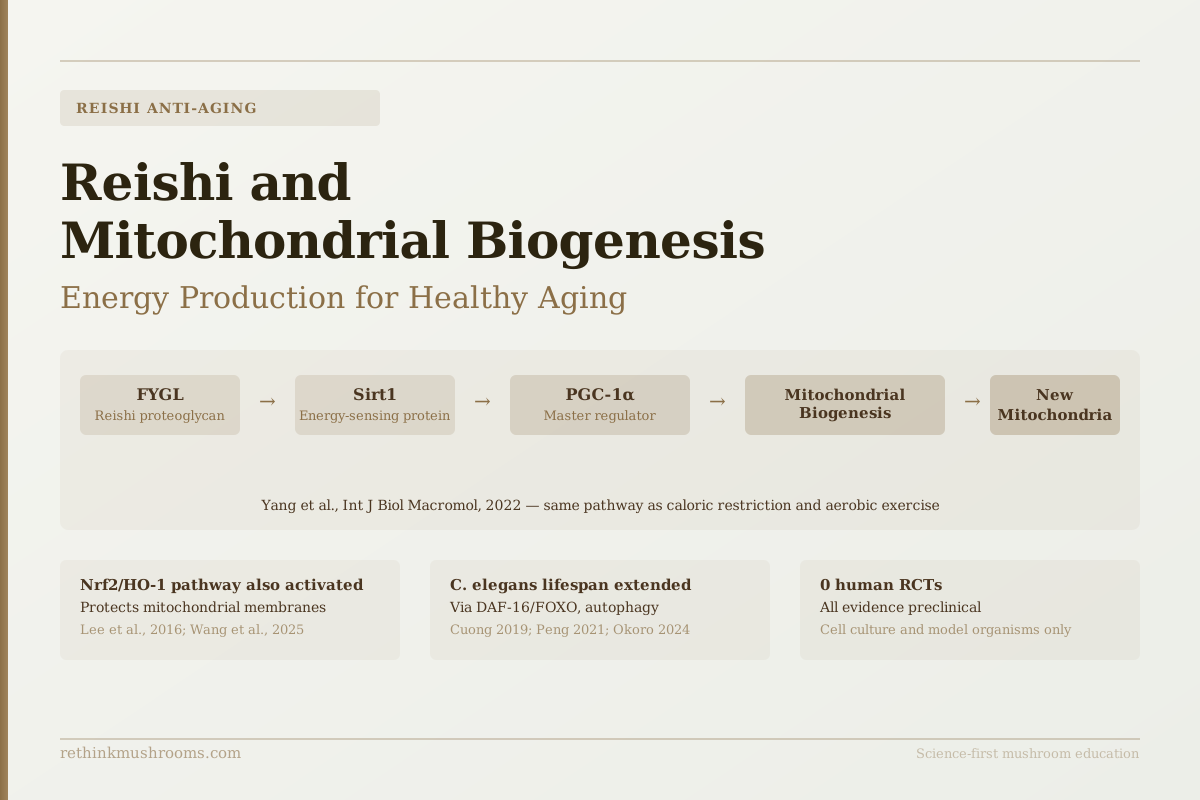
Yang and colleagues identified FYGL, a reishi proteoglycan, as an activator of the Sirt1/PGC-1α axis, the master pathway that stimulates new mitochondria formation, raising cellular ATP and mitochondrial DNA copy number in muscle cells and obese mice.
Yang et al., RSC Advances, 2019
PGC-1α
the master regulator of mitochondrial biogenesis activated by FYGL via Sirt1
Nrf2/HO-1
antioxidant pathway also activated by reishi, protecting mitochondrial membranes from ROS damage
0 human RCTs
clinical trials on reishi and mitochondrial biogenesis published; all evidence is preclinical
Yang et al., RSC Advances, 2019
 View as image ↗
The mitochondria in your cells do not simply wear out. They stop being replaced. After about age 30, the cellular machinery responsible for making new mitochondria begins to slow down, and the balance tips: mitochondria degrade faster than they are created. The result is the familiar pattern of age-related energy decline: less stamina, slower recovery, reduced aerobic capacity. These reflect a genuine reduction in the number and quality of mitochondria available to power cellular work.
A 2019 study identified a specific compound in reishi mushroom that activates the molecular switch at the center of that process. Yang and colleagues found that FYGL, a proteoglycan extracted from Ganoderma lucidum, engaged the Sirt1/PGC-1α signaling axis in skeletal muscle cells and in obese mice, increasing markers of mitochondrial biogenesis (the biological term for the process of building new mitochondria), raising cellular ATP, and lowering reactive oxygen species.[1] This article explains that finding, what it means, and what the broader evidence shows about reishi and mitochondrial health.
For the broader picture of how reishi addresses the hallmarks of aging, see What Is Reishi Mushroom? The Science Behind the Mushroom of Immortality.
Key Takeaways
- Yang and colleagues (RSC Advances, 2019) found that FYGL, a reishi proteoglycan, engaged the Sirt1/PGC-1α signaling axis in skeletal muscle cells and obese mice, raising ATP, lowering ROS, and increasing mitochondrial DNA copy number and other markers of mitochondrial biogenesis[1]
- PGC-1α is the master transcriptional regulator of mitochondrial biogenesis; its activity declines with age, contributing directly to the reduction in mitochondrial number and function seen in aging tissues
- Lee and colleagues (2016) found that reishi ethanol extract activates the Nrf2/HO-1 antioxidant pathway in muscle cells, strengthening the cell's built-in defenses against oxidative damage[2]
- Wang and colleagues (2025) found reishi extract reduced mitochondrial ROS and preserved mitochondrial membrane potential in aging cells, and eased UVA-induced mitochondrial damage in a mouse photoaging model[3]
- Multiple C. elegans studies show reishi extends lifespan and boosts stress resistance through conserved longevity pathways (germline signaling, autophagy with DAF-16 and the sirtuin SIR-2.1, and DAF-16/HSF-1/SKN-1 stress-response factors), providing whole-organism evidence that these mechanisms translate to functional longevity outcomes
- No human randomized controlled trials on reishi and mitochondrial biogenesis have been published; the entire evidence base is preclinical (cell cultures and animal models)
What Mitochondrial Biogenesis Is and Why It Declines With Age
Mitochondria are the organelles that generate most of the usable energy inside cells. They convert oxygen and nutrients into ATP (adenosine triphosphate), the molecular fuel that powers virtually every cellular process. A single cell might contain hundreds to thousands of mitochondria, and their number and quality directly determine how much energy that cell can produce.
Mitochondrial biogenesis is the process of making new mitochondria. Cells constantly create new ones to replace those that become damaged or dysfunctional. But this creation process is tightly regulated by a protein called PGC-1α (peroxisome proliferator-activated receptor gamma coactivator 1-alpha). PGC-1α is the master switch that turns on the hundreds of genes involved in building mitochondria, importing the proteins they need, and maintaining their energy-generating membranes.
Age suppresses PGC-1α activity. The mechanisms involve oxidative damage, mitochondrial DNA mutations, and a signaling pathway connected to a protein called Sirt1 (a sirtuin, part of a family of proteins that help regulate cellular responses to energy status and stress). When Sirt1 activity drops with age, PGC-1α gets less activation signal, mitochondrial biogenesis slows, and fewer new mitochondria are produced to replace those that deteriorate.
The downstream consequence is felt as energy. Tissues with high energy demands (heart muscle, skeletal muscle, brain) are most affected by declining mitochondrial quantity and quality. The fatigue that characterizes aging is partly a cellular energy deficit. Addressing PGC-1α activation is therefore one mechanistically valid approach to slowing the energy decline associated with getting older.
How FYGL Activates the Sirt1/PGC-1α Switch
The Yang 2019 study identified a reishi compound that directly engages this pathway.[1]
FYGL is a proteoglycan, a type of large molecule that combines protein and sugar components, extracted from Ganoderma lucidum. Yang and colleagues found that FYGL positively modulated the Sirt1/PGC-1α pathway: in cells where PGC-1α expression had been silenced, FYGL restored it. The downstream effects were measurable: reactive oxygen species fell and cellular ATP rose in rat skeletal muscle cells, and in obese (ob/ob) mice given FYGL by mouth, mitochondrial DNA copy number and the genes that control mitochondrial biogenesis increased.
What makes this finding significant is its specificity. Rather than testing a crude reishi extract and observing general antioxidant effects, the study identified a defined compound (FYGL), established a defined pathway (Sirt1/PGC-1α), and measured a defined outcome (mitochondrial biogenesis). The same Sirt1/PGC-1α pathway is activated by caloric restriction and aerobic exercise, two of the best-established interventions for extending healthspan in model organisms and improving metabolic health in humans. FYGL appears to turn the same molecular lever.
The study combined cell culture (rat L6 muscle cells) with a live animal model (ob/ob mice given FYGL orally), but did not include humans. This is important context for interpreting how directly these results translate to human biology. The mechanistic chain (FYGL modulates Sirt1/PGC-1α, PGC-1α drives mitochondrial biogenesis) is supported by the data, and the fact that the oral route worked in mice is encouraging for bioavailability. But whether FYGL reaches the relevant tissues at active concentrations in people, and at what dose, has not been tested. The work was framed around insulin resistance and energy metabolism rather than aging specifically.
For a deeper look at the ganoderic acids and proteoglycans that define reishi's pharmacology, see Ganoderic Acids: The Unique Triterpenes in Reishi.
Protecting Mitochondria From the Other Direction: Nrf2 and Membrane Integrity
The FYGL/Sirt1/PGC-1α pathway describes how reishi may promote the creation of new mitochondria. Separate research addresses how reishi protects existing mitochondria from damage.
Mitochondria are particularly vulnerable to oxidative stress. Their membranes generate a constant electrochemical gradient to produce ATP, and that process produces reactive oxygen species (chemically aggressive molecules, sometimes called free radicals) as a byproduct. When antioxidant defenses cannot neutralize these molecules fast enough, they damage the mitochondrial membrane, impairing its ability to maintain the gradient and generate energy. Over time, this damage accumulates and is a central mechanism of mitochondrial aging.
Lee and colleagues (2016) found that reishi ethanol extract activated the Nrf2/HO-1 pathway in hydrogen-peroxide-stressed muscle cells (C2C12 myoblasts), driving expression of the protective enzyme heme oxygenase-1 (HO-1) in an Nrf2-dependent manner; silencing Nrf2 abolished the protection.[2] Nrf2 is itself a master transcription factor for antioxidant defense; when activated, it drives the production of the cell's internal antioxidant machinery rather than simply supplying exogenous antioxidant molecules. This is a more durable form of protection than consuming dietary antioxidants, because it enhances the cell's own capacity to manage oxidative load.
Wang and colleagues (2025) extended this into a mitochondria-specific context, testing reishi extract in aging cells and in a mouse photoaging model.[3] The findings: reishi extract reduced the abnormal rise in mitochondrial ROS in aging cells, maintained mitochondrial membrane integrity and inner membrane potential, and affected mitochondrial biogenesis; in mice, it eased UVA-induced mitochondrial dysfunction while reducing UVA-triggered skin damage. A photoaging model is useful for studying accelerated mitochondrial aging because UV exposure rapidly increases mitochondrial ROS in a measurable, reproducible way. Together with Lee's Nrf2 finding, this study extends reishi's antioxidant action to the mitochondrial membrane itself.
These two studies describe complementary mechanisms: one that activates the cell's own antioxidant program (Lee 2016), and one that shows reishi extract protects mitochondria from ROS-driven damage (Wang 2025). Together, they support the picture that reishi addresses mitochondrial decline from both sides: promoting the creation of new mitochondria (FYGL/Sirt1/PGC-1α) and protecting existing ones from oxidative damage (Nrf2/HO-1).
For more on reishi's full antioxidant mechanism, see Reishi and Oxidative Stress: The Anti-Aging Antioxidant Connection.
What Happened When Researchers Tested Reishi on Living Organisms
Cell culture data provides mechanistic evidence. The more relevant question is whether reishi's effects on mitochondrial pathways translate to actual longevity or healthspan outcomes in organisms with complex biology.
The Caenorhabditis elegans model is the primary tool for this question. C. elegans is a roundworm about 1mm long whose genome encodes many of the same aging-relevant pathways as mammals, including the DAF-16/FOXO pathway that responds to energy status and stress and directly regulates lifespan. C. elegans lives two to three weeks, making it possible to measure lifespan and healthspan effects in real experimental time.
Cuong and colleagues (2019) found that Ganoderma lucidum water extract extended C. elegans lifespan and boosted resistance to oxidative stressors (the herbicide paraquat and heavy metals). The worms' longer lifespan depended chiefly on the germline signaling pathway, while the stress resistance ran through the diet-restriction and mTOR/S6K signaling pathways.[4]
Peng and colleagues (2021) examined the mechanism more specifically, finding that Ganoderma extract extended worm lifespan through activation of autophagy (the cellular recycling process that clears damaged organelles, including dysfunctional mitochondria).[5] Lifespan extension disappeared in worms lacking the autophagy gene atg-18, the FOXO factor daf-16, or the sirtuin sir-2.1, showing that autophagy and stress-resistance pathways were required. Critically, in cultured human cells the same extract raised the autophagy marker LC3 and lowered phosphorylated mTOR (a known brake on autophagy), showing the effect was not limited to worms. This cross-species validation matters: it suggests the pathway activated by reishi is conserved between model organisms and human cells.
Okoro and colleagues (2024) narrowed the focus to a single compound, finding that methyl ganoderate E, a triterpenoid from Ganoderma lucidum, extended C. elegans lifespan by about 26% (at 10 µg/mL) through the daf-16, hsf-1, and skn-1 stress-response pathways, while also improving healthspan and reducing the aggregation of alpha-synuclein and amyloid-beta.[6] The specificity of this finding (one purified compound, defined genetic pathways, one model organism) adds confidence that the longevity effects are not simply due to nonspecific factors in crude extracts.
None of these studies are human trials. C. elegans is separated from humans by enormous evolutionary distance, and lifespan extension in worms does not automatically predict the same effect in mammals, much less in clinical populations. But they are the same well-validated model organisms used to identify interventions that later showed effects in mammalian models and eventually in human health, and they are the best evidence available for testing whether specific compounds activate specific aging pathways.
For context on how reishi compounds also address cellular senescence, a related aging mechanism, see Ganoderma lucidum and Cellular Senescence. For a comparison with ergothioneine, another mushroom compound that protects mitochondria through a different mechanism, see Ergothioneine and Mitochondrial Protection.
Evidence Map
The Mitochondrial Evidence — Two Mechanisms, All Preclinical
Reishi's mitochondrial case rests on three layers of preclinical work: building new mitochondria, protecting existing ones, and extending lifespan in whole organisms. Each layer is supported by specific studies. The human layer — the one that would confirm a real-world effect on energy or fatigue — has never been tested.
Build new mitochondria
Cells + miceFYGL activates the Sirt1/PGC-1α switch
Yang 2019: FYGL restored PGC-1α in silenced cells, lowered ROS and raised ATP in rat muscle cells, and increased mitochondrial DNA copy number in obese (ob/ob) mice.
Yang 2019
Protect existing mitochondria
Cells + miceNrf2/HO-1 antioxidant defense + membrane protection
Lee 2016: reishi extract drove Nrf2/HO-1 in H₂O₂-stressed myoblasts. Wang 2025: reishi extract cut mitochondrial ROS and preserved membrane potential in aging cells, and eased UVA damage in mice.
Lee 2016 · Wang 2025
Extend lifespan in a whole organism
Worms + human cellsConserved longevity & stress-resistance pathways
Cuong 2019: extract extended C. elegans lifespan via germline signaling. Peng 2021: autophagy via atg-18/daf-16/sir-2.1, confirmed in human cells. Okoro 2024: methyl ganoderate E extended lifespan ~26% via daf-16/hsf-1/skn-1.
Cuong 2019 · Peng 2021 · Okoro 2024
Improve energy or mitochondrial health in people
HumansHuman randomized controlled trial
No human trial has tested reishi on mitochondrial biogenesis, mitochondrial function, or cellular energy production. This tier is empty.
Does not yet exist
How to read it: the three solid tiers are genuinely supported — in cells, mice, and worms. The dashed tier is the gap that matters: no human trial has connected any of these mechanisms to measurable energy or fatigue outcomes in people. The mechanisms are real; the clinical proof is not yet in.
Sources: Yang 2019 [1]; Lee 2016 [2]; Wang 2025 [3]; Cuong 2019 [4]; Peng 2021 [5]; Okoro 2024 [6]. Tiers reflect evidence type, not quantitative effect sizes.
What All This Actually Means: The Clinical Gap
The evidence reviewed above is entirely preclinical. There are no human randomized controlled trials testing reishi's effects on mitochondrial biogenesis, mitochondrial function, or cellular energy production in any human population.
What the preclinical evidence establishes is a mechanistic pathway. FYGL activates Sirt1 and PGC-1α in aging cells, which drives mitochondrial biogenesis. Nrf2/HO-1 activation protects mitochondrial membranes from oxidative damage. Autophagy activation, validated in both worms and human cells, clears dysfunctional mitochondria as part of the cellular recycling process. These are not speculative connections; they are mechanistic findings from cell culture and model organism studies published in peer-reviewed journals.
What the evidence does not establish is whether oral reishi supplementation at typical doses reaches the relevant tissues in concentrations sufficient to activate these pathways, whether the effects seen in cell culture and worms translate to clinical benefits in humans, or what dose and duration would be required to see measurable effects on energy, fatigue, or mitochondrial health in people.
The honest assessment: reishi's Sirt1/PGC-1α pathway data is genuinely interesting mechanistically, and is more specific and detailed than anything competitors have published on this topic. It provides a plausible biological basis for reishi's reported effects on fatigue and energy in some human studies. It is not yet evidence of clinical benefit for mitochondrial disease, age-related energy decline, or fatigue in humans.
For the broader anti-aging evidence context across the full reishi research program, see Reishi and Longevity: Why It's Called the Mushroom of Immortality. For the telomere-specific aging data, see Reishi and Telomere Length: Anti-Aging Research.
The Bottom Line
The most specific finding connecting reishi to mitochondrial biogenesis is the Yang 2019 identification of FYGL, a reishi proteoglycan, as an activator of the Sirt1/PGC-1α axis, the same molecular switch activated by caloric restriction and exercise. Separately, Lee 2016 established Nrf2/HO-1 activation, and Wang 2025 extended this to direct mitochondrial ROS reduction and membrane potential preservation. Multiple C. elegans lifespan studies confirm that reishi compounds engage conserved longevity pathways — germline signaling, autophagy, and sirtuin and FOXO stress-response factors — in intact organisms. The entire evidence base is preclinical: no human trials have tested reishi's effects on mitochondrial biogenesis. The mechanistic picture is compelling and specific; the clinical validation has not been done.
Frequently Asked Questions
Sources & References
- 1RTHM-01146·Yang, Zhou et al. (2019). “Modulation of energy metabolism and mitochondrial biogenesis by a novel proteoglycan from Ganoderma lucidum..” RSC advances.Study breakdown →PubMed →↩
- 2RTHM-00802·Lee, Yoo-Hwan et al. (2016). “Ethanol Extract of Ganoderma lucidum Augments Cellular Anti-oxidant Defense through Activation of Nrf2/HO-1..” Journal of pharmacopuncture.Study breakdown →PubMed →↩
- 3RTHM-02203·Wang, Han et al. (2025). “Ganoderma lucidum extract reduces skin aging by reducing mitochondrial stress and controlling mitochondrial numbers..” Fitoterapia.Study breakdown →PubMed →↩
- 4RTHM-01046·Cuong, Vu Thi et al. (2019). “The anti-oxidation and anti-aging effects of Ganoderma lucidum in Caenorhabditis elegans..” Experimental gerontology.Study breakdown →PubMed →↩
- 5RTHM-01417·Peng, Hsin-Hsin et al. (2021). “Ganoderma lucidum stimulates autophagy-dependent longevity pathways in Caenorhabditis elegans and human cells..” Aging.Study breakdown →PubMed →↩
- 6RTHM-01961·Okoro, Nkwachukwu Oziamara et al. (2024). “Ganoderma lucidum methyl ganoderate E extends lifespan and modulates aging-related indicators in Caenorhabditis elegans..” Food & function.Study breakdown →PubMed →↩