Reishi — Ganoderic Acids & Triterpenes
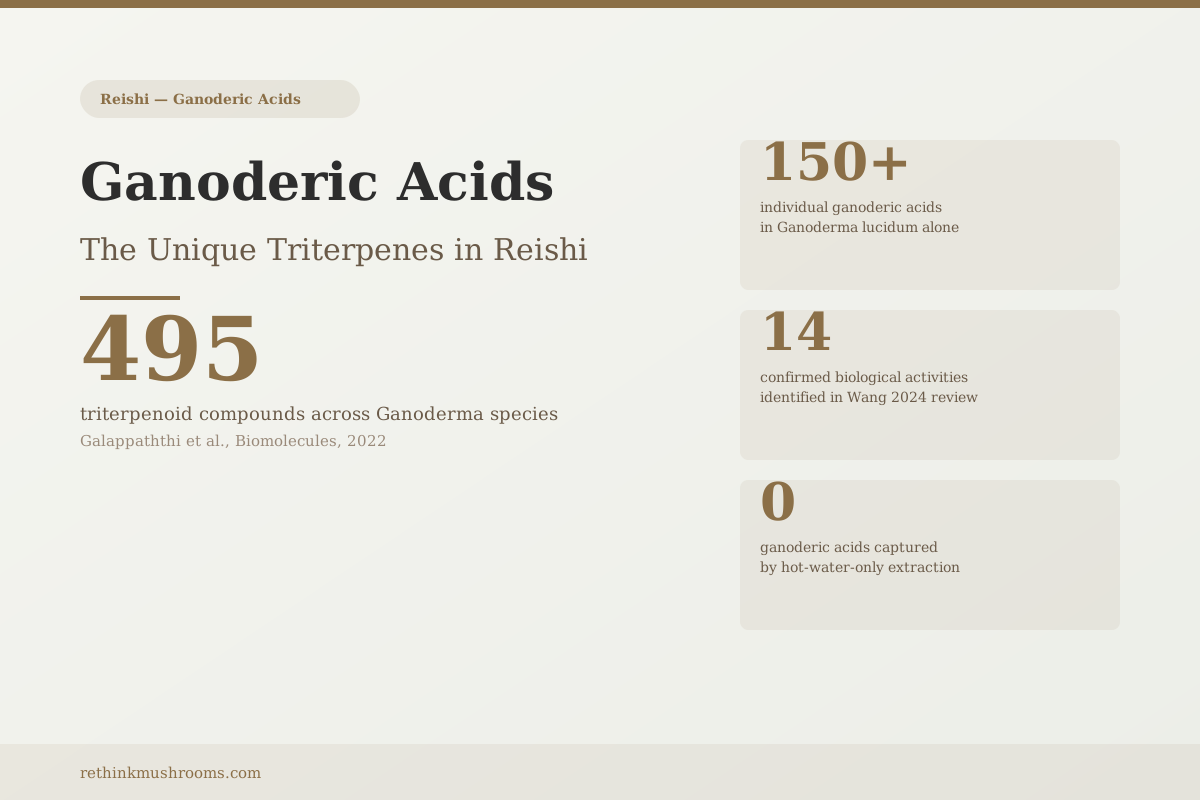
495 triterpene compounds
Galappaththi et al. (2022) documented 495 distinct triterpenoid compounds across 25 Ganoderma species — more than any other known mushroom family and the foundation for Reishi's unique pharmacology.
Galappaththi et al., Biomolecules, 2022
150+
individual ganoderic acids in Ganoderma lucidum alone
14
confirmed biological activities in the Wang 2024 systematic review
0
ganoderic acids captured by hot-water-only extraction
Galappaththi et al., Biomolecules, 2022
 View as image ↗
No other edible mushroom genus has been so systematically mapped for individual chemical compounds. Galappaththi and colleagues documented 495 distinct triterpenoid compounds across 25 Ganoderma species in a 2022 systematic review published in Biomolecules.[1] The vast majority of that chemical complexity is concentrated in Ganoderma lucidum — the mushroom known as Reishi — and is found essentially nowhere else in the fungal kingdom.
Ganoderic acids are the largest and most pharmacologically studied subclass within that chemical profile. They are responsible for Reishi's distinctively bitter taste. They require alcohol for extraction, meaning any hot-water-only Reishi product contains essentially none of them. And a 2024 systematic review of the past five years of research identified 14 confirmed biological activities for this compound class alone.[3]
The broader science of what Reishi does in the body covers the full pharmacological picture. This article focuses specifically on ganoderic acids: what they are, how they work, and what the research has confirmed so far.
Key Takeaways
- Galappaththi et al. (2022) documented 495 distinct triterpenoid compounds across 25 Ganoderma species, making this the most chemically complex medicinal mushroom genus known
- More than 150 individual ganoderic acids have been identified in Ganoderma lucidum, a number that increases as isolation and identification methods improve
- Ahmad et al. (2021) confirmed ganoderic acids cause Reishi's bitter taste and inhibit HMG-CoA reductase, the liver enzyme that controls cholesterol production
- Wang et al. (2024) review identified 14 confirmed biological activities for ganoderic acids including anti-cancer, anti-inflammatory, hepatoprotective, and neuroprotective effects
- Dudhgaonkar et al. (2009) showed the anti-inflammatory effects come specifically from the triterpene fraction, not the polysaccharide (beta-glucan) fraction
- Jafari et al. (2025) GRADE assessment found moderate clinical evidence for lipid-lowering effects; most anti-cancer evidence remains preclinical
What Ganoderic Acids Are, and Why They Don't Exist in Other Mushrooms
Ganoderic acids are a class of organic molecules found almost exclusively in mushrooms of the Ganoderma genus. They belong to the broader family of triterpenoids — compounds the fungus builds from a long chain of carbon and hydrogen atoms by folding it into a specific shape. The lanostane-type shape that ganoderic acids take is the key distinguishing feature. It is a four-ring carbon skeleton that the Ganoderma genus assembles but most other fungi do not.
The biosynthetic pathway — the sequence of chemical reactions the mushroom uses to build these compounds — requires a starting material called lanosterol, which the mushroom derives from the same precursors used to make sterols. Ganoderma has evolved enzymes that modify this scaffold into hundreds of distinct acid variants. Other edible mushrooms, including Lion's Mane, Shiitake, Turkey Tail, and Cordyceps, do not carry the same enzymatic machinery and produce none of these compounds.
Galappaththi and colleagues' 2022 review in Biomolecules documented 495 triterpenoid compounds identified across 25 Ganoderma species, with ganoderic acids representing the largest single class.[1] In Ganoderma lucidum specifically, the count exceeds 150 individually characterized ganoderic acids. That number continues to grow as isolation methods improve. The diversity is so large partly because small chemical modifications — a hydroxyl group in a different position, a different side chain — create a new compound with potentially different biological properties.
This chemical exclusivity has two practical implications. First, if you want ganoderic acids, you need Ganoderma lucidum or a closely related Ganoderma species — no other mushroom is a substitute. Second, the sheer number of variants means that different Reishi products standardized to "total triterpene percentage" may contain very different compound profiles depending on extraction method, species source, and growing conditions.
The overview of all Reishi bioactive classes — including polysaccharides, sterols, and proteins alongside the triterpenes — is in Reishi Bioactive Compounds: Triterpenes, Polysaccharides, and Sterols.
The Bitter Taste Explained: Why Reishi Tastes Like Nothing Else
Anyone who has consumed a Reishi tea or tincture made from actual fruiting body material knows the taste: profoundly bitter, distinctly earthy, nothing like other mushrooms. Ahmad and colleagues' 2021 comprehensive review in Phytotherapy Research confirmed the biochemical source of that bitterness.[2]
Ganoderic acids are intensely bitter compounds. Their lanostane-type structure activates bitter taste receptors on the tongue at extremely low concentrations. The bitterness of a Reishi product is, in practice, a crude signal of ganoderic acid content — a very bitter Reishi is likely to have more of them than a mild or tasteless one. This is not a validated quantitative test, but it is not meaningless either.
The same review identified a mechanistic parallel that put ganoderic acids into a more familiar pharmacological context. Ganoderic acids inhibit HMG-CoA reductase, the liver enzyme that controls the rate of cholesterol production. HMG-CoA reductase is also the target of statin medications (atorvastatin, rosuvastatin, and the rest). Ganoderic acids work through the same enzyme using different binding chemistry. This is the biochemical basis for Reishi's traditional use in cardiovascular health and is supported by the lipid-lowering effects seen in clinical trials.
The lipid-solubility of ganoderic acids matters for both taste and extraction. Because they dissolve in fats and oils but not in water, they cannot be captured by steeping Reishi in hot water. Hot water extracts the polysaccharides — the beta-glucans responsible for immune effects — but leaves the triterpenes largely untouched. The practical implication is explored further in Ganoderic Acid Extraction Methods: How Processing Affects Potency.
14 Biological Activities in Five Years of Research
Wang and colleagues published a systematic review in the journal Life in 2024, covering the research on ganoderic acid biological activities from 2020 to 2024.[3] The review identified 14 confirmed biological activities for ganoderic acids as a class, including:
Anti-cancer effects. Multiple ganoderic acid subtypes have demonstrated tumor cell inhibition across liver, lung, breast, colon, and brain cancer models. They work through at least four distinct mechanisms — triggering programmed cell death, activating cellular self-digestion (autophagy), cutting off tumor blood supply, and suppressing the signaling proteins that drive cancer cell survival.
Anti-inflammatory effects. Ganoderic acids suppress the molecular switch inside cells that activates inflammation. This is the same protein (NF-kB — the master inflammatory controller) targeted by some pharmaceutical anti-inflammatory drugs.
Hepatoprotection. The liver concentration of ganoderic acids after oral dosing (documented in rat pharmacokinetic studies) is consistent with the traditional use of Reishi for liver support. The HMG-CoA inhibition is part of this picture; direct cellular protection in liver tissue models has also been demonstrated.
Neuroprotection. Research from 2021 showed a specific ganoderic acid (GA-A) can trigger the cellular cleanup process that removes amyloid-beta, the protein aggregate that accumulates in Alzheimer's disease. This was demonstrated in both cell culture and mouse models.[3]
Immunomodulation, anti-aging, and anti-radiation effects round out the 14-activity list, most of which are supported by preclinical evidence that is not yet matched by clinical trial data.
The individual compounds responsible for each of these effects — and what makes GA-A, GA-DM, GA-T, and GA-D biochemically distinct — are covered in Ganoderic Acid A, B, and Beyond: Individual Compound Research.
Why Anti-Inflammatory Effects Come From Triterpenes, Not Beta-Glucans
A common question when reading about Reishi is whether polysaccharides (beta-glucans) and triterpenes (ganoderic acids) do the same things or different things. The research is clear: they do different things through entirely different mechanisms.
Dudhgaonkar and colleagues published a specific test of this question in the International Journal of Immunopharmacology in 2009.[4] The team isolated the triterpene fraction from Reishi (leaving out the polysaccharides) and applied it to immune cells in culture. The isolated triterpenes suppressed NF-kB activation (the master inflammatory controller inside cells) and reduced COX-2 expression (the enzyme that produces inflammatory signals — the same target as ibuprofen). The polysaccharide fraction did not produce these effects.
This clean separation matters for how to think about Reishi pharmacology:
Polysaccharides, particularly the beta-glucans, activate immune cells. They bind to receptors on the surface of immune cells and increase the immune system's readiness. This is an activating effect.
Triterpenes, specifically the ganoderic acids, suppress inflammatory signaling pathways inside cells. This is a calming or modulating effect.
Both are genuinely useful. But a person consuming a water-only extract is getting the immune-activating fraction without the anti-inflammatory one. A person consuming an alcohol-only tincture is getting the anti-inflammatory fraction without the immune-activating one. Only a dual extraction — using both water and alcohol — captures both classes of compounds.
Sarkar and colleagues' 2025 pharmacology review in Natural Product Research noted that traditional Chinese medicine preparations of Reishi often involved both water decoction and alcohol extraction steps, suggesting that practitioners had empirically discovered this complementarity long before the biochemistry was characterized.[5]
The full mechanistic comparison of triterpenes and polysaccharides is in How Reishi Triterpenes Differ from Polysaccharides in Mechanism. For practical supplement product evaluation, Double-Extraction Tinctures: What Makes Them Superior covers why dual-extraction products are the only form that captures both fractions.
The Extraction Problem: Why Many Reishi Products Contain Zero Ganoderic Acids
Ren and colleagues' 2025 review in Food Science and Nutrition was direct about the extraction requirement: dual extraction is necessary to capture both the water-soluble and alcohol-soluble bioactive fractions of Reishi.[6] A product using only hot water captures the polysaccharides and delivers essentially no ganoderic acids.
This is not a minor quality distinction. It means that a substantial portion of the U.S. Reishi supplement market — hot-water extracts standardized only for polysaccharide content — is not delivering the compound class responsible for Reishi's anti-inflammatory, liver-protective, and anti-cancer preclinical effects.
The 2025 pharmacological review by Sarkar and colleagues confirmed the same extraction principle from a traditional pharmacology standpoint, noting that the lipid-soluble fraction of Reishi has been studied specifically because it is distinct from and complementary to the water-soluble fraction.[5]
For consumers, the practical implication is to look for three things on a Reishi product label:
First, a triterpene percentage (not just a polysaccharide percentage). A product that lists only "polysaccharides: 30%" is telling you about one of its two primary compound classes.
Second, a statement that the product uses dual extraction or alcohol extraction. "Hot water extract" without mention of an alcohol fraction does not deliver ganoderic acids.
Third, the part used. Ganoderic acids concentrate in the fruiting body; mycelium-on-grain products are largely unstandardized for triterpene content.
What Clinical Research Has and Hasn't Confirmed
The preclinical evidence for ganoderic acids is extensive. Cell culture and animal studies document anti-cancer, anti-inflammatory, liver-protective, and neuroprotective effects across many different experimental models. The question of what this translates to in actual human patients is answered with more caution.
Jafari and colleagues published a GRADE-assessed systematic review and meta-analysis of clinical trials on Ganoderma lucidum in Food Science and Nutrition in 2025.[7] GRADE is a standardized framework for evaluating the quality of clinical evidence, rating each finding from very low to high certainty.
The Jafari review found moderate-quality clinical evidence for lipid-lowering effects — consistent with the HMG-CoA reductase inhibition mechanism. This is one of the more clinically validated effects of Reishi, supported by multiple randomized trials.
For anti-cancer effects in humans, the review found insufficient evidence to support clinical claims. The preclinical signals are real. The human randomized trial data does not yet exist at the scale needed to make clinical efficacy claims. This is the honest state of the research.
The Wang 2024 review reflects the same pattern from a different angle: identifying 14 biological activities in the preclinical literature while acknowledging that most have not been followed through to human clinical trials in the way that lipid lowering has.[3]
The specific cancer mechanisms and what the preclinical data shows for individual tumor types is detailed in Ganoderic Acids and Cancer: Specific Anti-Tumor Research.
The Bottom Line
Ganoderic acids are a class of 150+ triterpenoid compounds found almost exclusively in Ganoderma mushrooms. They give Reishi its bitter taste, inhibit the same cholesterol-controlling enzyme as statin drugs, and have demonstrated anti-inflammatory, hepatoprotective, and anti-cancer activity across 14 confirmed biological pathways. They are lipid-soluble and require alcohol extraction — a Reishi product without alcohol extraction delivers essentially none of them. Clinical evidence is strongest for lipid-lowering effects; most anti-cancer evidence remains preclinical.
Frequently Asked Questions
Sources & References
- 1RTHM-01519·Galappaththi, Mahesh C A et al. (2022). “A Review of Ganoderma Triterpenoids and Their Bioactivities..” Biomolecules.Study breakdown →PubMed →↩
- 2RTHM-01321·Ahmad, Rizwan et al. (2021). “Ganoderma lucidum (Reishi) an edible mushroom; a comprehensive and critical review of its nutritional, cosmeceutical, mycochemical, pharmacological, clinical, and toxicological properties..” Phytotherapy research : PTR.Study breakdown →PubMed →↩
- 3RTHM-02014·Wang, Siyi et al. (2024). “Research Progress on the Biological Activity of Ganoderic Acids in Ganoderma lucidum over the Last Five Years..” Life (Basel.Study breakdown →PubMed →↩
- 4RTHM-00152·Dudhgaonkar, Shailesh et al. (2009). “Suppression of the inflammatory response by triterpenes isolated from the mushroom Ganoderma lucidum..” International immunopharmacology.Study breakdown →PubMed →↩
- 5RTHM-02175·Sarkar, Tumpa et al. (2025). “Reishi Mushroom (Ganoderma lucidum): pharmacology of a potent healer in traditional Chinese medicine..” Natural product research.Study breakdown →PubMed →↩
- 6RTHM-02166·Ren, Sizhu et al. (2025). “A Review of Bioactive Components and Pharmacological Effects of Ganoderma lucidum..” Food science & nutrition.Study breakdown →PubMed →↩
- 7RTHM-02098·Jafari, Ali et al. (2025). “The Nutritional Significance of Ganoderma lucidum on Human Health: A GRADE-Assessed Systematic Review and Meta-Analysis of Clinical Trials..” Food science & nutrition.Study breakdown →PubMed →↩