Reishi Triterpenes
26.3%
In a 2017 analysis of 19 batches of Reishi supplements bought in the United States, only 5 products — 26.3% — had measured triterpene and polysaccharide content that actually matched their labels.
Wu et al., Scientific Reports, 2017
Lipid-soluble
ganoderic acids need ethanol or CO2; water alone is a poor solvent for them
85 MPa
supercritical CO2 pressure that beat ethanol reflux for total triterpenoid content
No fixed ratio
the optimal ethanol percentage changes with the extraction technique used
Wu et al., Scientific Reports, 2017
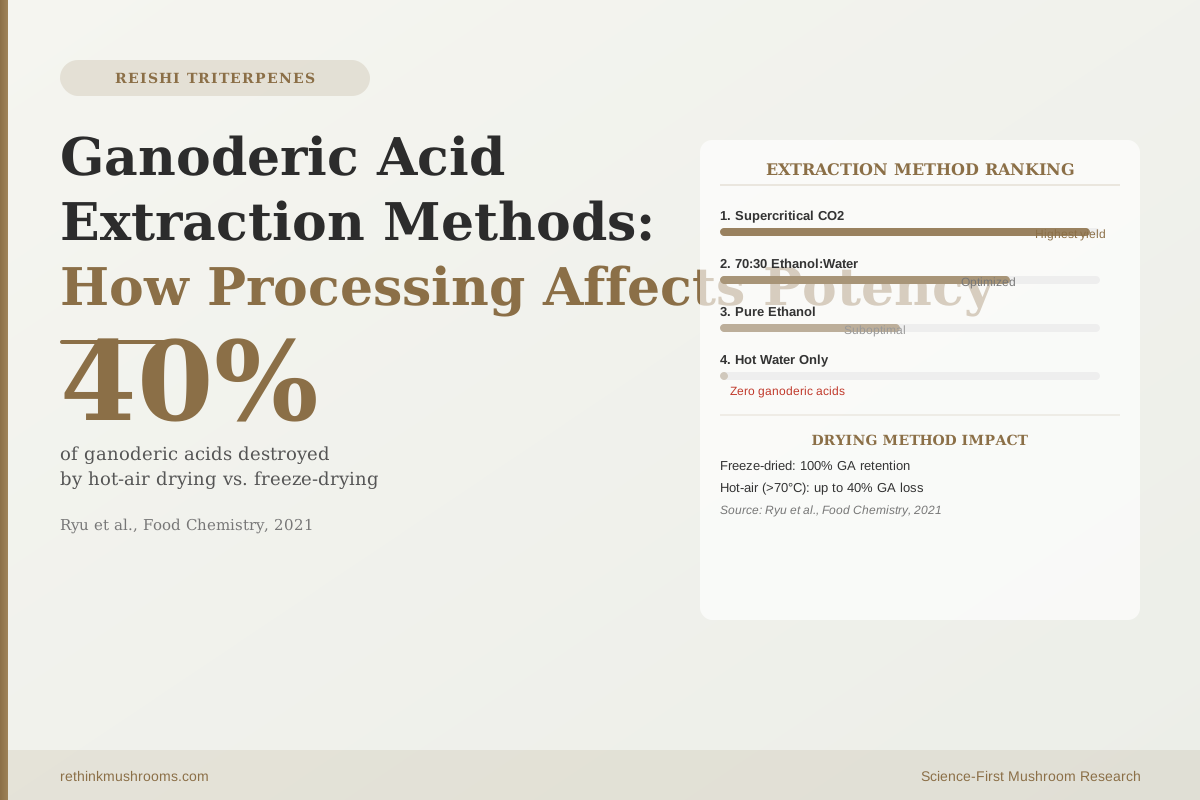 View as image ↗
Wu and colleagues bought 19 batches of Reishi supplements in the United States and measured what was actually in them. Only 5 batches — 26.3% — contained the ingredient amounts their labels claimed.[1]
That gap has a chemical explanation most buyers never encounter. Ganoderic acids are triterpenes: lipid-soluble compounds that dissolve poorly in water. Hot water, the solvent behind nearly all mushroom tea and a great many commercial extracts, is the wrong tool for pulling them out of the mushroom. A product can be genuine Reishi, competently made, and still deliver very little ganoderic acid — simply because of the solvent chosen.
This matters because ganoderic acids are the fraction of Reishi most closely tied to its anti-inflammatory, liver-related, and anti-tumor research. A 2025 review catalogued Reishi's bioactives across four chemically distinct classes — polysaccharides, triterpenoids, peptides and proteins, and sterols — while cautioning that very few of its compounds have been clinically validated as superior to existing therapies.[2] Those classes do not share a solvent. Understanding the ganoderic acid extraction method behind a product is what tells you which of them you are actually buying.
For the broader picture of what ganoderic acids are and why they matter, see the Reishi guide at what is reishi mushroom: the science behind the mushroom of immortality.
Key Takeaways
- Only 5 of 19 US Reishi supplement batches (26.3%) had measured triterpene and polysaccharide content matching their labels (Wu et al., Sci Rep, 2017)
- Ganoderic acids are lipid-soluble triterpenes; ethanol and supercritical CO2 extract them effectively, and water-only extraction is a poor match for the chemistry
- There is no single "correct" ethanol ratio — optimization studies landed on 62.5%, 89.5%, and 50% ethanol depending on whether heat, ultrasound, or co-extraction was used (Oludemi et al., Food Funct, 2018; Zheng et al., PLoS One, 2020)
- Supercritical CO2 at 85 MPa produced significantly more total triterpenoids than ethanol reflux, and its anti-tumor potency in liver cancer cells tracked that triterpenoid content (Zhu et al., Front Pharmacol, 2020)
- The claim that hot-air drying destroys ganoderic acids is not supported; a direct comparison found heat drying increased ganoderic acid production relative to freeze-drying (Sadiq et al., Molecules, 2021)
- Reishi spores have a hard sporoderm that physically hinders release of the triterpenes inside, which is why sporoderm-breaking is a meaningful processing step for spore products (Wang et al., Nat Prod Res, 2017)
The Quality Problem: Most US Reishi Supplements Did Not Match Their Labels
Wu and colleagues evaluated 19 batches of Reishi dietary supplements purchased from US retail sources, measuring both triterpenes and polysaccharides using chromatographic methods and saccharide mapping. The measured ingredients of only 5 samples — 26.3% — were in accordance with their label claims. The authors concluded that quality consistency in the US Reishi market was poor and warranted closer investigation.[1]
That is a label-accuracy finding, and it is worth being precise about what it does and does not say. It does not establish that hot-water extraction is the specific culprit in those products, and it does not rank one processing method against another. What it establishes is narrower and still important: for roughly three out of four batches tested, the number on the label was not a reliable guide to what was in the bottle.
The extraction question sits underneath that result. Reishi's actives are split across chemically distinct classes, and the two most studied ones do not dissolve in the same solvent. Polysaccharides, including beta-glucans, are water-soluble. Triterpenes — the ganoderic acids — are lipid-soluble. A hot-water extract concentrates the first group. An alcohol extract concentrates the second. A dual extraction is the process designed to capture both, because no single conventional solvent does.
The practical implication: reading a supplement label for polysaccharide percentage tells you very little about ganoderic acid content. They are separate fractions, measured separately, and captured by different solvents.
For a mechanistic explanation of why these two fractions do different things in the body, see the companion article on how Reishi triterpenes differ from polysaccharides in mechanism.
Why Hot Water Is a Poor Solvent for Ganoderic Acids
The chemistry is straightforward. Ganoderic acids are triterpenes, a class of largely fat-soluble compounds. Like fat, they have limited solubility in water. When Reishi is steeped in hot water, the water-soluble polysaccharides, proteins, and minerals dissolve and move into the liquid. Most of the triterpene fraction stays behind in the mushroom tissue.
This is why Reishi tea does not deliver the same compound profile as a dual extract, and it is why extraction studies that target triterpenoids reach for ethanol rather than water. In a direct comparison of extraction approaches, the polysaccharide fraction obtained by ultrasonic-assisted co-extraction showed higher antioxidant capacity than polysaccharides from traditional hot-water extraction, while the triterpenoid-rich extracts were benchmarked against ethanol maceration — not against water.[4]
One honest caveat: "hot water extracts zero ganoderic acids" is an overstatement that circulates widely. Trace triterpenes do carry over, and some laboratory preparations deliberately start with a hot-water step before removing ethanol-insoluble polysaccharides to enrich the triterpene fraction. The accurate statement is that water alone is an inefficient solvent for this compound class, and a water-only commercial process should not be expected to deliver meaningful ganoderic acid content.
For readers evaluating tincture products specifically, the article on mushroom tinctures: alcohol vs. glycerin extraction explains the practical implications for which solvent systems can and cannot capture ganoderic acids.
What the Optimization Studies Actually Found: No Single Magic Ratio
A popular claim holds that 70:30 ethanol-to-water is the scientifically optimized ratio for Reishi triterpenes. The optimization literature does not support a single fixed number. What it shows instead is that the best ethanol concentration depends heavily on which extraction technique is used alongside it.
Oludemi and colleagues applied response surface methodology — a statistical approach for finding the combination of variables that maximizes an outcome — to Reishi triterpenoids and phenolics, testing heat-assisted extraction (HAE) and ultrasound-assisted extraction (UAE) against a standard Soxhlet procedure. The two techniques optimized to markedly different conditions. HAE peaked at 78.9 minutes, 90.0 °C, and 62.5% ethanol. UAE peaked at 40 minutes, 100.0 W, and 89.5% ethanol. UAE was the more effective of the two, producing an extraction yield of 4.9 ± 0.6% containing 435.6 ± 21.1 mg/g of triterpenes.[3]
Oludemi et al. (2018) · Food & Function
- Population
- Ganoderma lucidum material, laboratory extraction study
- Intervention
- Response surface methodology across time, ethanol content, and temperature or ultrasonic power (circumscribed central composite design, three variables, five levels)
- Comparator
- Standard Soxhlet extraction procedure
- Finding
- Optimal conditions were 78.9 min at 90.0 °C with 62.5% ethanol for heat-assisted extraction, and 40 min at 100.0 W with 89.5% ethanol for ultrasound-assisted extraction. UAE was the most effective, yielding 4.9 ± 0.6% extract containing 435.6 ± 21.1 mg/g triterpenes and 106.6 ± 16.2 mg/g total phenolics, with recovery markedly enhanced over the alternatives.
positive This is a laboratory yield-optimization study, not a test of a finished consumer supplement. It shows that the best ethanol concentration is technique-dependent — it does not establish one universal ratio, and notably the ultrasound optimum sat near 90% ethanol, close to pure alcohol.
Oludemi et al., Food & Function, 2018; 9(1):209-226
Zheng and colleagues landed somewhere else again. Optimizing ultrasonic-assisted co-extraction to pull polysaccharides and triterpenoids out simultaneously — weighting both components equally — they identified 210 W of ultrasonic power, 80 °C, a liquid-to-solid ratio of 50 mL/g, 100 minutes, and 50% aqueous ethanol as optimal. That produced extraction yields of 0.63% polysaccharides and 0.38% triterpenoids, in what the authors described as the first report of simultaneous extraction of both fractions from Reishi.[4]
Three optimizations, three different answers: 62.5%, 89.5%, and 50% ethanol. The spread is not a contradiction in the science — it reflects that each study was maximizing a different objective under a different energy input. Ultrasound disrupts cell walls mechanically, which changes how much water is needed to drive diffusion. Co-extraction has to compromise between two fractions that want opposite solvents.
It is also worth noting what these studies did not find. None of them showed pure or near-pure ethanol performing poorly; the ultrasound optimum in Oludemi was 89.5% ethanol, close to neat alcohol. And none of them used low temperatures — the optima ran at 80 °C and 90 °C. The idea that ganoderic acids are so heat-fragile that extraction must stay cool is not what this literature shows.
Optimization Conditions Compared
There Is No Single “Optimal” Ethanol Ratio for Ganoderic Acids
Each published optimization maximized a different objective under a different energy input — and landed on a different solvent concentration.
Ultrasonic co-extraction (UACE)
Zheng 2020210 W · 80 °C · 100 min · 50 mL/g
Maximized: Polysaccharides and triterpenoids together (0.63% / 0.38% yield)
Heat-assisted extraction (HAE)
Oludemi 201890.0 °C · 78.9 min
Maximized: Triterpenoid and phenolic yield under heat
Ultrasound-assisted extraction (UAE)
Oludemi 2018100.0 W · 40 min
Maximized: Best overall — 4.9% yield, 435.6 mg/g triterpenes
Ultra-sonication + heating (freeze-dried material)
Ryu 202164.2–70 °C · 1.2 h
Maximized: Antioxidant activity and total ganoderic acid content
The spread runs from 50% to 89.5% ethanol. Two points are worth noting against common claims: no optimization found near-pure ethanol performing poorly — the ultrasound optimum sat at 89.5% — and none of them ran cool, with optima at 80–90 °C. A bare ethanol percentage on a label does not tell you whether the surrounding process was well designed.
Source: Oludemi et al. (2018), Food & Function 9(1):209-226; Zheng et al. (2020), PLoS One 15(12):e0244749; Ryu et al. (2021), Food Chemistry 335:127645.
The practical implication for a buyer is more modest than a magic ratio, and more useful: an ethanol percentage on a label, by itself, does not tell you whether a process was well designed. The solvent works in combination with temperature, time, and mechanical energy.
Supercritical CO2: Higher Triterpenoid Content, at High Pressure
Beyond ethanol sits a method most consumers never see on a label: supercritical CO2 extraction.
Carbon dioxide above its critical point (31 °C and roughly 73 atm) behaves as neither quite a gas nor quite a liquid. In that state it becomes an efficient non-polar solvent, dissolving lipid-soluble compounds like ganoderic acids without alcohol and without leaving residue — when pressure is released, the CO2 simply evaporates.
Zhu and colleagues tested high-pressure supercritical CO2 without an entrainer at three pressures — 65, 85, and 105 MPa, yielding extracts labelled G65, G85, and G105 — against a conventional ethanol reflux extract (GLE). Total triterpenoid content in G85 was significantly higher than in both G65 and GLE, though it did not differ significantly from G105. In two liver cancer cell lines, GLE, G65, and G85 all inhibited proliferation, arrested the cell cycle in G2/M phase, and induced apoptosis, with G85 strongest. Cytotoxic potency tracked total triterpenoid content, and the effect was associated with inhibition of Ras/Raf/MEK/ERK signaling.[5]
The pressure qualifier matters. CO2 did not beat ethanol universally — G65, the lowest-pressure CO2 extract, was not significantly better than the ethanol reflux extract for triterpenoid content. The advantage appeared at 85 MPa and did not improve further at 105. "CO2-extracted" on a label therefore signals a method, not automatically a superior product; the pressure it was run at is what drove the difference, and that number is essentially never disclosed.
- Cell culturecompleted
G2/M arrest and apoptosis in QGY7703 and SK-Hep1 liver cancer lines; potency tracked total triterpenoid content, via inhibition of Ras/Raf/MEK/ERK signaling
- Animal studiescurrent
G85 showed significant anti-hepatoma effect in vivo with low toxicity
- Case reportsmissing
None for high-pressure CO2 Reishi extracts
- Small human trialsmissing
No clinical trials of high-pressure CO2 Reishi extracts
- Large RCTsmissing
Not attempted
- Meta-analysismissing
No human trial base to pool
The evidence that higher-triterpenoid CO2 extracts are more cytotoxic to liver cancer cells is consistent from mechanism through animal models. It stops entirely before human testing. A 2025 review of Reishi's bioactives made the same general point: very few of its compounds have been clinically validated as superior to existing therapies.
Zhu et al., Frontiers in Pharmacology, 2020; Ren et al., Food Science & Nutrition, 2025
The practical drawback of supercritical CO2 is cost. It requires industrial pressure equipment and is more expensive per batch than ethanol extraction, which is why most manufacturers still use ethanol and CO2 extracts are positioned as premium.
For readers comparing extract types, the companion article on double-extraction tinctures and why they capture more compounds covers the practical implications of solvent selection for supplement quality.
The Drying Myth: Freeze-Drying Is Not Clearly Better for Ganoderic Acids
Drying method is genuinely under-discussed in supplement quality conversations. But the most commonly repeated version of the claim — that hot-air drying destroys a large share of Reishi's ganoderic acids and freeze-drying preserves them — runs opposite to the direct comparison that exists.[9]
Fact Check
Does hot-air drying destroy Reishi's ganoderic acids?
The claim
“Hot-air drying degrades a large fraction of Reishi's ganoderic acid content, so freeze-dried Reishi is meaningfully more potent in triterpenes.”
Generalized from heat-sensitivity of other plant bioactives, and from extraction studies that used elevated temperatures
What research shows
UnsupportedThe one head-to-head postharvest drying comparison in Ganoderma lucidum found the opposite direction. Comparing heat drying (36 h at 60 °C) with freeze-drying (36 h at -80 °C) by GC-MS metabolite profiling, the authors concluded that heat drying improves the production of ganoderic acids through upregulation of TCA-cycle-related pathways. Heat-dried extracts also produced a greater reduction in inflammatory signaling in LPS-treated BV2 microglial cells, with lower phosphorylation of Erk1/2, p38, JNK, and NF-kB p65.
This does not make heat drying universally superior. The two methods produced genuinely different metabolite profiles across 109 primary metabolites — heat-dried samples were higher in amino acids and monosaccharides, freeze-dried samples substantially higher in organic acids. Drying method changes the chemistry rather than simply preserving or destroying it, and this is a single study on one endpoint set.
Sadiq et al., Molecules, 2021; 26(15):4484
A separate study is often cited in support of the drying claim, and it is worth reading carefully because it is about something else. Ryu and colleagues optimized extraction conditions — combining ultra-sonication and heating — for Reishi, using response surface methodology across antioxidant activity, anti-diabetic activity, total ganoderic acid content, and total polysaccharide content. For freeze-dried material, extraction at 64.2–70 °C for 1.2 hours maximized antioxidant activity and ganoderic acid content. For heat-dried material, extraction at 50 °C for 3 hours gave the greatest anti-inflammatory activity against HaCaT cells. Their conclusion was that extraction conditions can be a limiting factor for target-oriented investigations.[6]
Those temperatures describe how the mushroom was extracted, not how it was dried. Conflating the two is where the "70 °C destroys ganoderic acids" claim appears to originate. Read correctly, the study reinforces a different point: the drying method and the extraction protocol interact, and the best extraction settings differ depending on how the material was dried beforehand.
The honest summary for a buyer is that drying method demonstrably changes Reishi's chemistry, that "freeze-dried" is not established as the higher-triterpene option, and that this remains a thin evidence base on which to choose a product.
The distinction still matters for heat-sensitive bioactives generally. For a detailed look at how drying method affects mushroom bioactives across species, see the article on how freeze-drying preserves mushroom bioactives.
Sporoderm-Broken Spores: What That Label Claim Actually Means
Reishi spores are the reproductive cells released by mature fruiting bodies, and they contain concentrated triterpenes. The obstacle is the sporoderm: a hard outer shell that evolution built to protect the spore.
Wang and colleagues describe the sporoderm as hard and indissolvable, and as a direct barrier to the release of the bioactive components inside. They developed a method combining a chemical reaction with physical actuation — ultrasonication and refrigeration — that rendered the sporoderm porous, confirmed by scanning electron microscopy. Breaking efficiency was evaluated by measuring how readily the inner triterpenoids dissolved out. The team then used beta-cyclodextrin to seal the holes in the finished product to improve its solubility and stability.[7]
Two points of precision are worth holding onto here. First, this is a laboratory dissolution and processing study. It demonstrates that breaking the sporoderm releases triterpenoids that otherwise stay locked inside — it does not measure what happens to intact spores in the human digestive tract, and it does not report absorption or bioavailability in people. The widely repeated claim that unbroken spores "pass straight through" is a reasonable inference from the shell's durability, not a finding this study reports.
Second, "sporoderm-broken" describes a processing step, not a verified potency level. Given that only 26.3% of US Reishi products in the Wu audit matched their labels at all, a processing claim on a bottle is worth exactly as much as the manufacturer's testing behind it.
For non-spore Reishi products — fruiting body powder, mycelium extracts — the sporoderm issue does not apply. It is specific to spore powder.
After Absorption: What the Pharmacokinetic Data Shows
Processing determines how much ganoderic acid makes it into a product. What happens after someone swallows it is a separate question, and the available data is narrower than it is often presented.
Cheng and colleagues developed and validated an LC-MS/MS method to simultaneously measure 4 representative ganoderic acids in rat plasma after oral administration of a Reishi extract. Because the four are structurally similar, they showed broadly similar pharmacokinetic behavior in some respects. But several parameters diverged: ganoderic acids B and E showed different profiles and different reabsorption peaks than ganoderic acids D and A, which the authors attributed to metabolic transformation among the ganoderic acids themselves.[8]
Two things this study does not show, despite being cited for them: it measured plasma, not tissue, so it makes no claim about where ganoderic acids concentrate in the body, and it did not report a ranking of half-lives identifying one form as longest-lasting. Claims that ganoderic acids accumulate preferentially in the liver and kidney do not come from this dataset.
For readers looking at specific ganoderic acid effects, the companion article on ganoderic acid A, B, and beyond: individual compound research covers what each major acid does once it reaches its target tissues.
Scope of the Evidence
ModerateReishi triterpene research is preclinical; it is not cancer or liver treatment
Concern
The most striking ganoderic acid findings — apoptosis in liver cancer cell lines, anti-tumor activity in mice, anti-inflammatory signaling in microglia — come from cell culture and animal models. A 2025 review noted that few Reishi compounds have been clinically validated as superior to existing therapies, and that the mushroom remains underexplored in modern pharmaceutical research.
What the research says
Treat extraction quality as a question about getting what you paid for, not as a treatment decision. No extraction method converts preclinical findings into a demonstrated human clinical benefit.
Particularly relevant for: Anyone considering Reishi for a diagnosed condition, and anyone taking prescription medication
What to do
This article is not medical advice. Consult a physician before using Reishi products for any health condition, particularly alongside existing treatment.
Zhu et al., Frontiers in Pharmacology, 2020; Ren et al., Food Science & Nutrition, 2025
Reading the Label: What Signals Meaningful Ganoderic Acid Content
Translating this into supplement evaluation comes down to a few markers — and to appropriate skepticism, given the label-accuracy data.
Look for triterpene or ganoderic acid standardization, not just polysaccharides. A product listing only "polysaccharides: 30%" has told you about the beta-glucan fraction and nothing about the triterpene fraction. The two are measured separately.
Dual extraction is the minimum for a product claiming both fractions. Polysaccharides and triterpenes do not share a solvent, so a single water-based process is not positioned to deliver both.
Treat a bare ethanol percentage as weak information. The optimization literature produced optima at 50%, 62.5%, and 89.5% ethanol depending on technique, temperature, and time. There is no single correct ratio to look for, and no percentage on a label tells you whether the surrounding process was competent.
"CO2-extracted" signals a method, not a guaranteed result. The triterpenoid advantage in the available data appeared specifically at 85 MPa; the lower-pressure CO2 extract was not significantly better than ethanol reflux. Manufacturers do not publish pressures.
Do not pay a premium for "freeze-dried" on ganoderic acid grounds. The one direct postharvest comparison in Reishi pointed the other way, finding heat drying increased ganoderic acid production. Drying method changes the metabolite profile; it has not been shown to make triterpenes scarcer.
"Sporoderm-broken" is mechanistically meaningful for spore products, since the intact shell demonstrably blocks triterpenoid release. It is still a manufacturer claim.
Third-party testing outranks all of the above. The single most robust finding in this entire literature is that roughly three-quarters of tested US Reishi products did not match their labels. A certificate of analysis reporting measured triterpene content is worth more than any processing adjective.
For the broader context of what these ganoderic acids do once they are absorbed, see the overview article on Reishi bioactive compounds: triterpenes, polysaccharides, and sterols, and the cluster articles on ganoderic acids and their specific mechanisms and ganoderic acids and cancer research.
The Bottom Line
Ganoderic acid content in a Reishi supplement is decided by processing choices invisible on the label. Ganoderic acids are lipid-soluble triterpenes, so ethanol or supercritical CO2 extracts them effectively while water alone does not. There is no universal ethanol ratio: published optimizations landed at 50%, 62.5%, and 89.5% ethanol depending on whether heat, ultrasound, or simultaneous co-extraction was used, all at temperatures of 80-90 °C. Supercritical CO2 at 85 MPa produced significantly more total triterpenoids than ethanol reflux, though lower-pressure CO2 did not. The common belief that hot-air drying destroys ganoderic acids is not supported — the one direct comparison found heat drying increased ganoderic acid production relative to freeze-drying, while changing the overall metabolite profile. Sporoderm-breaking genuinely releases triterpenoids trapped inside Reishi spores. Underneath all of it sits the finding that only 26.3% of US Reishi supplement batches tested matched their own labels, which makes third-party testing more informative than any processing claim.
Frequently Asked Questions
Sources & References
- 1RTHM-00499·Wu, Ding-Tao et al. (2017). “Evaluation on quality consistency of Ganoderma lucidum dietary supplements collected in the United States..” Scientific reports.Study breakdown →PubMed →↩
- 2RTHM-02166·Ren, Sizhu et al. (2025). “A Review of Bioactive Components and Pharmacological Effects of Ganoderma lucidum..” Food science & nutrition.Study breakdown →PubMed →↩
- 3RTHM-00988·Oludemi, Taofiq et al. (2018). “Extraction of triterpenoids and phenolic compounds from Ganoderma lucidum: optimization study using the response surface methodology..” Food & function.Study breakdown →PubMed →↩
- 4RTHM-00668·Zheng, Shizhong et al. (2020). “Optimization of ultrasonic-assisted extraction of polysaccharides and triterpenoids from the medicinal mushroom Ganoderma lucidum and evaluation of their in vitro antioxidant capacities..” PloS one.Study breakdown →PubMed →↩
- 5RTHM-01318·Zhu, Liping et al. (2020). “High-Pressure Supercritical CO2 Extracts of Ganoderma lucidum Fruiting Body and Their Anti-hepatoma Effect Associated With the Ras/Raf/MEK/ERK Signaling Pathway..” Frontiers in pharmacology.Study breakdown →PubMed →↩
- 6RTHM-01427·Ryu, Da Hye et al. (2021). “Optimization of antioxidant, anti-diabetic, and anti-inflammatory activities and ganoderic acid content of differentially dried Ganoderma lucidum using response surface methodology..” Food chemistry.Study breakdown →PubMed →↩
- 7RTHM-00496·Wang, Jiajia et al. (2017). “Breaking the sporoderm of Ganoderma lucidum spores by combining chemical reaction with physical actuation..” Natural product research.Study breakdown →PubMed →↩
- 8RTHM-00774·Cheng, Chun-Ru et al. (2016). “Pharmacokinetic Studies of Ganoderic Acids from the Lingzhi or Reishi Medicinal Mushroom, Ganoderma lucidum (Agaricomycetes), by LC-MS/MS..” International journal of medicinal mushrooms.Study breakdown →PubMed →↩
- 9RTHM-01428·Sadiq, Nooruddin-Bin et al. (2021). “Postharvest Drying Techniques Regulate Secondary Metabolites and Anti-Neuroinflammatory Activities of Ganoderma lucidum..” Molecules (Basel.Study breakdown →PubMed →↩