Reishi Anti-Aging & Longevity
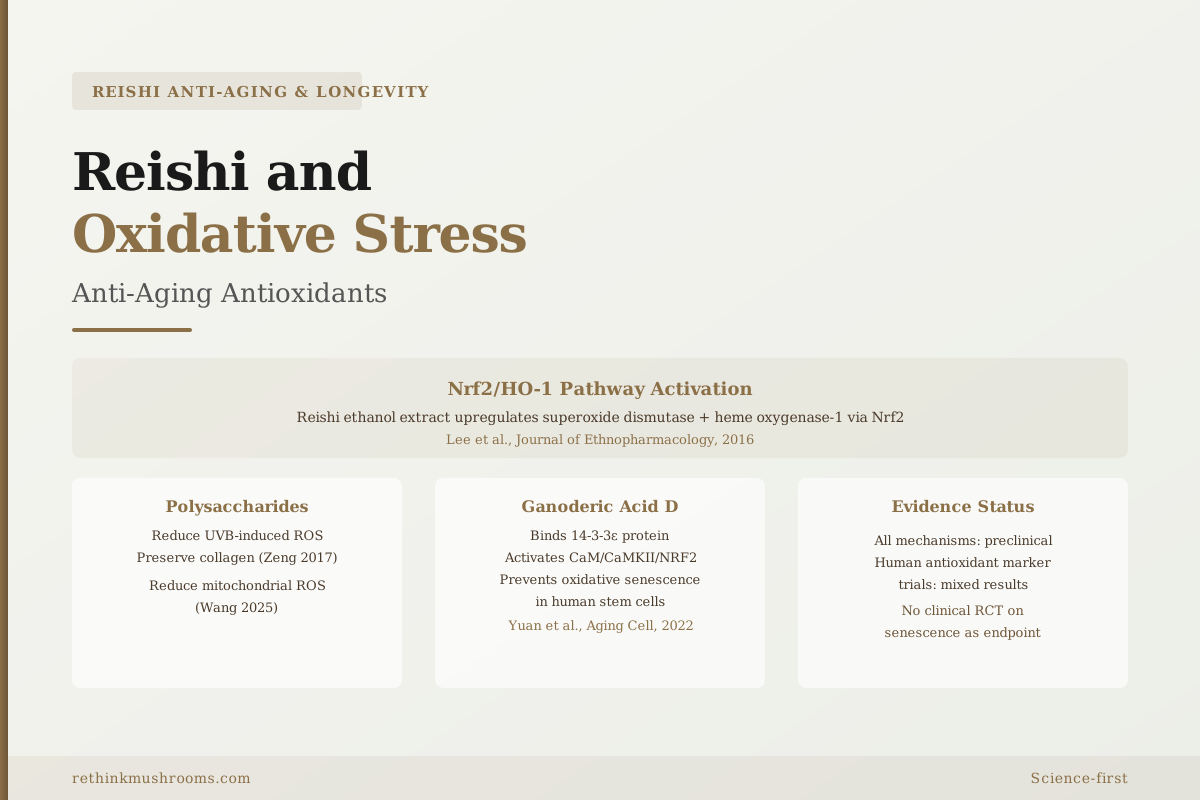
Nrf2 pathway
Lee et al. 2016 showed that Reishi ethanol extract activates the Nrf2/HO-1 master antioxidant pathway in stressed cells, upregulating protective enzymes including superoxide dismutase and heme oxygenase-1.
Lee et al., Journal of Ethnopharmacology, 2016
Nrf2/HO-1
master antioxidant pathway activated by Reishi ethanol extract (Lee 2016)
GA-D
ganoderic acid D shown to prevent oxidative stress-induced cellular senescence in human stem cells (Yuan 2022)
2025
year Wang et al. showed Reishi extract reduces mitochondrial ROS and preserves membrane potential in stressed skin cells
Lee et al., Journal of Ethnopharmacology, 2016
 View as image ↗
Oxidative stress is one of the central drivers of biological aging. When cells produce more reactive oxygen species (unstable molecules with unpaired electrons) than their antioxidant systems can neutralize, the excess damages proteins, fats, and DNA. This oxidative damage accumulates over decades and contributes to the tissue and organ decline associated with aging.
Reishi mushroom interacts with this process through several documented mechanisms. Its compounds activate the cell's own antioxidant production systems, reduce the oxidative burden in stressed cells, and in one particularly important 2022 discovery, prevent oxidative stress from pushing cells into a permanently aged state called cellular senescence.
This article covers what the research actually shows about Reishi and oxidative stress, from the well-established Nrf2 pathway activation to the more recent discovery about ganoderic acid D.
For foundational Reishi context, see the Reishi introduction. For how these mechanisms connect to the broader Reishi longevity evidence, see Reishi and longevity. For the specific compounds driving these effects, see ganoderic acids: the unique triterpenes in Reishi.
Key Takeaways
- Reishi ethanol extract activated the Nrf2/HO-1 master antioxidant signaling pathway in stressed cells, upregulating superoxide dismutase and heme oxygenase-1, per Lee et al. 2016
- Reishi polysaccharides reduced UVB-induced reactive oxygen species (ROS) in dermal fibroblasts, decreased matrix metalloproteinase expression, and preserved collagen synthesis, per Zeng et al. 2017
- Ganoderic acid D (GA-D) directly binds the 14-3-3ε protein to activate the CaM/CaMKII/NRF2 axis, preventing oxidative stress-induced senescence in human mesenchymal stem cells, per Yuan et al. 2022
- A 2025 Wang et al. study found that Reishi extract reduced mitochondrial ROS and preserved mitochondrial membrane potential in UVA-stressed skin cells
- A 2024 comparative study (Abdelkader et al., Foods) tested four medicinal and edible mushrooms and found Ganoderma lucidum among those that reduced ROS and DNA damage and protected human skin fibroblasts from induced aging
- Human studies have found mixed results on circulating antioxidant enzyme levels, and no human RCT has specifically tested Reishi's effect on oxidative stress biomarkers as a primary endpoint
How Reishi Reduces Oxidative Stress: The Nrf2 Pathway
Cells do not simply tolerate oxidative stress passively. They have an active defense system: when ROS levels rise, a protein called Nrf2 (Nuclear factor erythroid 2-related factor 2) translocates into the cell nucleus and switches on genes that produce antioxidant enzymes. These enzymes (including superoxide dismutase, catalase, glutathione peroxidase, and heme oxygenase-1) neutralize reactive oxygen species before they damage cellular structures.
Nrf2 is sometimes called the master regulator of antioxidant response. It is the cell's built-in response to oxidative threat.
Lee and colleagues demonstrated in a 2016 study that Reishi ethanol extract activates the Nrf2/HO-1 pathway in cells exposed to oxidative stress.[1] The extract upregulated the expression of antioxidant enzymes downstream of Nrf2, including heme oxygenase-1 (HO-1), in stressed cell lines. The mechanism was Nrf2-dependent: when Nrf2 activity was blocked, the protective effect of the extract was reduced.
This means Reishi does not primarily function as a direct antioxidant that scavenges free radicals itself (though some Reishi compounds do have direct radical-scavenging activity). It functions more accurately as an inducer of the cell's own antioxidant machinery, turning up the body's internal defenses rather than substituting for them.
This distinction matters because it suggests dose-timing considerations. Drugs that activate Nrf2 must be present long enough to trigger gene expression changes, which take longer than simple chemical antioxidant reactions. It also makes Reishi's antioxidant effect fundamentally different from, say, taking vitamin C, which directly scavenges specific radicals.
For how Nrf2 intersects with Reishi's cardiovascular and anti-cancer mechanisms, see Reishi bioactive compounds: triterpenes, polysaccharides, and sterols.
UVB Radiation, Collagen Loss, and What Reishi Did to Skin Cells
One of the most practically visible forms of oxidative stress is photoaging, the skin damage caused by ultraviolet radiation. UVB radiation generates ROS in skin cells, which activate matrix metalloproteinases (enzymes that break down collagen), reduce new collagen synthesis, and accelerate the visible appearance of aging.
Zeng and colleagues tested Reishi polysaccharides against this process in 2017.[2] They exposed human dermal fibroblasts (the cells that produce collagen in skin) to UVB radiation and then treated them with Reishi polysaccharide extract. The polysaccharides reduced UVB-induced ROS accumulation, decreased expression of matrix metalloproteinase-1 (MMP-1, the main collagen-degrading enzyme), and preserved type I collagen synthesis compared to untreated irradiated cells.
The Zeng 2017 data is preclinical. It was conducted in cell culture, not in human skin trials. But it identifies a specific mechanism (polysaccharide-mediated ROS reduction preserving collagen) that is both biologically plausible and relevant to the photoaging process that accounts for a large proportion of visible skin aging.
A 2025 study by Wang and colleagues extended this work by examining how Reishi extract affected oxidative stress specifically at the mitochondrial level in skin cells under UV stress.[5] Mitochondria are the primary site of cellular energy production and also a major source of ROS. Wang's team found that Reishi extract reduced mitochondrial ROS levels, preserved mitochondrial membrane potential (the electrical gradient across the mitochondrial membrane that drives energy production), and supported mitochondrial biogenesis in aging skin cells; in a murine UVA photoaging model, the extract also mitigated UVA-induced mitochondrial dysfunction and reduced epidermal thickening and dermal protein loss.
The mitochondrial angle connects the skin aging evidence to the broader anti-aging literature: mitochondrial dysfunction and ROS production increase with age across all tissues, not just skin. For more on this connection, see Reishi and mitochondrial biogenesis.
The Bridge Between Oxidative Stress and Cellular Aging: The GA-D Discovery
The most mechanistically significant piece of research in this area is a 2022 study published in Aging Cell by Yuan and colleagues.[3]
The study focused on a specific Reishi compound called ganoderic acid D (GA-D) and a process called cellular senescence. Cellular senescence is what happens when a cell is subjected to enough stress or damage that it stops dividing but does not die. Senescent cells accumulate in tissues with age and cause problems: they secrete inflammatory signals that damage neighboring cells, and their presence is associated with age-related diseases.
Yuan's team was studying how oxidative stress pushes cells into senescence, and they tested whether GA-D could intervene. The target was human mesenchymal stem cells, the precursor cells that give rise to bone, cartilage, fat, and connective tissue, and whose senescence contributes significantly to age-related decline.
The finding was specific and mechanistically detailed. GA-D directly binds to a protein called 14-3-3ε, which had previously been identified as a suppressor of the CaM/CaMKII/NRF2 signaling axis. By binding to 14-3-3ε, GA-D releases the suppression and activates the CaM/CaMKII/NRF2 pathway. This activation increases antioxidant capacity and prevents the oxidative stress-induced entry into senescence.
In plain terms: GA-D latches onto a molecular lock, and by latching onto it, opens a door that the cell's antioxidant defense needs to go through. Removing this specific lock prevents oxidative stress from permanently shutting down those stem cells.
This is more specific than "reishi has antioxidants." It is: compound X binds protein Y to activate pathway Z, which prevents senescence outcome W. That level of mechanistic specificity is what distinguishes this finding from the vague anti-aging claims that dominate the supplement space.
For more on GA-D and the broader ganoderic acid compound family, see the companion ganoderic acid A, B, and beyond: individual compound research. For how GA-D fits into the full cellular senescence picture, see Ganoderma lucidum and cellular senescence.
What Antioxidant Compounds Are Actually in Reishi?
The antioxidant activity in Reishi comes from several compound classes rather than a single molecule.
Polysaccharides, particularly the beta-glucan-containing fractions, are responsible for the photoaging protection shown by Zeng 2017 and contribute to general immune and antioxidant signaling. Polysaccharides are present in both hot water extracts (which dissolve them efficiently) and whole mushroom products.
Triterpenes, including the ganoderic acids (of which GA-D is one), are the lipid-soluble compounds responsible for the more specific molecular effects on Nrf2 and senescence pathways. Triterpenes are better extracted in alcohol or dual-extract products.
A 2024 comparative study directly tested four medicinal and edible mushrooms side by side, including Ganoderma lucidum (Reishi) and Pleurotus ostreatus (oyster mushroom).[4] Using standard chemical assays (DPPH, ABTS, reducing power) and a human skin fibroblast model of induced aging, the researchers found that all four mushrooms, Reishi among them, had significant antioxidant activity and reduced ROS and DNA damage in the aged cells. Oyster mushroom also shows antioxidant-mediated aging protection (see oyster mushroom and aging: antioxidant-mediated protection), reinforcing that the anti-aging antioxidant mechanism is not unique to Reishi but is shared across several species. This was an in-vitro study, not a clinical one.
The 2017 Wang review, covering the full landscape of anti-aging mechanisms in Ganoderma, placed oxidative stress modulation alongside immune senescence, mitochondrial function, and telomere integrity as the key aging hallmarks that Reishi research addresses.[6]
For a complementary perspective on mushroom antioxidants and aging from the ergothioneine angle, see ergothioneine and longevity: the vitamin of longevity hypothesis.
The Honest Picture: What Human Studies Show (and Don't Show)
The evidence reviewed above is entirely preclinical: cell cultures and animal models. This is important context.
Evidence Hierarchy
Reishi & Oxidative Stress — Specific in the Lab, Untested at the Human Endpoint
The antioxidant case is strongest where it is most mechanistic: named compounds acting on named pathways in cells. It thins toward the top, where a human trial on an oxidative-aging outcome would sit. Bar width reflects how much direct evidence exists at each tier.
Molecular mechanism (cell)
evidenceLee 2016 · Yuan 2022
Ethanol extract activates the Nrf2/HO-1 antioxidant pathway; ganoderic acid D binds 14-3-3ε to switch on the CaM/CaMKII/NRF2 axis and block senescence
Human & skin cell models
evidenceZeng 2017 · Wang 2025 · Abdelkader 2024
Polysaccharides reduce UVB-induced ROS and preserve collagen in human fibroblasts; extract lowers mitochondrial ROS in aging cells
Animal photoaging model
evidenceWang 2025
In mice, extract mitigates UVA-induced mitochondrial dysfunction and reduces epidermal thickening and dermal protein loss
Human antioxidant-biomarker trial
mixedChu 2012
A 12-week randomized, placebo-controlled crossover trial found Reishi well tolerated but without the robust, consistent antioxidant-biomarker shifts seen in the lab
Human oxidative-aging endpoint
gapDoes not yet exist
No trial has tested whether Reishi prevents oxidative stress-driven senescence or measurable aging outcomes in people
How to read it: the two lower tiers are wide and solid because the mechanistic and cell-model data converge on specific, repeatable effects. The one human trial that measured antioxidant biomarkers came back muted, and the trial that would test an actual oxidative-aging outcome in people has never been run. That top gap — not the quality of the mechanism — is the honest limit of the Reishi antioxidant claim.
Sources: Lee 2016 [1]; Zeng 2017 [2]; Yuan 2022 [3]; Abdelkader 2024 [4]; Wang 2025 [5]; Chu 2012 [7]. Bar widths are illustrative of evidence depth per tier, not quantitative effect sizes.
Human studies on Reishi and antioxidant markers have produced mixed results. In one of the better-controlled human trials, Chu and colleagues gave 26 adults with borderline hypertension or hyperlipidemia 1.44 g of Lingzhi (Reishi) daily for 12 weeks in a randomized, double-blind, placebo-controlled crossover design and measured antioxidant status alongside cardiovascular and metabolic parameters.[7] The supplement was well tolerated, but it did not produce the robust, consistent shifts in antioxidant biomarkers that the preclinical cell and animal data might lead one to expect. That gap, strong mechanistic effects in the lab and muted or inconsistent signals in human blood, is the central caveat of this literature.
The gap between compelling in-vitro and animal data and inconsistent human data is common in antioxidant supplement research and is not unique to Reishi. Several explanations exist: bioavailability of active compounds varies by preparation; circulating enzyme levels in blood may not reflect what is happening in target tissues; the oxidative stress burden in healthy study participants may be too low to detect a meaningful intervention effect.
None of this means the preclinical mechanisms are wrong. It means the preclinical mechanisms have been documented in controlled laboratory conditions and have not yet been consistently validated in human supplementation trials. That is an accurate description of where the research stands.
The GA-D senescence finding (Yuan 2022) is particularly compelling because it identifies a mechanism that could, in principle, be clinically relevant. But it was conducted in cell culture, and no human trial has tested whether GA-D supplementation prevents senescence accumulation in human tissues. That remains an open research question.
The Bottom Line
Reishi activates the Nrf2/HO-1 master antioxidant pathway in stressed cells, with its polysaccharides reducing UV-induced ROS and its triterpene ganoderic acid D preventing oxidative stress from triggering cellular senescence via the 14-3-3ε/CaM/CaMKII/NRF2 pathway. The 2025 Wang study added mitochondrial ROS reduction data. All evidence is preclinical; human studies on circulating antioxidant markers have shown mixed results. The most mechanistically significant finding is GA-D's ability to prevent senescence in human stem cells, though this has not been tested in human supplementation trials.
Frequently Asked Questions
Sources & References
- 1RTHM-00802·Lee, Yoo-Hwan et al. (2016). “Ethanol Extract of Ganoderma lucidum Augments Cellular Anti-oxidant Defense through Activation of Nrf2/HO-1..” Journal of pharmacopuncture.Study breakdown →PubMed →↩
- 2RTHM-00934·Zeng, Qinghai et al. (2017). “Ganoderma lucidum polysaccharides protect fibroblasts against UVB-induced photoaging..” Molecular medicine reports.Study breakdown →PubMed →↩
- 3RTHM-01644·Yuan, Huan et al. (2022). “Ganoderic acid D prevents oxidative stress-induced senescence by targeting 14-3-3ε to activate CaM/CaMKII/NRF2 signaling pathway in mesenchymal stem cells..” Aging cell.Study breakdown →PubMed →↩
- 4RTHM-01844·Abdelkader, Menna-Allah E et al. (2024). “Mitigating Oxidative Stress and Promoting Cellular Longevity with Mushroom Extracts..” Foods (Basel.Study breakdown →PubMed →↩
- 5RTHM-02203·Wang, Han et al. (2025). “Ganoderma lucidum extract reduces skin aging by reducing mitochondrial stress and controlling mitochondrial numbers..” Fitoterapia.Study breakdown →PubMed →↩
- 6RTHM-00926·Wang, Jue et al. (2017). “Emerging Roles of Ganoderma Lucidum in Anti-Aging..” Aging and disease.Study breakdown →PubMed →↩
- 7RTHM-00247·Chu, Tanya T W et al. (2012). “Study of potential cardioprotective effects of Ganoderma lucidum (Lingzhi): results of a controlled human intervention trial..” The British journal of nutrition.Study breakdown →PubMed →↩