Oyster Mushroom (Pleurotus ostreatus)
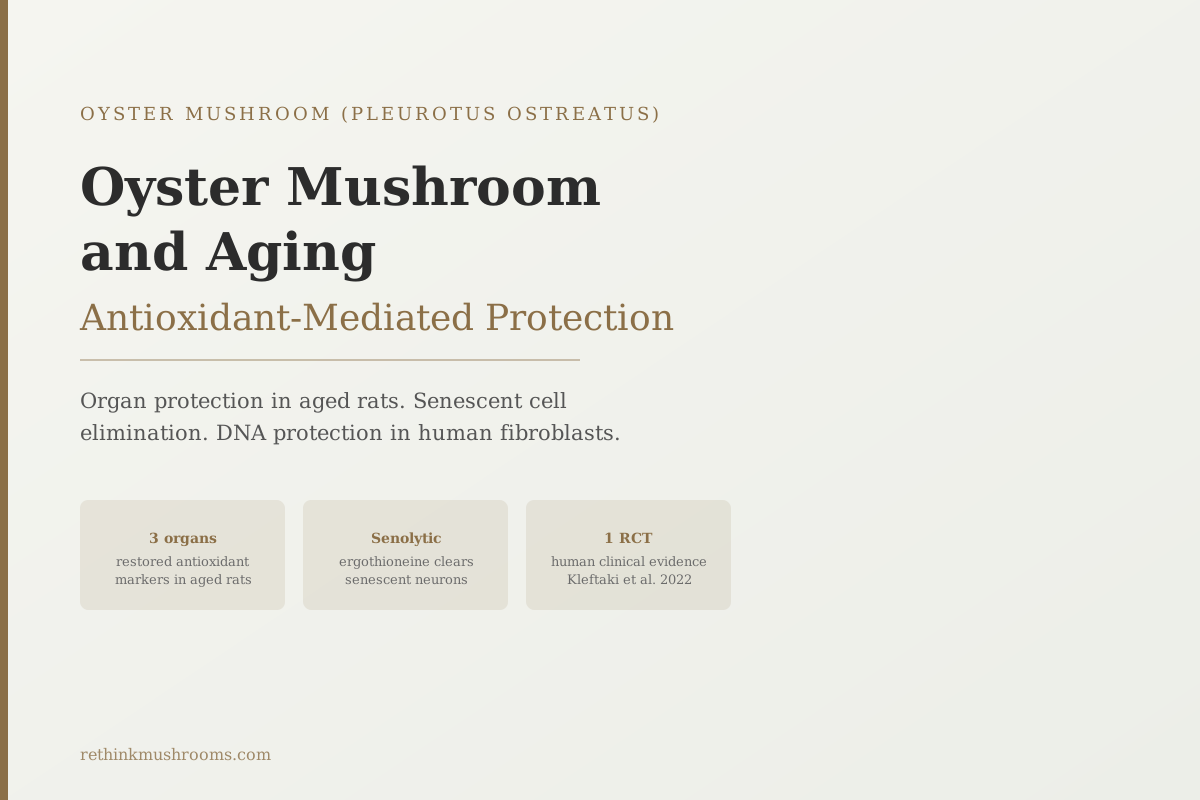
↑ Glutathione in 3 organs
Aged rats given Pleurotus ostreatus extract showed elevated glutathione, vitamins C and E, and antioxidant enzyme activity — alongside reduced malondialdehyde (a marker of oxidative damage) — in heart, liver, and kidney.
Jayakumar et al., 2007
Senolytic
ergothioneine-rich mushroom extract eliminated neuronal senescent cells in the HT22 model — a mechanism beyond antioxidant scavenging; oyster mushrooms are a leading dietary ergothioneine source (Apparoo et al., 2024)
Human cells
Abdelkader et al. (2024) found oyster mushroom extracts reduced DNA damage and ROS in D-galactose-aged human skin fibroblasts
1 RCT
Kleftaki et al. (2022) — the only randomized controlled trial on Pleurotus antioxidants in humans, with improved metabolic markers
Jayakumar et al., 2007
 View as image ↗
Biological aging is largely driven by the accumulation of oxidative damage. Over time, the body's endogenous antioxidant systems — primarily glutathione, vitamins C and E, and enzymes like superoxide dismutase — decline in efficiency. Reactive oxygen species (unstable molecules that damage DNA, proteins, and cell membranes) accumulate faster than the body can neutralize them, and this imbalance accelerates tissue aging in the organs that depend on antioxidant defense most: heart, liver, kidney, and brain.
This oxidative trajectory can be measured. And a 2007 study showed it can be modified by oyster mushroom consumption. Aged rats given Pleurotus ostreatus extract showed elevated glutathione, vitamins C and E, and antioxidant enzyme activity alongside reduced malondialdehyde (a marker of cellular membrane damage from oxidative stress) in heart, liver, and kidney — the signature of antioxidant system restoration in the context of aging-related decline.[1]
For an overview of oyster mushroom biology, nutritional profile, and the full breadth of studied health effects, see what is the oyster mushroom?. This article focuses on the aging-specific evidence.
Key Takeaways
- Jayakumar et al. (2007) found that aged rats fed Pleurotus ostreatus extract showed elevated glutathione, vitamins C and E, and superoxide dismutase activity in heart, liver, and kidney — alongside reduced malondialdehyde, a marker of lipid peroxidation caused by oxidative damage
- Aguilar et al. (2020) found P. ostreatus beta-glucans provided in-vivo protection against oxidative stress in animal models, confirming that antioxidant activity extends from test tubes into living organisms
- Abdelkader et al. (2024) in Foods found that oyster mushroom extracts reduced DNA damage and reactive oxygen species in D-galactose-aged human skin fibroblasts — the most direct human-cell-model evidence of oyster mushroom anti-aging effects
- Apparoo et al. (2024) found that an ergothioneine-rich mushroom extract (shiitake, the highest-ergothioneine species of 14 tested) eliminated neuronal senescent cells — aging "zombie cells" that accumulate and accelerate tissue damage. The effect was driven by ergothioneine itself, a compound oyster mushrooms also concentrate, making this senolytic activity a distinct anti-aging mechanism beyond antioxidant scavenging
- Liang et al. (2020) found Pleurotus eryngii (king oyster mushroom) powder improved memory and learning in Alzheimer's model mice by reducing amyloid-beta-induced oxidative damage in brain tissue
- Kleftaki et al. (2022) is the only randomized controlled trial on Pleurotus antioxidants in humans: P. eryngii with its antioxidant compounds and vitamin D2 improved markers of metabolic disorder in human participants
How Oxidative Stress Drives Biological Aging
Aging is not simply the passage of time. It's the progressive failure of cellular repair systems — particularly the antioxidant defenses that neutralize reactive oxygen species before they can damage the molecular machinery of the cell.
Reactive oxygen species (ROS) are unstable molecules produced as a byproduct of normal metabolism, particularly in the mitochondria — the organelles that generate cellular energy. A young cell keeps ROS under control through three main systems: enzymatic antioxidants (superoxide dismutase, catalase, glutathione peroxidase), non-enzymatic antioxidants (glutathione, vitamins C and E), and repair enzymes that fix oxidative damage to DNA and proteins.
With age, all three systems decline. Superoxide dismutase activity drops. Glutathione levels fall. Vitamin C and E concentrations in tissue decrease. The result is an increasingly favorable environment for oxidative damage to accumulate in cells and tissues — and this accumulation is now understood as a primary driver of age-related organ decline.
What's measurable in this process:
- Glutathione (GSH): the body's most abundant intracellular antioxidant. Lower levels mean less capacity to neutralize ROS.
- Malondialdehyde (MDA): a byproduct that forms when ROS attack the fat molecules in cell membranes. Higher MDA means more membrane damage has occurred.
- Superoxide dismutase (SOD): an antioxidant enzyme that neutralizes the superoxide radical, one of the most damaging ROS species.
- Vitamins C and E: dietary antioxidants that serve as the cell's external antioxidant reservoir.
The Jayakumar 2007 study measured all of these markers in aged rats before and after oyster mushroom extract treatment. What it found was a reversal of the aging antioxidant pattern: the protective markers went up, the damage marker went down — in three organs simultaneously.
The Aged-Rat Study: Organ-Level Protection
In 2007, Jayakumar and colleagues administered Pleurotus ostreatus extract to aged rats and measured antioxidant parameters in heart, liver, and kidney tissue.[1] These three organs represent three different types of oxidative stress exposure: the heart faces constant energy demand (high mitochondrial ROS production), the liver processes toxins and generates substantial metabolic ROS, and the kidney filters blood continuously.
The results showed consistent movement in the same direction across all three organs:
- Reduced glutathione (GSH) levels increased — the cell had more of its primary antioxidant available
- Vitamins C and E concentrations increased — the tissue antioxidant reservoir was restored
- Superoxide dismutase and related enzyme activities increased — the enzymatic antioxidant systems were more active
- Malondialdehyde (MDA) decreased — less oxidative damage to cell membranes had occurred
This is in-vivo evidence — from living animals, not test tubes. The study didn't show that oyster mushroom extract has antioxidant activity in isolation (that was already established by in-vitro work). It showed the activity translates to actual organ tissue in aging animals.
Jayakumar et al. (2007) · Experimental Gerontology
- Population
- 24-month-old (aged) rats, compared against 4-month-old (young) rats
- Intervention
- Oral Pleurotus ostreatus extract
- Comparator
- Untreated aged rats; young-rat baseline
- Finding
- Glutathione, vitamins C and E, and antioxidant enzyme activity (SOD, catalase, glutathione peroxidase) rose toward young-rat levels, while malondialdehyde (a lipid-peroxidation damage marker) fell — across liver, kidney, heart, and brain.
positive In-vivo animal evidence. Establishes biological plausibility for organ-level antioxidant restoration, but does not by itself demonstrate an effect in humans.
Jayakumar et al. (2007), J Med Food — PMID 17126515 [ref 1]
Aguilar et al. (2020) corroborated the in-vivo principle from a different angle: P. ostreatus beta-glucans provided protection against oxidative stress induced by acrylamide, a chemical oxidative stressor, in animal models.[2] Acrylamide is a widely studied oxidative challenge model. Beta-glucan protection against it confirms that the polysaccharide fraction of oyster mushroom, not just the phenolics, contributes to in-vivo antioxidant defense.
For the broader antioxidant research including DPPH/ABTS scavenging data and the full compound profile, see oyster mushroom antioxidants: free radical scavenging research.
2024 Human Cell Evidence: DNA Damage Reduced in Aged Fibroblasts
Animal models establish biological plausibility. The closer to human biology the model gets, the more clinically relevant the findings become.
Abdelkader et al. (2024) in Foods tested extracts from P. ostreatus alongside three other mushroom species on human skin fibroblasts that had been aged using D-galactose — a standard laboratory model for inducing cellular aging markers.[3] D-galactose causes cells to accumulate ROS, develop DNA damage, and express patterns of oxidative stress associated with biological aging. It's used as a rapid aging simulation in cell culture because it produces measurable changes within days.
Oyster mushroom extracts reduced both ROS levels and DNA damage markers in these aged fibroblasts. The cells exposed to the mushroom extract showed a less-damaged oxidative profile than aged cells without the extract.
This is still preclinical — human cells in a dish rather than a living person. But the model is designed to simulate aging-relevant oxidative damage in human cell lines rather than rodent tissue, which is a meaningful step toward clinical relevance. It confirms that the antioxidant effects seen in aged-rat organs are not artifacts of a species-specific response.
Beyond Antioxidants: Oyster Mushrooms and Senescent Cells
The most surprising finding in recent oyster mushroom aging research doesn't involve antioxidants at all. It involves senolysis.
Senescent cells are cells that have stopped dividing normally but haven't died. Instead of completing the cell cycle, they enter a state of permanent growth arrest and begin secreting inflammatory signals — cytokines, matrix-degrading enzymes, and pro-inflammatory factors — that damage surrounding healthy tissue. They're sometimes called "zombie cells." Their accumulation is now recognized as a significant driver of tissue aging, and clearing them (a process called senolysis) is an active target in aging research.
Apparoo et al. (2024) in Brain Research screened 14 mushroom species for ergothioneine content, identified shiitake (Lentinula edodes) as the richest source, and found that its ergothioneine-rich extract eliminated neuronal senescent cells in the HT22 cell model — a well-validated neuronal cell line used in aging and neuroprotection research.[4] Critically, the researchers ran the mushroom extract head-to-head against an equimolar dose of pure ergothioneine, which pinned the senolytic effect on the ergothioneine itself rather than some other component of the extract. That distinction is what makes the finding relevant to oyster mushrooms: they are among the highest dietary ergothioneine sources, even though this particular experiment used shiitake.
Ergothioneine is a sulfur-containing amino acid produced almost exclusively by fungi and concentrated in oyster mushrooms. The body absorbs it through a dedicated transporter protein called OCTN1 and concentrates it in tissues facing the highest oxidative stress, particularly the mitochondria. This targeting is what makes ergothioneine unusual: while most dietary antioxidants distribute broadly, ergothioneine specifically accumulates where aging-related ROS originates at 50 to 100 times the concentration in blood.
The senolytic finding means ergothioneine may act through a fundamentally different mechanism than free radical scavenging. Rather than simply neutralizing ROS as they're produced, ergothioneine-rich mushroom extracts appear to clear the accumulated cellular damage — the senescent cells themselves — that drives tissue inflammation in aging.
This is in vitro evidence from a cell model, not a human trial. Senolytic interventions in humans remain an active research area. But the mechanism is biologically distinct from anything the broader antioxidant narrative captures, and it appears nowhere in consumer-facing oyster mushroom content. For more on ergothioneine's longevity-related mechanisms, see ergothioneine in oyster mushrooms: the longevity antioxidant. For the anti-inflammatory aspects of ergothioneine that complement the senolytic activity, see ergothioneine and inflammation.
How Oyster Mushrooms Protect the Brain from Aging
The aging brain faces the same oxidative challenge as other organs, but with additional specificity: neurons are among the most metabolically active cells in the body, relying on continuous mitochondrial energy production and therefore generating substantial ROS. Neuronal senescent cells are particularly damaging because neurons that enter senescence signal their neighbors to follow.
Liang et al. (2020) tested Pleurotus eryngii (king oyster mushroom) powder in an Alzheimer's disease model using mice engineered to develop amyloid-beta (Aβ) pathology.[5] Amyloid-beta is the toxic protein that accumulates in Alzheimer's disease and drives oxidative damage in neurons. The P. eryngii-fed mice showed improved memory and learning performance compared to untreated Alzheimer's model animals, with mechanistic evidence pointing to reduced Aβ-induced oxidative stress as the underlying pathway.
This is not a study claiming oyster mushrooms prevent or treat Alzheimer's disease. It's a preclinical study showing that the antioxidant compounds in king oyster mushroom can reduce the specific type of oxidative damage that amyloid-beta produces in neuronal tissue. The relevance to aging is that amyloid-beta-associated oxidative stress is an extreme version of the same oxidative cascade that drives normal brain aging.
For a broader look at how the antioxidant activity within the Pleurotus genus compares across species, see comparing antioxidant activity across Pleurotus species.
Ergothioneine: The Compound That Targets Aging at the Source
Oyster mushrooms contain multiple antioxidant compounds: phenolic acids, flavonoids, beta-glucan polysaccharides, and ergothioneine. Of these, ergothioneine has the most distinctive anti-aging mechanism.
Liu et al. (2020) studied ergothioneine stability from culinary mushrooms including Pleurotus species and found it maintained strong antioxidant properties under various environmental conditions — heat, light, and pH variation — that degrade most common dietary antioxidants.[7] Ergothioneine is thermostable, which means cooking oyster mushrooms does not substantially degrade it. This is practically significant: you can sauté, steam, or roast oyster mushrooms without destroying the primary aging-relevant compound.
Ergothioneine's mechanism is its specificity. The body expresses OCTN1 transporters most densely in tissues that face the highest oxidative stress: the lens of the eye, bone marrow, blood cells, mitochondria-dense organs, and the brain. Ergothioneine is actively accumulated in these tissues to concentrations 50 to 100 times higher than plasma levels. This targeting puts it exactly where aging-related oxidative damage originates.
The human clinical evidence. Kleftaki et al. (2022) published the only randomized controlled trial of Pleurotus antioxidants in human participants, testing P. eryngii supplementation alongside its naturally occurring antioxidant compounds and vitamin D2 in people with metabolic disorders.[6] The trial showed improvements in metabolic markers in the treated group. This is the strongest human evidence for functional effects of Pleurotus antioxidants, and it used king oyster mushroom — the same species tested by Liang 2020 in Alzheimer's model mice and by Abdelkader 2024 in aging fibroblasts.
The RCT was not specifically an aging study; it measured metabolic markers in participants with metabolic disorders. But metabolic oxidative stress and aging-related oxidative stress share overlapping mechanisms, and the demonstrated improvement in antioxidant-related markers provides clinical-context validation for what the preclinical aging studies show.
The Evidence Picture
Taken together, the oyster mushroom aging literature shows convergent evidence across four levels of experimental complexity:
- In-vivo animal organ protection (Jayakumar 2007): glutathione, vitamins C/E, and enzyme activity all improved in three organs of aged rats, with reduced lipid peroxidation damage.
- In-vivo animal oxidative challenge (Aguilar 2020): beta-glucan fraction specifically protected against induced oxidative stress in living animals.
- Human cell model (Abdelkader 2024): direct reduction of DNA damage and ROS in D-galactose-aged human fibroblasts.
- Human RCT (Kleftaki 2022): improved antioxidant-relevant metabolic markers in human participants with Pleurotus eryngii supplementation.
Evidence Convergence
Four Tiers of Evidence — Strong at the Bottom, Thin at the Top
The case for oyster mushrooms and aging is built bottom-up: many cell and animal studies, one indirect human trial, and no long-term human aging trial yet. Bar width reflects how much direct evidence sits at each tier — narrower toward the top means closer to humans but less data.
Cell & in-vitro models
evidenceAbdelkader 2024 · Apparoo 2024
Aged human fibroblasts; ergothioneine clears senescent neurons
Animal models (in-vivo)
evidenceJayakumar 2007 · Aguilar 2020 · Liang 2020
Aged-rat organ antioxidant restoration; beta-glucan & cognition effects
Human trial (indirect)
evidenceKleftaki 2022
One RCT — improved antioxidant markers, but a metabolic (not aging) endpoint
Human aging trial
gapDoes not yet exist
No trial has measured aging biomarkers in people eating oyster mushrooms over time
How to read it: mechanistic and animal evidence converge consistently, which is why the lower tiers are wide and solid. The human evidence is a single, indirect trial, and the aging-specific human trial that would confirm a real-world effect has not been run. That gap — not the strength of the lower tiers — is the honest limit of the claim.
Sources: Jayakumar 2007 [1]; Aguilar 2020 [2]; Abdelkader 2024 [3]; Apparoo 2024 [4]; Liang 2020 [5]; Kleftaki 2022 [6]. Bar widths are illustrative of evidence depth per tier, not quantitative effect sizes.
- Cell / in-vitro studiescompleted
Aged human skin fibroblasts (Abdelkader 2024); ergothioneine clearing senescent HT22 neurons (Apparoo 2024, using shiitake extract).
- Animal studiescompleted
Aged-rat organ antioxidant restoration (Jayakumar 2007); beta-glucan protection vs. oxidative challenge (Aguilar 2020); Alzheimer's-model cognition (Liang 2020).
- Small / indirect human trialcurrent
One RCT of P. eryngii in metabolic disorder — improved antioxidant-relevant markers (Kleftaki 2022). Not an aging-specific endpoint.
- Large RCT with aging endpointsmissing
No trial has measured oxidative-stress or biological-age biomarkers in people eating oyster mushrooms over months to years.
- Meta-analysismissing
Not possible until aging-specific human trials exist.
The mechanistic and animal evidence is consistent and points the same direction. Human evidence exists but is a single, indirect trial measuring metabolic — not aging — endpoints. Treat oyster mushrooms as a promising, well-tolerated food, not a proven anti-aging intervention.
Jayakumar 2007 [1]; Aguilar 2020 [2]; Abdelkader 2024 [3]; Apparoo 2024 [4]; Liang 2020 [5]; Kleftaki 2022 [6]
What's missing: a long-term human trial measuring aging biomarkers (oxidative stress markers, biological age indicators, senescent cell burden) in healthy participants consuming oyster mushrooms over months to years. That trial does not yet exist.
The senolytic data from Apparoo 2024 adds a mechanistic possibility that is worth watching as the field develops: if ergothioneine can clear senescent cells in neuronal models, it may represent an active anti-aging intervention rather than passive antioxidant protection. This would position oyster mushrooms in a fundamentally different category from typical dietary antioxidants. But this evidence is early, from a single cell model, and needs replication and extension to in-vivo aging systems before stronger claims can be made.
For the full polyphenol compound profile and how cooking method affects antioxidant retention, see Pleurotus ostreatus polyphenols and oxidative stress protection. For how oyster mushroom's anti-inflammatory properties connect to the aging mechanisms described here, see oyster mushroom and inflammation.
Context
ModerateWhat this evidence does — and doesn't — support
Concern
The anti-aging findings come from aged rats, induced-aging cell cultures, and one indirect human trial. It is tempting to read 'reverses aging markers' as 'will slow my aging,' but no study has tested that in healthy people over time.
What the research says
The research supports oyster mushrooms as a nutrient-dense, well-tolerated food with antioxidant and ergothioneine content that is biologically plausible for healthy aging. It does not establish a therapeutic dose, a treatment claim, or an effect on human lifespan or disease.
Particularly relevant for: Anyone considering oyster mushrooms (or ergothioneine supplements) specifically to slow aging or treat a condition
What to do
Enjoy oyster mushrooms as part of a varied diet. This article is not medical advice — talk to a physician before using any food or supplement to manage a medical condition, and do not substitute it for prescribed treatment.
Evidence base: Jayakumar 2007 [1], Aguilar 2020 [2], Abdelkader 2024 [3], Apparoo 2024 [4], Liang 2020 [5], Kleftaki 2022 [6]
The Bottom Line
The oyster mushroom aging evidence spans four levels: aged-rat organ protection (elevated glutathione and reduced oxidative damage in heart, liver, kidney), beta-glucan antioxidant protection in living animals, DNA damage reduction in aged human skin fibroblasts, and one human RCT showing improved metabolic markers. The most novel finding is from Apparoo 2024: an ergothioneine-rich mushroom extract (shiitake, the highest-ergothioneine species tested) eliminated neuronal senescent cells, with the effect traced to ergothioneine itself — a compound oyster mushrooms also concentrate — suggesting a senolytic mechanism that goes beyond free radical scavenging. No long-term human aging trial exists.
Frequently Asked Questions
Sources & References
- 1RTHM-00217·Jayakumar, Thanasekaran et al. (2007). “Protective effect of an extract of the oyster mushroom, Pleurotus ostreatus, on antioxidants of major organs of aged rats..” Experimental gerontology.Study breakdown →PubMed →↩
- 2RTHM-01161·Aguilar Uscanga, Blanca Rosa et al. (2020). “In-vivo assessment of the protection of β-glucans of Pleurotus ostreatus against oxidative stress caused by acrylamide intake (part II)..” Nutricion hospitalaria.Study breakdown →PubMed →↩
- 3RTHM-01844·Abdelkader, Menna-Allah E et al. (2024). “Mitigating Oxidative Stress and Promoting Cellular Longevity with Mushroom Extracts..” Foods (Basel.Study breakdown →PubMed →↩
- 4RTHM-01850·Apparoo, Yasaaswini et al. (2024). “Potential role of ergothioneine rich mushroom as anti-aging candidate through elimination of neuronal senescent cells..” Brain research.Study breakdown →PubMed →↩
- 5RTHM-01237·Liang, Chih-Hung et al. (2020). “Effect of the King Oyster Culinary-Medicinal Mushroom Pleurotus eryngii (Agaricomycetes) Basidiocarps Powder to Ameliorate Memory and Learning Deficit in Ability in Aβ-Induced Alzheimer's Disease C57BL/6J Mice Model..” International journal of medicinal mushrooms.Study breakdown →PubMed →↩
- 6RTHM-00771·Kleftaki, Stamatia-Angeliki et al. (2022). “A Randomized Controlled Trial on Pleurotus eryngii Mushrooms with Antioxidant Compounds and Vitamin D2 in Managing Metabolic Disorders..” Antioxidants (Basel.Study breakdown →PubMed →↩
- 7RTHM-00633·Liu, Xinqi et al. (2020). “A Study on the Antioxidant Properties and Stability of Ergothioneine from Culinary-Medicinal Mushrooms..” International journal of medicinal mushrooms.Study breakdown →PubMed →↩