Oyster Mushroom Antioxidants
6+ Pleurotus species compared
Pleurotus antioxidant activity is not a single number. Polyphenols, β-glucans, and ergothioneine vary by species, strain, substrate, and processing, producing measurable differences in DPPH, TEAC, FRAP, and cell-based assays.
Tan et al., 2015; Lam & Okello, 2015; Li & Shah, 2013; Petraglia et al., 2023
Polyphenols
the water-soluble antioxidant fraction
β-glucans
the polysaccharide antioxidant pool
Ergothioneine
the mushroom-specific amino-acid antioxidant
Tan et al., 2015; Lam & Okello, 2015; Li & Shah, 2013; Petraglia et al., 2023
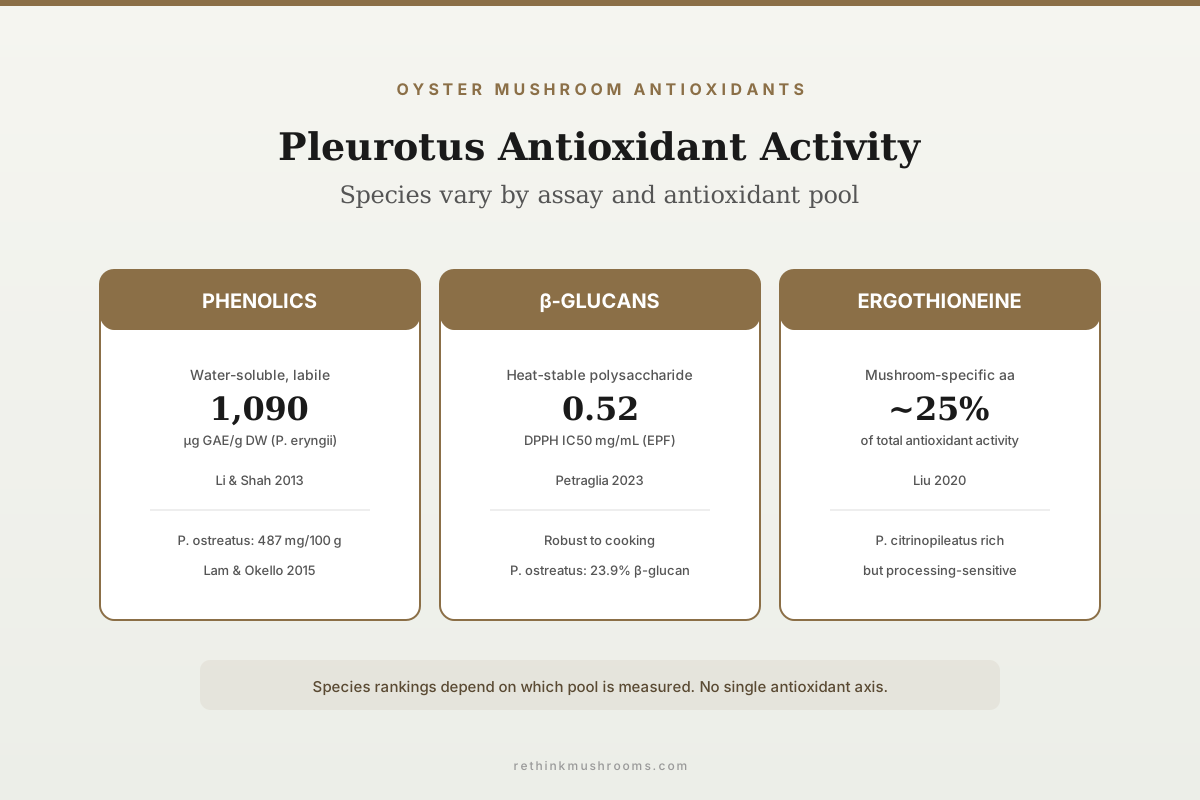 View as image ↗
"Oyster mushroom" is a trade name that covers more than a dozen cultivated Pleurotus species, and the antioxidant profile differs meaningfully among them. Tan and colleagues (2015) compared six species (Pleurotus eryngii, P. citrinopileatus, P. cystidiosus, P. flabellatus, P. floridanus, P. pulmonarius) across boiling, microwaving, and pressure cooking, and found that the antioxidant response tracked the species-cooking pairing rather than the species alone: pressure cooking raised free-radical scavenging in P. floridanus by more than 200% and in P. flabellatus by 117.6%, while P. eryngii was not among the species improved by pressure cooking and instead gained 17% in TEAC under microwaving.[1] Tagkouli and colleagues (2020), working on three species on shared cultivation substrates, showed total free amino acids ranging from 17.37 mg/g in P. nebrodensis to 130.12 mg/g in P. ostreatus, a 7.5-fold interspecies gap in a single compound class.[2]
This article maps the Pleurotus antioxidant activity data species by species, by measurement class (phenolics, β-glucans, ergothioneine), and by the practical variables (strain, substrate, drying, cooking) that determine what actually reaches the plate. For adjacent coverage see ergothioneine in oyster mushrooms: the longevity antioxidant you can eat, oyster mushroom and antioxidants: free radical scavenging research, oyster mushroom and aging: antioxidant-mediated protection, and Pleurotus ostreatus polyphenols and oxidative stress protection.
Key Takeaways
- Tan et al. (2015) compared six Pleurotus species under identical cooking and found species-specific antioxidant responses, with pressure cooking improving DPPH scavenging in P. floridanus by >200% and P. flabellatus by 117.6%
- P. ostreatus in Lam and Okello (2015) contained 487.12 mg gallic acid equivalent polyphenols per 100 g dry matter, DPPH scavenging at 14.46 µmol TE/g, TEAC at 16.51 µmol/g, and FRAP at 11.21 µmol/g
- P. eryngii in Li and Shah (2013) reached total phenolics of 1,090.42 µg GAE/g DW freeze-dried, of which the bound fraction supplied 71%; the freeze-dried free fraction gave the best DPPH result (IC50 32.61 µg/mL), but oven-dried won on reducing power and boiling-treated bound phenolics won on superoxide
- P. eryngii polysaccharides (Petraglia et al., 2023) showed DPPH IC50 at 0.52 mg/mL, superoxide IC50 at 1.15 mg/mL, hydroxyl radical IC50 at 0.89 mg/mL, and protected brain glial cells from H2O2-induced ROS at 0.05–0.2 mg/mL
- Ergothioneine (Liu et al., 2020) accounts for ~25% of total antioxidant activity in mushroom extract, with the compound itself scavenging H2O2 at IC50 11.65 µg/mL, hydroxyl radicals at 70.31 µg/mL, and superoxide at 160.44 µg/mL
- Kleftaki et al. (2022) randomised 100 metabolically unhealthy patients for three months to a daily baked, UV-B-irradiated P. eryngii snack or counselling alone; the snack group saw regulated glucose, reduced weight, fat and waist and hip circumference, higher 25(OH)D2, and lower IL-6 and oxidised LDL
- Tagkouli et al. (2020) found that the same species grown on different substrates (wheat straw, grape marc, olive by-product) produced meaningfully different free amino acid profiles, confirming that substrate is a third variable alongside species and cooking
The Three Antioxidant Pools In Pleurotus
Comparing species requires separating what is being compared. The antioxidant activity measured in a mushroom extract is the sum of three largely independent molecular pools.
Phenolics and flavonoids. Water- and methanol-soluble small molecules including gallic acid, protocatechuic acid, p-hydroxybenzoic acid, and flavonoid aglycones. Quantified by Folin-Ciocalteu (for total phenols), by HPLC (for specific compounds), and measured as activity by DPPH, TEAC, and FRAP assays. The phenolic pool leaches into cooking water and is temperature-sensitive during drying.
β-glucans and other polysaccharides. Polymeric compounds from the fungal cell wall, with antioxidant activity through both direct radical scavenging and through induction of cellular antioxidant defenses. Quantified by enzymatic Megazyme assays for β-1,3-(1,6)-D-glucan specifically. Retained through cooking because the polymers are heat-stable at typical culinary temperatures.
Ergothioneine. A unique sulfur-containing amino acid that mushrooms (and a small number of other organisms) biosynthesise and that humans accumulate through a dedicated transporter (OCTN1/SLC22A4). Distinct from the phenolic and polysaccharide pools. Quantified by HPLC. As a purified compound it is highly stable to heat, light, and acid-base swings, though copper ions degrade it — and, importantly, ergothioneine extracted from mushroom tissue proved less heat-stable than the pure standard (Liu et al., 2020).[3]
Three Pools, Three Assays, Three Fates
“Antioxidant Activity” Is Not One Measurement
A single number for a mushroom’s antioxidant activity hides three chemically independent pools. They are quantified by different assays, reported in different units, and they respond to the same pot of boiling water in different directions. A species can lead on one pool and be undocumented on another.
Phenolics & flavonoids
Small water- and methanol-soluble molecules — gallic acid, protocatechuic acid, flavonoid aglycones.
Measured by
Folin-Ciocalteu, HPLC; activity read as DPPH, TEAC, FRAP
- 1,090.42 µg GAE/g DWP. eryngii, freeze-dried total — Li & Shah 2013 [5]
- 71% of total (freeze-dried)Held as the bound fraction — Li & Shah 2013 [5]
- 487.12 mg GAE/100 g DMP. ostreatus, raw total polyphenols — Lam & Okello 2015 [4]
Leaches into cooking water and degrades with heat. Boiling cut P. eryngii free phenolics to 95.42 µg GAE/g DW; blanching lowered P. ostreatus polyphenols.
β-glucans & polysaccharides
Cell-wall polymers, notably (1-3; 1-6)-β-D-glucans, active by direct scavenging and by inducing cellular defenses.
Measured by
Megazyme enzymatic assay for glucan content; radical assays on isolated fractions
- 23.9% of dry weightP. ostreatus β-glucan content — Lam & Okello 2015 [4]
- IC50 0.52 mg/mLP. eryngii EPF, DPPH — Petraglia 2023 [6]
- IC50 0.89 mg/mLP. eryngii EPF, hydroxyl radical — Petraglia 2023 [6]
Blanching did not significantly affect β-glucan content, and boiling actually raised total glucans by enhancing the β-glucan fraction — the opposite direction to what boiling does to phenolics.
Ergothioneine
A sulfur-containing amino acid that mushrooms biosynthesise and humans accumulate through a dedicated transporter (OCTN1/SLC22A4).
Measured by
HPLC
- ~25%Share of extract antioxidant ability — Liu 2020 [3]
- IC50 11.65 µg/mLPure EGT vs hydrogen peroxide — Liu 2020 [3]
- IC50 160.44 µg/mLPure EGT vs superoxide — Liu 2020 [3]
Pure ergothioneine showed excellent light, thermal, and acid-base stability, though Cu²⁺ lowered it. The catch: EGT extracted from the mushroom was less thermally stable than the purified standard.
Note what is absent: per-species ergothioneine values. Liu 2020 established that concentration differs significantly between mushroom species, but published no Pleurotus ranking — so the pool most often invoked in marketing copy is the one with the thinnest comparative data.
A species that ranks highly on one pool may rank poorly on another. Liu and colleagues (2020) reported that ergothioneine concentration differed significantly between mushroom species and used P. citrinopileatus (the golden oyster) as their extraction source, though the published account does not set out a per-species ergothioneine league table.[3] P. eryngii (the king oyster) ranks highly on phenolics in Li and Shah (2013)[5] and on polysaccharide antioxidant activity in Petraglia et al. (2023).[6] The clearest evidence that the pools move independently comes from Tan and colleagues (2015), who found no correlation between total phenolic content and measured antioxidant activity across their six-species panel — a species can carry phenolics without leading on activity, which points to polysaccharides, ergothioneine, and peptides carrying part of the response.[1]
The practical consequence is that the question "which oyster mushroom has the most antioxidant activity" does not have a single answer. It has a species-by-assay answer.
Species By Species: What The Data Show
Pleurotus ostreatus (pearl oyster)
The most commercially widespread Pleurotus species. Lam and Okello (2015) quantified raw P. ostreatus at 487.12 mg gallic acid equivalent total polyphenols per 100 g dry matter, with DPPH scavenging activity of 14.46 µmol Trolox equivalent/g, TEAC of 16.51 µmol/g, and FRAP of 11.21 µmol/g. Blanching decreased polyphenol content and antioxidant activities, but mushroom rolls produced from blanched mushrooms plus the blanching water recovered β-glucan and polyphenol content, showing that the phenolic pool leaches into cooking liquid and can be retained by capturing that liquid.[4]
Jedinak and colleagues (2011) demonstrated anti-inflammatory activity of P. ostreatus extracts through inhibition of NF-κB and AP-1 signalling in macrophages, linking the direct antioxidant chemistry to a downstream cellular mechanism.[7] Effiong and colleagues (2023) assessed the nutritional quality of P. ostreatus, reporting 17.06% crude protein, 43.42% carbohydrate, and 23.63% crude fibre alongside vitamin, monosaccharide, and amino-acid profiles. That work characterises the food matrix rather than the antioxidant assays — it is a reason to eat the mushroom, not a measurement of its radical scavenging.[8]
Pleurotus eryngii (king oyster)
The meatier, thicker-stemmed species. Li and Shah (2013) quantified free and bound phenolics in P. eryngii across freeze-dried, oven-dried, and boiling-treated samples. Free phenolics ranged from 95.42 µg GAE/g DW in the boiling-treated extract to 442.50 µg GAE/g DW; bound phenolics peaked at 774.17 µg GAE/g DW in the freeze-dried sample; and total phenolics peaked at 1,090.42 µg GAE/g DW, again freeze-dried. The bound fraction did most of the work, contributing 71% of total phenolics in freeze-dried material against 49.76% in oven-dried. Critically, no single treatment won every assay: the freeze-dried free fraction gave the strongest DPPH scavenging (IC50 32.61 µg/mL), the oven-dried free fraction the strongest reducing power (IC50 26.31 µg/mL), and the boiling-treated bound fraction the strongest superoxide scavenging (IC50 14.07 µg/mL).[5]
Petraglia and colleagues (2023) isolated a polysaccharide fraction from cultivated P. eryngii rich in (1-3, 1-6)-β-D-glucans and measured direct antioxidant activity with DPPH IC50 at 0.52 mg/mL, superoxide IC50 at 1.15 mg/mL, hydroxyl IC50 at 0.89 mg/mL, and nitric oxide IC50 at 2.83 mg/mL. At 0.05–0.2 mg/mL the fraction counteracted H2O2-induced ROS production in rat glial DI-TNC1 cells, showing the antioxidant activity is not only cell-free chemistry but also protection of a living cell.[6]
Kleftaki and colleagues (2022) randomised 100 metabolically unhealthy patients across two arms for three months, with the intervention group eating a daily baked, UV-B-irradiated P. eryngii snack on top of the nutritional counselling both groups received. Relative to control, the snack regulated glucose and reduced body weight, fat, and waist and hip circumference; serum 25(OH)D2 rose, and IL-6 and oxidised LDL fell in the mushroom group. That makes it clinical-endpoint data for a Pleurotus preparation in a patient population rather than a laboratory extract.[9] Amerikanou and colleagues (2023) chemically characterised that style of UV-B-irradiated, baked P. eryngii chip and found it low in calories and lipids and high in fibre, protein, ergosterol, and β-glucans — evidence that the polysaccharide and sterol fractions come through the process intact. Their analysis did not report phenolic retention.[10]
Pleurotus citrinopileatus (golden oyster)
The yellow-capped species with distinctive aroma. Liu and colleagues (2020) measured ergothioneine (EGT) across mushroom species and extracted EGT from P. citrinopileatus specifically. The EGT fraction accounted for approximately 25% of total antioxidant activity of the extract. Interestingly, the thermal stability of EGT extracted from P. citrinopileatus (PEGT) was not as robust as purified EGT standards, with long-term high-temperature heating reducing concentration. Pure EGT scavenged hydrogen peroxide at IC50 11.65 µg/mL, hydroxyl at 70.31 µg/mL, and superoxide at 160.44 µg/mL.[3]
The practical consequence is a stability asymmetry that is easy to miss. Pure ergothioneine is robust — Liu's team found excellent light, thermal, and acid-base stability, with only copper ions dropping its concentration. But the ergothioneine as extracted from the mushroom behaved less robustly than the purified standard under sustained heat. The compound's reputation for indestructibility comes from the purified molecule; the food matrix version has a lower ceiling.
P. pulmonarius (phoenix oyster), P. flabellatus, P. floridanus, P. cystidiosus
Tan and colleagues (2015) compared these species alongside P. eryngii and P. citrinopileatus in a single cooking-method experiment, measuring DPPH and TEAC after boiling, microwaving, and pressure-cooking. The comparison surfaced clear species-cooking interactions: pressure cooking improved DPPH scavenging in P. floridanus by more than 200% and in P. flabellatus by 117.6% relative to raw, while P. eryngii's TEAC value improved 17% under microwaving but not pressure cooking. Total phenolic content did not correlate with antioxidant activity across all species, suggesting that non-phenolic compounds (polysaccharides, ergothioneine, peptides) drive part of the response.[1]
P. nebrodensis
A gourmet species with a narrow distribution. Tagkouli 2020 found the lowest free amino acid content of their three-species panel (17.37 mg/g dw), about one-seventh the P. ostreatus level.[2] Published antioxidant data for P. nebrodensis is sparse compared to ostreatus and eryngii.
Side-By-Side: The Comparison Table
Values below are taken only from the cited studies, in the units those studies used. Where a cell reads "not reported in the cited sources," that is a statement about the evidence base, not an implied zero or an implied low value — it means no per-species figure exists in the papers this article rests on. Filling those cells with plausible-sounding estimates is exactly the error that makes cross-species antioxidant comparisons untrustworthy. Note too that comparing absolute numbers across rows risks apples-and-oranges error, because the labs used different assay conditions and different reference standards.
| Species | Phenolics (GAE) | DPPH activity | Ergothioneine | β-glucan antioxidant data |
|---|---|---|---|---|
| P. ostreatus | 487 mg GAE/100 g DW (Lam 2015) | 14.46 µmol TE/g (Lam 2015) | Not separately quantified in the cited sources | β-glucan 23.9% of DW (Lam 2015) |
| P. eryngii | Total up to 1,090 µg GAE/g DW, freeze-dried (Li 2013) | IC50 32.61 µg/mL, free frac., freeze-dried (Li 2013) | Not separately quantified in the cited sources | EPF DPPH IC50 0.52 mg/mL (Petraglia 2023) |
| P. citrinopileatus | Not reported in the cited sources | Not among the species improved by pressure cooking (Tan 2015) | Extraction source in Liu 2020; extracted EGT less heat-stable than pure standard | Not reported in the cited sources |
| P. pulmonarius | Not reported in the cited sources | Pressure cooking +49.1% (Tan 2015) | Not reported in the cited sources | Not reported in the cited sources |
| P. flabellatus | Not reported in the cited sources | Pressure cooking +117.6% (Tan 2015) | Not reported in the cited sources | Not reported in the cited sources |
| P. floridanus | Not reported in the cited sources | Pressure cooking >200% (Tan 2015) | Not reported in the cited sources | Not reported in the cited sources |
| P. nebrodensis | Not reported in the cited sources | Not reported in the cited sources | Not reported in the cited sources | Not reported in the cited sources |
The temptation on reading a table like this is to convert everything into one unit and sort it. That operation produces a number, and the number is meaningless. Here is why:
Why The Numbers Cannot Be Ranked
Six Real Figures From This Article, None Of Them Comparable
Every number below is accurately reported from a peer-reviewed source. Put them in one column and they still cannot be sorted, because they disagree about the unit, about which direction means “better,” and about what was actually in the tube — whole raw mushroom, an isolated fraction, or a purified compound that never was a mushroom.
| Reported figure | What was measured | Scale direction |
|---|---|---|
| 487.12 mg GAE/100 g DMLam & Okello 2015 [4] | Total polyphenols, raw P. ostreatusFolin-Ciocalteu | ▲ Higher = stronger |
| 14.46 µmol TE/gLam & Okello 2015 [4] | DPPH activity, raw P. ostreatusDPPH vs Trolox standard | ▲ Higher = stronger |
| 1,090.42 µg GAE/g DWLi & Shah 2013 [5] | Total phenolics, freeze-dried P. eryngiiFolin-Ciocalteu | ▲ Higher = stronger |
| IC50 32.61 µg/mLLi & Shah 2013 [5] | Freeze-dried free phenolic fractionDPPH, half-inhibition concentration | ▼ Lower = stronger |
| IC50 0.52 mg/mLPetraglia 2023 [6] | Enriched polysaccharide fraction, P. eryngiiDPPH, half-inhibition concentration | ▼ Lower = stronger |
| IC50 11.65 µg/mLLiu 2020 [3] | Pure ergothioneine standard, not a mushroomHydrogen peroxide scavenging | ▼ Lower = stronger |
The trap, worked through
Convert Lam’s oyster figure into Li’s units and 487.12 mg GAE/100 g becomes 4,871.2 µg GAE/g — about 4.5× Li’s 1,090.42 µg GAE/g for king oyster. The arithmetic is correct. The conclusion “pearl oyster has 4.5× the phenolics of king oyster” is still wrong: Lam measured total polyphenols in raw mushroom, Li measured free plus bound phenolics in freeze-dried mushroom, in different labs with different extraction chemistry. Valid conversion, invalid comparison.
Substrate And Strain: Two Variables Often Ignored
Cross-species comparisons fail if substrate and strain are not controlled. Tagkouli and colleagues (2020) demonstrated the point sharply by growing three Pleurotus species on wheat straw alone, on wheat straw plus grape marc, and on olive by-product, and measuring free amino acid profiles. They found significant differences in free amino acid levels both among the species and among the cultivation substrates used, and principal component analysis on the full profile of six Pleurotus strains cleanly separated P. ostreatus from P. eryngii and P. nebrodensis, in line with their phylogenetic affinity.[2]
The implication is that when a commercial P. ostreatus is compared to a commercial P. eryngii, the two samples may differ because of species and because of substrate. Cultivators who grow on oat straw, hardwood sawdust, cotton waste, coffee grounds, or proprietary supplemented mixes will produce mushrooms with different antioxidant profiles within the same species. Studies that report "P. ostreatus phenolics were X mg/100 g" without specifying substrate, strain, and harvest stage cannot be directly compared to another "P. ostreatus phenolics were Y" without the same parameters.
Kleftaki 2022's trial sidestepped this variability by giving every participant the same standardised snack — mushrooms harvested, baked, and UV-B-irradiated to a single specification. That is a strength for internal validity and a limit on generalisation: the result belongs to that preparation, and extrapolating it to consumer P. eryngii bought loose at a supermarket is not automatic.[9]
Cooking Changes Everything (In Species-Specific Ways)
The most important practical variable is cooking. Tan 2015's six-species pressure-cooking data make the point unavoidably: the same cooking method can dramatically improve activity in one species and barely move it in another. The mechanism is multifactorial: heat breaks cell walls and releases bound phenolics (increasing measurable free activity), heat can also oxidise labile compounds (decreasing activity), and water extraction removes soluble compounds into the cooking liquid (lowering the measured activity of the drained solid).[1]
Six Species, Three Cooking Methods
The Best Cooking Method Depends On The Species
Tan and colleagues cooked six oyster-mushroom species by boiling, microwaving, and pressure cooking. There was no single winning method. Pressure cooking lifted radical scavenging sharply in three species; the king oyster instead responded to microwaving, on a different assay.
DPPH free-radical scavenging vs uncooked
DPPH free-radical scavenging vs uncooked
DPPH free-radical scavenging vs uncooked
TEAC reducing power vs uncooked — Not among the species improved by pressure cooking — a different method won for this species.
Also in the panel, no figure reported
These two species were in the six-species panel but no improvement figure was published for them. That is a gap in the record, not a measured lack of response — and it is why this article does not rank them.
The result that travels furthest: across the whole panel there was no correlation between total phenolic content and antioxidant activity. Whatever is driving the cooking response, it is not phenolics alone — which is the strongest available evidence that the polysaccharide and ergothioneine pools are carrying part of the signal.
Li and Shah (2013) showed the drying-method version of the same phenomenon. P. eryngii free phenolics ranked freeze-dried > oven-dried > boiling-treated. Bound phenolics followed the same rank. Freeze-drying retains the phenolic pool; oven-drying loses some to heat; boiling strips a large fraction into cooking liquid.[5]
Lam and Okello (2015) showed the β-glucan side is more robust. Blanching did not significantly affect β-glucan content in P. ostreatus, while it did decrease dry matter and polyphenol content. The polysaccharide antioxidant pool survives cooking better than the phenolic pool does.[4]
Roncero-Ramos and colleagues (2017) tested boiling, microwaving, grilling, and deep frying across four cultivated species including P. ostreatus and P. eryngii. Antioxidant capacity fell significantly after boiling and frying, while grilled and microwaved samples held higher values, and the authors named microwaving and grilling the best processes for preserving the nutritional profile. Their glucan result points the same way as Lam and Okello's: boiling increased total glucan content by enhancing the β-glucan fraction, even as it cost antioxidant capacity. The two pools respond to the same pot of water in opposite directions.[11]
From In-Vitro Activity To Clinical Endpoints
Most of the Pleurotus antioxidant literature consists of laboratory assays (DPPH, TEAC, FRAP, ORAC) and cell-based models. These are valuable for ranking and mechanism work but are not themselves clinical outcomes. Two study designs bridge the gap.
Cellular protection assays. Petraglia 2023's DI-TNC1 rat glial cells challenged with H2O2 and protected by the P. eryngii EPF at 0.05–0.2 mg/mL establish that the cell-free radical scavenging activity translates into protection of a living cell from oxidative damage. The same fraction was biocompatible across 0.006–1 mg/mL, so the protective window is not simply the fraction being toxic to the cells.[6]
Randomised controlled trials in humans. Kleftaki 2022's RCT of P. eryngii in metabolic-disorder patients is the closest thing to a clinical-endpoint test in the Pleurotus antioxidant literature. The trial used a controlled mushroom preparation standardised for its antioxidant compound content and vitamin D2, and measured clinical metabolic parameters.[9] The bridging logic is: if a preparation carrying a characterised antioxidant profile moves a clinical endpoint in a randomised controlled design, the antioxidant activity has translated out of the lab. Kleftaki's trial is evidence for P. eryngii specifically under a specific preparation protocol; it does not generalise automatically to every Pleurotus species at every dose.
Kleftaki et al. (2022) · Antioxidants
- Population
- 100 metabolically unhealthy adults, randomised to two arms
- Intervention
- A daily baked, UV-B-irradiated Pleurotus eryngii snack for three months, on top of conventional nutritional counselling
- Comparator
- Conventional nutritional counselling alone
- Finding
- Compared with control, snack consumption regulated glucose levels and reduced body weight, body fat, and waist and hip circumference. Serum 25(OH)D2 rose significantly in the intervention group, LDL and SGOT fell within that group, and IL-6 and oxidised LDL decreased in the mushroom arm alongside an increase in overall physical health.
narrow-scope A genuine randomised design with real clinical endpoints — and the only one of its kind in this article. It tests one species, in one heavily engineered preparation (baked and UV-B-irradiated to raise vitamin D2), in one patient population. The vitamin D2 enrichment also means the antioxidant fraction is not the only active variable, so the result cannot be read as a clean test of Pleurotus antioxidants alone.
Kleftaki et al., Antioxidants, 2022 [9]
Reading This Responsibly
ModerateTrial evidence in patients is not a self-treatment protocol
Concern
The strongest human evidence here comes from people with diagnosed metabolic disorders who were also receiving clinical nutritional counselling. That framing is easy to lose, and the results get repeated as though eating more oyster mushrooms will lower anyone's glucose or oxidised LDL.
What the research says
Treat oyster mushrooms as a nutritious food with promising but early evidence, not as a therapy. The Kleftaki snack was a standardised, UV-B-irradiated preparation delivered alongside medical supervision — not a supermarket punnet. Dicks and colleagues, reviewing eight P. ostreatus trials, rated most of them at high or unclear risk of bias and concluded only that intake may improve cardiometabolic health.
Particularly relevant for: Anyone managing diabetes, lipid disorders, or cardiovascular disease — and anyone on glucose-lowering or lipid-lowering medication, where diet changes can interact with dose.
What to do
Talk to your physician before using mushrooms to manage a diagnosed condition or before changing any medication. Nothing in this article is medical advice.
Kleftaki et al., 2022 [9]; Dicks et al., 2020 [12]
Limitations Of The Comparative Evidence
Absolute numbers across studies are rarely directly comparable. Assay conditions (solvent, concentration, Trolox-equivalent calibration, incubation time) vary between labs. The "P. ostreatus DPPH at 14.46 µmol TE/g" from Lam 2015 and a "P. eryngii DPPH IC50 of 32.61 µg/mL" from Li 2013 are reporting different things with different reference standards; they cannot be ranked against each other without a standardised reanalysis.
Reporting quality is the binding constraint on the human evidence. Dicks and colleagues (2020) assessed eight clinical trials of P. ostreatus intake against the Cochrane risk-of-bias tool and found that in most of them the risk of bias was high or unclear, driven by methodological weaknesses and inadequate reporting. Their conclusion is deliberately conditional: P. ostreatus intake may improve cardiometabolic health, and better-designed trials are needed before that becomes a firmer statement.[12]
Substrate and strain variation within a species can exceed interspecies variation. Tagkouli 2020's substrate-driven differences demonstrate that "P. ostreatus on wheat straw" and "P. ostreatus on grape marc" are chemically different products with different nutrient profiles.[2]
Processing history is often omitted from nutrition-panel labels. A dried P. eryngii freeze-dried versus oven-dried differs substantially in retained antioxidant activity (Li 2013), yet consumer products rarely disclose the drying method.[5]
Human outcome data are limited, and species-imbalanced. Kleftaki 2022 is a randomised trial of a P. eryngii preparation with clinical endpoints; Dicks 2020's systematic review covers eight P. ostreatus trials whose findings pointed toward improved glucose and lipid measures — with body weight unchanged, and appetite never assessed — but at a risk of bias its authors rated high or unclear in most cases. For the other Pleurotus species in this article there is no comparable human outcome literature at all.[9][12]
Fact Check
The golden oyster and the ergothioneine crown
The claim
“Pleurotus citrinopileatus — the golden oyster — is the richest ergothioneine source among oyster mushrooms.”
Liu et al. (2020) chose P. citrinopileatus as the mushroom to extract ergothioneine from, and reported that ergothioneine accounted for around 25% of the extract's total antioxidant ability. Being the species a research team worked with is easily retold as being the species that won.
What research shows
UnsupportedLiu's team established that ergothioneine concentration differs significantly between mushroom species, and characterised the compound in depth — its scavenging IC50 values, its stability, its degradation by copper. What they did not publish is a per-species ranking of Pleurotus ergothioneine content. The golden oyster was their extraction source, not a declared winner.
Ergothioneine is genuinely the most interesting of the three antioxidant pools — mushrooms are its main dietary source and humans have a dedicated transporter for it. But it is also the pool with the thinnest per-species comparative data in the Pleurotus literature, which is precisely the gap that lets confident marketing claims grow.
Liu et al., Int J Med Mushrooms, 2020 [3]
Some Pleurotus bioactivities sit outside the antioxidant frame entirely. Wong and colleagues (2020) reviewed Pleurotus activity against breast cancer cell lines, a pathway that involves immune modulation and apoptosis signalling rather than simple radical scavenging.[13] Summarising Pleurotus as "an antioxidant mushroom" undersells the rest of its pharmacology.
What The Evidence Actually Establishes
- Cell-free and cell-based assayscompleted
Dense and consistent. DPPH, TEAC, FRAP and radical-scavenging IC50 values exist for multiple species and fractions, and Petraglia 2023 took it a step further — the P. eryngii polysaccharide fraction protected live rat glial cells from H2O2-induced ROS at 0.05–0.2 mg/mL, at concentrations that were not toxic to them.
- Animal modelscompleted
Present but narrow, and mostly aimed at inflammation rather than antioxidant endpoints. Jedinak 2011 showed a P. ostreatus concentrate suppressing TNF-α, IL-6 and IL-12p40 in macrophages and blunting LPS-induced inflammation in mice via NF-κB and AP-1.
- Small human trialscurrent
This is the frontier. Kleftaki 2022 randomised 100 metabolically unhealthy patients for three months and moved glucose, weight, IL-6 and oxidised LDL. Dicks 2020 found eight P. ostreatus clinical trials in total — with most at high or unclear risk of bias.
- Large randomised trialsmissing
None. No adequately powered trial tests a characterised Pleurotus antioxidant preparation against a clinical endpoint, and nothing at all exists at this level for species other than P. ostreatus and P. eryngii.
- Pooled quantitative synthesismissing
None. Dicks 2020 is a systematic review that deliberately stops short of pooling, because the underlying trials are too heterogeneous and too weakly reported to support a combined estimate.
The laboratory chemistry is well established and internally consistent; the human evidence is one three-month randomised trial of one species in one engineered preparation, plus eight mostly bias-prone trials of another. The gap between 'this fraction scavenges radicals in a tube' and 'eating this mushroom changes an outcome in you' has been crossed once, narrowly, and not for most of the genus.
Jedinak et al. 2011 [7]; Kleftaki et al. 2022 [9]; Dicks et al. 2020 [12]; Petraglia et al. 2023 [6]
The Pleurotus antioxidant activity picture, reduced to the defensible claims:
- Antioxidant activity in Pleurotus comes from at least three largely independent molecular pools: phenolics, β-glucans, and ergothioneine.
- Species rankings depend on which pool is measured. P. ostreatus and P. eryngii are the best-characterised, with quantified phenolic and polysaccharide data; the smaller-market species are documented mainly through their cooking responses.
- Per-species ergothioneine figures are the largest hole in the comparative data. Liu 2020 establishes that species differ significantly and characterises the compound thoroughly, but does not publish a Pleurotus ranking.
- Substrate and strain are independent variables that can shift composition within a species meaningfully.
- Cooking changes the measured activity in species-specific ways. Freeze-drying retains total phenolics best; pressure cooking raised scavenging in three of Tan's six species and not the others; β-glucan content is comparatively robust to boiling and blanching.
- One randomised controlled trial (Kleftaki 2022, n=100, three months) provides a clinical-endpoint bridge for a specific P. eryngii preparation.
- Assay-standardisation limits prevent a clean universal ranking of all Pleurotus species on a single antioxidant axis.
The Bottom Line
Pleurotus ostreatus, eryngii, citrinopileatus and other oyster-mushroom species carry antioxidant activity through three largely independent molecular pools: phenolics (100s–1,000s of µg GAE/g DW), β-glucans (polysaccharide antioxidant activity with DPPH IC50 in the mg/mL range for isolated fractions), and ergothioneine (a mushroom-specific amino-acid antioxidant). Species rankings differ by assay, and substrate, strain, and cooking method all shift the measured activity. One randomised controlled trial (Kleftaki 2022) bridges from laboratory activity to clinical metabolic endpoints for P. eryngii.
Frequently Asked Questions
Sources & References
- 1RTHM-00403·Tan, Yee-Shin et al. (2015). “Influence of customized cooking methods on the phenolic contents and antioxidant activities of selected species of oyster mushrooms (Pleurotus spp.)..” Journal of food science and technology.Study breakdown →PubMed →↩
- 2RTHM-00658·Tagkouli, Dimitra et al. (2020). “Free Amino Acids in Three Pleurotus Species Cultivated on Agricultural and Agro-Industrial By-Products..” Molecules (Basel.Study breakdown →PubMed →↩
- 3RTHM-00633·Liu, Xinqi et al. (2020). “A Study on the Antioxidant Properties and Stability of Ergothioneine from Culinary-Medicinal Mushrooms..” International journal of medicinal mushrooms.Study breakdown →PubMed →↩
- 4RTHM-00384·Lam, Yu Shan et al. (2015). “Determination of Lovastatin, β-glucan, Total Polyphenols, and Antioxidant Activity in Raw and Processed Oyster Culinary-Medicinal Mushroom, Pleurotus ostreatus (Higher Basidiomycetes)..” International journal of medicinal mushrooms.Study breakdown →PubMed →↩
- 5RTHM-00296·Li, Siqian et al. (2013). “Effects of various heat treatments on phenolic profiles and antioxidant activities of Pleurotus eryngii extracts..” Journal of food science.Study breakdown →PubMed →↩
- 6RTHM-00847·Petraglia, Tania et al. (2023). “Antioxidant Activity of Polysaccharides from the Edible Mushroom Pleurotus eryngii..” Molecules (Basel.Study breakdown →PubMed →↩
- 7RTHM-00219·Jedinak, Andrej et al. (2011). “Anti-inflammatory activity of edible oyster mushroom is mediated through the inhibition of NF-κB and AP-1 signaling..” Nutrition journal.Study breakdown →PubMed →↩
- 8RTHM-00823·Effiong, Magdalene Eno et al. (2023). “Assessing the nutritional quality of Pleurotus ostreatus (oyster mushroom)..” Frontiers in nutrition.Study breakdown →PubMed →↩
- 9RTHM-00771·Kleftaki, Stamatia-Angeliki et al. (2022). “A Randomized Controlled Trial on Pleurotus eryngii Mushrooms with Antioxidant Compounds and Vitamin D2 in Managing Metabolic Disorders..” Antioxidants (Basel.Study breakdown →PubMed →↩
- 10RTHM-00813·Amerikanou, Charalampia et al. (2023). “Pleurotus eryngii Chips-Chemical Characterization and Nutritional Value of an Innovative Healthy Snack..” Foods (Basel.Study breakdown →PubMed →↩
- 11RTHM-00488·Roncero-Ramos, Irene et al. (2017). “Effect of different cooking methods on nutritional value and antioxidant activity of cultivated mushrooms..” International journal of food sciences and nutrition.Study breakdown →PubMed →↩
- 12RTHM-00614·Dicks, Lisa et al. (2020). “Effect of the Intake of Oyster Mushrooms (Pleurotus ostreatus) on Cardiometabolic Parameters-A Systematic Review of Clinical Trials..” Nutrients.Study breakdown →PubMed →↩
- 13RTHM-00664·Wong, Jack Ho et al. (2020). “Mushroom extracts and compounds with suppressive action on breast cancer: evidence from studies using cultured cancer cells, tumor-bearing animals, and clinical trials..” Applied microbiology and biotechnology.Study breakdown →PubMed →↩