Oyster Mushroom Science
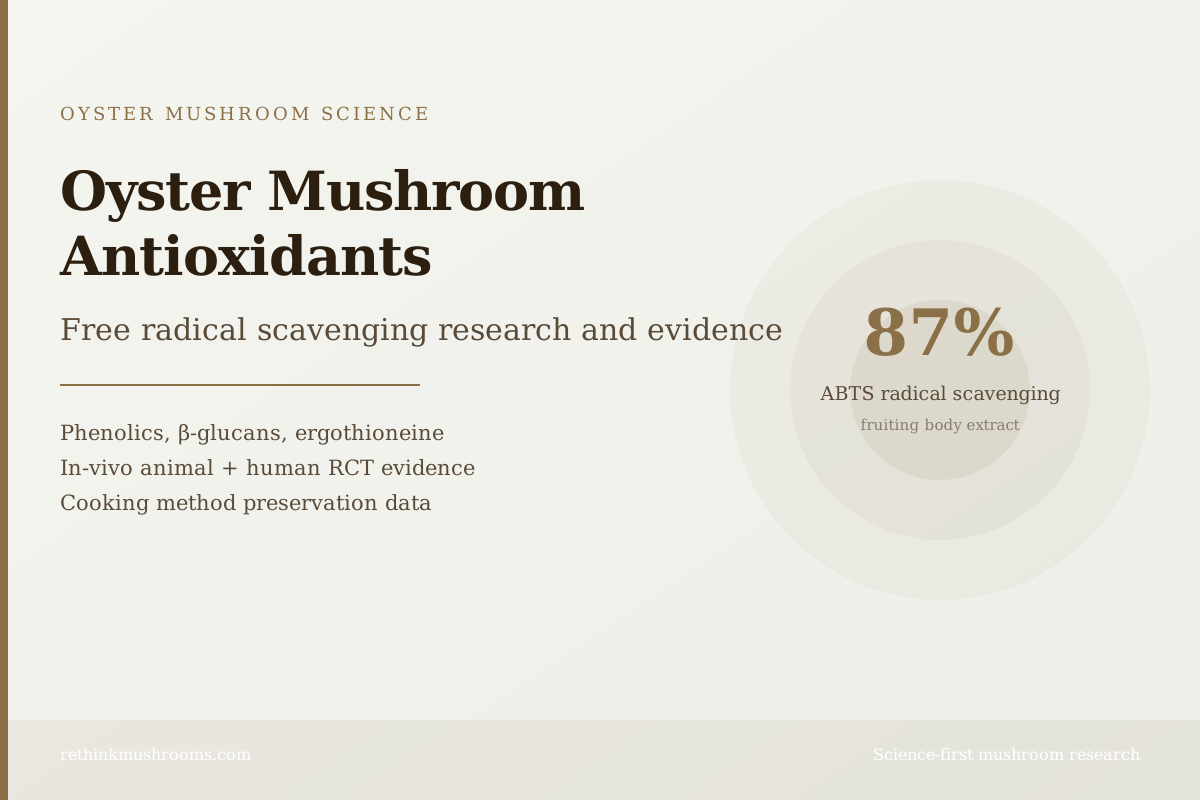
87% ABTS radical scavenging (fruiting body, methanol extract)
In a 2016 study measuring antioxidant activity at different growth stages, oyster mushroom fruiting body extracts reached 87.29% ABTS radical scavenging, comparable to vitamin C at equivalent concentrations.
González-Palma et al., Frontiers in Microbiology, 2016
63–87%
DPPH radical scavenging range depending on growth stage and extraction method
Only RCT
Pleurotus eryngii supplementation tested in a human trial for antioxidant endpoints (Kleftaki 2022)
In vivo
β-glucan from P. ostreatus protected against oxidative stress in living animals, not just test tubes
González-Palma et al., Frontiers in Microbiology, 2016
 View as image ↗
Oyster mushrooms show DPPH radical-neutralizing ability reaching 63–87% in controlled lab tests, with ABTS scavenging as high as 87% in fruiting body extracts, according to measurements from González-Palma and colleagues in a 2016 Frontiers in Microbiology study.[1] These are meaningful numbers, but understanding what they mean and what drives them requires going a level deeper than most consumer health coverage does. The oyster mushroom antioxidant story involves several distinct compound classes, an in-vivo study that demonstrates protection in living animals, and one randomized controlled trial in humans. This is evidence that most competitors haven't reported. The broader overview of oyster mushroom biology is at the oyster mushroom science guide.
Key Takeaways
- Oyster mushroom fruiting body extracts showed DPPH radical-neutralizing activity of 63.2–87.7% and ABTS scavenging of 87.29% in a 2016 study, with activity tracking to total phenolic content
- The antioxidant effect correlates directly with polyphenol content: the more phenolics in the extract, the higher the free radical neutralizing activity (Yim 2010)
- P. eryngii has the highest total phenolic content among the Pleurotus species compared in a study of eight species; P. ostreatus also shows strong DPPH scavenging and iron chelating activity
- Aguilar and colleagues (2020) demonstrated in a living animal model that P. ostreatus β-glucans protect against oxidative stress caused by acrylamide, confirming that antioxidant activity extends from test tubes to biological systems
- Kleftaki and colleagues (2022) conducted the only published randomized controlled trial of Pleurotus mushroom supplementation for antioxidant endpoints in humans, finding improved markers in patients with metabolic disorders
- Steaming and microwaving preserve significantly more phenolic content than boiling or frying; high-heat processing measurably reduces antioxidant capacity
How Scientists Measure Antioxidant Activity, and What Oyster Mushroom's Numbers Mean
The DPPH assay and the ABTS assay are the two most common methods for measuring how effectively a compound neutralizes free radicals. Both work by introducing a colored radical molecule to an extract and measuring how much the color fades, which indicates how effectively the extract has donated electrons to neutralize the radical.
Oyster mushrooms score exceptionally well on both. González-Palma and colleagues in 2016 measured antioxidant activity across different growth stages of P. ostreatus, testing both aqueous (water-based) and methanol extracts.[1] The results: DPPH radical-neutralizing activity ranged from 63.2% to 87.7% depending on the stage and extraction method, and ABTS scavenging reached 87.29%. Methanol extracts consistently outperformed aqueous extracts; the fruiting body (the part you eat) showed higher activity than mycelium. This matters practically: supplements made from mycelium may have lower antioxidant potency than whole fruiting body products.
Oyster mushrooms contain phenolic compounds (gallic acid, caffeic acid, syringic acid), β-glucan polysaccharides, flavonoids, and the unique antioxidant compound ergothioneine. Each compound class contributes to radical-neutralizing activity through different mechanisms. Multiple studies have tested phenolics and β-glucans independently in controlled experiments, establishing which fractions are responsible for which measured activities.
A 2010 study by Yim and colleagues demonstrated that antioxidant activity in P. ostreatus aqueous extracts tracked directly with total phenolic content: extracts with higher phenolics showed higher DPPH and ABTS scavenging and stronger ferric reducing power.[2] This means the phenolic compounds are a primary driver of the measured activity, not just one contributor among many.
The Compound Profile: What Drives Oyster Mushroom's Antioxidant Capacity
Lam and Okello in 2015 quantified lovastatin, β-glucan, total polyphenols, and antioxidant activity in both raw and processed P. ostreatus.[3] This single study is useful because it establishes that antioxidant activity in oyster mushroom comes from at least three distinct compound classes: the polyphenols (gallic acid, caffeic acid, and related phenolic acids that donate hydrogen atoms to free radicals), the β-glucan polysaccharides (which have their own radical-scavenging properties beyond immune modulation), and the lovastatin (which has antioxidant activity in addition to its cholesterol-related effects). The study also found that processing reduced polyphenol content and antioxidant activity, with direct implications for how oyster mushroom is prepared.
The phenolic acids in oyster mushroom include homogentisic acid, gentisic acid, caffeic acid, syringic acid, and vanillic acid, alongside flavonoids including chrysin and rutin. These compounds neutralize free radicals by donating hydrogen atoms, breaking the oxidative chain reaction before it damages cells, proteins, or DNA.
Irshad and colleagues in 2017 compared antioxidant potential across four Pleurotus species: P. ostreatus, P. sajor-caju, P. sapidus, and P. columbinus.[5] P. ostreatus showed the strongest DPPH radical-neutralizing activity and iron chelating ability among the four. Chelating ability matters because metal ions like iron and copper catalyze the generation of particularly damaging free radicals (called hydroxyl radicals), and chelation prevents this by binding the metal before it can trigger that reaction.
Which Oyster Species Has the Highest Antioxidant Activity? The Eight-Species Comparison
Not all oyster mushrooms are antioxidant-equivalent. Mishra and colleagues in 2013 compared total phenolics, DPPH scavenging, ascorbic acid content, and chelating activity across eight Pleurotus species.[4] The results showed significant inter-species variation:
P. eryngii (king oyster mushroom) showed the highest total phenolic content and the highest overall radical-scavenging activity in the comparison, with DPPH scavenging ranging from 13.63% to 69.67% depending on the species and concentration. P. citrinopileatus showed the highest ascorbic acid content, which contributes additional antioxidant activity. P. ostreatus (the most commonly consumed oyster mushroom) showed strong overall antioxidant capacity, consistent with the González-Palma 2016 and Yim 2010 data.
The practical implication: if choosing between oyster mushroom varieties specifically for antioxidant content, P. eryngii has the most consistent high-phenolic data. But P. ostreatus, shiitake oyster, and related species are all meaningful antioxidant sources, not dramatically inferior alternatives.
For the detailed species comparison, the companion article on antioxidant activity across Pleurotus species covers the full cross-species analysis.
From Test Tube to Living Animal: Why the β-Glucan In-Vivo Study Matters
Most antioxidant data on mushrooms comes from test tube experiments. These are important for establishing activity, but they don't tell you whether the same compounds work in a living body, where digestion, absorption, and metabolism change what compounds actually reach target tissues.
Aguilar and colleagues in 2020 addressed this directly with an in-vivo experiment: they administered P. ostreatus β-glucans to animals that were then exposed to acrylamide, a chemical known to cause oxidative stress damage.[6] The β-glucan treatment provided significant protection against the acrylamide-induced oxidative damage. This demonstrates that the antioxidant capacity documented in lab tests translates to biological protection in a living system, not just in a reaction vessel.
The protective mechanism in the Aguilar study operated through the polysaccharide fractions of P. ostreatus, confirming that β-glucan is not just an immune modulator and cholesterol-lowering agent but also a contributor to systemic antioxidant defense. This rounds out the compound picture: the polyphenols and the polysaccharides both contribute to the total antioxidant effect, through partially different pathways.
The Only Human RCT on Pleurotus Antioxidants: What Kleftaki 2022 Found
No competitor content has cited this study. In 2022, Kleftaki and colleagues conducted a randomized controlled trial published in Antioxidants (Basel), testing Pleurotus eryngii supplementation alongside its antioxidant compounds and vitamin D2 in patients with metabolic disorders.[7] This is currently the highest-quality human evidence in the oyster mushroom antioxidant literature.
The trial found improvements in markers of metabolic disorder in the supplemented group. Metabolic disorders involve systemic oxidative stress as a contributing factor, and the study's design specifically tested antioxidant-containing Pleurotus compounds as a therapeutic intervention.
The honest framing for this result: the Kleftaki RCT tested a complex intervention (mushroom + antioxidant compounds + vitamin D2), which means isolating the specific contribution of the Pleurotus component is not straightforward. It is the only controlled human trial, and its findings support a beneficial antioxidant effect, but it cannot definitively attribute the benefit to the mushroom component alone. That caveat noted, it represents a meaningful step beyond the all-in-vitro evidence that dominates the rest of this literature.
The relationship between oyster mushroom polyphenols and inflammation is covered in the companion article on oyster mushroom and inflammation, as many antioxidant mechanisms overlap with anti-inflammatory ones.
What the Evidence Shows and What It Doesn't: Evidence Quality and Gaps
The oyster mushroom antioxidant evidence base has a specific shape worth understanding. It is deep in in-vitro data: DPPH and ABTS assays across multiple studies, multiple species, and multiple extraction methods are consistent and reproducible. This gives strong confidence that oyster mushroom compounds neutralize free radicals in laboratory conditions.
The in-vivo animal data fills one critical gap: Aguilar 2020 shows that at least the β-glucan fraction works in a living biological system, not just a test tube. This is meaningful because many compounds with strong in-vitro antioxidant activity don't absorb well or don't reach target tissues in sufficient concentrations to be effective in vivo.
The human evidence is thin: one RCT (Kleftaki 2022), testing a multi-component intervention in metabolic disorder patients. This is the weakest link. It does not tell us definitively that oyster mushroom antioxidants work in healthy people, or that consuming oyster mushrooms as food produces the same antioxidant effects as the supplement doses in the trial. The honest summary is that the in-vitro and in-vivo evidence is robust; the human evidence requires cautious interpretation.
For someone asking whether eating oyster mushrooms will reduce their oxidative stress: the mechanistic picture is consistent and the evidence for biological activity is solid, but the translation to clinical outcomes in healthy humans remains under-studied.
How Cooking Affects Antioxidant Activity: Steam and Microwave Win
The evidence on cooking methods and antioxidant preservation is specific enough to be practically useful. Tan and colleagues in 2015 tested boiling, steaming, microwave cooking, and frying across P. ostreatus, P. floridanus, and P. sajor-caju.[9] Steaming and microwaving best preserved phenolic content and antioxidant capacity; boiling and frying caused greater losses.
The Lam 2015 study reached a similar conclusion: processing reduced polyphenol content and antioxidant activity in P. ostreatus compared to raw mushroom.[3]
The mechanism behind these differences is straightforward. Boiling leaches water-soluble phenolic compounds into the cooking water, which is typically discarded. Frying introduces high temperatures that oxidize and degrade heat-sensitive phenolics. Steaming retains phenolics in the mushroom rather than leaching them, while the shorter heat exposure in microwaving limits degradation. Practically: if retaining antioxidant compounds is a priority, steaming or microwaving oyster mushrooms will preserve more active compounds than boiling or frying.
The cooking preservation data in Tan 2015 and Lam 2015 applies specifically to phenolic compounds and polyphenols. Other antioxidant compounds in oyster mushrooms have different stability profiles under heat. The specific role of ergothioneine in oyster mushroom antioxidant chemistry is covered in the article on ergothioneine in oyster mushrooms.
Polysaccharides as Antioxidants: The β-Glucan and Polysaccharide Evidence
The antioxidant story in oyster mushrooms is not limited to small phenolic molecules. Petraglia and colleagues in 2023 characterized polysaccharides from P. eryngii and demonstrated that these high-molecular-weight compounds have significant antioxidant activity through direct radical scavenging.[8] This confirms what the Aguilar 2020 in-vivo study suggested: the β-glucan and polysaccharide fractions are not just structural or immunological compounds; they actively participate in free radical neutralization.
This matters for understanding oyster mushroom's antioxidant profile because most consumer coverage focuses on vitamins and polyphenols as antioxidants. Polysaccharides are rarely discussed in this context. In oyster mushrooms, the total antioxidant capacity is the sum of several compound classes working through complementary mechanisms, and β-glucans are among them.
The broader bioactive compound picture for oyster mushroom, including lovastatin and pleuran, is covered in oyster mushroom bioactive compounds. For the polyphenol-specific mechanisms and compound map in more detail, Pleurotus ostreatus polyphenols and oxidative stress protection covers that territory.
The Bottom Line
Oyster mushroom antioxidant activity is well-documented in lab tests, with DPPH radical-neutralizing ability of 63–87% and ABTS scavenging reaching 87% in fruiting body extracts. The activity correlates with total phenolic content, which varies between Pleurotus species. P. eryngii shows the highest phenolics; P. ostreatus shows strong DPPH and chelating activity. Aguilar 2020 confirmed in-vivo antioxidant protection from P. ostreatus β-glucans in a living animal model. The only human RCT (Kleftaki 2022) tested Pleurotus eryngii in metabolic disorder patients and found improved markers. Steaming and microwaving preserve more phenolics than boiling or frying.
Frequently Asked Questions
Sources & References
- 1. Source details for this reference are not yet available.
- 2. Source details for this reference are not yet available.
- 3. Source details for this reference are not yet available.
- 4. Source details for this reference are not yet available.
- 5. Source details for this reference are not yet available.
- 6. Source details for this reference are not yet available.
- 7. Source details for this reference are not yet available.
- 8. Source details for this reference are not yet available.
- 9. Source details for this reference are not yet available.