Oyster Mushroom
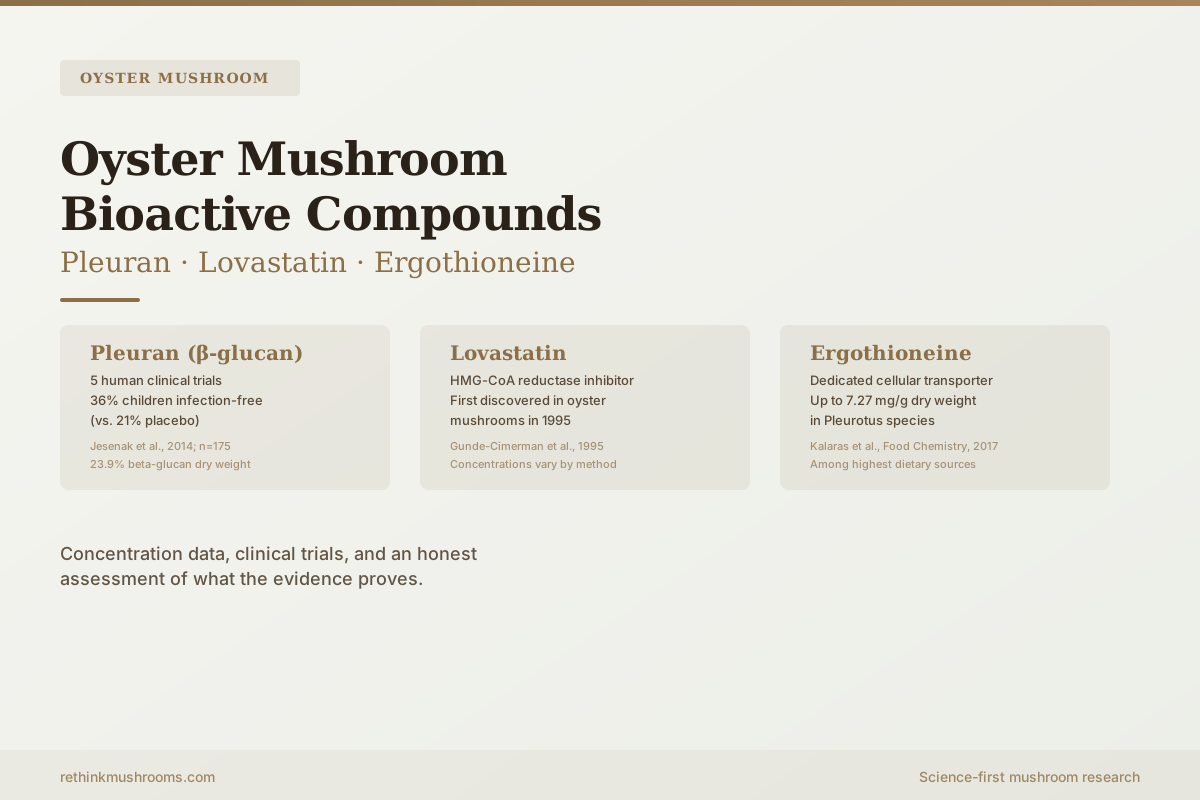
36% of children infection-free on pleuran (vs. 21% placebo)
In a randomized, double-blind trial of 175 children with recurrent respiratory infections, 36% of those given pleuran — the signature beta-glucan from oyster mushrooms — stayed completely infection-free throughout the treatment period versus 21% in the placebo group.
Jesenak et al., International Immunopharmacology, 2013
23.9%
beta-glucan content in raw P. ostreatus fruiting bodies (Lam & Okello, 2015)
5
human studies have tested pleuran — from elite athletes to cancer patients
7.27 mg/g
maximum ergothioneine measured in Pleurotus species, dry weight (Kalaras et al., 2017)
Jesenak et al., International Immunopharmacology, 2013
 View as image ↗
In a trial published in 2013, a team of Slovak researchers enrolled 175 children with recurrent respiratory tract infections. One group received a pleuran-based syrup — the beta-glucan found specifically in oyster mushrooms — while the other received a placebo. By the end of the treatment period, 36% of the pleuran group had experienced zero respiratory infections, compared to 21% in the placebo group.
That result is among the most compelling human evidence in the functional mushroom literature. It is also essentially unknown to the people who learned about oyster mushroom benefits from the health websites that dominate search results, because those websites don't cite it.
Oyster mushrooms contain three bioactive compound classes with genuine research behind them: pleuran (a specific beta-glucan), lovastatin (a cholesterol-regulating molecule), and ergothioneine (an antioxidant that human cells actively import). This article covers the documented concentrations, the clinical trial evidence for each, and an honest assessment of what the research does and doesn't prove. For the species overview and nutritional profile, see What Is Oyster Mushroom? The World's Second Most Popular Mushroom.
Key Takeaways
- Pleuran is the name for the specific beta-1,3/1,6-glucan from Pleurotus ostreatus; its branched molecular structure is distinct from oat beta-glucan and interacts with different immune receptors, which explains why the two compounds have different biological effects
- Five human studies have tested pleuran: two RCTs in elite athletes during intensive training, one RCT in 175 children, one cohort study in breast cancer patients, and a systematic review synthesizing the athlete trials
- The 175-child pleuran RCT is the strongest single trial: 36% of pleuran-treated children were completely infection-free versus 21% on placebo (Jesenak et al., 2013), with a companion analysis of the same trial documenting a significant anti-allergic effect (Jesenak et al., 2014)
- Oyster mushrooms contain measurable lovastatin (the same HMG-CoA reductase inhibitor used in pharmaceutical statins), first confirmed by Gunde-Cimerman et al. in 1995; reported concentrations vary widely because different analytical methods yield different numbers (Tsiantas et al., 2021)
- Pleurotus species are among the highest dietary sources of ergothioneine — an antioxidant with its own dedicated cellular transporter — with Kalaras et al. (2017) measuring up to 7.27 mg/g dry weight in Pleurotus species
- Dicks et al.'s 2020 systematic review of cardiometabolic clinical trials concluded overall evidence quality is "low" — an honest assessment every reader should have before interpreting any individual positive result
Three Bioactive Compound Classes
Same Mushroom, Three Very Different Evidence Footings
Oyster mushrooms carry three researched compound classes — but the strength and type of evidence behind each is not the same. This map pairs each compound’s headline documented figure with an honest read on how far the research actually goes.
Pleuran
Beta-1,3/1,6-glucan
23.9%
beta-glucan in raw fruiting bodies (dry weight)
Strongest evidence5 human studies; a 175-child RCT found 36% infection-free vs 21% on placebo.
Lam & Okello (2015); Jesenak trial (2013/2014)
Lovastatin
HMG-CoA reductase inhibitor
1995
year first confirmed in Pleurotus
Real but uncertain quantityOne 2015 study detected none at all — reported amounts swing with the analytical method.
Gunde-Cimerman (1995); Tsiantas (2021)
Ergothioneine
Sulfur antioxidant (OCTN1 transporter)
0.15–7.27
mg/g dry weight in Pleurotus species
Well measured, outcomes earlyAmong the highest dietary sources; human cells actively import it, but disease-outcome trials are early.
Kalaras et al. (2017)
How to read this: pleuran carries the most developed clinical-trial record; lovastatin is genuinely present but its concentration is method-dependent and sometimes undetectable; ergothioneine is well quantified as a dietary antioxidant, though trials on specific health outcomes remain early-stage.
Sources: Lam & Okello (2015) [ref 6]; Jesenak et al. (2013/2014) [ref 5]; Gunde-Cimerman et al. (1995) [ref 1]; Tsiantas et al. (2021) [ref 10]; Kalaras et al. (2017) [ref 7]. Figures are dry-weight concentrations or trial results as reported in the cited studies.
Pleuran: What 5 Human Studies Have Found About Oyster Mushroom's Signature Beta-Glucan
Pleuran is not a generic term. It is the specific name for the beta-glucan isolated from Pleurotus ostreatus fruiting bodies, and it has an unusually developed clinical trial record for a mushroom-derived compound.
The first trial to test pleuran in humans enrolled elite athletes. Bobovčák et al.'s 2010 RCT in Applied Physiology, Nutrition, and Metabolism focused on a well-documented problem in sports physiology: intensive training suppresses immune function.[2] During hard training blocks, the immune system's capacity to destroy pathogens drops — a phenomenon sometimes called the "open window" of immune vulnerability. In the trial, the placebo group showed a significant decline in phagocytosis activity (the process by which immune cells engulf and destroy pathogens) over the training period. The pleuran group maintained stable phagocytosis function throughout. The compound appeared to buffer against training-induced immune suppression rather than enhancing baseline immune function in non-stressed individuals.
Bergendiova et al.'s 2011 RCT in the European Journal of Applied Physiology tested a similar athlete population over three months.[3] The pleuran group showed a significant reduction in upper respiratory tract infection (URTI) symptoms compared to placebo, alongside an increase in circulating NK cells. NK cells — natural killer cells — are immune cells that destroy infected and abnormal cells without needing to be trained to recognize a specific pathogen first. Higher NK cell counts represent a more broadly capable immune surveillance system.
The most-cited evidence comes from children. Jesenak et al.'s randomized, double-blind, placebo-controlled trial followed 175 children with histories of recurrent respiratory infections, and its results were reported across two companion analyses.[5] The headline infection-prevention result — 36% of pleuran-treated children had no respiratory infections throughout the treatment period versus 21% in the placebo group — was first reported in the trial's 2013 primary analysis in International Immunopharmacology. A separate analysis of the same trial cohort, published in Phytotherapy Research in 2014, documented a significant reduction in markers of allergic inflammation: lower blood eosinophilia and stabilized IgE levels. The authors linked this anti-allergic effect to pleuran's influence on the Th1/Th2 immune balance, the ratio between the immune arm that fights pathogens and the arm associated with allergic reactions.
Spacek et al.'s 2022 cohort study in Immunotherapy extended the pleuran evidence into cancer care.[11] Patients with endocrine-dependent breast cancer who received Pleurotus-derived beta-glucan showed measurable immunomodulatory effects: changes in NK cell activity and cytokine profiles. This does not constitute evidence that pleuran treats cancer. It is evidence that the compound produces measurable immune changes in cancer patients, which is a narrower claim relevant to the question of adjuvant immunosupport.
For the full pleuran immune evidence in detail, including athlete dosing and duration specifics, see Oyster Mushroom and Immune Support: Pleuran Beta-Glucan Research. The children's data is covered in depth at Oyster Mushroom for Children's Immunity: Clinical Evidence.
Why Pleuran's 1,3/1,6 Branch Structure Makes It Different From Oat Beta-Glucan
"Beta-glucan" appears on supplement labels for oats, barley, mushrooms, and yeast — and the term often implies equivalence between sources. The molecular reality is more specific.
Beta-glucans are chains of glucose molecules, but the way those molecules connect determines the three-dimensional shape of the chain and which receptors in the body recognize it. Oat and barley beta-glucans have primarily 1,3 and 1,4 linkages between glucose units, producing a linear chain structure. Mushroom beta-glucans have primarily 1,3 and 1,6 linkages, producing a branched structure.
The branching matters because the main immune receptor that recognizes mushroom beta-glucans — a receptor called Dectin-1, found on the surface of macrophages, dendritic cells, and NK cells — has high affinity specifically for 1,3/1,6-linked glucans. Dectin-1 recognition triggers the immune activation cascade that the athlete and children's trials measured. This receptor does not respond to oat beta-glucan in the same way.
Majtan's 2012 systematic review in Medicine and Sport Science analyzed the pleuran evidence specifically to understand what mechanism explains the trial results.[4] The review concluded that pleuran's specific beta-(1,3/1,6) architecture is responsible for its immunomodulatory activity, and that this activity is structurally distinct from other dietary beta-glucans. The practical implication is that a supplement listing "beta-glucan" without specifying the source and linkage type is providing less information than the label suggests.
Raw Pleurotus ostreatus fruiting bodies contain approximately 23.9% beta-glucan on a dry weight basis, according to Lam and Okello's 2015 quantification study in the International Journal of Medicinal Mushrooms.[6] That same study did not detect any lovastatin in its P. ostreatus samples — an early sign of the quantification problem covered in the next section — and found that blanching preserved the beta-glucan content while significantly reducing the mushroom's polyphenol and antioxidant levels. For readers interested in how cooking affects the bioactive profile, see Pleurotus ostreatus Nutritional Profile: Protein, Vitamins, and Unique Compounds for the full nutrient picture, and the broader context of species-level variation in Oyster Mushroom Species Guide: P. ostreatus, P. sajor-caju, P. djamor.
Lovastatin: Discovered in Oyster Mushrooms in 1995, Still Contentious 30 Years Later
In 1995, Gunde-Cimerman et al. published an analytical finding in Experimental Mycology: Pleurotus fruiting bodies contain measurable lovastatin — the compound that works by inhibiting HMG-CoA reductase, the liver enzyme that controls how much cholesterol the body produces.[1] Pharmaceutical lovastatin was already a major drug at the time. The discovery that the same molecule occurs naturally in a commercially cultivated edible fungus was genuinely novel.
Clinical evidence for cholesterol-related effects followed. Abrams et al.'s 2011 RCT in BMC Complementary and Alternative Medicine tested oyster mushroom supplementation in HIV-infected patients receiving antiretroviral therapy — a population with elevated cardiovascular risk due to medication side effects.[9] The supplementation group showed significant reductions in total cholesterol, LDL (the form of cholesterol most associated with cardiovascular risk), and triglycerides compared to placebo. The mechanism is plausibly lovastatin, though the beta-glucan content may also contribute through a different cholesterol-lowering pathway.
The complication is the quantification problem. Tsiantas et al.'s 2021 study in Molecules systematically analyzed lovastatin and ergothioneine concentrations across mushroom species using different analytical approaches, including HPLC and LC-MS techniques.[10] The study found that the choice of analytical method significantly affects the reported lovastatin concentration — which explains why different published sources report numbers that differ by a factor of two or more for the same species.
This is not a minor methodological footnote. If you search for "how much lovastatin is in oyster mushrooms," you will find numbers that appear contradictory. The Tsiantas 2021 paper provides the explanation: those numbers were likely obtained using different methods, and the methods are not equivalent. No single published concentration value should be treated as definitive.
What this means practically: the lovastatin content of oyster mushrooms is real, was confirmed in 1995, and has clinical evidence behind cholesterol effects. But the exact amount per serving, and how much reaches systemic circulation, remains an open question. For the dedicated deep-dive on quantification, see Lovastatin in Oyster Mushrooms: How Much Is Actually There?.
Ergothioneine: The Antioxidant Your Cells Have a Dedicated Transporter For
Most dietary antioxidants diffuse passively into cells. Ergothioneine does not. Your cells express a specific protein transporter called OCTN1 (organic cation transporter 1) that actively captures ergothioneine from the bloodstream and concentrates it inside the cell. The existence of a dedicated transporter is one reason ergothioneine has attracted significant scientific interest: biology does not build dedicated transport systems for molecules it doesn't want.
Oyster mushrooms are one of the best food sources of ergothioneine available. Kalaras et al.'s 2017 study in Food Chemistry measured ergothioneine concentrations across multiple mushroom species and found Pleurotus species among the highest sources, with concentrations ranging from 0.15 to 7.27 mg/g dry weight depending on species, growing conditions, and harvest timing.[7] The same study measured glutathione — another antioxidant — finding it ranged from 0.11 to 2.41 mg/g dry weight across species, with Pleurotus again among the higher-content options.
The 20-fold variation in measured concentrations across the Kalaras 2017 dataset underlines the same point Tsiantas 2021 made for lovastatin: species identity, growing substrate, and analytical method all affect the numbers significantly.[10] A number from one study cannot be assumed to apply to a different cultivar or drying method.
What's established: Pleurotus ostreatus is a meaningful dietary source of ergothioneine, and ergothioneine is a compound that human physiology appears to actively seek. What remains under investigation is the specific health benefit timeline — ergothioneine accumulates in red blood cells, the liver, and kidney tissue, but clinical trial evidence for specific disease outcomes is still early-stage. For the full ergothioneine story, see Ergothioneine in Oyster Mushrooms: The Longevity Antioxidant You Can Eat. For P. ostreatus as the dominant research model for understanding how mushrooms produce this compound, see Pleurotus ostreatus: A Model Organism for Medicinal Mushroom Research.
What the 2020 Systematic Review Concluded About the Overall Evidence
Dicks et al.'s 2020 systematic review in Nutrients did something most mushroom research summaries don't: it applied formal evidence quality assessment to the clinical trial literature and stated its conclusion plainly.[8]
The review synthesized clinical trials testing the cardiometabolic effects of Pleurotus ostreatus — glucose, lipid levels, blood pressure, and body weight. The finding was that oyster mushroom intake may improve these parameters. The quality assessment was that the overall evidence is "low." The authors specifically called for better-designed, larger RCTs before drawing stronger conclusions.
This is the framing every reader should have before interpreting the Abrams 2011 cholesterol result or the Khatun 2007 glucose data.[12] Individual trials — especially those with small sample sizes, short durations, or unblinded designs — produce results that look compelling but may not replicate. The systematic review's "low quality" judgment is not a dismissal of the individual findings; it is a calibration of how much confidence those findings warrant.
For the pleuran immune evidence specifically, the Bobovčák, Bergendiova, and Jesenak trials have better methodology than most cardiometabolic trials in the literature — controlled, randomized, placebo-blinded — which is why the immune claims are on somewhat more solid footing than the cholesterol claims. But "better methodology than the rest of the field" is not the same as "conclusive."
The honest summary is this: the pleuran and ergothioneine research is interesting, specific, and worth following. The lovastatin finding is real but quantitatively uncertain. The overall cardiometabolic evidence is promising but not at the level that warrants strong clinical conclusions.
This article is educational and is not medical advice. Anyone considering oyster mushroom supplementation for a specific health concern — particularly cholesterol management, blood sugar control, or supportive care during cancer treatment — should discuss it with a qualified healthcare provider first.
The Bottom Line
Pleurotus ostreatus contains three bioactive compound classes with documented research: pleuran (a specific 1,3/1,6-linked beta-glucan with 5 human clinical trials, including a 175-child RCT showing 36% versus 21% infection-free rates), lovastatin (first identified in 1995, with clinical cholesterol-lowering data but significant quantification variability), and ergothioneine (among the highest in any food source, 0.15–7.27 mg/g dry weight, with a dedicated human cellular transporter). Dicks et al.'s 2020 systematic review found the overall cardiometabolic clinical evidence is "low quality," though the pleuran immune trials are among the better-controlled studies in the functional mushroom literature.
Frequently Asked Questions
Sources & References
- 1RTHM-00016·Gunde-Cimerman, N et al. (1995). “Pleurotus fruiting bodies contain the inhibitor of 3-hydroxy-3-methylglutaryl-coenzyme A reductase-lovastatin..” Experimental mycology.Study breakdown →PubMed →↩
- 2RTHM-00327·Bobovčák, Marián et al. (2010). “Effect of Pleuran (β-glucan from Pleurotus ostreatus) supplementation on cellular immune response after intensive exercise in elite athletes..” Applied physiology.Study breakdown →PubMed →↩
- 3RTHM-00379·Bergendiova, Katarina et al. (2011). “Pleuran (β-glucan from Pleurotus ostreatus) supplementation, cellular immune response and respiratory tract infections in athletes..” European journal of applied physiology.Study breakdown →PubMed →↩
- 4RTHM-00476·Majtan, Juraj (2012). “Pleuran (β-glucan from Pleurotus ostreatus ): an effective nutritional supplement against upper respiratory tract infections?.” Medicine and sport science.Study breakdown →PubMed →↩
- 5RTHM-00602·Jesenak, Milos et al. (2014). “Anti-allergic effect of Pleuran (β-glucan from Pleurotus ostreatus) in children with recurrent respiratory tract infections..” Phytotherapy research : PTR.Study breakdown →PubMed →↩
- 6RTHM-00384·Lam, Yu Shan et al. (2015). “Determination of Lovastatin, β-glucan, Total Polyphenols, and Antioxidant Activity in Raw and Processed Oyster Culinary-Medicinal Mushroom, Pleurotus ostreatus (Higher Basidiomycetes)..” International journal of medicinal mushrooms.Study breakdown →PubMed →↩
- 7RTHM-00476·Kalaras, Michael D et al. (2017). “Mushrooms: A rich source of the antioxidants ergothioneine and glutathione..” Food chemistry.Study breakdown →PubMed →↩
- 8RTHM-00614·Dicks, Lisa et al. (2020). “Effect of the Intake of Oyster Mushrooms (Pleurotus ostreatus) on Cardiometabolic Parameters-A Systematic Review of Clinical Trials..” Nutrients.Study breakdown →PubMed →↩
- 9RTHM-00203·Abrams, Donald I et al. (2011). “Antihyperlipidemic effects of Pleurotus ostreatus (oyster mushrooms) in HIV-infected individuals taking antiretroviral therapy..” BMC complementary and alternative medicine.Study breakdown →PubMed →↩
- 10RTHM-00725·Tsiantas, Konstantinos et al. (2021). “On the Identification and Quantification of Ergothioneine and Lovastatin in Various Mushroom Species: Assets and Challenges of Different Analytical Approaches..” Molecules (Basel.Study breakdown →PubMed →↩
- 11RTHM-01617·Spacek, Jan et al. (2022). “Immunomodulation with β-glucan from Pleurotus ostreatus in patients with endocrine-dependent breast cancer..” Immunotherapy.Study breakdown →PubMed →↩
- 12RTHM-00115·Khatun, K et al. (2007). “Oyster mushroom reduced blood glucose and cholesterol in diabetic subjects..” Mymensingh medical journal : MMJ.Study breakdown →PubMed →↩