Oyster Mushroom (Pleurotus ostreatus)
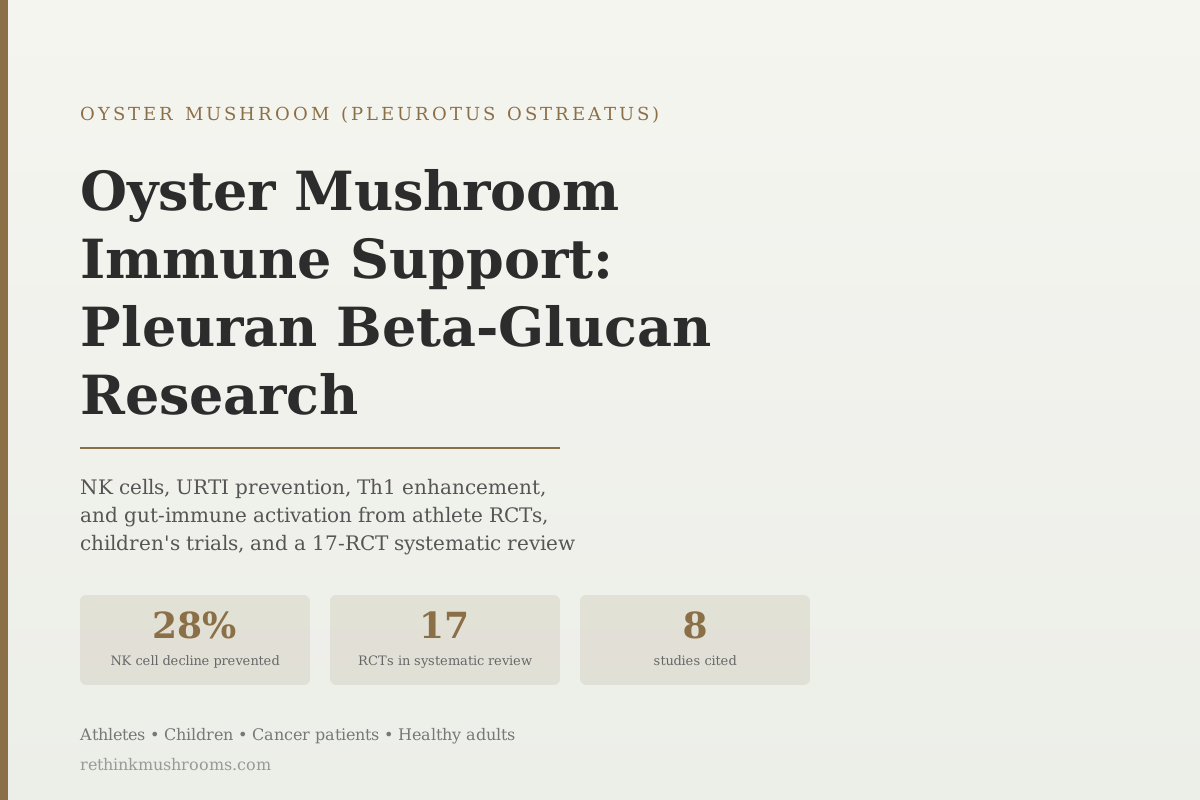
28% NK cell decline
Elite athletes in the placebo group showed a 28% reduction in NK cell activity after intensive exercise. Athletes taking pleuran showed no significant decline. That single data point from the Bobovcak 2010 RCT captures what makes oyster mushroom beta-glucan stand out: it prevents exercise-induced immune suppression.
Bobovcak et al., Eur J Appl Physiol, 2010
17 RCTs
analyzed in the Vlassopoulou 2021 systematic review: fungal beta-glucans consistently strengthened defense against upper respiratory infections
3 populations
pleuran has human clinical data in athletes, children with recurrent respiratory infections, and breast cancer patients on endocrine therapy
Insoluble
unlike most beta-glucans, pleuran's insoluble structure survives digestion intact and reaches Peyer's patches in the small intestine
Bobovcak et al., Eur J Appl Physiol, 2010
 View as image ↗
The generic claim "mushrooms support immunity" covers a huge amount of variation in terms of what compounds are involved, what immune effects have been measured, and in whom. Pleuran is one of the more specifically characterized mushroom immune compounds: it has a defined chemical structure, a proposed mechanism involving specific intestinal immune tissue, and clinical data from multiple populations tested in controlled trials.
Pleuran is the insoluble β-1,3/1,6-glucan found in oyster mushrooms (Pleurotus ostreatus). Unlike most mushroom beta-glucans, it is insoluble, meaning it is not broken down or absorbed in the upper digestive tract. It reaches Peyer's patches in the small intestine intact, where it activates NK cells, macrophages, and T-lymphocytes through Dectin-1 and CR3 receptor binding. The result is immune activation that happens in the gut-associated lymphoid tissue rather than requiring systemic absorption.
A 2021 systematic review by Vlassopoulou and colleagues synthesizing 17 randomized controlled trials of fungal beta-glucans found consistent evidence of strengthened defense against upper respiratory tract infections, with 8 trials specifically in athletes confirming reduced exercise-induced immune decline.[5] Pleuran is the most-studied fungal beta-glucan in that literature.
For the wider picture of how oyster mushrooms contribute to health, see the oyster mushroom complete overview.
Key Takeaways
- In the Bobovcak 2010 RCT, elite athletes in the placebo group showed a 28% decline in NK cell activity after intensive exercise; athletes taking pleuran showed no significant decline (p less than 0.01)
- Bergendiova and colleagues in 2011 tested 50 athletes over 3 months and found the pleuran group had significantly fewer URTI symptoms and increased circulating NK cells versus placebo
- A double-blind, placebo-controlled RCT by Tanaka and colleagues in 2016 found oyster mushroom extract significantly enhanced Th1-type immune responses in healthy adults, the mechanism explaining why NK cell preservation leads to infection protection
- Jesenak and colleagues in 2014 found pleuran reduced URTI incidence in children with recurrent respiratory tract infections AND produced anti-allergic effects, suggesting a Th1 immunomodulatory shift that addresses both infection susceptibility and allergic tendency
- The Vlassopoulou 2021 systematic review of 17 RCTs found fungal beta-glucans consistently improved defense against upper respiratory infections, particularly in athletes after exercise
- A 2025 study by Kerezoudi and colleagues showed fermented Pleurotus eryngii (a related species) protected intestinal barrier integrity and modulated immune signaling in human colonic tissue models, supporting the gut-immune mechanism proposed for pleuran
What Makes Pleuran Different From Other Beta-Glucans
Beta-glucans are a broad class of polysaccharides found in oats, yeast, and fungi. Most mushroom immune research uses terms like "beta-glucan" without specifying the form, structure, or source. Pleuran is a specific compound from a specific species with a specific structural property that distinguishes it from other beta-glucans in the immune literature.
The key property is insolubility. Most beta-glucans used in supplements are water-soluble, meaning they dissolve in the digestive tract and are absorbed through the intestinal wall into circulation. Pleuran is water-insoluble. It passes through the upper GI tract without being broken down, arrives at the small intestine intact, and encounters Peyer's patches: aggregations of immune tissue in the intestinal lining that are specialized for sampling the gut environment and initiating immune responses.
At Peyer's patches, pleuran engages two pattern recognition receptors. Dectin-1 on macrophages and dendritic cells recognizes the beta-1,3-glucan structure and initiates pro-inflammatory signaling. CR3 (complement receptor 3) on NK cells primes their cytotoxic activity. This dual receptor engagement activates different arms of the innate immune response simultaneously, without requiring the compound to enter the bloodstream.
The macrophage activation side of pleuran's mechanism is documented at the molecular level by Jedinak and colleagues in 2011, who showed that oyster mushroom extract inhibited both NF-κB and AP-1 signaling pathways in macrophages, the master switches controlling inflammatory cytokine production.[7] This means oyster mushroom acts as an immunomodulator rather than a pure stimulant: it can activate immune defenses while simultaneously moderating excessive inflammation.
A 2025 study by Kerezoudi and colleagues extended the gut-immune story to a related species (Pleurotus eryngii), showing that fermented oyster mushroom protected intestinal barrier integrity and modulated immune signaling pathways in human colonic tissue models exposed to a bile acid stressor.[8] The finding supports the principle that Pleurotus species' immune effects are partly mediated through the intestinal immune system rather than requiring systemic absorption.
The Athletic Immune Data: Two RCTs Measuring Different Outcomes
Two separate athlete RCTs have tested pleuran supplementation. They are often conflated but measure different things, and both are needed to understand the full picture.
Bobovcak and colleagues in 2010 specifically measured NK cell activity (NKCA) in elite athletes during and after intensive exercise training.[2] The critical finding: placebo group athletes showed a 28% decline in NKCA below baseline during the recovery period (p less than 0.01), while athletes receiving pleuran showed no significant decline. Intensive exercise is known to create a temporary window of immune suppression; this study shows that pleuran specifically prevents the NK cell component of that suppression.
Bergendiova and colleagues in 2011 tested 50 elite athletes in a 3-month RCT using pleuran versus placebo.[1] The primary outcome was different from Bobovcak: they measured circulating NK cells and upper respiratory tract infection (URTI) incidence. The pleuran group had significantly more circulating NK cells and significantly fewer URTI symptoms over the trial period compared to placebo.
Together, these two studies trace the causal chain: intensive exercise depletes NK cells (Bobovcak), pleuran prevents that depletion, and preventing NK cell depletion reduces the frequency of respiratory infections (Bergendiova). The mechanistic and clinical outcomes align.
For a detailed breakdown of the athlete immune evidence and the "open window hypothesis" of exercise-induced immune suppression, see Pleuran and Upper Respiratory Infection Prevention in Athletes.
Th1 Enhancement: Why Immune Type Shift Matters
NK cells and macrophages operate within a broader immune landscape defined by Th1 and Th2 balance. Th1 immunity is oriented toward fighting intracellular pathogens, viruses, and cancer cells; it produces interferon-gamma and activates cytotoxic immune responses. Th2 immunity is oriented toward extracellular parasites and is also involved in allergic responses.
Most respiratory infections require robust Th1 defenses to clear efficiently. People with a Th2-dominant immune profile (common in atopy and allergy) have relatively weaker antiviral defenses and are more prone to recurrent respiratory infections.
Tanaka and colleagues in 2016 tested this in a double-blind, placebo-controlled RCT: oyster mushroom (tamogitake) extract significantly enhanced Th1-type immune responses in healthy adults compared to placebo.[3] This Th1 shift explains the mechanism by which pleuran supplementation reduces respiratory infections in athletes: it is not simply that there are more NK cells, but that the immune system is more actively oriented toward the type of responses that clear viral infections.
For the specific NK cell receptor mechanism (NKG2D upregulation and KIR2DL downregulation) by which pleuran activates NK cells at the molecular level, see Oyster Mushroom and NK Cell Activity.
Children and Recurrent Respiratory Infections
The clinical evidence for pleuran extends beyond athletes to children who are prone to frequent respiratory infections.
Jesenak and colleagues in 2014 tested pleuran supplementation in children with recurrent respiratory tract infections (RRTI) in a clinical study.[4] Pleuran significantly reduced URTI incidence in these children. An additional finding emerged: pleuran also produced anti-allergic effects. Children with RRTI often have atopic (Th2-dominant) profiles that predispose them to both frequent infections and allergic conditions. The Th1-shifting mechanism of pleuran appears to simultaneously reduce infection frequency and address the allergic tendency: two outcomes through one immunological shift.
Spacek and colleagues in 2022 tested pleuran (Pleurotus ostreatus beta-glucan) in a more challenging population: patients with endocrine-dependent breast cancer receiving hormone therapy.[6] Pleuran supplementation produced measurable immunomodulatory effects in these patients. This is relevant because cancer treatment typically suppresses immune function, and demonstrating immune effects in an immunocompromised population is a more stringent test than healthy adults.
For the full children's immunity evidence including dosing data, see Oyster Mushroom for Children's Immunity: Clinical Evidence.
The Systematic Review: What 17 Trials Collectively Show
The most comprehensive synthesis of fungal beta-glucan immune evidence is the Vlassopoulou 2021 systematic review, which analyzed 17 randomized controlled trials of fungal beta-glucans and their effects on health outcomes.[5]
Key findings from the review: individuals receiving beta-glucan supplementation showed stronger defense against upper respiratory infections across trials. Eight of the 17 trials were specifically in athletes, and these consistently found that beta-glucans reduced exercise-induced immune decline. This makes fungal beta-glucan one of the more systematically reviewed natural immune compounds in the RCT literature.
The review also provides the scholarly anchor for the population-specific patterns seen in individual trials: athletes and children with recurrent infections see the most consistent effects. Healthy adults at baseline with no immune challenge show smaller or less consistent effects.
For a deeper dive into pleuran as a specifically characterized compound compared to beta-glucans from other mushrooms and sources, see Pleuran: The Oyster Mushroom Beta-Glucan With Clinical Immune Evidence and Ergothioneine in Oyster Mushrooms: The Longevity Antioxidant for oyster mushroom's parallel antioxidant immune-support compounds.
The Bottom Line
Pleuran is the insoluble beta-glucan from Pleurotus ostreatus with the most extensively documented immune effects among oyster mushroom compounds. Its clinical evidence spans two athlete RCTs showing NK cell preservation and URTI reduction, an RCT in children with recurrent respiratory infections showing anti-allergic and anti-infective effects, a breast cancer patient study, and a 17-RCT systematic review confirming fungal beta-glucan immune effects broadly. The mechanism centers on gut-based immune activation through Peyer's patches, Dectin-1, and CR3 receptors, with a Th1-enhancing effect that simultaneously improves antiviral defenses and reduces allergic tone.
Frequently Asked Questions
Sources & References
- 1. Source details for this reference are not yet available.
- 2. Source details for this reference are not yet available.
- 3. Source details for this reference are not yet available.
- 4. Source details for this reference are not yet available.
- 5. Source details for this reference are not yet available.
- 6. Source details for this reference are not yet available.
- 7. Source details for this reference are not yet available.
- 8. Source details for this reference are not yet available.