Oyster Mushroom Immune Support
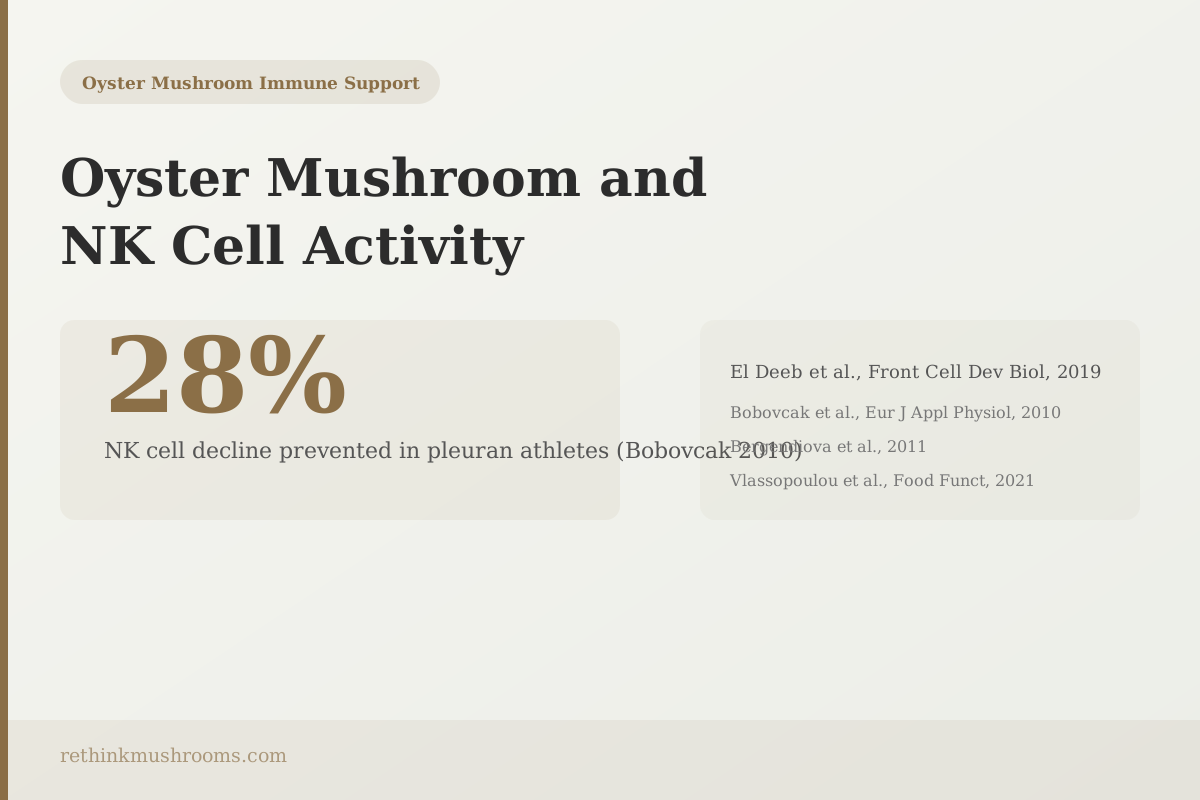
28% NK cell decline prevented
In elite athletes taking pleuran (oyster mushroom beta-glucan), NK cell activity did not decline after intensive exercise. The placebo group showed a 28% reduction below baseline during recovery. Pleuran specifically preserved natural killer cell function during the exercise-induced immune suppression window.
Bobovcak et al., Applied Physiology, Nutrition, and Metabolism, 2010
NKG2D up
the NK cell activating receptor was upregulated by Pleurotus ostreatus beta-glucan in cell culture, tracking with cytotoxic killing of cancer cells (El Deeb 2019)
81.2%
peak NK cell cytotoxicity against breast cancer cells driven by the oyster mushroom glucan in culture, amplified when IL-2 was present (El Deeb 2019)
34 RCTs
synthesized in the Vlassopoulou 2021 systematic review of fungal beta-glucans, which found reduced incidence and symptoms of respiratory infections
Bobovcak et al., Applied Physiology, Nutrition, and Metabolism, 2010
 View as image ↗
Natural killer cells are a specific type of white blood cell that kills virus-infected cells and cancer cells without needing to be trained for each threat. Unlike antibody-based immunity, which requires prior exposure to build a response, NK cells respond immediately to cells that display stress signals or have lost the normal surface markers of healthy tissue. They are part of the innate immune system, the rapid-response layer that acts in the first hours of an infection rather than the days it takes for the adaptive immune system to mount a targeted response.
Oyster mushroom's specific beta-glucan compound, called pleuran, has more precisely characterized NK cell research than almost any other food compound. A 2019 cell study identified specific NK cell surface receptors that pleuran modulates: NKG2D, an activating receptor, and KIR2DL, a receptor from the killer-cell immunoglobulin-like family.[1] And two athlete clinical trials have shown that oyster mushroom beta-glucan preserves NK cell activity after intensive exercise and is associated with fewer respiratory infections over a three-month period.[2]
This article explains the mechanism and what the clinical evidence shows. For the full oyster mushroom immune support overview, see oyster mushroom and immune support: pleuran beta-glucan research. This cluster connects to the oyster mushroom guide.
Key Takeaways
- Natural killer (NK) cells are innate immune first responders that kill virus-infected cells and cancer cells without prior sensitization; their activity is suppressed by intensive exercise, stress, and sleep deprivation
- El Deeb et al. (2019, Frontiers in Cell and Developmental Biology) found that Pleurotus ostreatus beta-glucan upregulated both the NKG2D and KIR2DL receptors on NK cells in culture; NKG2D upregulation tracked with cytotoxic killing of cancer cells, while KIR2DL upregulation was linked to cytokine secretion — the net result was increased NK cell cytotoxicity, greatest against breast cancer cells (81.2%)
- Bobovcak et al. (2010, Applied Physiology, Nutrition, and Metabolism) found that elite athletes taking pleuran maintained NK cell activity after intensive exercise, while the placebo group showed a 28% reduction below baseline in natural killer cell activity (NKCA)
- Bergendiova et al. (2011, European Journal of Applied Physiology) found that 50 athletes randomized to pleuran over 3 months had significantly fewer upper respiratory tract infections and increased circulating NK cells, directly linking the NK cell mechanism to a clinical outcome
- Tanaka et al. (2016) conducted a double-blind, placebo-controlled RCT showing oyster mushroom extract enhances Th1-type immune responses, the immune orientation associated with antiviral and antibacterial defense
- Most NK cell data for pleuran comes from athlete and cancer-cell studies; NK cell data from general healthy populations has not been directly published
What Natural Killer Cells Do and Why They Can Be Suppressed
Most explanations of the immune system focus on antibodies, which are specific proteins your body makes in response to a particular pathogen it has encountered before. NK cells work through a different and faster logic. They do not need to recognize a specific foreign protein. Instead, they scan cells for two types of signals: the absence of normal surface markers that healthy cells display (called "missing self"), and the presence of stress proteins that appear on cells that are infected, cancerous, or otherwise damaged.
When an NK cell detects either signal, it releases cytotoxic granules, specialized packages of proteins that punch holes in the target cell membrane and trigger cell death. The entire process can happen within hours of infection, before the adaptive immune system has had time to recognize the pathogen and produce targeted antibodies.
NK cells are also part of the body's cancer surveillance system. Cells that are becoming cancerous often lose their normal surface markers before they cause any symptoms, and NK cells can identify and destroy these pre-cancerous cells before they become clinically detectable tumors.
Despite their effectiveness, NK cell activity is measurably suppressed by several common stressors: intensive physical exercise, psychological stress, sleep deprivation, and aging. The suppression after exercise is particularly well-documented. During and immediately after intense physical training, the number and activity level of NK cells in the bloodstream drops, creating a window of elevated vulnerability to respiratory infections that researchers call the "open window." This is the physiological context in which the pleuran athlete studies were conducted.[2]
The Receptor Mechanism: How Pleuran Acts on NK Cell Surface Receptors
El Deeb et al.'s 2019 study in Frontiers in Cell and Developmental Biology provided the most specific molecular characterization of how an oyster mushroom compound acts on NK cells.[1] The researchers extracted and partially purified a glucan-rich fraction from cultured Pleurotus ostreatus fruiting bodies, applied it to human NK cells, and measured what happened to the cells' receptor gene expression and their ability to kill three different cancer cell lines, both with and without added interleukin-2 (IL-2).
NK cells carry two broad classes of surface receptors that shape their behavior. Activating receptors, when triggered, push the NK cell toward attack mode; the most important is NKG2D. Inhibitory receptors, by contrast, normally tell the NK cell to stand down, and the killer-cell immunoglobulin-like receptor (KIR) family is the classic example. NKG2D recognizes stress proteins that appear on infected, DNA-damaged, or pre-cancerous cells, while KIR receptors read normal self-proteins — a check that keeps NK cells from attacking healthy tissue.
Here is where the actual finding is more interesting than the usual shorthand. El Deeb's team did not find that the mushroom glucan simply "switched off" the braking receptor. Instead, the glucan upregulated both receptors it tracked — NKG2D and KIR2DL — but the two upregulations mapped to different arms of NK cell activation.[1] NKG2D upregulation correlated with the cytotoxic killing of cancer cells and with the release of interferon-gamma (IFN-γ) and nitric oxide. KIR2DL upregulation, on the other hand, was associated with cytokine secretion rather than with cytotoxicity. The net readout across the co-culture conditions was a measurable increase in NK cell cytotoxicity toward cancer cells — largest against breast cancer cells (81.2%) — and the effect was enhanced when IL-2 was present.
Mechanism · What El Deeb 2019 Measured
Oyster mushroom glucan raised both receptors it tracked — but they do different jobs
In cell culture, Pleurotus ostreatus glucan increased the expression of both NKG2D and KIR2DL. The two upregulations mapped to different arms of NK-cell activation, and the combined readout was stronger killing of cancer cells.
This is cell-culture (in vitro) data. It shows what the compound does to isolated NK cells, not what orally eaten mushroom does inside the body.
Source: El Deeb et al. (Frontiers in Cell and Developmental Biology, 2019)
View as image ↗This receptor-level detail is the most mechanistically specific NK cell data for any oyster mushroom compound in the published literature. Most immune claims for medicinal mushrooms stay at the level of "stimulates immune cells" without specifying which receptors, cytokines, or pathways are involved. El Deeb's study names specific receptors (NKG2D, KIR2DL) and specific downstream signals (IFN-γ, nitric oxide), which is why it functions as the mechanistic anchor for this topic — while remaining, importantly, a cell-culture study rather than a demonstration of what happens in the body.
El Deeb et al. (2019) · Frontiers in Cell and Developmental Biology
- Population
- Human NK cells in culture, tested against lung and breast cancer cell lines (with and without IL-2)
- Intervention
- Partially purified Pleurotus ostreatus glucan fraction
- Comparator
- Untreated NK cells
- Finding
- The glucan upregulated both NKG2D and KIR2DL. NKG2D upregulation tracked with cytotoxic killing of cancer cells (plus IFN-γ and nitric oxide release), while KIR2DL upregulation was linked to cytokine secretion. NK-cell cytotoxicity was highest against breast cancer cells (81.2%) and was amplified by IL-2.
positive Mechanistically specific and directionally positive, but this is in-vitro cell-culture data — it does not by itself show the same receptor changes occur after a person eats oyster mushroom.
El Deeb et al., Frontiers in Cell and Developmental Biology, 2019
For a complete profile of pleuran as a compound, including its unusual insoluble structure and why that structure matters for reaching immune tissue in the gut, see pleuran: the oyster mushroom beta-glucan with clinical immune evidence.
Athlete Studies: What Happened to NK Cell Activity After Intensive Exercise
Bobovcak et al.'s 2010 study in Applied Physiology, Nutrition, and Metabolism tested pleuran supplementation in elite athletes specifically because the exercise-induced suppression of NK cells provides a measurable, validated model for studying immune decline.[2] In this double-blind pilot trial, 20 elite athletes were randomized to take 100 mg of Pleurotus ostreatus beta-glucan (Imunoglukan) or placebo once daily for two months.
The researchers measured natural killer cell activity, abbreviated NKCA, which is an assay that tests how effectively NK cells from a blood sample kill target cells. After intensive exercise, NKCA in the placebo group fell 28% below pre-exercise baseline values (p < 0.01). In the pleuran group, NKCA showed no significant decline, and NK cell counts also held steady. The placebo athletes experienced the expected exercise-induced immune suppression. The pleuran athletes did not.
The NKCA measurement was taken during the recovery period after exercise, which corresponds to the open window when athletes are most vulnerable to respiratory infections. Preserving NK cell activity during this window is clinically relevant precisely because it is the window when infections occur.
Bergendiova et al.'s 2011 study in the European Journal of Applied Physiology enrolled 50 athletes in a randomized, placebo-controlled trial over three months and measured whether NK cell changes translated into a clinical difference.[3] They did. The pleuran group had significantly fewer upper respiratory tract infection (URTI) symptoms and an increased number of circulating NK cells compared to placebo, and phagocytosis (another arm of innate defense) held stable in the pleuran group while it dropped in the placebo group.
The mechanistic chain across these two studies is direct: pleuran preserves NK cell activity after exercise (Bobovcak), and pleuran supplementation over a sustained period is associated with more circulating NK cells and fewer respiratory infections (Bergendiova). The El Deeb 2019 receptor data provides a candidate molecular explanation for why oyster mushroom glucan keeps NK cells active: by upregulating NKG2D and driving IFN-γ output, it supports the activation state of NK cells even as exercise pushes immune activity downward.
For the full athlete respiratory infection data, the pleuran and upper respiratory infection prevention in athletes article covers both studies in depth.
The Th1 Connection: What Type of Immune Response Pleuran Promotes
Tanaka et al.'s 2016 double-blind, placebo-controlled RCT in the Journal of Traditional and Complementary Medicine tested an oyster mushroom extract — from Pleurotus cornucopiae (Tamogitake), a close relative of the common oyster mushroom — in humans over eight weeks and found that it significantly raised interferon-gamma (IFN-γ, p = 0.013) and interleukin-12, markers of a Th1-type immune response.[4] NK cell activity in the same trial trended upward but did not reach statistical significance, so the study is best read as evidence of a Th1 shift rather than a direct NK-count result.
Th1 and Th2 refer to two different orientations of the adaptive immune response. Th1 responses are organized around fighting intracellular pathogens: viruses, bacteria that hide inside cells, and cancer cells. Th2 responses are organized around extracellular threats: parasites, allergens, and environmental particles. NK cells operate within the Th1 immune environment. When the immune system is in a Th1 orientation, NK cells are more active and their cytotoxic behavior is better supported by surrounding immune cell signaling.
Pleuran's Th1-enhancing effect is the broader immune context that helps explain why oyster mushroom beta-glucan is associated with benefits against respiratory infections. Respiratory viruses are intracellular pathogens. A Th1-shifted immune environment, with its accompanying NK cell support, is specifically better equipped to handle viral respiratory challenges.
The Tanaka 2016 RCT confirmed this Th1 shift in humans under controlled conditions, providing immune-orientation data that complements the NK cell activity data from the athlete studies. Together, these studies describe a coherent picture: oyster mushroom beta-glucan promotes a Th1 orientation, supports NK cell activity within that environment, and — in athlete populations — is associated with fewer respiratory infections.
The Systematic Review and Honest Limitations
Vlassopoulou et al.'s 2021 systematic review in Food and Function synthesized 34 randomized controlled trials of fungal beta-glucan supplementation and their health effects.[5] The fungal sources across those trials included Pleurotus ostreatus alongside baker's yeast, Aureobasidium pullulans, shiitake, and reishi. The primary outcome across the majority of interventions was immunomodulation, which the reviewers summarized as strengthened immune defense that reduced the incidence and symptoms of colds, flu, and other respiratory infections, plus improvement in allergic symptoms. Importantly, the review also noted that findings at the cellular and molecular level were inconsistent between studies, and that no adverse event was causally linked to the glucans. This is the broadest evidence synthesis for the class of compounds that pleuran belongs to.
- Cell & Lab Studiescompleted
El Deeb 2019: P. ostreatus glucan upregulated NKG2D and KIR2DL and raised NK cytotoxicity against cancer cells (81.2% vs breast cancer), amplified by IL-2
- Animal Studiesmissing
No dedicated animal NK-cell study for pleuran was identified for this article
- Case Reports & Early Seriesmissing
Not the evidence base here; pleuran work moved directly to controlled human trials in athletes
- Small Human Trialscurrent
Bobovcak 2010 (20 elite athletes): pleuran prevented the 28% post-exercise drop in NK-cell activity. Bergendiova 2011 (50 athletes): fewer respiratory infections and more circulating NK cells over 3 months. Tanaka 2016: a Th1 shift (raised IFN-γ) in a placebo-controlled trial
- Large Randomized Trialsmissing
No large multi-center NK-cell RCT; no data in sedentary or general-population adults
- Meta-Analyses & Systematic Reviewsmissing
Vlassopoulou 2021 (34 RCTs) reviews the fungal beta-glucan class for respiratory-infection defense, but no meta-analysis targets pleuran's specific NK-cell endpoints
The receptor mechanism is characterized in cell culture and the direct human evidence reaches small athlete trials, but there is no large trial, no general-population data, and no meta-analysis of pleuran's specific NK-cell endpoints. A broader systematic review (Vlassopoulou 2021, 34 RCTs) supports the fungal beta-glucan class for respiratory-infection defense.
El Deeb 2019; Bobovcak 2010; Bergendiova 2011; Tanaka 2016; Vlassopoulou 2021
The limitation worth stating directly: most of the NK cell data for pleuran comes from elite athletes and cancer-cell models, not from general healthy populations. The Bobovcak and Bergendiova studies used elite athletes because they offered a model with measurable, reproducible immune suppression. Whether sedentary or moderately active people experience the same NK cell preservation from pleuran is not directly established by these studies.
Similarly, the El Deeb 2019 receptor data comes from NK cells in culture exposed to a mushroom glucan, which is not the same as NK cells in a living human responding to orally consumed mushroom extract. The pathway from oral pleuran to NK receptor modulation in vivo involves digestion, gut immune activation, and systemic signaling, none of which the cell-culture study directly measures.
The Vlassopoulou systematic review provides the broadest support for fungal beta-glucan clinical effects, and pleuran sits within that category with the most specific mechanistic and clinical data of any compound in the class. But the evidence is strongest for specific populations (athletes, children with recurrent infections) rather than general immune enhancement in healthy adults. For the immune and antioxidant dual benefit picture in oyster mushrooms, the ergothioneine in oyster mushrooms article covers the antioxidant compound that works alongside pleuran's immune effects.
Safety & scope
LowThis is immune-biology research, not medical advice
Concern
The NK-cell findings here come from cell culture and from athletes under heavy training. They describe how a compound behaves in specific settings, not a treatment for infection, cancer, or any immune condition.
What the research says
Oyster mushrooms are a nutritious food and can be eaten as part of a normal diet. The pleuran benefits described were seen with specific standardized products (e.g., Imunoglukan) at defined doses, not with mushrooms in general.
Particularly relevant for: Anyone with an immune condition, on immunosuppressive therapy, or considering supplements for a diagnosed illness
What to do
Talk to a qualified clinician before using oyster mushroom supplements to manage any medical condition.
Bobovcak 2010; Bergendiova 2011; El Deeb 2019
The Bottom Line
Oyster mushroom's pleuran compound acts on NK cell surface receptors: in cell culture, Pleurotus ostreatus glucan upregulated both NKG2D and KIR2DL, with NKG2D upregulation tracking cytotoxic killing of cancer cells and KIR2DL upregulation linked to cytokine secretion — the net effect being increased NK cytotoxicity, greatest against breast cancer cells (81.2%) and amplified by IL-2 (El Deeb 2019). Two athlete trials confirm human relevance: Bobovcak et al. (2010) found pleuran prevented the 28% exercise-induced decline in NK cell activity seen in placebo groups, and Bergendiova et al. (2011) found fewer respiratory infections and more circulating NK cells in 50 athletes over three months. Tanaka et al. (2016) confirmed a Th1 immune shift (raised IFN-γ) in a human RCT. The evidence is strongest in athlete and clinical populations; general healthy-adult data is less direct, and the receptor findings are in-vitro.
Frequently Asked Questions
Sources & References
- 1RTHM-01053·El-Deeb, Nehal M et al. (2019). “Modulation of NKG2D, KIR2DL and Cytokine Production by Pleurotus ostreatus Glucan Enhances Natural Killer Cell Cytotoxicity Toward Cancer Cells..” Frontiers in cell and developmental biology.Study breakdown →PubMed →↩
- 2RTHM-00327·Bobovčák, Marián et al. (2010). “Effect of Pleuran (β-glucan from Pleurotus ostreatus) supplementation on cellular immune response after intensive exercise in elite athletes..” Applied physiology.Study breakdown →PubMed →↩
- 3RTHM-00379·Bergendiova, Katarina et al. (2011). “Pleuran (β-glucan from Pleurotus ostreatus) supplementation, cellular immune response and respiratory tract infections in athletes..” European journal of applied physiology.Study breakdown →PubMed →↩
- 4RTHM-00830·Tanaka, Aiko et al. (2016). “Enhancement of the Th1-phenotype immune system by the intake of Oyster mushroom (Tamogitake) extract in a double-blind, placebo-controlled study..” Journal of traditional and complementary medicine.Study breakdown →PubMed →↩
- 5RTHM-01451·Vlassopoulou, Marigoula et al. (2021). “Effects of fungal beta-glucans on health - a systematic review of randomized controlled trials..” Food & function.Study breakdown →PubMed →↩