Oyster Mushroom Immune Support
28% NK cell decline in placebo
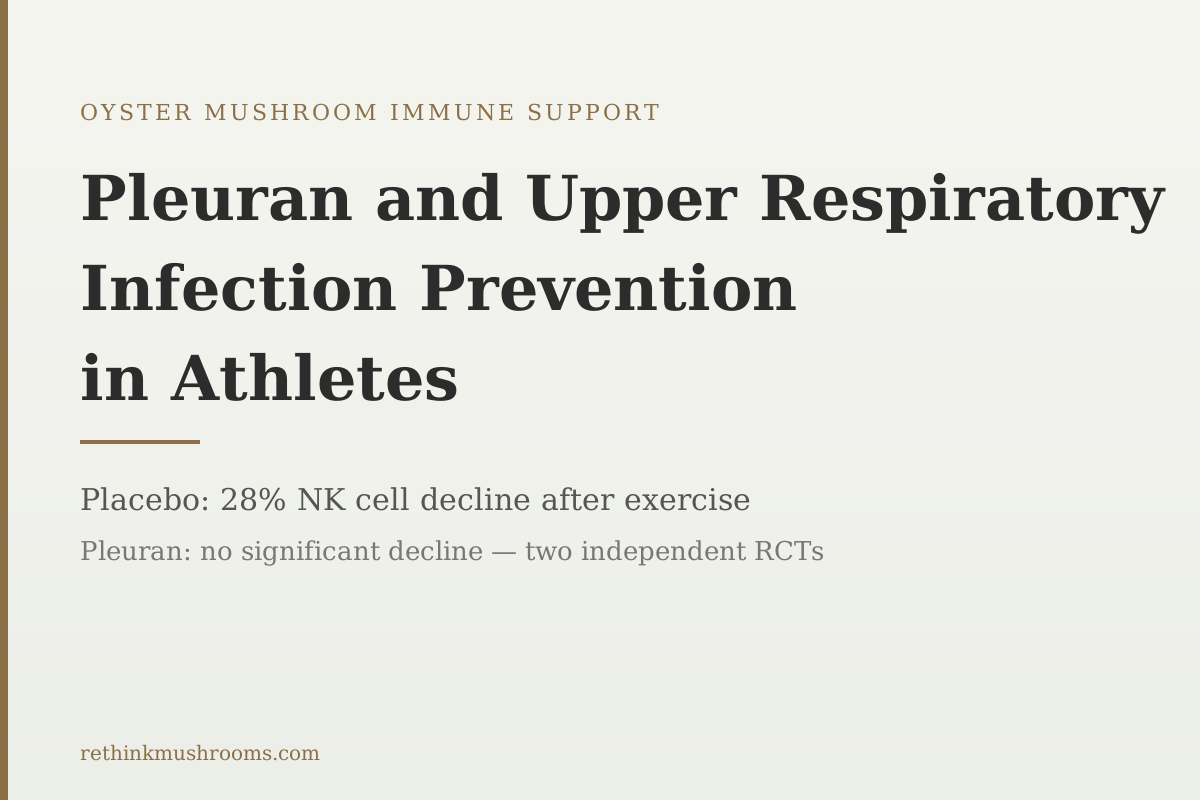
Elite athletes who took pleuran before intensive exercise maintained NK cell activity. Athletes on placebo showed a 28% reduction below baseline during recovery (p<0.01), directly linked to the elevated infection risk that follows heavy training sessions.
Bobovcak et al., European Journal of Applied Physiology, 2010
50 athletes
enrolled in the 3-month RCT confirming fewer respiratory infections in the pleuran group
3 months
duration of both athlete RCTs, the longest evidence window for pleuran in sports contexts
17 RCTs
reviewed in the Vlassopoulou 2021 systematic review, all finding beta-glucans reduce URTI defense decline
Bobovcak et al., European Journal of Applied Physiology, 2010
 View as image ↗
Intense training creates a paradox for competitive athletes. The people who work hardest to build physical performance also suppress their immune systems most severely. Overtraining is a well-documented risk factor for upper respiratory infections, and for elite athletes, a respiratory illness during a training block or in the days before competition can erase weeks of work.
Pleuran is the insoluble beta-1,3/1,6-glucan derived from oyster mushrooms (Pleurotus ostreatus). It is one of the few mushroom compounds tested in athletic populations in rigorous human trials for this specific problem, with two separate randomized controlled trials showing it prevents the immune suppression that follows heavy exercise.
This article covers what those two trials found, how pleuran produces its effect on natural killer cells, and what the broader evidence base adds to the athlete-specific picture. For the full overview of pleuran's immune mechanisms, see Oyster Mushroom and Immune Support: Pleuran Beta-Glucan Research. For the species overview, see our guide to What Is Oyster Mushroom: The World's Second Most Popular Mushroom.
Key Takeaways
- Elite athletes who supplemented with pleuran for 6 weeks maintained NK cell activity after intensive exercise; athletes on placebo showed a 28% reduction below baseline during recovery (p<0.01) (Bobovcak et al., European Journal of Applied Physiology, 2010)
- In a separate 3-month trial of 50 athletes, the pleuran group had significantly fewer upper respiratory tract infection (URTI) symptoms and higher circulating NK cells compared to placebo (Bergendiova et al., European Journal of Applied Physiology, 2011)
- Intense exercise creates a 3-6 hour immune suppression window (the "open window") where NK cell activity drops and infection risk rises; this is the specific vulnerability that pleuran supplementation appears to address
- A 2021 systematic review of 17 RCTs found consistent beta-glucan benefits for immune defense, with 8 trials in athletes specifically showing reduced exercise-induced immune decline (Vlassopoulou et al., 2021)
- A double-blind RCT found oyster mushroom extract significantly enhanced Th1-type immune responses, establishing the mechanism by which NK cell preservation leads to fewer respiratory infections (Tanaka et al., 2016)
- Pleuran is the standardized extract used in both athlete trials; other oyster mushroom products may not share the same clinical evidence unless they specify pleuran or equivalent beta-glucan standardization
Why Intense Exercise Opens an Immune Window to Respiratory Infections
The relationship between exercise and immunity follows a J-shaped curve. Moderate exercise is broadly protective: it improves circulation, reduces chronic inflammation, and enhances immune cell function. Heavy training at elite intensity, by contrast, temporarily suppresses the immune system.
The mechanism is hormonal. High-intensity exercise triggers a surge in cortisol, the body's primary stress hormone. Cortisol suppresses lymphocyte activity and reduces NK cell production in the hours following a demanding session. This creates what exercise immunologists call the "open window": a period of 3 to 6 hours after intense exercise during which the immune system is measurably less capable of responding to viral and bacterial challenges.
For an elite athlete who trains once or twice daily, this open window is not a rare event. It is a recurring feature of their immune landscape. The accumulated effect of repeated open windows during an intense training block creates conditions where viral respiratory infections, which are normally cleared before they become symptomatic, are more likely to take hold.
Athletes are well-known to have elevated URTI incidence during heavy training periods and in the weeks surrounding competition. The problem is not that athletes are generally less healthy; it is that the specific demands of high-volume training repeatedly create the immune gap that respiratory pathogens exploit.
A 2012 review by Majtan surveyed the clinical evidence for pleuran specifically against URTIs in athletic populations, identifying the open window as the primary target for supplementation-based intervention.[3] The hypothesis: if a supplement could preserve NK cell activity during the recovery window following intensive exercise, it would reduce the period of immune vulnerability and consequently reduce infection incidence.
Study 1: Pleuran Prevented the 28% Exercise-Induced NK Cell Decline in Elite Athletes
The first rigorous test of this hypothesis came from Bobovcak and colleagues, published in the European Journal of Applied Physiology in 2010.[1]
The study enrolled elite athletes who were supplemented with pleuran or placebo for six weeks while continuing their normal training program. After the supplementation period, researchers measured natural killer cell activity (NKCA) before and after an intensive exercise session.
The result was stark. Athletes who received placebo showed a 28% reduction in NK cell activity below their own baseline during the recovery period following intensive exercise (P < 0.01). Athletes who received pleuran showed no significant decline in NK cell activity after the same exercise session.
This finding is more specific than "pleuran supports immunity." It shows that pleuran preserves a particular type of immune cell's function during the specific time period when exercise is known to suppress it. The 28% decline in the placebo group corresponds directly to the biological mechanism of the open window: NK cells are the innate immune defenders most directly responsible for clearing early-stage viral infections, and their temporary suppression after exercise is what creates the vulnerability window.
Preserving NKCA during this period should, if the mechanism holds, translate to fewer infections. The Bobovcak study established the mechanism; it did not directly measure infection incidence.
Study 2: Fewer Respiratory Infections Over Three Months in 50 Athletes
That clinical translation was the subject of a separate trial by Bergendiova and colleagues, also published in the European Journal of Applied Physiology, in 2011.[2]
The Bergendiova study enrolled 50 athletes in a randomized, double-blind design. Participants received either pleuran or placebo for three months. Immune cell profiles and URTI incidence were tracked throughout.
The outcomes: the pleuran group showed significantly fewer upper respiratory tract infection symptoms over the three months, and also had higher circulating NK cell counts compared to placebo.
The two athlete studies are complementary rather than redundant. Bobovcak demonstrated the cellular mechanism: pleuran preserves NK cell activity during exercise recovery. Bergendiova demonstrated the clinical outcome: this NK cell preservation translates to fewer respiratory infections over a full competitive season segment. Together, they provide mechanism and outcome evidence from two independent research groups.
The three-month duration is practically relevant. Supplement trials often run four to eight weeks, which may not capture effects that develop over longer supplementation periods. Three months represents a meaningful portion of a training season and provides confidence that the effect is stable over time rather than an acute response.
For how pleuran's NK cell effects compare to the general oyster mushroom literature, including the Th1 immune shift evidence, see Oyster Mushroom and NK Cell Activity.
How Pleuran Works: From Gut Absorption to NK Cell Activation
Most beta-glucans from dietary sources are at least partially soluble and are absorbed or partially broken down in the small intestine. Pleuran is unusual because it is insoluble. Its beta-1,3/1,6-glucan structure resists gastric digestion and arrives intact at the Peyer's patches, which are immune surveillance structures embedded in the wall of the small intestine.
Peyer's patches are densely populated with macrophages, dendritic cells, and lymphocytes. They express pattern-recognition receptors including Dectin-1 and Complement Receptor 3 (CR3) that specifically recognize beta-1,3-glucan structures. When pleuran reaches these patches intact, the receptor binding triggers an innate immune cascade: macrophages activate, cytokines including IL-12 are released, and NK cell production is upregulated.
A 2016 double-blind, placebo-controlled RCT by Tanaka and colleagues confirmed that oyster mushroom extract significantly enhanced Th1-type immune responses in humans.[5] Th1 dominance is associated with stronger antiviral and antibacterial cellular immunity, the type that fights respiratory pathogens. This Th1 enhancement is the immune-type explanation for why NK cell preservation translates to fewer infections: the immune environment after pleuran supplementation is shifted toward the cellular response that viral pathogens are most susceptible to.
The Majtan 2012 review specifically identified the insoluble structure as the feature that distinguishes pleuran from soluble beta-glucans found in oats or other mushroom sources.[3] Soluble beta-glucans may be partially digested or metabolized before reaching Peyer's patches, reducing direct immune cell engagement. Pleuran's insolubility is what allows gut-direct immune activation rather than systemic delivery.
What the Systematic Evidence Shows About Beta-Glucans and Athlete Immunity
The two pleuran athlete trials exist within a broader evidence base for fungal beta-glucans and exercise-induced immune suppression.
A 2021 systematic review by Vlassopoulou and colleagues examined 17 randomized controlled trials testing fungal beta-glucans for health outcomes.[4] Among these, 8 trials were specifically conducted in athletic populations. The review found consistent evidence that beta-glucan supplementation strengthened defense against upper respiratory tract infections and reduced exercise-induced immune decline across multiple trials and multiple species.
The athlete-specific finding, replicated across 8 independent trials, provides confidence that the effect seen in the Bobovcak and Bergendiova pleuran studies is not unique to those populations or to oyster mushroom. The mechanism appears to be a general property of insoluble fungal beta-glucans engaging gut immune surveillance. Pleuran from oyster mushroom is among the best-characterized examples, but the phenomenon is broader.
This systematic review context also clarifies the appropriate level of confidence: this is not a finding from one or two well-marketed studies. It is a consistent pattern across 8 controlled trials in athletic populations.
For the broader evidence base for oyster mushroom immune support beyond athletes, see Pleuran: The Oyster Mushroom Beta-Glucan With Clinical Immune Evidence.
Practical Questions: Dosing, Timing, and What to Look For
The two athlete RCTs provide the most relevant dosing information for athletic use.
The Bergendiova 2011 trial ran for three months, which is longer than most supplement trials. This duration suggests that the effects may accumulate over time rather than being fully established in the first few weeks. Starting pleuran supplementation at least several weeks before an important competition block is implied by the evidence.
The Bobovcak 2010 trial ran for six weeks and measured NK cell activity acutely after exercise. Both studies show that continuous supplementation, not just pre-competition loading, characterizes the evidence base.
Neither study found significant adverse effects during the supplementation periods. This is consistent with oyster mushroom's safety profile as a long-consumed food, though athletes with specific health conditions or immunosuppressive treatments should consult their medical team before adding any immune-modifying supplement.
Product selection matters significantly for this specific evidence base. The clinical data comes from a standardized extract called pleuran. General oyster mushroom supplement products may contain beta-glucan, but the specific insoluble structural form and the delivery to Peyer's patches depend on processing methods. When evaluating an oyster mushroom immune supplement, looking for products that specifically name pleuran or reference the beta-1,3/1,6-glucan fraction from P. ostreatus, ideally with beta-glucan percentage specified, provides the clearest connection to the evidence base.
For the complete picture of what oyster mushroom offers beyond immune support, see Ergothioneine in Oyster Mushrooms: The Longevity Antioxidant and Oyster Mushrooms and Cholesterol: The Natural Statin Connection.
The Bottom Line
Two separate randomized controlled trials in elite athletes established that pleuran (oyster mushroom beta-1,3/1,6-glucan) prevents the exercise-induced NK cell decline that creates infection vulnerability during intense training. Bobovcak 2010 showed the cellular mechanism: 28% NK cell reduction in placebo versus no decline in pleuran. Bergendiova 2011 showed the clinical outcome: fewer respiratory infections over three months in 50 athletes. A 2021 systematic review of 17 RCTs found consistent effects across 8 athlete trials, situating the pleuran findings within a broader pattern of fungal beta-glucan benefit for exercise-induced immune suppression.
Frequently Asked Questions
Sources & References
- 1. Source details for this reference are not yet available.
- 2. Source details for this reference are not yet available.
- 3. Source details for this reference are not yet available.
- 4. Source details for this reference are not yet available.
- 5. Source details for this reference are not yet available.