Children's Immune Research
17 RCTs
have tested fungal beta-glucans for immune health, with pleuran from oyster mushrooms emerging as the most clinically studied compound for recurrent respiratory infections in both athletes and children.
Vlassopoulou et al., Food & Function, 2021
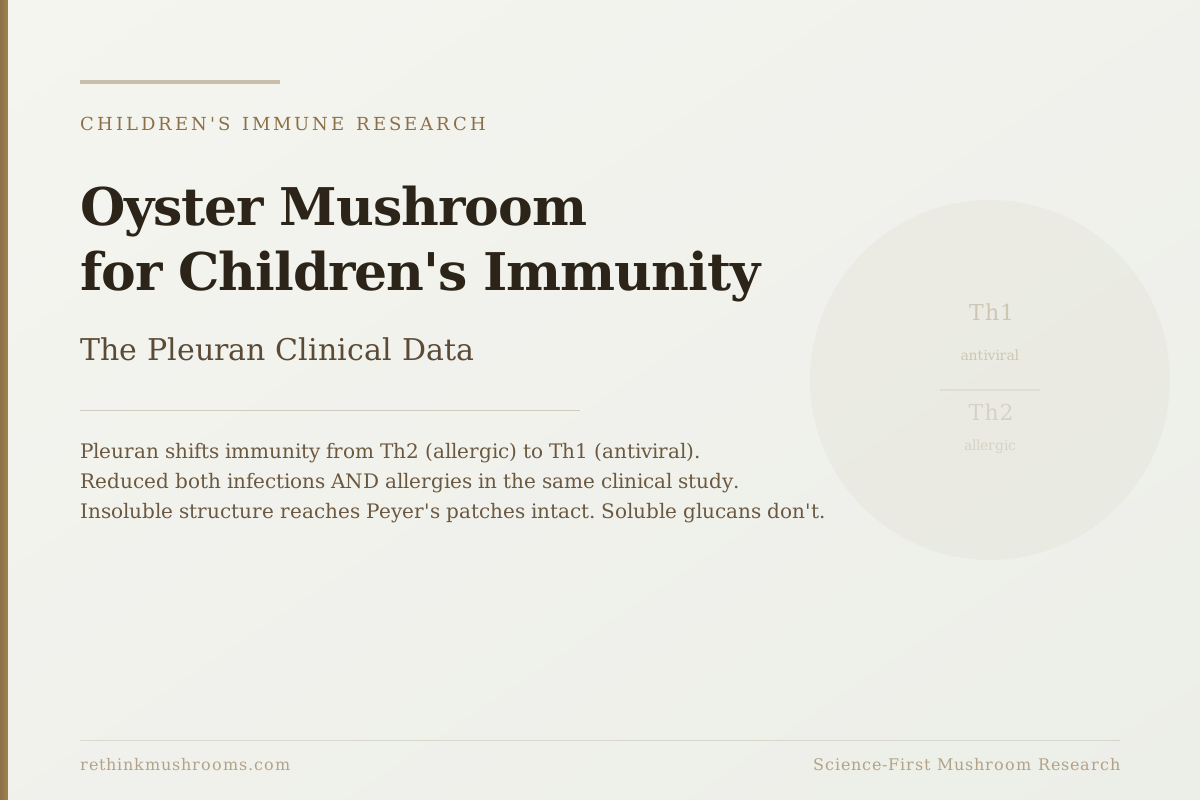
Th1 shift
oyster mushroom enhanced Th1 immune responses in a double-blind RCT
Dual benefit
reduced both respiratory infections and allergic responses in the same study
Peyer's patches
insoluble structure survives digestion to activate gut-associated lymphoid tissue
Vlassopoulou et al., Food & Function, 2021
 View as image ↗
Children who get sick repeatedly (three, four, five or more respiratory infections in a school year) are a distinct clinical population. Their immune systems are not simply "weak" in some vague sense. Most have a specific pattern: their immune response is skewed toward allergic reactions (the Th2 type) and away from the antiviral and antibacterial defenses (the Th1 type) that would otherwise stop respiratory pathogens efficiently. This pattern is precisely what research on oyster mushroom and children's immunity has been targeting. Pleuran, the specific beta-glucan extracted from oyster mushrooms, has been tested in clinical studies of children with recurrent respiratory infections and found to reduce both infection frequency and allergic responses simultaneously.
This article examines what those clinical findings show, why the mechanism addresses both problems at once, and where the evidence still has gaps. For the broader oyster mushroom overview, what is oyster mushroom: the world's second most popular mushroom provides the foundational context.
Key Takeaways
- Pleuran is the insoluble beta-1,3/1,6-glucan produced specifically by Pleurotus ostreatus (oyster mushroom); unlike most beta-glucans, it survives gastric digestion intact and reaches Peyer's patches in the gut, where it directly engages immune cells
- A 2014 RCT by Jesenak and colleagues found pleuran supplementation in children with recurrent respiratory tract infections reduced both URTI incidence and allergic responses, addressing two problems simultaneously[1]
- The mechanism for both benefits is a Th1 immune shift: pleuran pushes the immune system away from the Th2 (allergic) orientation and toward the Th1 (antiviral/antibacterial) orientation, improving defense against infections while reducing allergic reactivity
- A 2016 double-blind placebo-controlled RCT confirmed that oyster mushroom extract significantly enhanced Th1-type immune responses in adults, providing the mechanistic clinical evidence behind the children's trial findings[4]
- A 2021 systematic review of 17 RCTs on fungal beta-glucans found individuals receiving beta-glucan supplementation had stronger defense against upper respiratory tract infections across populations[3]
- The children's clinical evidence is primarily from studies of children with recurrent infections, not healthy children; benefits are likely more pronounced in this susceptible population
Why Some Children Get Sick Repeatedly (And What the Immune Pattern Shows)
Children who experience recurrent respiratory tract infections (RRTIs) have a recognizable immunological signature. Their immune response is shaped toward the Th2 pathway and away from the Th1 pathway. Understanding this distinction is necessary for understanding why pleuran works in this population.
The immune system has two major orientations for adaptive responses. The Th1 (T-helper type 1) pathway is optimized for fighting viruses and intracellular bacteria. It activates macrophages, natural killer cells, and cytotoxic T cells. When the Th1 response is strong, the body clears respiratory viruses efficiently.
The Th2 (T-helper type 2) pathway is optimized for fighting parasites and mounting allergic responses. It drives IgE antibody production, mast cell activation, and eosinophil recruitment. When Th2 dominates, the immune system is primed for allergic reactions: hay fever, asthma, eczema. Crucially, Th2 dominance also suppresses Th1, which is why people with allergic conditions often get more respiratory infections. The two pathways compete; when one is high, the other tends to be lower.
Many children with recurrent respiratory infections are Th2-skewed. They get more colds and upper respiratory infections than their peers, and they often have co-occurring allergic conditions: eczema, food sensitivities, asthma, rhinitis. The immune imbalance is a single root cause producing two apparently different problems.
A review by Majtan in 2012 established the specific role of Pleuran in addressing this pattern.[2] The review identified Pleuran's unique structural property as key: because it is insoluble, it survives gastric acid and digestive enzymes intact. Most polysaccharides dissolve or degrade. Pleuran reaches the lower small intestine intact, where Peyer's patches are located.
Peyer's patches are clusters of lymphoid tissue embedded in the intestinal wall. They are part of the gut-associated lymphoid tissue (GALT) system and serve as one of the primary sites where the immune system encounters and learns from material passing through the gut. Pleuran binds to pattern recognition receptors on macrophages and dendritic cells in Peyer's patches, particularly Dectin-1 and complement receptor 3 (CR3). This binding triggers innate immune activation and promotes a Th1-oriented adaptive response.
This is the mechanism that explains the clinical findings.
What Pleuran Is and Why Its Structure Is Different
Pleuran is categorized as a beta-1,3/1,6-glucan, meaning glucose units are linked in both 1,3 and 1,6 positions in the molecular chain. This branching structure is what most mushroom beta-glucans share. What makes Pleuran specifically different from beta-glucans in oats, barley, or other mushrooms is its solubility profile.
Oat beta-glucan is soluble: it dissolves in water, forms a gel, and is absorbed in the upper gastrointestinal tract, where it slows glucose absorption and binds cholesterol. Its immune-modulatory activity is limited because it doesn't reach Peyer's patches intact.
Most other mushroom polysaccharide extracts are at least partially soluble. Pleuran from Pleurotus ostreatus is insoluble. This insolubility is not a limitation; it is the mechanism. Because it cannot dissolve, it passes through the stomach and small intestine as a physical particle, arriving at Peyer's patches in its intact structural form. There, it is recognized by immune receptors as a foreign microbial-type particle (beta-glucans are components of fungal cell walls, which the innate immune system has evolved to recognize) and mounts a response accordingly.
This structural distinction is why the Pleuran clinical evidence is not automatically transferable to other beta-glucan products. A yeast-derived beta-glucan supplement or an oat beta-glucan product has different solubility, different bioavailability, and different immune exposure patterns. The clinical evidence specifically for children with recurrent respiratory infections was built with Pleuran, and extrapolating it to other beta-glucan products assumes the mechanism is identical, which the structural evidence does not support.
For the full clinical evidence base including adult populations, oyster mushroom and immune support: Pleuran beta-glucan research covers the complete evidence hierarchy.
The Children's Clinical Evidence: URTI Reduction and Anti-Allergic Effects Together
Jesenak and colleagues conducted an RCT of Pleuran supplementation specifically in children who had a history of recurrent respiratory tract infections.[1] The study was published in Phytotherapy Research in 2014. The children received Pleuran supplementation or placebo over a treatment period.
The primary finding was a significant reduction in upper respiratory tract infection (URTI) incidence in the Pleuran group compared to placebo. This means fewer colds, fewer ear infections, fewer episodes of strep throat and similar infections, over the course of the study period.
The secondary finding was the one that has received less attention in consumer health content but is arguably more important for the target population: Pleuran demonstrated anti-allergic effects alongside the URTI reduction. The same supplement that reduced infections also reduced allergic reactivity.
This dual outcome is not coincidental. It is mechanistically predicted by the Th1 shift. When Pleuran activates Peyer's patch immune cells and promotes Th1 responses, it simultaneously downregulates Th2 responses. The allergy-reducing effect and the infection-reducing effect are the same immune shift seen from two angles: more Th1 means fewer viral infections; less Th2 means less allergic inflammation.
This is clinically relevant because children with recurrent RTIs very commonly have co-occurring allergic conditions. Eczema and asthma are not separate problems from their frequent infections; they are expressions of the same Th2 imbalance. A supplement that addresses the Th2/Th1 skew addresses both problems. This is what the Jesenak 2014 data shows.
For the athlete immune evidence (the first clinical population where Pleuran was tested), Pleuran and upper respiratory infection prevention in athletes covers the Bobovcak 2010 and Bergendiova 2011 trials.
The Th1 Mechanism: The Double-Blind Clinical Confirmation
The Jesenak 2014 children's study identified the clinical outcome. A 2016 double-blind placebo-controlled RCT by Tanaka and colleagues provided a clean human mechanistic confirmation of the underlying immune shift.[4]
Tanaka's trial enrolled adults and administered oyster mushroom extract under double-blind, placebo-controlled conditions. At the end of the trial, the oyster mushroom group showed significantly enhanced Th1-type immune responses compared to placebo. Th1 enhancement was measurable in immune cell activity parameters.
A double-blind RCT showing Th1 enhancement in a human population is the clinical evidence that links the mechanistic model (Pleuran triggers Dectin-1 signaling, which promotes Th1) to actual human immune system changes. The Jesenak children's trial showed that Pleuran reduces infections and allergies; the Tanaka RCT shows that oyster mushroom extract shifts the Th1/Th2 balance in a measurable, controlled way.
The implications for atopic children (those with eczema, asthma, or food allergies who also experience recurrent infections) are clear at the mechanistic level: a supplement that measurably shifts the immune system toward Th1 could simultaneously reduce infection frequency and reduce allergic reactivity. The Jesenak data suggests this happens in practice. The Tanaka data confirms the mechanism produces measurable changes.
Why is this relevant to children specifically? The Th2 skew that characterizes recurrent infection susceptibility is more pronounced in young children because the neonatal immune system starts Th2-dominant (beneficial for tolerating maternal antigens in utero) and gradually shifts toward Th1 balance as the child is exposed to microbial antigens. Children who are raised in overly sterile environments or who receive frequent antibiotics that disrupt gut microbiota may not make this shift efficiently, leaving them more Th2-dominant than their age peers. Pleuran's Peyer's patch activation appears to accelerate the Th1 shift.
For the NK cell mechanism evidence (which is also a Th1-associated immune component), oyster mushroom and NK cell activity covers the El Deeb 2019 receptor data in detail.
The Systematic Evidence Context
The children's and athlete data on Pleuran is part of a broader evidence base on fungal beta-glucans and immune health.
A 2021 systematic review by Vlassopoulou and colleagues examined 17 randomized controlled trials on fungal beta-glucans across health outcomes.[3] Among the key findings: individuals receiving beta-glucan supplementation had stronger defense against upper respiratory tract infections across the studied populations. Eight of the 17 trials specifically examined athletes and found beta-glucan supplementation reduced the exercise-induced immune decline that opens the window to infection.
This systematic review is the scholarly anchor for the entire Pleuran cluster. It provides the meta-level evidence that fungal beta-glucans as a class produce the type of immune outcomes that the individual Pleuran trials demonstrate. The Pleuran evidence base fits within a broader pattern of evidence, not as an outlier claim.
For the broader oyster mushroom immune support picture including the cancer immunotherapy data, Pleuran: the oyster mushroom beta-glucan with clinical immune evidence covers the complete evidence hierarchy including the Spacek 2022 cancer patient data.
The Honest Evidence Picture: What Remains Unknown
Several important limitations apply to interpreting the children's Pleuran evidence.
Population specificity. The Jesenak 2014 trial studied children with recurrent respiratory tract infections, not healthy children without a history of frequent infections. Benefits may be more pronounced in this vulnerable population and smaller or absent in healthy children who already mount effective immune responses to respiratory pathogens.
Pleuran specificity. The insoluble structure of Pleuran is the proposed mechanism for its superior Peyer's patch delivery vs. soluble beta-glucans. Whether generic oyster mushroom powder products (which may not standardize for Pleuran content or particle size) produce the same effects as the standardized Pleuran extract used in clinical trials has not been directly compared.
Effect size data. The brief's study records for Jesenak 2014 do not include specific numerical effect sizes for URTI reduction (e.g., percentage reduction in infection episodes). The finding is significant and published in a peer-reviewed journal, but the magnitude of the effect relative to placebo requires consulting the primary paper for the specific numbers.
Age and dosing. Standard dosing in children studies has been reported as 10mg Pleuran per 5kg body weight with 10mg vitamin C in some publications. Duration in the Bergendiova athlete trial was 3 months. Whether shorter or longer durations produce proportionally different effects in children is not established.
For ergothioneine and antioxidant immune support from oyster mushrooms (a separate protective mechanism), ergothioneine in oyster mushrooms: the longevity antioxidant covers that parallel immune-protective compound.
The Bottom Line
Pleuran, the insoluble beta-1,3/1,6-glucan from oyster mushrooms, has been tested clinically in children with recurrent respiratory tract infections and found to reduce both URTI incidence and allergic responses. The mechanism is a Th1 immune shift: Pleuran activates Peyer's patches via Dectin-1 and CR3 receptors, promoting antiviral Th1 responses while downregulating allergic Th2 activity. A double-blind RCT confirmed Th1 enhancement from oyster mushroom extract in adults. A 2021 systematic review of 17 RCTs supports fungal beta-glucan immune efficacy broadly. The evidence applies primarily to children with recurrent infections, not healthy children without susceptibility.
Frequently Asked Questions
Sources & References
- 1. Source details for this reference are not yet available.
- 2. Source details for this reference are not yet available.
- 3. Source details for this reference are not yet available.
- 4. Source details for this reference are not yet available.