Oyster Mushroom Science
17 RCTs reviewed in the Vlassopoulou 2021 systematic review of fungal beta-glucan immune evidence
A 2021 systematic review found that individuals receiving fungal beta-glucan supplementation had stronger defense against upper respiratory infections across 17 randomized controlled trials, with 8 trials specifically in athletes.
Vlassopoulou et al., Food & Function, 2021
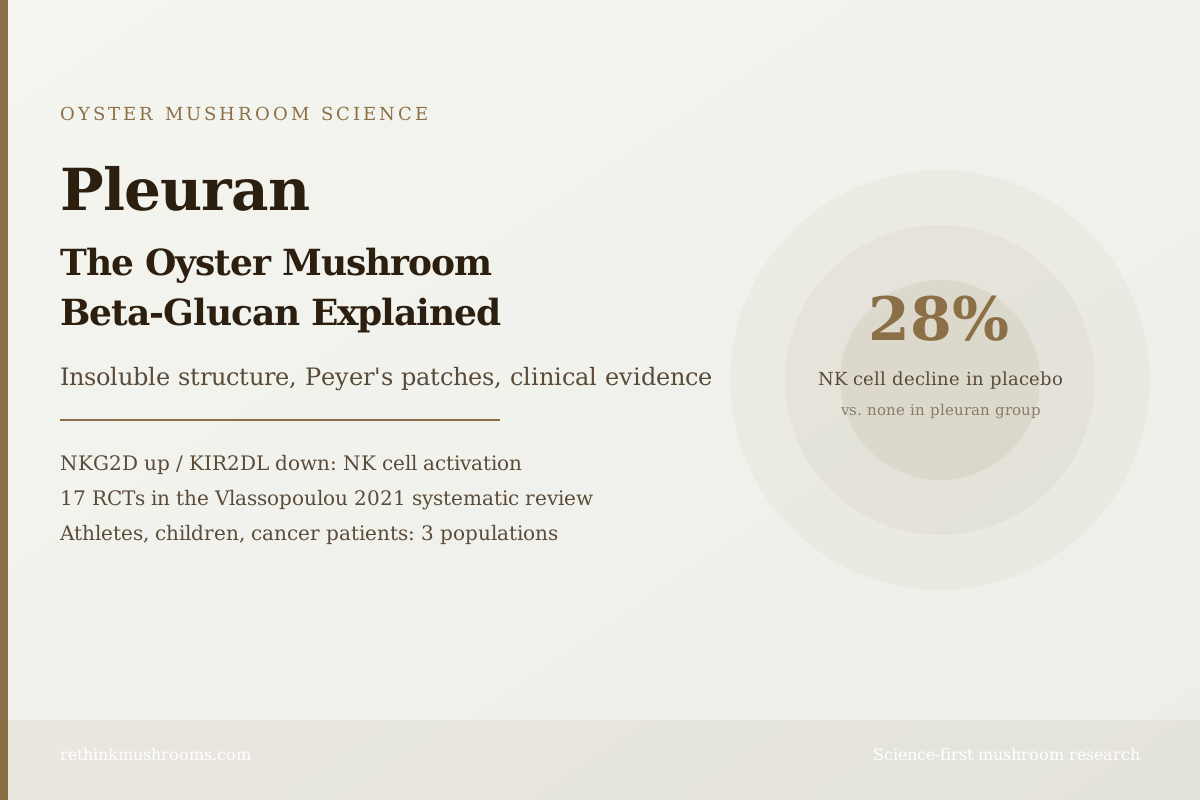
28%
NK cell activity decline in placebo athletes prevented entirely by pleuran (Bobovcak 2010)
50 athletes
in the Bergendiova 2011 RCT showing significantly fewer respiratory infections over 3 months
Insoluble
pleuran's key structural property: survives digestion intact to reach Peyer's patches and engage immune receptors directly
Vlassopoulou et al., Food & Function, 2021
 View as image ↗
Pleuran is the specific beta-glucan produced by oyster mushrooms (Pleurotus ostreatus), and it has more controlled clinical trial evidence than most mushroom immune compounds. A 2021 systematic review in Food and Function by Vlassopoulou and colleagues analyzed 17 randomized controlled trials of fungal beta-glucan supplementation and found consistent evidence for stronger defense against upper respiratory tract infections, with 8 of those trials in athletes specifically.[1] What distinguishes pleuran beta-glucan immune evidence from the broader beta-glucan category is a structural property that separates it mechanistically from soluble beta-glucans from oats, baker's yeast, or other mushrooms. This article covers how pleuran works, the clinical datasets across different populations, and where the evidence ends. The broader oyster mushroom overview is at the oyster mushroom guide.
Key Takeaways
- A 2021 systematic review of 17 fungal beta-glucan RCTs found consistent evidence for reduced upper respiratory tract infections; 8 trials were specifically in athletes
- Pleuran is insoluble: unlike most beta-glucans, it survives gastric digestion intact and reaches Peyer's patches (immune sampling sites in the small intestine), where it activates immune cells through Dectin-1 and CR3 receptors directly
- El Deeb 2019 identified the specific NK cell receptor mechanism: pleuran upregulates NKG2D (activating receptor) and downregulates KIR2DL (inhibitory receptor), shifting NK cells toward higher cytotoxic readiness
- In athlete studies, pleuran prevented the 28% post-exercise NK cell activity decline seen in placebo (Bobovcak 2010) and reduced upper respiratory infection incidence in 50 athletes over 3 months (Bergendiova 2011)
- In children with recurrent respiratory infections, Jesenak 2014 found pleuran reduced both infection frequency and allergic symptoms through Th1 immune modulation
- Spacek 2022 extended the evidence to breast cancer patients receiving endocrine therapy, finding measurable immunomodulatory effects in a clinical population beyond healthy adults
What Makes Pleuran Different From Other Beta-Glucans
Not all beta-glucans are equivalent, and this is where most consumer health writing goes wrong. Beta-glucans from oats, baker's yeast, reishi, shiitake, and oyster mushrooms share a structural family but differ in solubility, molecular weight, and chain branching. These differences determine where in the body the compound reaches its targets.
Pleuran is insoluble. This might seem like a disadvantage compared to soluble compounds that absorb readily, but in the gut immune context it is the key to its mechanism. Soluble beta-glucans dissolve in the digestive tract, get partially broken down, and enter circulation as modified fragments. Pleuran, because it resists digestion, travels through the stomach and small intestine as intact particles.
In the small intestine, particularly the terminal ileum, clusters of immune tissue called Peyer's patches act as the gut's immune surveillance stations, sampling intestinal contents and calibrating immune responses to what they find. Specialized cells called M cells within Peyer's patches take up intact particles from the gut lumen. When pleuran particles are present, M cells transport them to underlying immune cells, which recognize them through receptors called Dectin-1 and CR3. This recognition activates macrophages, NK cells, and dendritic cells in the underlying immune tissue, generating a broad immunological priming effect.
Majtan, reviewing the evidence in a 2012 paper in Medicine and Sport Science, specifically identified this insoluble Peyer's patch mechanism as what differentiates pleuran from soluble beta-glucans that work primarily through circulatory routes.[2] This mechanism also explains why pleuran studies typically require weeks to months of supplementation: the Peyer's patch activation pathway is an immunological priming process that builds gradually.
The NK Cell Receptor Mechanism: More Precise Than "Immune Boosting"
Natural killer cells are the immune system's first-response surveillance cells. They don't need prior instruction about a specific pathogen; they kill cells that display stress, infection, or malignancy markers through a receptor-based recognition system. Two key receptors govern this: NKG2D, an activating receptor that recognizes stress signals on target cell surfaces, and KIR2DL, an inhibitory receptor that prevents NK cells from attacking healthy self-cells.
In 2019, El Deeb and colleagues published a study in Frontiers in Cell and Developmental Biology identifying exactly what P. ostreatus beta-glucan does to these receptors.[3] Pleuran upregulated NKG2D and downregulated KIR2DL simultaneously. More activating receptor plus less inhibitory receptor means NK cells are primed toward higher cytotoxic activity against infected or abnormal cells.
This is the most mechanistically specific NK cell activation data available for any mushroom compound. Consumer health content typically says "mushroom X increases NK cell activity" without specifying how. The El Deeb 2019 data explains the shift at the receptor level: not a general stimulation but a targeted recalibration of the activating-to-inhibitory receptor ratio.
These NK cells that defend against cancer cells are also the front-line defense against viral respiratory infections, which connects the mechanistic data to the athlete clinical outcomes below.
Immune Modulation vs. Immune Stimulation: The Th1 Balance
A common confusion in mushroom immune marketing is treating all immune effects as equivalent. The immune system operates through competing branches. Th1 responses handle anti-viral, anti-bacterial, and anti-tumor cellular immunity. Th2 responses handle allergic and parasitic immunity. Many people prone to frequent respiratory infections have relatively lower Th1 activity; people with allergies have overactive Th2 responses.
In 2016, Tanaka and colleagues published a double-blind, placebo-controlled RCT in the Journal of Traditional and Complementary Medicine testing oyster mushroom extract on immune phenotype in human participants.[5] Oyster mushroom extract significantly enhanced Th1-type immune responses. This Th1 enhancement explains two clinical outcomes seen in separate studies: reduced viral respiratory infections (better Th1 antiviral defense) and reduced allergic symptoms (Th1 shift counteracts Th2-dominant allergy), both of which appeared in the Jesenak 2014 children's trial.
On the anti-inflammatory side, Jedinak and colleagues in 2011 found that oyster mushroom extract inhibited NF-κB and AP-1 signaling in macrophages, the transcription factors governing inflammatory cytokine overproduction.[4] This means pleuran's immune effects include suppression of excessive inflammatory signaling alongside activation of anti-viral defenses. This balance is what makes pleuran an immunomodulator rather than a simple immune stimulant.
The Athlete Evidence: Two Studies, Two Types of Data
The athlete clinical data for pleuran comes from two separate studies that measure different things and are more informative together than either is alone.
Bobovcak and colleagues in 2010 published an RCT in the European Journal of Applied Physiology testing pleuran supplementation in elite athletes during intensive exercise.[6] In the placebo group, natural killer cell activity declined 28% below baseline during the recovery period after intensive training. In the pleuran group, no significant decline occurred. This study measures the mechanism: pleuran preserved NK cell function during the post-exercise immunosuppression window.
Bergendiova and colleagues in 2011 published a separate RCT in the same journal with 50 athletes randomized to pleuran or placebo over three months.[7] The pleuran group had significantly fewer upper respiratory tract infection symptoms over the study period. Circulating NK cell counts were also higher in the pleuran group.
The two studies form a mechanistic-plus-clinical pair: Bobovcak 2010 shows pleuran prevents the NK cell decline that follows intensive exercise; Bergendiova 2011 shows that NK cell preservation translates to fewer actual infections. Intense exercise suppresses immune function, creating a vulnerability window; NK cell preservation closes that window; the result is fewer infections.
For detailed coverage of the athlete-specific evidence and the exercise immune suppression mechanism, the companion article on pleuran and upper respiratory infection prevention in athletes covers that territory. The NK cell receptor mechanisms are at oyster mushroom and NK cell activity.
The Children's Evidence: Th1 Shift Reduces Both Infections and Allergy
In 2014, Jesenak and colleagues published an RCT in Phytotherapy Research testing pleuran in children with recurrent respiratory tract infections.[8] The result was notable for two reasons: pleuran reduced both infection frequency and allergic symptoms in the same children.
This dual outcome follows logically from the Th1/Th2 balance. Children with recurrent respiratory infections often have lower Th1-type immune activity. Children with allergic conditions have higher Th2 activity. The Th1-shifting effect of pleuran simultaneously improves antiviral defense and shifts the immune balance away from the Th2-dominant allergic state. One compound, one mechanism, two clinically meaningful outcomes in the same population.
The pediatric evidence and dosing data are covered in more depth at oyster mushroom for children's immunity.
Clinical Evidence Beyond Healthy Adults: Spacek 2022
Most pleuran studies test healthy athletes or children prone to infections. Spacek and colleagues in 2022 extended the evidence to breast cancer patients receiving endocrine therapy, a population with significantly compromised immune function from both the malignancy and the treatment.[9]
The study found measurable immunomodulatory effects from P. ostreatus beta-glucan supplementation in these patients. That pleuran produced immune effects in this immunologically challenged population suggests the Peyer's patch mechanism operates even when systemic immunity is compromised, which is consistent with the local gut-immune activation model: the activation starts in gut tissue rather than requiring circulating immune competence.
The Gut Connection: Why Pleuran's Mechanism Starts in the Intestine
A 2025 study by Kerezoudi and colleagues in Nutrients tested fermented P. eryngii (a Pleurotus species) in human colonic tissue models and found protection of intestinal barrier integrity alongside modulation of immune signaling pathways.[10] This supports the broader model: Pleurotus species compounds reach gut immune tissue, engage barrier-protecting and immune-activating pathways locally, and produce systemic immune effects upstream from that interaction.
Peyer's patches are not isolated from the rest of the immune system. Once primed by pleuran in the gut, macrophages and dendritic cells in Peyer's patches migrate to draining lymph nodes and communicate the immune signal to circulating NK cells, T cells, and B cells. The local gut activation becomes a systemic immune priming event. This is the mechanism linking the insoluble fiber structure of pleuran to the circulating NK cell effects measured in the Bobovcak and Bergendiova athlete studies.
For the broader immune support research on pleuran, oyster mushroom and immune support: Pleuran beta-glucan research covers the full evidence hierarchy. The anti-inflammatory side of oyster mushroom immune effects is at oyster mushroom and inflammation.
What the Clinical Evidence Covers and What It Doesn't
The pleuran clinical evidence base has a specific shape. It is strongest for: athletes under exercise-induced immune stress (two RCTs, NK cell + URTI outcomes), children with recurrent respiratory infections (one RCT, anti-allergic + URTI outcomes), and immunocompromised cancer patients (one clinical study). The Vlassopoulou 2021 systematic review provides the broadest evidence frame: fungal beta-glucans as a category, across 17 RCTs, show immune benefits particularly for respiratory infections.
What the evidence does not cover: there are no large-scale RCTs of pleuran in otherwise healthy general adults seeking routine immune support. The assumption that benefits in athletes and infection-prone children will translate to healthy adults with normal immune function has not been formally tested in this population. This is worth stating clearly for a reader who is not an athlete, not prone to recurrent infections, and not immunocompromised: the benefit in that specific scenario is less certain than for the populations studied.
The Bottom Line
Pleuran is the insoluble beta-glucan from Pleurotus ostreatus, structurally distinct from soluble beta-glucans due to its resistance to digestion. It reaches Peyer's patches in the small intestine intact, activating NK cells and macrophages through Dectin-1 and CR3 receptors. A 2019 study identified the specific receptor mechanism: NKG2D upregulation and KIR2DL downregulation on NK cells. Clinical evidence spans athletes (two RCTs showing NK cell preservation and URTI reduction), children with recurrent infections (anti-allergic plus anti-infective effects through Th1 modulation), and breast cancer patients (immunomodulation in a compromised population). A 2021 systematic review of 17 fungal beta-glucan RCTs provides the broadest context.
Frequently Asked Questions
Sources & References
- 1. Source details for this reference are not yet available.
- 2. Source details for this reference are not yet available.
- 3. Source details for this reference are not yet available.
- 4. Source details for this reference are not yet available.
- 5. Source details for this reference are not yet available.
- 6. Source details for this reference are not yet available.
- 7. Source details for this reference are not yet available.
- 8. Source details for this reference are not yet available.
- 9. Source details for this reference are not yet available.
- 10. Source details for this reference are not yet available.