Oyster Mushroom
23.9% beta-glucan
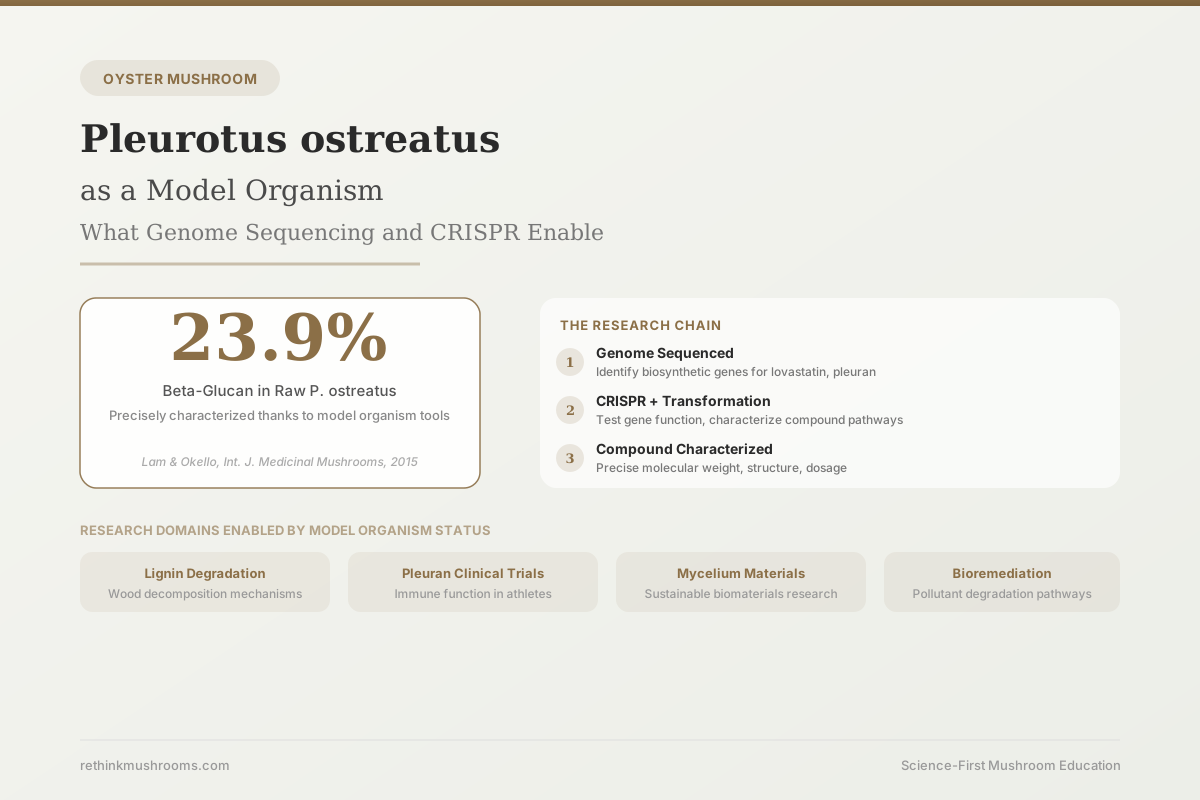
The concentration of beta-glucan in raw P. ostreatus is precisely documented at 23.9% by dry weight because oyster mushroom is science's most studied edible fungus, with a sequenced genome and CRISPR-capable tools that make compound characterization possible.
Lam & Okello, International Journal of Medicinal Mushrooms, 2015
CRISPR-capable
P. ostreatus accepts precision gene editing, a key model organism qualification (Nakazawa et al., 2024)
1995
Year researchers first confirmed lovastatin in P. ostreatus fruiting bodies, the same compound used in pharmaceutical statins
4 domains
Lignin degradation, sexual development, protein secretion, and biomaterials research where P. ostreatus is the primary model
Lam & Okello, International Journal of Medicinal Mushrooms, 2015
 View as image ↗
Model organisms changed biology. Before the fruit fly helped scientists decode inheritance in the early 1900s, heredity was a mystery. Before baker's yeast became the standard system for studying cell division, scientists had no reliable way to watch it happen in real time. Before a tiny roundworm became the model for mapping every cell division in a developing organism, developmental biology lacked a blueprint to follow.
Every major field of biology has one: a species that is fast to grow, genetically accessible, and produces findings that transfer to related organisms. For the wood-decomposing mushrooms of the class Agaricomycetes, which includes most of the edible and medicinal species people use, that organism is Pleurotus ostreatus.
A 2024 review in Applied Microbiology and Biotechnology by Nakazawa and colleagues documented this formally: P. ostreatus is now the established model system for the Agaricomycetes, with a sequenced genome, efficient DNA transformation protocols, CRISPR capability, and a research corpus spanning lignin degradation, sexual development, protein secretion, and mycelium-based materials.[1]
This matters for anyone reading about the health effects of oyster mushroom. The clinical trials on pleuran beta-glucan, the characterization of lovastatin, the precise ergothioneine concentration data: all of these were enabled by molecular infrastructure that model organism status created. When a mushroom species has a sequenced genome and CRISPR tools, researchers can ask questions that are simply unanswerable for species without these resources. P. ostreatus has those resources. Most other edible mushrooms do not.
For the broader introduction to oyster mushroom health effects, see What Is Oyster Mushroom? The World's Second Most Popular Mushroom.
Key Takeaways
- A model organism is a species chosen for research because it is easy to study and produces findings that generalize to related species. For mushroom science, P. ostreatus now fills this role, as documented by Nakazawa et al. in Applied Microbiology and Biotechnology (2024)
- P. ostreatus qualifies because of four properties: fast mycelium growth, multiple DNA insertion methods that work reliably, a sequenced genome, and CRISPR capability that enables precise genetic editing
- The lovastatin discovery in 1995, by Gunde-Cimerman and colleagues, was the first demonstration that P. ostreatus fruiting bodies contain a pharmaceutical-grade HMG-CoA reductase inhibitor: the same compound used in statin drugs to lower cholesterol
- The clinical pleuran trials in athletes showing maintained immune function during intensive training were possible because model organism tools had already characterized pleuran's molecular weight, linkage structure, and fermentation behavior (Bergendiova et al., 2011)
- Raw P. ostreatus beta-glucan content is precisely documented at 23.9% by dry weight because analytical chemistry tools developed for the model organism system allow rigorous quantification (Lam & Okello, 2015)
- Model organism status also drives applications beyond health: P. ostreatus is the primary system for studying wood degradation, bioremediation of plastics and pollutants, and mycelium-based sustainable materials
What a Model Organism Is and Why Biology Depends on Them
A model organism is not a famous organism. It is a convenient one.
Biologists choose model organisms based on research tractability: the species has to grow fast, be easy to maintain in laboratory conditions, produce a lot of offspring quickly, accept genetic manipulation, and ideally have a small, well-annotated genome. The fruit fly (Drosophila) lives for weeks and produces hundreds of offspring per female. The roundworm (C. elegans) is transparent, allowing microscopes to watch every cell. Baker's yeast (Saccharomyces cerevisiae) grows on a petri dish overnight.
The choice is not random. It is driven by whoever can answer important questions most efficiently. Once a model organism is established, all the molecular tools built for it, transformation protocols, genetic mutant libraries, reporter strains, gene knockout approaches, become available for the entire research community. That collective infrastructure is what makes a model organism valuable. A new researcher working on cell division doesn't rebuild everything from scratch; they use the yeast tools that the field has accumulated over 50 years.
For the fungi that produce edible and medicinal mushrooms, the Agaricomycetes class, no single model organism was established until recently. This is part of why mushroom health research has lagged behind research on bacteria or mammals: the molecular infrastructure was underdeveloped.
P. ostreatus is changing that. Nakazawa and colleagues documented in 2024 that P. ostreatus now has all the qualifications of a model organism, making it the first Agaricomycetes species to achieve this status systematically.[1]
Why P. ostreatus Got Chosen: Growth, Transformation, and the Genome
Model organism status does not get voted on. It accretes: researchers start using a species, develop tools for it, publish methods that other researchers adopt, and over time, the species becomes the default starting point for the field's questions.
P. ostreatus accumulated this status because of specific practical properties.
Growth rate. Oyster mushroom mycelium colonizes a lignocellulosic substrate (wood chips, straw, or sawdust in a laboratory flask) faster than most Agaricomycetes. This means researchers can set up experiments, collect data, and iterate in timescales that are practical for academic research cycles.
Transformation. The technical term for inserting foreign DNA into a fungal cell is transformation. Multiple transformation protocols work reliably for P. ostreatus, including protoplast-mediated transformation and Agrobacterium-mediated transformation. Each method has different strengths for different applications. Having multiple reliable methods means researchers have options when one approach fails or is suboptimal for a specific experiment.
The sequenced genome. The full genomic sequence of P. ostreatus has been determined and annotated. This means scientists can look up any gene, see what protein it encodes, and compare it to known genes in other organisms. The genome sequence was a prerequisite for identifying which genes are responsible for lovastatin biosynthesis, beta-glucan synthesis, and lignin degradation. Without it, these would be invisible molecular processes.
CRISPR. The gene-editing system that allows researchers to cut DNA at precise locations works in P. ostreatus. This means a researcher can disable a specific gene, introduce a precise mutation, or insert a reporter at a specific genomic location. The ability to make targeted genetic changes is what allows researchers to test hypotheses about gene function rather than just observing correlations.
Nakazawa and colleagues documented these capabilities comprehensively, including demonstrations of multiple simultaneous gene disruptions, showing that the genetic toolset is now sophisticated enough to tackle complex biosynthetic pathway questions.[1]
What the Genome Sequence Unlocked: Lignin and Lovastatin
The most commercially important property of P. ostreatus for the bioindustry is its ability to degrade lignin. Lignin is the tough, complex polymer that gives wood its structural strength and makes it resistant to most biological degradation. Lignin is the reason wood takes decades or centuries to decompose in a forest without specific organisms attacking it.
P. ostreatus, like other white-rot fungi, produces enzymes that break lignin apart. These enzymes (peroxidases and laccases, broadly) work through oxidative mechanisms that are unlike anything in animal or bacterial biochemistry. Understanding these enzymes has applications in biofuels, paper manufacturing, textile processing, and bioremediation of industrial pollutants.
The genome sequence made it possible to identify exactly which genes encode these enzymes, how those genes are regulated, and how the degradation system is organized. This research, enabled by the model organism infrastructure, is why P. ostreatus is now used to degrade agricultural and industrial waste.
The lovastatin connection runs through the same infrastructure. In 1995, Gunde-Cimerman and colleagues confirmed that P. ostreatus fruiting bodies contain measurable lovastatin, the same HMG-CoA reductase inhibitor used in pharmaceutical statin drugs.[2] An HMG-CoA reductase inhibitor is a compound that blocks a specific enzyme in the cholesterol synthesis pathway. Blocking this enzyme reduces the liver's production of LDL cholesterol, which is why statins became major cardiovascular drugs.
The 1995 discovery was possible because researchers already had tools to study P. ostreatus's secondary metabolites. The genome sequence later revealed the biosynthetic gene cluster responsible for lovastatin production, allowing researchers to understand how the mushroom makes it and how environmental conditions affect the yield. For the quantification story, see Lovastatin in Oyster Mushrooms: How Much Is Actually There? and the biosynthetic mechanism at Lovastatin Biosynthesis in Pleurotus ostreatus.
Sexual Development in Fungi: What P. ostreatus Research Revealed
Fungi reproduce sexually through a system that is fundamentally different from animal sexual reproduction. Instead of two sexes, most Agaricomycetes have multiple mating types, meaning a single individual can mate with any partner that carries a different mating type gene combination. The number of compatible mating combinations in some species runs into the thousands.
Understanding how this system works, how hyphae from two compatible partners recognize each other and fuse, how the fused cell undergoes nuclear migration, and how fruiting body formation is triggered, required a model organism where these processes could be observed and manipulated.
P. ostreatus became the primary system for working out several of these mechanisms. Nakazawa and colleagues documented how model organism tools have been used to characterize the genetic basis of mating type determination, the molecular signals that trigger fruiting body formation, and the cell biology of hyphal tip growth.[1]
These are not abstract biology questions. Understanding what triggers fruiting body formation directly informs cultivation: growers who know the molecular signals for fruiting can optimize their conditions more precisely than growers who can only observe outcomes without understanding the mechanism.
From Laboratory Discovery to Clinical Trial: The Pleuran Story
Pleuran is a specific form of beta-glucan extracted from P. ostreatus, characterized by its 1,3/1,6 branching structure and its molecular weight. The precision of that characterization is directly due to model organism infrastructure.
Before a compound can enter a clinical trial, researchers need to know exactly what it is. For pleuran, that meant determining its molecular weight range, characterizing its three-dimensional structure, establishing how it behaves in gastric conditions, and understanding its fermentation behavior in the colon. These questions require analytical tools that are most practical when the source organism has known genetics and reproducible growth characteristics. P. ostreatus's model organism status provided exactly this.
The quantification work demonstrated that raw P. ostreatus contains 23.9% beta-glucan by dry weight, one of the highest concentrations in any cultivated edible fungus, with 487 mg gallic acid equivalents per 100g in polyphenols.[4]
With the compound characterized, clinical research became possible. Bergendiova and colleagues ran an RCT in elite athletes taking pleuran during intensive training.[3] Athletes on pleuran maintained stable phagocyte function, meaning their immune cells maintained their ability to engulf and destroy pathogens, while athletes in the placebo group showed significant decline during the high-training period. They also showed significantly reduced incidence of upper respiratory tract infection symptoms and increased circulating natural killer cells.
Natural killer cells are the immune system's fast-responding pathogen killers: they can attack infected or abnormal cells without prior sensitization. Maintaining NK cell activity during intensive physical training, which suppresses immunity in most athletes, is a meaningful clinical finding.
This research chain, from molecule characterization to athletic immune support trial, represents about 15 years of work. Without the model organism foundation, the molecular characterization step, which precedes and enables all clinical research, would have taken much longer. For the full pleuran clinical evidence, see Oyster Mushroom Bioactive Compounds: Pleuran, Lovastatin, and More.
Bioremediation and Materials: Where the Model Organism Research Is Heading
Model organism status creates a feedback loop: more tools lead to more research questions, which generate more tools. The P. ostreatus research portfolio has expanded beyond health into environmental and materials applications.
Bioremediation. P. ostreatus's lignin-degrading enzyme system also works on synthetic pollutants that share structural features with lignin. Laboratory studies have demonstrated degradation of plastics, polycyclic aromatic hydrocarbons from petroleum, and pharmaceutical residues. The feasibility of using P. ostreatus mycelium to clean contaminated soil or water depends on understanding the enzyme system at the molecular level, which requires the genome and transformation tools that model organism status provides.
Mycelium materials. Nakazawa and colleagues documented the emerging field of mycelium-based materials as a specific research application enabled by the P. ostreatus model system.[1] Mycelium grown on agricultural waste can be shaped, compressed, and dried to form rigid materials with insulating and structural properties. The resulting material is biodegradable, renewable, and being investigated as an alternative to plastic packaging, foam insulation, and even leather.
The mechanical properties of mycelium materials depend on cell wall composition, including chitin and beta-glucan content, and on how mycelium growth is directed. Optimizing these properties for manufacturing requires understanding the genetics of cell wall biosynthesis: exactly the kind of question that CRISPR-capable model organism tools can address.
What Model Organism Status Means for Readers of Health Research
The practical implication of P. ostreatus's model organism status is this: when you read about a clinical trial using oyster mushroom compounds, that trial was preceded by decades of molecular characterization that simply has not happened for most other edible mushroom species.
The lovastatin discovery in 1995 required tools to identify and quantify a secondary metabolite in a fungal fruiting body. The pleuran clinical trials required precise structural characterization of the beta-glucan before it could be used as a reproducible test compound. Both depended on the research infrastructure that accumulated around P. ostreatus.
For species like shiitake, reishi, or lion's mane, the equivalent infrastructure is less developed. Genomes exist for some. CRISPR protocols are being established. But the depth of molecular tooling available for P. ostreatus has no equivalent in other edible mushroom species.
This explains an asymmetry in the evidence base: oyster mushroom has more clinical trial data, more precisely characterized bioactives, and more mechanistic research than almost any other culinary mushroom. That is not entirely because oyster mushroom's compounds are more potent. It is substantially because the research infrastructure for studying them is more developed.
Model organism status does not prove health effects. It means the hypothesis testing is done with better tools. The clinical outcomes still need to be demonstrated in well-designed human trials, and as the Dicks 2020 systematic review noted, the overall evidence quality for oyster mushroom cardiometabolic effects is currently low. For the full nutritional and compound profile, see Pleurotus ostreatus Nutritional Profile: Protein, Vitamins, and Unique Compounds. For species-level context, see Oyster Mushroom Species: ostreatus, djamor, and sajor-caju.
The Bottom Line
Pleurotus ostreatus became science's model mushroom because it grows fast, accepts genetic manipulation through multiple methods, has a fully sequenced genome, and can be edited with CRISPR. This infrastructure, documented in a 2024 review by Nakazawa and colleagues, enabled the 1995 lovastatin discovery, the molecular characterization of pleuran beta-glucan, and the subsequent clinical trials in athletes and children. The same tools now drive research into wood degradation, bioremediation, and mycelium-based sustainable materials. For health researchers and consumers, model organism status explains why P. ostreatus has more precisely characterized bioactive compounds than any other edible fungal species.
Frequently Asked Questions
Sources & References
- 1RTHM-01955·Nakazawa, Takehito et al. (2024). “Pleurotus ostreatus as a model mushroom in genetics, cell biology, and material sciences..” Applied microbiology and biotechnology.Study breakdown →PubMed →↩
- 2RTHM-00016·Gunde-Cimerman, N et al. (1995). “Pleurotus fruiting bodies contain the inhibitor of 3-hydroxy-3-methylglutaryl-coenzyme A reductase-lovastatin..” Experimental mycology.Study breakdown →PubMed →↩
- 3RTHM-00379·Bergendiova, Katarina et al. (2011). “Pleuran (β-glucan from Pleurotus ostreatus) supplementation, cellular immune response and respiratory tract infections in athletes..” European journal of applied physiology.Study breakdown →PubMed →↩
- 4RTHM-00384·Lam, Yu Shan et al. (2015). “Determination of Lovastatin, β-glucan, Total Polyphenols, and Antioxidant Activity in Raw and Processed Oyster Culinary-Medicinal Mushroom, Pleurotus ostreatus (Higher Basidiomycetes)..” International journal of medicinal mushrooms.Study breakdown →PubMed →↩