Oyster Mushroom
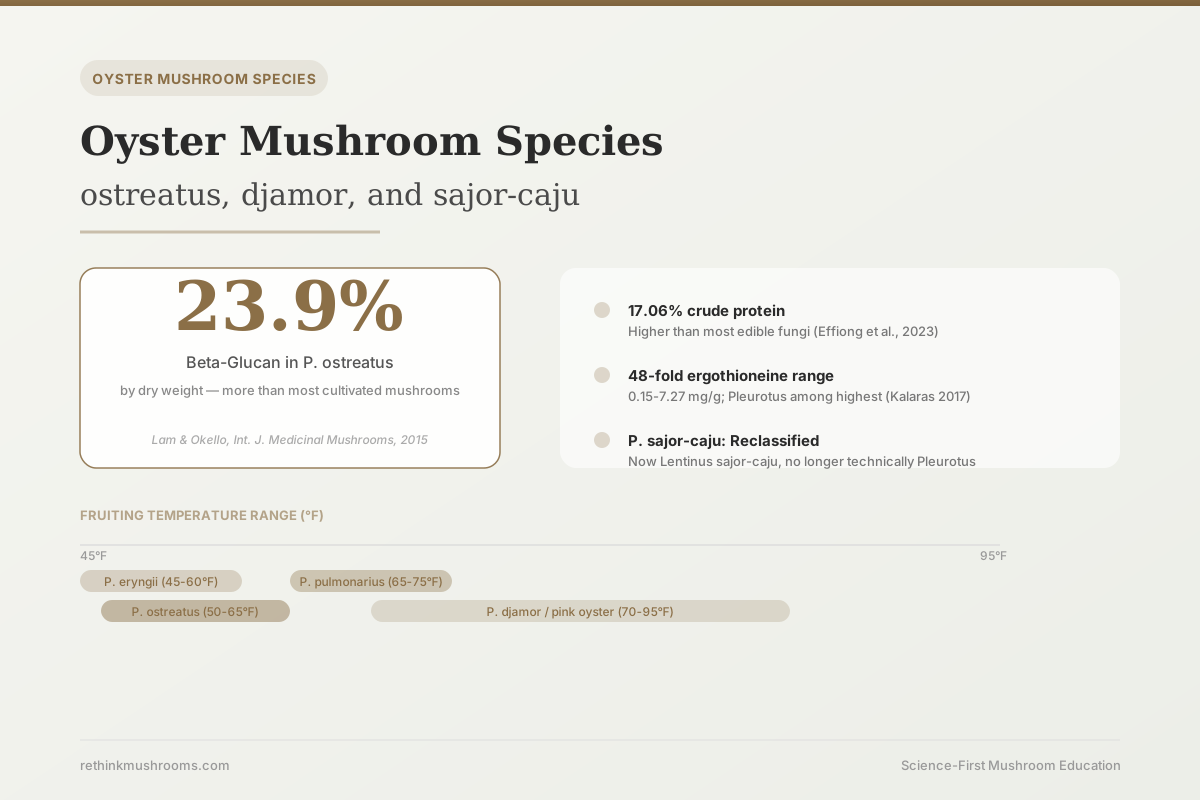
23.9% beta-glucan
Raw Pleurotus ostreatus contains 23.9% beta-glucan content by dry weight, more than most cultivated mushrooms, but that figure varies significantly by species. Some of the mushrooms sold as 'oyster' are not technically Pleurotus at all.
Lam & Okello, International Journal of Medicinal Mushrooms, 2015
17.06%
crude protein in P. ostreatus, higher than most edible fungi (Effiong et al., 2023)
48-fold
range in ergothioneine concentration across mushroom species; Pleurotus among the highest (Kalaras et al., 2017)
Reclassified
P. sajor-caju is no longer taxonomically Pleurotus; it was moved to genus Lentinus
Lam & Okello, International Journal of Medicinal Mushrooms, 2015
 View as image ↗
Most guides to oyster mushroom species describe Pleurotus sajor-caju as a Pleurotus mushroom. Taxonomically, it no longer is. Mycologists reclassified it to the genus Lentinus, which means thousands of product labels, cultivation guides, and health articles are technically describing a different genus than the one they think they're describing.
That taxonomic detail is not just trivia. It illustrates a real problem with how "oyster mushroom" gets used: the name covers at least five commercially grown species from genuinely different genetic lineages, each with different growth temperatures, shelf lives, nutritional profiles, and bioactive compound concentrations. If you are buying oyster mushrooms for nutritional reasons, the species matters. If you are growing them, the temperature tolerance matters even more.
This guide covers the main cultivated oyster mushroom species: what makes each genetically distinct, how their nutritional profiles compare, and what the research actually shows about species-level differences in beta-glucan, lovastatin, and ergothioneine content. For the full introduction to oyster mushroom health research, see What Is Oyster Mushroom? The World's Second Most Popular Mushroom.
Key Takeaways
- The term "oyster mushroom" commercially covers at least five Pleurotus species organized into biological intersterility groups, meaning they cannot crossbreed with each other despite looking similar
- P. ostreatus (pearl or blue oyster) has the most extensive research base, with documented 23.9% beta-glucan content by dry weight and 17.06% crude protein, making it the nutritional benchmark for comparison (Lam & Okello, 2015; Effiong et al., 2023)
- P. sajor-caju, widely sold as an oyster mushroom, was reclassified to the genus Lentinus in modern mycological taxonomy, meaning products labeled "sajor-caju oyster mushroom" are technically from a different fungal genus
- Ergothioneine, the antioxidant amino acid with a dedicated human transporter, varies up to 48-fold across mushroom species (0.15 to 7.27 mg/g dry weight), with Pleurotus species among the highest dietary sources (Kalaras et al., 2017)
- Published lovastatin values for the same Pleurotus species vary dramatically depending on the analytical chemistry method used (HPLC vs. LC-MS), not because the mushrooms are different but because the measurement techniques produce different numbers (Tsiantas et al., 2021)
- Temperature tolerance is the most practical differentiator for growers and buyers: P. ostreatus thrives at 50-65°F, P. djamor at 70-95°F, and P. eryngii at 45-60°F; the wrong species in the wrong climate means failed cultivation
How Many Oyster Mushroom Species Are There? The Biological Grouping Answer
The genus Pleurotus contains over 40 described species, but the consumer market recognizes maybe a handful. Most people encounter three to five cultivated forms. The scientific way to understand how these species relate to each other is through biological intersterility groups.
Intersterility groups are clusters of mushroom strains that can mate and produce fertile offspring with each other but cannot do so with members of other groups. Think of it as a genetic compatibility boundary. Two strains within the same group can hybridize. Two strains from different groups, even if they look nearly identical, cannot.
For oyster mushrooms, mycologists have identified five to six major intersterility groups within Pleurotus. The ones most relevant to commercial cultivation are:
Intersterility Group I covers the classic Pleurotus ostreatus complex, including the pearl oyster, blue oyster, and cold-weather cultivars grown across temperate regions.
Intersterility Group II includes Pleurotus pulmonarius, called the phoenix oyster or summer oyster. It looks similar to P. ostreatus but performs better at slightly warmer temperatures.
Intersterility Group III covers tropical species including Pleurotus djamor (pink oyster) and related warm-weather forms.
Intersterility Group IV includes what used to be called Pleurotus sajor-caju before its reclassification.
Intersterility Group V covers Pleurotus eryngii (king oyster) and its close relatives, which have a very different morphology from the others.
The practical implication: when you buy from a supplier offering "oyster mushroom spawn," you need to know which group the strain belongs to, because each has different growth requirements, different yield characteristics, and a different nutritional composition.
P. ostreatus: The Pearl Oyster and the Most Nutritionally Characterized Species
Pleurotus ostreatus is the species where research has accumulated most completely. This is partly because it was domesticated first, partly because it grows well in temperate laboratory conditions, and partly because it became the subject of the first systematic bioactive compound characterizations in the 1990s.
From a nutritional standpoint, a 2023 analysis published in Frontiers in Nutrition by Effiong and colleagues provides the most complete recent characterization.[1] Their analysis of raw P. ostreatus found 17.06% crude protein, 43.42% carbohydrate, 23.63% crude fiber, and 91% moisture in fresh tissue. Among minerals, potassium, iron, and magnesium were the highest. Riboflavin (vitamin B2) reached 92.97 mg/kg, an exceptionally high value compared to most vegetables.
A 2015 analysis by Lam and Okello in the International Journal of Medicinal Mushrooms quantified beta-glucan specifically, finding 23.9% beta-glucan content in raw P. ostreatus fruiting bodies, with 487 mg gallic acid equivalents per 100g dry matter for polyphenols.[2] That same analysis found that cooking significantly reduces lovastatin content while preserving beta-glucan, which has implications for anyone using P. ostreatus specifically for the cholesterol-linked compound.
P. ostreatus is the only cultivated oyster mushroom species with a substantial clinical trial corpus. The pleuran trials (covering immune effects in athletes and children), the cholesterol reduction studies, and the model organism research all used P. ostreatus. Other oyster mushroom species have far less clinical data. For the full bioactive compound breakdown, see Oyster Mushroom Bioactive Compounds: Pleuran, Lovastatin, and More.
Growth characteristics: P. ostreatus prefers 50-65°F (10-18°C) for fruiting. It is cold-tolerant and one of the most productive species per unit of substrate. Shelf life is approximately 5-7 days fresh, shorter than king oyster.
P. djamor: The Pink Oyster's Thermal Advantage and Tradeoffs
Pleurotus djamor, commonly sold as "pink oyster mushroom," belongs to a different biological species group from P. ostreatus. The two cannot hybridize. Their growth requirements are essentially opposite: where P. ostreatus needs cool temperatures, P. djamor thrives in heat.
Pink oyster mushrooms fruit optimally at 70-95°F (21-35°C), making them the practical choice for tropical climates and for indoor cultivation in warm environments without expensive climate control. Growers in Southeast Asia and Central America have cultivated P. djamor for centuries.
The nutritional profile of P. djamor has not been characterized as extensively as P. ostreatus. Published ergothioneine data by Kalaras and colleagues found variation across Pleurotus species generally, with P. djamor having measurable ergothioneine but typically lower than P. ostreatus.[3] Lovastatin content in P. djamor is generally reported as lower than P. ostreatus, though as discussed below, these comparisons depend heavily on the analytical method used.
The striking pink color of P. djamor is produced by a pigment that is heat-sensitive. When cooked, the mushroom loses its pink color rapidly and turns gray-beige. This surprises cooks who buy it for visual appeal. The flavor is strong and slightly bacon-like, more assertive than P. ostreatus.
Shelf life is shorter for P. djamor than for P. ostreatus: 2-4 days fresh, compared to 5-7. The fragility of the fruiting body and the fast growth cycle (shorter than P. ostreatus) make it less suited to commercial fresh distribution but practical for local growers.
P. eryngii and P. citrinopileatus: Related by Name, Different by Biology
King oyster (Pleurotus eryngii) and golden oyster (Pleurotus citrinopileatus) are sold as oyster mushrooms but belong to a different biological species group from the P. ostreatus complex.
Pleurotus eryngii is the most visually distinct. Instead of the fan-shaped caps and clustered growth of P. ostreatus, king oyster produces thick, dense stems with small caps. The fruiting body is much more robust, which translates directly to a longer shelf life: 10-14 days refrigerated, compared to 5-7 for P. ostreatus. This makes P. eryngii the commercial choice for retail distribution where products need to travel and sit on shelves.
Nutritionally, P. eryngii has lower lovastatin content than P. ostreatus but good ergothioneine levels. The dense flesh holds up to cooking well, meaning less moisture is lost during preparation than with P. ostreatus, which releases significant water when heated.
Pleurotus citrinopileatus (golden oyster) is visually striking: bright yellow or gold caps, delicate texture, and a shorter shelf life of 3-5 days. It grows best at 65-75°F, between the cold preference of P. ostreatus and the heat requirement of P. djamor. Nutritional data for P. citrinopileatus is sparse compared to P. ostreatus. What data exists suggests it is a meaningful source of ergothioneine, consistent with Pleurotus species broadly, but species-specific bioactive quantification is limited.
The P. sajor-caju Reclassification: What Every Guide Gets Wrong
Pleurotus sajor-caju has been sold as an oyster mushroom for decades, particularly in South and Southeast Asia. Online guides, cultivation suppliers, and product labels almost universally describe it as a Pleurotus species. Modern mycological classification disagrees.
P. sajor-caju was reclassified to the genus Lentinus. The reclassification was based on molecular phylogenetic analysis showing that the species belongs to a different evolutionary lineage than true Pleurotus species. While P. sajor-caju and P. ostreatus look similar and have similar growth patterns on lignocellulosic substrates, their genetic relationship is more distant than surface morphology suggests.
The practical implications depend on what you care about:
For cultivation, the reclassification changes nothing. The mushroom still grows. Temperature preferences, substrate requirements, and yield characteristics remain the same.
For nutritional claims, it matters. The clinical trials on pleuran beta-glucan, the lovastatin characterizations, and the ergothioneine studies were all conducted on true Pleurotus species, primarily P. ostreatus. It is not accurate to extrapolate those findings to Lentinus sajor-caju without direct evidence that it produces the same compounds at comparable concentrations.
For product labeling, the reclassification creates a gap between scientific accuracy and commercial practice. Most suppliers and retailers continue to use "P. sajor-caju" because it is what customers recognize. The scientific literature, however, has moved on.
How Bioactive Compounds Vary by Species: What the Analytical Data Shows
The most honest answer to "which oyster mushroom species is most nutritious" is: the data is mostly for P. ostreatus, and comparing other species is difficult because the analytical data is sparse and the measurement methods matter enormously.
A 2021 study in Molecules by Tsiantas and colleagues investigated this directly by quantifying ergothioneine and lovastatin across Pleurotus and other mushroom species using both HPLC (high-performance liquid chromatography) and LC-MS (liquid chromatography-mass spectrometry) methods.[4] Their finding: the same mushroom sample produced significantly different reported lovastatin values depending on which analytical method was used. The variation was methodological, not biological.
This explains why published lovastatin content values for oyster mushrooms vary so widely across sources. One study might report a particular value, another a much higher or lower one, for what appears to be the same species. Without knowing the analytical method, you cannot compare the numbers. For a full analysis of what the lovastatin data actually shows, see Lovastatin in Oyster Mushrooms: How Much Is Actually There?.
For ergothioneine, a 2017 analysis by Kalaras and colleagues in Food Chemistry measured ergothioneine and glutathione across multiple mushroom species and found that the range was extraordinary: 0.15 to 7.27 mg/g dry weight across species, a 48-fold range.[3] Pleurotus species were consistently among the highest sources. However, the data was not broken down to individual Pleurotus species in a way that allows a clean P. ostreatus vs. P. djamor comparison. The clear takeaway: if ergothioneine is your primary interest, Pleurotus as a group is a strong dietary source, and P. ostreatus specifically has the most supporting data. For the full ergothioneine story, see Ergothioneine in Oyster Mushrooms: The Longevity Antioxidant You Can Eat.
Species Comparison: Temperature, Nutrition, and What the Research Shows
The table below summarizes the major cultivated oyster mushroom species on the dimensions that matter most. Nutritional data comes from the cited studies where available. Temperature preferences and shelf life are based on established cultivation literature. Where research data is limited, this is noted.
| Species | Common Name | Fruiting Temp | Beta-Glucan | Lovastatin | Shelf Life |
|---|---|---|---|---|---|
| P. ostreatus | Pearl / Blue oyster | 50-65°F | 23.9%* | Highest documented | 5-7 days |
| P. pulmonarius | Phoenix oyster | 65-75°F | Similar to ostreatus | Similar to ostreatus | 5-7 days |
| P. djamor | Pink oyster | 70-95°F | Limited data | Lower than ostreatus | 2-4 days |
| P. eryngii | King oyster | 45-60°F | Limited data | Lower than ostreatus | 10-14 days |
| P. citrinopileatus | Golden oyster | 65-75°F | Limited data | Limited data | 3-5 days |
| Lentinus sajor-caju | Sajor-caju oyster | 65-80°F | Limited data | Limited data | 4-6 days |
*Lam & Okello, 2015.[2] Lovastatin comparisons based on Tsiantas 2021.[4]
The honest summary on "which is most nutritious": P. ostreatus has the most research and the best-characterized bioactive profile. P. eryngii has an advantage in shelf life and texture. P. djamor is the choice for tropical growing environments. P. citrinopileatus is visually striking but comparatively uncharacterized.
The research imbalance is real. Most of what is known about oyster mushroom bioactives comes from P. ostreatus studies. Applying those findings to P. djamor or L. sajor-caju requires assuming similar compound profiles, which is an assumption rather than a finding. For species-level nutritional detail on P. ostreatus specifically, see Pleurotus ostreatus Nutritional Profile: Protein, Vitamins, and Unique Compounds. For how cooking affects these compound levels, see How to Cook Oyster Mushrooms for Maximum Nutrient Retention.
The Bottom Line
The name "oyster mushroom" covers at least five cultivated Pleurotus species plus Lentinus sajor-caju, each in a different biological species group with distinct growth requirements and nutritional profiles. P. ostreatus is the most research-characterized species and the one with the best-documented bioactive compound data, including 23.9% beta-glucan and among the highest ergothioneine levels of any common edible mushroom. Comparisons between species are limited by sparse data and significant methodological variation in how lovastatin and ergothioneine are measured. The P. sajor-caju reclassification to Lentinus is a genuine taxonomic change that most consumer content has not yet incorporated.
Frequently Asked Questions
Sources & References
- 1RTHM-00823·Effiong, Magdalene Eno et al. (2023). “Assessing the nutritional quality of Pleurotus ostreatus (oyster mushroom)..” Frontiers in nutrition.Study breakdown →PubMed →↩
- 2RTHM-00384·Lam, Yu Shan et al. (2015). “Determination of Lovastatin, β-glucan, Total Polyphenols, and Antioxidant Activity in Raw and Processed Oyster Culinary-Medicinal Mushroom, Pleurotus ostreatus (Higher Basidiomycetes)..” International journal of medicinal mushrooms.Study breakdown →PubMed →↩
- 3RTHM-00476·Kalaras, Michael D et al. (2017). “Mushrooms: A rich source of the antioxidants ergothioneine and glutathione..” Food chemistry.Study breakdown →PubMed →↩
- 4RTHM-00725·Tsiantas, Konstantinos et al. (2021). “On the Identification and Quantification of Ergothioneine and Lovastatin in Various Mushroom Species: Assets and Challenges of Different Analytical Approaches..” Molecules (Basel.Study breakdown →PubMed →↩