Oyster Mushroom Nutrition
23.9% of dry mass is beta-glucan
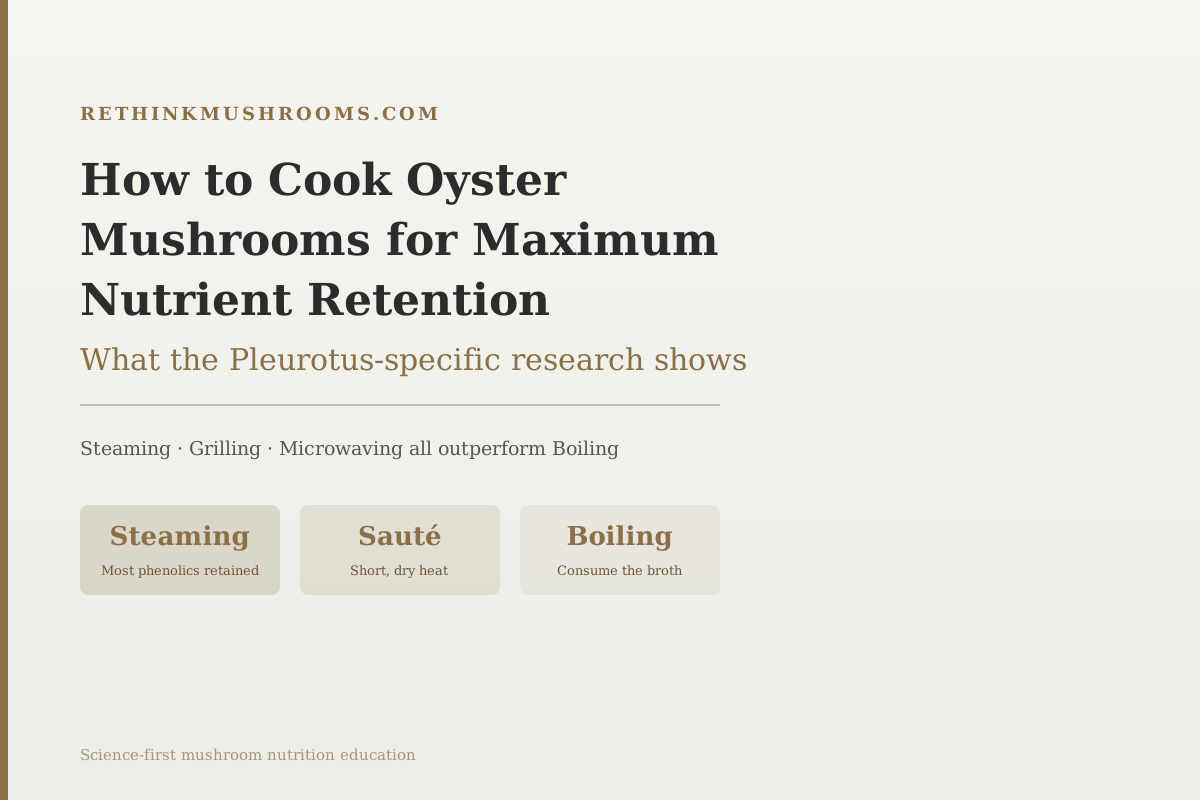
Raw Pleurotus ostreatus contains 23.9% beta-glucan by dry mass. Deep frying caused the greatest losses in both beta-glucan and polyphenols. Steaming and grilling preserved the most across Pleurotus species.
Lam & Okello, Int J Med Mushrooms, 2015; Tan et al., J Food Sci Technol, 2015
Steaming
retained the most total phenolics across multiple Pleurotus species in Tan et al. (J Food Sci Technol, 2015)
Vitamin D2
is stable through cooking; placing caps gill-side-up in midday sun for 2 hours before cooking significantly increases D2 levels
Boiling water
leaches water-soluble beta-glucans and B vitamins; consuming the cooking broth recovers them from the dish
Lam & Okello, Int J Med Mushrooms, 2015; Tan et al., J Food Sci Technol, 2015
 View as image ↗
Most articles recommending the "microwave is best" approach to mushroom cooking cite a 2017 Spanish study on button mushrooms (Agaricus bisporus). Oyster mushrooms are a different species with different chemistry. When Tan and colleagues specifically studied how cooking affects phenolic content and antioxidant activity in Pleurotus species, they found steaming retained the most phenolics across the oyster mushroom genus, with microwaving and grilling also outperforming boiling.[1] The species matters.
This article organizes the cooking question by nutrient class, because beta-glucans, phenolics, vitamin D, and water-soluble vitamins respond differently to each cooking method. Understanding what each method does to each compound class is more useful than a single ranked list. For the culinary side of cooking oyster mushrooms (flavor, texture, techniques), see best ways to cook oyster mushrooms for nutrition and flavor. For the broader mushroom cooking science across species, see how cooking affects mushroom bioactives: what the research shows. For the nutritional profile of oyster mushrooms, see the oyster mushroom nutritional profile: complete breakdown. For a broader overview of oyster mushrooms, see what is the oyster mushroom?.
Key Takeaways
- Across multiple Pleurotus species, steaming retained the most total phenolics and antioxidant activity; microwaving and grilling also outperformed boiling; P. cornucopiae (golden/abalone oyster) retained highest overall antioxidants across all methods (Tan et al., 2015)
- Raw P. ostreatus contains 23.9% beta-glucan by dry mass and 487 mg GAE/100g dry mass polyphenols; deep frying caused the greatest losses in both compounds; beta-glucans are heat-stable but water-soluble (Lam & Okello, 2015)
- In king oyster (P. eryngii), heat treatment at moderate temperatures (50-90°C) had minimal effect on phenolics and antioxidants; prolonged exposure to high heat caused the greatest losses; autoclaving at 121°C preserved phenolics better than boiling at 100°C (Li & Shah, 2013)
- Vitamin D2 in oyster mushrooms is stable through standard cooking methods; placing mushrooms gill-side up in midday sunlight for 2 hours before cooking can significantly increase D2 content prior to any heat treatment (Keegan et al., 2013; Phillips et al., 2011)
- An 8-week randomized controlled trial of king oyster (P. eryngii) consumption significantly improved antioxidant status and metabolic markers in adults with metabolic disorders, confirming that the bioactives in normally cooked oyster mushrooms reach the body in meaningful amounts (Kleftaki et al., 2022)
- Lovastatin was not detected in raw P. ostreatus samples in the Lam 2015 study, contradicting some commercial claims; this finding underscores the importance of studying specific species rather than relying on claims transferred from other Pleurotus species
Pleurotus-Specific Cooking Data: What the Species Research Actually Shows
The majority of mushroom cooking research has been conducted on Agaricus bisporus (button, crimini, portobello). The findings don't translate directly to oyster mushrooms, which have different cell wall structures, different compound profiles, and different moisture content.
Tan and colleagues conducted the most direct study on cooking method effects in oyster mushrooms specifically, testing multiple Pleurotus species including P. ostreatus, P. cornucopiae, and related varieties across boiling, steaming, microwaving, and other methods.[1] Across all Pleurotus species tested, steaming retained the most total phenolic compounds. Microwaving and grilling also outperformed boiling. Boiling caused the most significant losses.
Within the species tested, P. cornucopiae (the golden/abalone oyster) retained the highest overall antioxidant activity after cooking, across all methods tested. This suggests species-level differences in how well compounds survive heat treatment.
The practical hierarchy for phenolic retention in oyster mushrooms: steaming > grilling > microwaving > boiling. This differs from the button mushroom finding, where microwaving was identified as optimal.
Beta-Glucans: Heat-Stable but Water-Soluble
Beta-glucans are the primary immune-active polysaccharides in oyster mushrooms and the compounds most buyers are seeking when they choose mushrooms for health purposes.
Lam and Okello quantified the beta-glucan content of raw P. ostreatus at 23.9% of dry matter, a substantial proportion of the mushroom's dry mass.[3] The same study tested how cooking methods affected this content. The key finding: deep frying caused the greatest losses in beta-glucan content, as well as the greatest reduction in total polyphenols.
Beta-glucans are structurally robust polysaccharides that form part of the fungal cell wall. Standard cooking temperatures do not break the glycosidic bonds that give them biological activity. The problem with boiling is not heat degradation; it is leaching. When mushrooms are submerged in water, water-soluble polysaccharides diffuse out of the mushroom tissue into the surrounding liquid. If that liquid is discarded, the beta-glucans go with it.
The practical implication: boiling oyster mushrooms is not a disaster for beta-glucan retention provided you consume the cooking liquid. Mushroom soups, stews, or broths that include the cooking water preserve most of the beta-glucans that leached from the mushroom tissue. Discarding the broth means discarding a meaningful portion of the primary bioactive compound class.
Deep frying is the method that produces genuine heat-related losses, not just leaching, likely because the high oil temperature (typically 160-180°C) combined with the moisture-expulsion effect of frying degrades the cell wall structure more aggressively than water-based methods.
For more on how beta-glucans and other mushroom compounds respond to cooking across species, see how cooking affects mushroom bioactives: what the research shows.
Phenolics and Antioxidants: Method and Duration Both Matter
Li and Shah's study on king oyster mushroom (P. eryngii) heat treatments provides the most granular data on how temperature and duration interact to affect phenolic content.[2]
Their findings across a range of temperatures: heat treatment at 50-90°C had minimal negative effects on antioxidant activity; higher temperatures (100°C prolonged boiling) caused greater losses; autoclaving at 121°C actually preserved phenolics better than boiling at 100°C. This counterintuitive result reflects that autoclaving achieves high temperatures rapidly with little water present, while boiling keeps mushrooms in water for longer periods, allowing leaching to accumulate.
The duration point is as important as the temperature: prolonged exposure caused the greatest losses across all methods. Short, intense heat treatments preserved more than extended lower-heat treatments in water.
This finding from Li and Shah on king oyster aligns with the Tan 2015 finding across pearl and other Pleurotus species: the common thread is that water contact duration is the primary driver of phenolic loss, more than heat intensity alone.
Practical guidance from this data: sauté or stir-fry oyster mushrooms in a dry pan or with minimal oil, over high heat, for a short time. This minimizes water contact, limits duration, and produces results consistent with the best-performing methods in both studies. Steam for lower-fat applications, using a steamer basket that keeps the mushrooms above the water rather than submerged.
Vitamin D: Heat-Stable and Upgradeable
Oyster mushrooms contain vitamin D2 (ergocalciferol), confirmed by Phillips and colleagues' survey of mushroom D2 content across retail US products.[5] Vitamin D2 content varies significantly between samples depending on prior UV exposure; mushrooms that received more sunlight exposure during cultivation or post-harvest have meaningfully higher D2 levels.
Keegan and colleagues' review of mushroom vitamin D photobiology established two practical facts for cooks.[4] First, vitamin D2 in mushrooms is stable through standard cooking methods; boiling, steaming, and microwaving do not significantly reduce D2 content. Cooking temperature does not degrade this nutrient at standard culinary temperatures. Second, UV-treated mushroom vitamin D2 is bioavailable in humans, with efficacy comparable to D2 supplements at equivalent doses.
The actionable insight: placing oyster mushrooms gill-side up in direct midday sunlight for 1-2 hours before cooking can substantially increase D2 content before any heat treatment. The gills have the highest ergosterol concentration (the D2 precursor), and UV exposure converts ergosterol to vitamin D2. Cooking afterward does not reduce the D2 that was created. This simple pre-cooking step is one of the only food preparation techniques that genuinely increases a specific nutrient before cooking rather than merely preserving it.
Cooking Method Summary
The research across the six studies leads to a practical hierarchy:
Best methods for each nutrient:
| Nutrient | Best Method | Worst Method | Key Finding |
|---|---|---|---|
| Beta-glucans | Dry heat or steam; consume broth if boiling | Deep frying | 23.9% DM in raw; deep frying caused most structural losses (Lam 2015) |
| Phenolics | Steaming (Pleurotus-specific) | Boiling, discarding liquid | Steaming > microwaving/grilling > boiling across Pleurotus spp. (Tan 2015) |
| Vitamin D2 | All methods preserve it | N/A | Stable through standard cooking; UV pre-treatment adds D2 (Keegan 2013) |
| King oyster phenolics | Short high heat (sauté/autoclave) | Prolonged boiling | 50-90°C minimal impact; duration matters more than temperature (Li 2013) |
Practical synthesis: For most oyster mushroom cooking, a quick sauté or pan roast in a dry or lightly oiled pan over medium-high heat for 3-5 minutes preserves the most bioactives across all compound classes. Steam for low-fat applications. If boiling or making broth, consume the liquid. Avoid deep frying for maximum nutrient retention.
Human Evidence: Do These Nutrients Actually Reach the Body?
Laboratory studies measure what's present in the cooked mushroom. They don't confirm that those compounds survive digestion and reach the bloodstream. The Kleftaki 2022 randomized controlled trial fills this gap for king oyster mushrooms specifically.[6]
Participants consumed P. eryngii (king oyster mushrooms) for 8 weeks in a controlled trial design. At the end of the intervention, the mushroom-eating group showed significantly improved antioxidant status and improved metabolic markers compared to the control group. Mushroom-derived vitamin D2 was clinically bioavailable and produced measurable effects.
This RCT confirms what the laboratory cooking studies suggest: the bioactives in normally prepared oyster mushrooms survive cooking and digestion in sufficient quantities to produce measurable physiological effects in humans. The cooking methods used in the trial were standard culinary preparations, not laboratory optimized protocols.
For the species-specific nutritional differences that affect which oyster variety is richest in ergothioneine, GABA, or specific phenolics, see oyster mushroom varieties: flavor and nutrition comparison. For the ergothioneine content specifically and its health implications, see ergothioneine in oyster mushrooms: the longevity antioxidant you can eat. For a comprehensive look at the microwaving method specifically for mushrooms, see microwaving mushrooms: the surprising best method for nutrient retention.
The Bottom Line
Oyster mushroom cooking research shows steaming retains the most phenolics across Pleurotus species, with microwaving and grilling also outperforming boiling. Deep frying causes the greatest losses in beta-glucans and polyphenols. Beta-glucans (23.9% of dry mass in raw P. ostreatus) are heat-stable but leach into boiling water; consuming the cooking broth recovers them. Vitamin D2 is stable through all standard cooking methods and can be increased by UV pre-treatment (gill-side-up sun exposure for 1-2 hours before cooking). An 8-week RCT of king oyster consumption confirmed that normally cooked oyster mushrooms produce measurable improvements in antioxidant status and metabolic markers, confirming real-world bioavailability.
Frequently Asked Questions
Sources & References
- 1RTHM-00403·Tan, Yee-Shin et al. (2015). “Influence of customized cooking methods on the phenolic contents and antioxidant activities of selected species of oyster mushrooms (Pleurotus spp.)..” Journal of food science and technology.Study breakdown →PubMed →↩
- 2RTHM-00296·Li, Siqian et al. (2013). “Effects of various heat treatments on phenolic profiles and antioxidant activities of Pleurotus eryngii extracts..” Journal of food science.Study breakdown →PubMed →↩
- 3RTHM-00384·Lam, Yu Shan et al. (2015). “Determination of Lovastatin, β-glucan, Total Polyphenols, and Antioxidant Activity in Raw and Processed Oyster Culinary-Medicinal Mushroom, Pleurotus ostreatus (Higher Basidiomycetes)..” International journal of medicinal mushrooms.Study breakdown →PubMed →↩
- 4RTHM-00292·Keegan, Raphael-John H et al. (2013). “Photobiology of vitamin D in mushrooms and its bioavailability in humans..” Dermato-endocrinology.Study breakdown →PubMed →↩
- 5RTHM-00230·Phillips, Katherine M et al. (2011). “Vitamin D and sterol composition of 10 types of mushrooms from retail suppliers in the United States..” Journal of agricultural and food chemistry.Study breakdown →PubMed →↩
- 6RTHM-00771·Kleftaki, Stamatia-Angeliki et al. (2022). “A Randomized Controlled Trial on Pleurotus eryngii Mushrooms with Antioxidant Compounds and Vitamin D2 in Managing Metabolic Disorders..” Antioxidants (Basel.Study breakdown →PubMed →↩