Oyster Mushroom Nutrition
23.9% DM
beta-glucan content in raw pearl oyster mushroom as a percentage of dry matter, making it one of the richest natural dietary sources of this fiber. Species and cooking method both affect how much survives to your plate.
Lam & Okello, Int J Med Mushrooms, 2015
5+ species
of Pleurotus with meaningfully different bioactive profiles
Golden oyster
richest in ergothioneine-related compounds across three Pleurotus species tested (2020)
Steaming
retained the most phenolics across Pleurotus species in a cooking comparison study
Lam & Okello, Int J Med Mushrooms, 2015
 View as image ↗
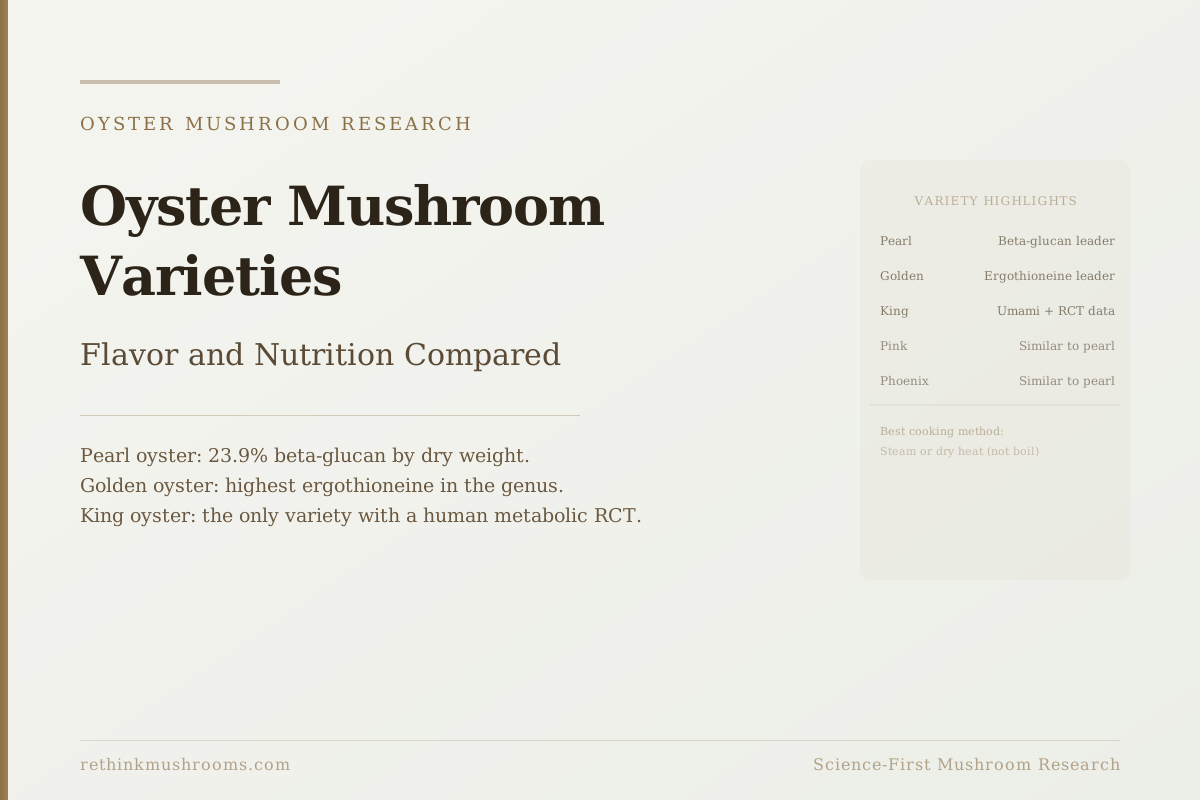
Most content on oyster mushrooms treats the whole genus as one thing. It isn't. The oyster mushroom varieties in your grocery store or grow kit belong to different species with different amino acid profiles, different bioactive concentrations, and different responses to heat. The pearl oyster (Pleurotus ostreatus) has the highest measured beta-glucan content at 23.9% of dry matter. The golden oyster (Pleurotus citrinopileatus) is richest in ergothioneine-related compounds. The king oyster (Pleurotus eryngii) is the only species with a human metabolic RCT behind it. These are not marketing claims; they come from published analytical chemistry and one randomized controlled trial.
This article covers what the science says about each major oyster mushroom variety and how to get the most from them. For the full nutritional breakdown of the most common variety, what is oyster mushroom: the world's second most popular mushroom provides the overview.
Key Takeaways
- Pearl oyster (Pleurotus ostreatus) contains 23.9% beta-glucan by dry weight and 487 mg GAE/100g dry matter of total polyphenols, the highest values recorded for any Pleurotus species in analytical comparison[7]
- Golden oyster (Pleurotus citrinopileatus) was richest in ergothioneine-related compounds across three Pleurotus species tested in the same analytical conditions, making it the strongest dietary source of this antioxidant within the genus[1]
- King oyster (Pleurotus eryngii) showed the highest glutamic acid (the amino acid that produces umami flavor) and is the only oyster variety tested in a human metabolic RCT, where 8 weeks of consumption improved antioxidant status and metabolic markers[1][4]
- Steaming consistently retained the most phenolics across multiple Pleurotus species; boiling caused the most significant loss; deep frying caused the greatest beta-glucan and polyphenol losses[3][7]
- Fruiting bodies consistently outperformed mycelia in phenolic content, ergothioneine, and polysaccharide levels across culinary mushroom species, supporting whole-food or fruiting body extract use over mycelium-on-grain products[2]
- A 2022 systematic review confirmed oyster mushrooms among the most nutritionally complete edible fungi, with protein quality in Pleurotus species exceeding most plant proteins in amino acid completeness[5]
The Five Main Oyster Mushroom Varieties and How They Differ
Oyster mushrooms belong to the Pleurotus genus. The five species most commonly grown for food and supplements in the Western market are different organisms with distinct biochemical profiles, though they share structural similarities and all contain beta-glucans, ergothioneine, and a set of B vitamins.
| Variety | Species | Flavor Profile | Texture |
|---|---|---|---|
| Pearl / Blue / Grey | Pleurotus ostreatus | Mild, slightly sweet | Tender, meaty |
| Golden | Pleurotus citrinopileatus | Fruity, delicate | Thin, fragile |
| King Trumpet | Pleurotus eryngii | Savory, umami-rich | Dense, firm |
| Pink | Pleurotus djamor | Mild, slightly fruity | Similar to pearl |
| Phoenix / Indian | Pleurotus pulmonarius | Similar to pearl, slightly stronger | Slightly thicker |
The flavor differences are partly traceable to free amino acid profiles. A 2020 study by Tagkouli and colleagues specifically measured free amino acids across three commercially important Pleurotus species grown under identical conditions on agricultural byproduct substrates.[1] The study provides the most direct scientific comparison of these species' bioactive content currently available.
Pearl Oyster (Pleurotus ostreatus): The Beta-Glucan Benchmark
Pearl oyster is the most widely cultivated Pleurotus species globally and the one with the most extensive analytical data. It is also the species most commonly used in pleuran immune supplement research (see the immune cluster for that evidence).
In terms of structural fiber, pearl oyster's beta-glucan content is the highest measured for any Pleurotus species in direct comparison. Lam and Okello measured 23.9% beta-glucan by dry matter in raw Pleurotus ostreatus, alongside 487 mg gallic acid equivalents per 100g dry matter for total polyphenols.[7] These are substantial concentrations: for context, oats are typically 3-5% beta-glucan by dry weight. Mushroom beta-glucan is structurally different from oat beta-glucan and reaches different immune receptors, but the quantity makes pearl oyster a genuinely significant dietary source of this fiber.
The same Lam 2015 study confirmed something commercially important: lovastatin was NOT detected in raw Pleurotus ostreatus samples. Some supplement marketing implies oyster mushrooms are a natural statin source. The analytical data does not support this for raw pearl oyster. Lovastatin is documented in some Pleurotus ostreatus strains under specific growth conditions but is not a guaranteed constituent.
Tagkouli 2020 found that Pleurotus ostreatus had the highest total free amino acids and the highest GABA (gamma-aminobutyric acid) content of the three species tested.[1] GABA is both a neurotransmitter precursor and a flavour compound contributing to mild sweetness. The high total free amino acids also explain why pearl oyster has the most versatile flavour profile: more free amino acids means more compound flavour development during cooking.
For the vitamin D picture: Phillips and colleagues found that oyster mushrooms contain vitamin D2 even without UV exposure, and that UV treatment (placing mushrooms gill-side up in sunlight before cooking) dramatically increases D2 concentration.[6] This applies to pearl oyster as the standard commercial species.
Golden Oyster (Pleurotus citrinopileatus): The Ergothioneine Leader
Golden oyster mushrooms are visually striking (bright yellow clusters) and more delicate than pearl oysters. They are less commonly found fresh in supermarkets but are increasingly available through specialty growers and farmers markets.
The Tagkouli 2020 analytical comparison provided the clearest differentiation: Pleurotus citrinopileatus was richest in ergothioneine-related compounds among the three species tested.[1] Ergothioneine is a sulfur-containing amino acid that humans cannot synthesize but accumulate in tissues, particularly in mitochondria, where it acts as an antioxidant. It has attracted research attention as a longevity-associated compound because blood ergothioneine levels are inversely associated with several age-related conditions. Mushrooms are the primary dietary source.
The practical implication: if ergothioneine intake is a specific dietary goal, golden oyster mushrooms appear to provide more per gram than pearl or king oyster based on the Tagkouli comparative data.
The caveat from Lo 2012 applies here as well as to all varieties: fruiting body forms outperform mycelium-derived products in ergothioneine, phenolics, and polysaccharide content.[2] Choosing a golden oyster fruiting body supplement (or eating the fresh mushroom) delivers more than a mycelium-on-grain product claiming the same species.
For the specific ergothioneine research, ergothioneine in oyster mushrooms: the longevity antioxidant covers the full evidence base.
King Oyster (Pleurotus eryngii): The Only Variety With a Human RCT
King oyster (also called king trumpet) is the largest and densest oyster mushroom species. Its thick, firm texture makes it suitable for high-heat cooking (grilling, pan-searing, roasting) where smaller varieties would collapse.
From a flavour-chemistry standpoint, Tagkouli 2020 found Pleurotus eryngii had a distinct free amino acid profile with substantially higher glutamic acid compared to the other two species.[1] Glutamic acid is the primary driver of umami taste. This explains why king oyster tastes more savoury and meaty than its relatives and why it functions particularly well as a meat substitute in dishes where a savoury depth is needed.
What separates king oyster from a research perspective is the existence of a human RCT. Kleftaki and colleagues conducted an 8-week randomized controlled trial with Pleurotus eryngii in adults with metabolic disorders.[4] Participants consuming the mushroom showed improved antioxidant status and improved metabolic markers. The study also confirmed that mushroom-derived vitamin D2 was clinically bioavailable and effective in real participants. Pearl oyster has more analytical chemistry data; king oyster has the only human clinical data. Both matter, and they support different conclusions.
The Ishara 2022 systematic review identified ergothioneine and beta-glucans as the primary bioactives in oyster mushrooms with validated health effects and noted that Pleurotus protein quality exceeds most plant protein sources in amino acid completeness.[5] This applies across the genus, not to king oyster exclusively.
For the broader metabolic research on king oyster, oyster mushroom and blood sugar: what the research shows covers the glucose evidence.
Cooking Method Matters: Steaming Beats Boiling Across All Varieties
The nutritional content of oyster mushrooms at the point of eating is not the same as nutritional content at the point of harvest. Cooking method, specifically how heat and water interact with the mushroom, determines which bioactives survive.
Tan and colleagues measured how different cooking methods affected phenolic content and antioxidant activity across multiple Pleurotus species simultaneously.[3] The findings were consistent across species:
Steaming retained the most total phenolics. Without direct water contact, the water-soluble phenolic compounds cannot leach out.
Microwaving and grilling both outperformed boiling, though with smaller margins than steaming.
Boiling caused the most significant loss. Phenolics, polyphenols, and water-soluble compounds leach into the cooking water. Unless you consume the broth (as in soups or sauces), those compounds are discarded.
The Tan 2015 data also noted that Pleurotus cornucopiae (golden/abalone oyster) retained the highest overall antioxidants after cooking of the varieties tested. This is consistent with golden oyster's higher ergothioneine baseline: ergothioneine is heat-stable, so a higher starting point means a higher endpoint even after moderate cooking.
For beta-glucan specifically, the Lam 2015 study found that deep frying caused the greatest losses in both beta-glucan and polyphenols in Pleurotus ostreatus.[7] This is a practically significant finding: fried oyster mushroom dishes are popular (oyster mushroom "fried chicken" recipes are widespread), but deep frying substantially degrades the primary immune-relevant fiber.
The practical hierarchy for nutrient retention: steam or sauté in dry heat. If boiling, capture the cooking liquid. Avoid deep frying if beta-glucan and polyphenol content is a priority.
For the full nutrient-by-nutrient cooking science, how to cook oyster mushrooms for maximum nutrient retention covers that specifically. And for how cooking affects the wider mushroom bioactive landscape beyond oyster specifically, how cooking affects mushroom bioactives: what the research shows provides the broader context. For the fresh vs. dried comparison, dried vs. fresh mushrooms: nutrient density, shelf life, and medicinal value compared covers that trade-off.
The Honest Comparison: What Science Can and Cannot Tell You
The Tagkouli 2020 data comparing three Pleurotus species provides the best species-level bioactive comparison currently available. A few important caveats apply to interpreting it.
Substrate matters as much as species. Tagkouli specifically noted that the substrate on which mushrooms are grown (the material they digest for growth) affects free amino acid profiles as much as species identity. Mushrooms grown on wheat straw vs. coffee grounds vs. sawdust can show different amino acid and bioactive profiles even within the same species. This means "golden oyster" as a category is not a fixed nutritional specification; the specific growing conditions determine the actual content.
The Tagkouli comparison covered three species. Pink oyster (P. djamor) and phoenix oyster (P. pulmonarius) are less studied in comparative analytical research. Their nutritional profiles are assumed similar to pearl oyster based on structural similarity, but direct comparison data at the bioactive level is limited.
The human RCT data exists only for king oyster (Kleftaki 2022). Drawing clinical conclusions about pearl or golden oyster from that trial requires assuming their bioactive content produces similar metabolic effects, which hasn't been directly tested in a comparable clinical design.
For the protein quality story, oyster mushroom as a protein source: amino acid analysis covers the Tagkouli 2020 amino acid data in full depth alongside the bioavailability evidence. For the complete nutritional profile of the pearl variety, oyster mushroom nutritional profile: complete breakdown covers all nutrients in detail.
The Bottom Line
Pearl oyster (Pleurotus ostreatus) has the highest measured beta-glucan content (23.9% DM) and total polyphenols among oyster varieties. Golden oyster (Pleurotus citrinopileatus) is richest in ergothioneine-related compounds. King oyster (Pleurotus eryngii) has the highest umami amino acids and the only human metabolic RCT in the genus. For all varieties, steaming retains the most phenolics and antioxidants; deep frying causes the greatest beta-glucan and polyphenol losses. Fruiting bodies consistently outperform mycelium-derived products in ergothioneine, phenolics, and polysaccharides.
Frequently Asked Questions
Sources & References
- 1RTHM-00658·Tagkouli, Dimitra et al. (2020). “Free Amino Acids in Three Pleurotus Species Cultivated on Agricultural and Agro-Industrial By-Products..” Molecules (Basel.Study breakdown →PubMed →↩
- 2RTHM-00256·Lo, Yu-Chang et al. (2012). “Comparative study of contents of several bioactive components in fruiting bodies and mycelia of culinary-medicinal mushrooms..” International journal of medicinal mushrooms.Study breakdown →PubMed →↩
- 3RTHM-00403·Tan, Yee-Shin et al. (2015). “Influence of customized cooking methods on the phenolic contents and antioxidant activities of selected species of oyster mushrooms (Pleurotus spp.)..” Journal of food science and technology.Study breakdown →PubMed →↩
- 4RTHM-00771·Kleftaki, Stamatia-Angeliki et al. (2022). “A Randomized Controlled Trial on Pleurotus eryngii Mushrooms with Antioxidant Compounds and Vitamin D2 in Managing Metabolic Disorders..” Antioxidants (Basel.Study breakdown →PubMed →↩
- 5RTHM-01542·Ishara, Jackson et al. (2022). “Nutraceutical potential of mushroom bioactive metabolites and their food functionality..” Journal of food biochemistry.Study breakdown →PubMed →↩
- 6RTHM-00230·Phillips, Katherine M et al. (2011). “Vitamin D and sterol composition of 10 types of mushrooms from retail suppliers in the United States..” Journal of agricultural and food chemistry.Study breakdown →PubMed →↩
- 7RTHM-00384·Lam, Yu Shan et al. (2015). “Determination of Lovastatin, β-glucan, Total Polyphenols, and Antioxidant Activity in Raw and Processed Oyster Culinary-Medicinal Mushroom, Pleurotus ostreatus (Higher Basidiomycetes)..” International journal of medicinal mushrooms.Study breakdown →PubMed →↩