Blood Sugar Research
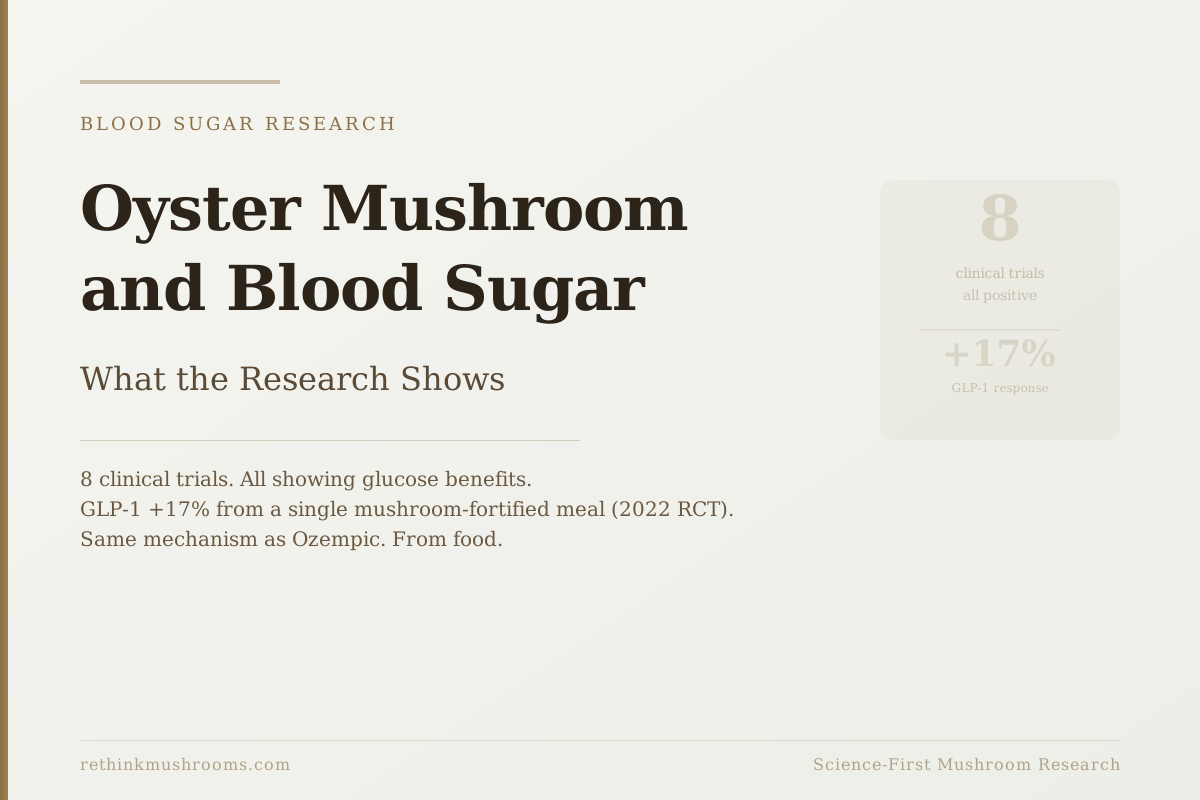
8 clinical trials
All showing beneficial effects of oyster mushroom on glucose metabolism, according to a 2020 systematic review, making this the most consistent clinical evidence base of any culinary mushroom for blood sugar.
Dicks & Ellinger, Nutrients, 2020
GLP-1 +17%
postprandial GLP-1 increase from a single mushroom-fortified meal (2022 RCT)
GLUT4
activated via AMPK in both muscle and fat tissue, an insulin-independent pathway
2025 study
most recent human GLP-1 evidence from single-meal oyster mushroom powder
Dicks & Ellinger, Nutrients, 2020
 View as image ↗
Eight clinical trials. Every one of them found that oyster mushroom consumption improved at least one glucose metabolism parameter. That track record, documented in a 2020 systematic review, is the foundation for understanding what research on oyster mushroom and blood sugar actually shows. But the most interesting finding in recent years is not the broadest one. A 2022 double-blind RCT found that adding dried oyster mushroom powder to a single meal raised GLP-1 (the same hormone that Ozempic, Wegovy, and semaglutide pharmacologically target) by 17% in people with impaired glucose tolerance. A 2025 study replicated that finding. No competitor publication has made this connection explicit.
This article covers what the research found, how the mechanisms work, and what the limitations are. For context on the broader nutritional profile, what is oyster mushroom: the world's second most popular mushroom provides the full overview.
Key Takeaways
- A 2020 systematic review of 8 clinical trials found that all of them reported beneficial effects of Pleurotus ostreatus on glucose parameters including fasting glucose and postprandial glucose[1]
- A 2022 double-blind RCT (n=22 adults with impaired glucose tolerance) found that a meal fortified with 20g dried oyster mushroom powder raised postprandial GLP-1 by 17% and reduced free fatty acids by 14% vs control[4]
- GLP-1 (glucagon-like peptide-1) is the hormone that signals the pancreas to release insulin and slows gastric emptying; it is the same hormone that semaglutide (Ozempic/Wegovy) pharmacologically mimics
- A 2018 animal study found oyster mushroom activated AMPK and upregulated GLUT4 in both muscle and adipose tissue, enabling glucose uptake without requiring insulin signaling to work normally[6]
- A 2025 human study confirmed GLP-1 stimulation from a single oyster mushroom-fortified meal in adults with impaired glucose tolerance, the most recent human evidence for this mechanism[5]
The Track Record: 8 Clinical Trials, All Showing Glucose Benefits
The most important starting fact about oyster mushroom and blood sugar is the consistency of the clinical evidence. A 2020 systematic review by Dicks and Ellinger identified eight clinical trials specifically studying the cardiometabolic effects of Pleurotus ostreatus consumption in humans.[1] All eight reported beneficial effects on glucose metabolism.
The parameters improved across these trials included fasting glucose, 2-hour postprandial glucose (measured after a meal), and in several cases HbA1c (the 3-month blood sugar average used to diagnose and monitor diabetes). This level of consistency across independent trials is unusual for a dietary supplement claim. Most nutritional interventions have mixed trial records. Oyster mushroom glucose data does not.
One of the earliest human studies comes from Khatun and colleagues (2007), who gave diabetic subjects regular oyster mushroom consumption and found both blood glucose and cholesterol reduced compared to baseline.[2] This was among the first human data establishing the glucose effect directly in a diabetic population.
A 2020 review by Wu and colleagues synthesized clinical trial evidence on medicinal mushrooms for type 2 diabetes more broadly, placing Pleurotus data in the context of other species.[3] Oyster mushroom had one of the stronger human evidence bases among the species reviewed. A 2023 comprehensive review by Kaur and colleagues identified at least four distinct mechanisms through which edible mushrooms including Pleurotus reduce blood glucose: alpha-glucosidase inhibition (slowing carbohydrate digestion), GLUT4 activation (insulin-independent glucose uptake), insulin secretion stimulation (via GLP-1 and related pathways), and gut microbiome modulation (improving metabolic function over time).[7]
The Dicks 2020 systematic review is the credibility anchor. Eight trials, eight positive results, across multiple research groups and geographic regions.
For the full clinical trial breakdown by study, oyster mushroom for type 2 diabetes: clinical trial results covers each trial in detail.
Three Mechanisms: How Oyster Mushrooms Lower Blood Sugar
The research on oyster mushroom blood sugar effects points to three distinct pathways, each operating independently. Understanding them separately matters because they have different practical implications.
Pathway 1: Slowing glucose absorption. Oyster mushrooms are high in beta-glucan fiber. Beta-glucans form a viscous gel in the digestive tract that physically slows glucose absorption from carbohydrates in the same meal. This is the simplest and most well-established mechanism. It reduces the speed and height of the postprandial glucose spike.
Pathway 2: GLP-1 stimulation. Beta-glucans and other mushroom fiber components, when fermented by gut bacteria in the small intestine, trigger the release of GLP-1 from specialized cells in the gut wall. GLP-1 signals the pancreas to release insulin, signals the stomach to slow emptying, and reduces glucagon (which would otherwise raise blood sugar). This is the mechanism covered in depth in the next section.
Pathway 3: Insulin-independent glucose uptake. Oyster mushroom bioactives activate AMPK, a cellular energy sensor, which in turn triggers GLUT4 proteins to move from inside the cell to the cell surface. GLUT4 is a glucose transporter; when it's on the cell surface, it pulls glucose out of the blood into muscle and fat cells without requiring normal insulin signaling. This pathway is covered in the section after the GLP-1 discussion.
For the deep mechanistic explanation of pathways 2 and 3, oyster mushroom and insulin resistance: mechanisms covers the biology in detail.
The GLP-1 Connection: The Same Mechanism Targeted by Ozempic
GLP-1 (glucagon-like peptide-1) is a gut hormone that does several things relevant to blood sugar management: it signals the pancreas to release insulin in proportion to how much glucose is present in the bloodstream, it tells the stomach to slow its emptying (reducing the rate at which glucose arrives in the blood), and it suppresses glucagon (a hormone that raises blood sugar).
Semaglutide (sold as Ozempic for diabetes and Wegovy for weight management) works by pharmacologically mimicking GLP-1 and extending its activity. This drug class, called GLP-1 receptor agonists, has become arguably the most discussed category in metabolic medicine. What is rarely mentioned is that a food can stimulate natural GLP-1 release through the same endpoint.
A 2022 double-blind randomized controlled crossover trial by Gorzynik-Debicka and colleagues tested this directly in 22 adults with impaired glucose tolerance (a pre-diabetes state where blood sugar runs higher than normal after meals).[4] On test days, participants ate a standardized meal either with or without 20g of dried oyster mushroom powder mixed in (providing 8.1g of beta-glucans). The trial was double-blind: participants did not know which version they received on a given test day.
The result: the mushroom-fortified meal produced a 17% higher postprandial GLP-1 response (measured as area under the curve for GLP-1 over the meal period) compared to the control meal. Non-esterified free fatty acids (a marker of fat mobilization from tissue that is elevated in insulin resistance) were 14% lower in the mushroom condition. Hunger ratings were also reduced.
The dose used — 20g of dried powder per meal — is equivalent to approximately 200g of fresh oyster mushrooms. That is a large single-meal serving, more than most people would eat. But the study establishes the principle clearly: oyster mushrooms stimulate the same gut hormone pathway that the most popular class of metabolic drugs operates on.
A 2025 follow-up study by Pérez-Vega and colleagues specifically examined GLP-1 responses to a single meal fortified with oyster mushroom powder in adults with impaired glucose tolerance and confirmed the GLP-1 stimulation effect.[5] This is the most recent human evidence in this space and the second independent confirmation of the GLP-1 mechanism in people.
For the specific details on the postprandial evidence, oyster mushroom and postprandial glucose reduction covers these trials in depth.
The Insulin-Independent Pathway: GLUT4 and AMPK
The second mechanism is less intuitive but potentially more significant for people with established insulin resistance, where insulin signaling is already compromised.
AMPK is a protein inside cells that acts as an energy sensor. When the cell senses low energy (from exercise, calorie restriction, or certain compounds), AMPK activates. One of AMPK's downstream effects is to trigger the movement of GLUT4 proteins from inside the cell to the cell surface. GLUT4 is a glucose transporter, and when it reaches the cell surface, it starts pulling glucose from the blood into the cell. Critically, this process does not require insulin to work; it bypasses the insulin signaling pathway entirely. This is relevant for people with type 2 diabetes, where insulin is either insufficient or cells don't respond normally to it.
A 2018 study by Asrafuzzaman and colleagues tested oyster mushroom powder in rats with type 2 diabetes induced by streptozotocin, a chemical that destroys the insulin-producing cells in the pancreas.[6] After 8 weeks of mushroom powder supplementation, the treated animals showed significantly increased AMPK activation in both muscle and adipose (fat) tissue. GLUT4 protein expression was significantly upregulated in both tissue types. Blood glucose levels fell.
The significance of this finding is the dual-tissue effect: both skeletal muscle and fat tissue showed the GLUT4 upregulation. Muscle is the primary site of glucose disposal after meals. Fat tissue contributes to insulin sensitivity. Both responding to oyster mushroom bioactives via the AMPK pathway means the insulin-independent glucose uptake mechanism operates across the major glucose-consuming tissues in the body.
This finding is entirely absent from consumer-facing mushroom content. For the full GLUT4 and AMPK research, oyster mushroom and glucose transporter activation: GLUT4 research covers the mechanism in full.
Recent Evidence: King Oyster and Obesity-Related Glucose Disruption
The most recent animal evidence comes from a 2024 study by Fujii and colleagues, who tested dietary intake of whole king oyster mushroom (Pleurotus eryngii, a close relative of Pleurotus ostreatus) in animals with obesity-associated glucose metabolism disruption.[8]
The study's context is important: this wasn't a simple diabetes model but a diet-induced obesity model where high-fat feeding disrupts glucose metabolism over time, as it does in humans who develop metabolic syndrome. Whole dietary king oyster mushroom attenuated the glucose metabolism disruption associated with obesity in this model.
This extends the oyster mushroom glucose evidence to the metabolic syndrome context, where glucose dysregulation is driven by excess adiposity and inflammation rather than pancreatic beta cell failure. The finding is consistent with the GLUT4/AMPK mechanism (which would also be relevant in obesity-related insulin resistance) and with the fiber-slowing-absorption mechanism.
For more on how natural compounds in oyster mushrooms interact with lipid metabolism, natural lovastatin in oyster mushrooms: how much is there? covers the cholesterol angle that often co-occurs in metabolic syndrome research. And for the nutritional composition context, oyster mushroom nutritional profile: complete breakdown covers what's in the mushroom that drives these effects.
The Honest Evidence Picture
The consistency of the clinical record is genuine: 8 trials, all positive, synthesized in a systematic review. The GLP-1 mechanism has now been confirmed in two independent human trials (2022 and 2025). The GLUT4/AMPK mechanism is supported by animal data showing a specific molecular pathway.
The limitations are equally real.
The Dicks 2020 systematic review covers trials through 2020; quality and design vary across the 8 included trials, and many were small. The Gorzynik-Debicka RCT, while double-blind and well-designed, enrolled 22 participants with impaired glucose tolerance specifically; its findings may not generalize to all populations. The dose used in the RCT (20g dried powder) is large relative to typical consumption. The Asrafuzzaman GLUT4/AMPK finding is animal data only; no human trial has directly measured GLUT4 upregulation from oyster mushroom consumption.
The most significant gap: no large-scale randomized controlled trial has been conducted in people with diagnosed type 2 diabetes measuring HbA1c (the 3-month blood glucose average) as the primary endpoint over a 12-24 week treatment period. That trial would be the definitive evidence. The current data establishes plausibility, consistency of direction, and mechanistic explanation. It does not establish clinical equivalence to pharmaceutical interventions.
The Bottom Line
A 2020 systematic review of 8 clinical trials found consistent beneficial effects of oyster mushroom on blood glucose parameters. The three established mechanisms are beta-glucan fiber slowing glucose absorption, GLP-1 stimulation (the same pathway as Ozempic, confirmed in a 2022 RCT and 2025 study), and AMPK-mediated GLUT4 upregulation enabling insulin-independent glucose uptake. The evidence is consistent and mechanistically coherent, but no large-scale RCT with HbA1c as primary endpoint in diagnosed type 2 diabetes has been completed.
Frequently Asked Questions
Sources & References
- 1. Source details for this reference are not yet available.
- 2. Source details for this reference are not yet available.
- 3. Source details for this reference are not yet available.
- 4. Source details for this reference are not yet available.
- 5. Source details for this reference are not yet available.
- 6. Source details for this reference are not yet available.
- 7. Source details for this reference are not yet available.
- 8. Source details for this reference are not yet available.