Oyster Mushroom & Blood Sugar / Diabetes
Insulin-independent glucose clearance
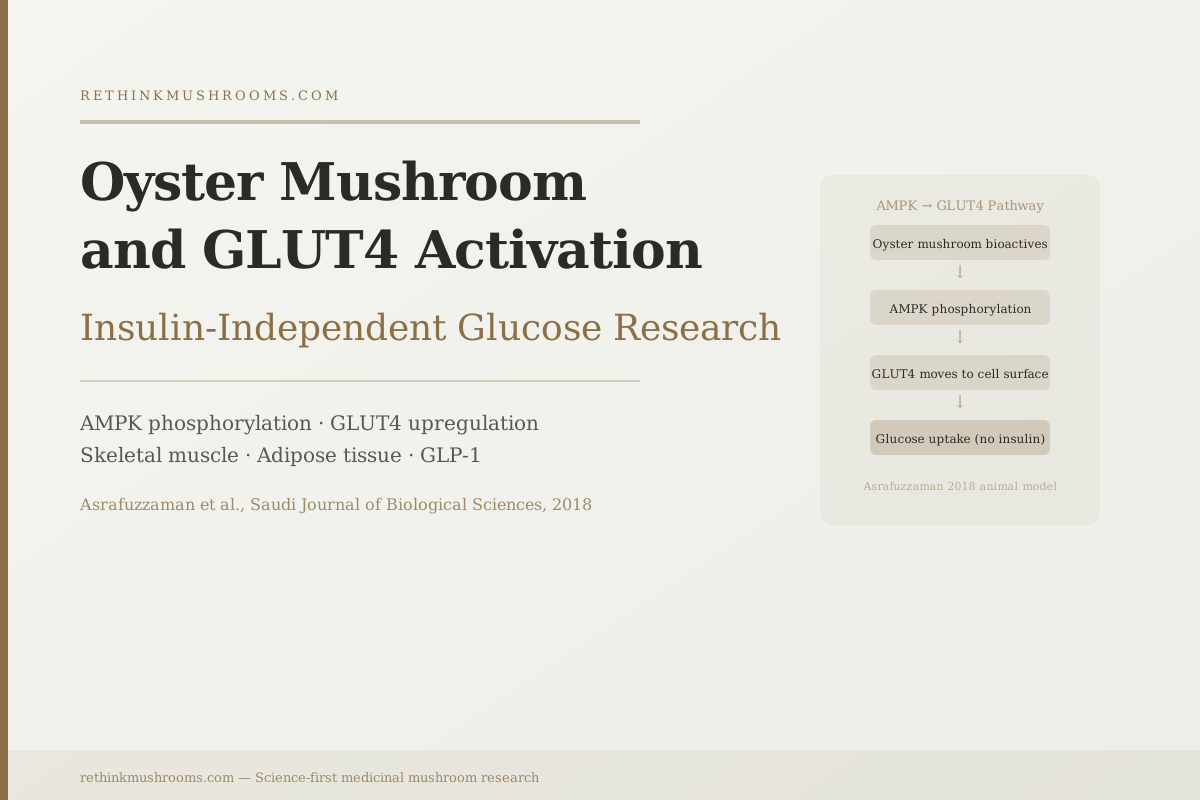
Oyster mushroom bioactives phosphorylate AMPK, a cell energy sensor, which moves glucose transporters (GLUT4) to the surface of muscle cells — enabling glucose uptake from the blood without requiring insulin to trigger the process.
Asrafuzzaman et al., Journal of Taibah University Medical Sciences, 2018
Both tissues
GLUT4 was upregulated in skeletal muscle AND adipose tissue in the Asrafuzzaman 2018 study — insulin-independent glucose clearance in two key metabolic tissues simultaneously
2nd pathway
GLP-1 stimulation from oyster mushroom powder (Klümpen et al., 2025) represents a completely separate blood sugar mechanism operating alongside GLUT4 activation
8 weeks
duration of oyster mushroom powder supplementation in the GLUT4/AMPK animal study
Asrafuzzaman et al., Journal of Taibah University Medical Sciences, 2018
 View as image ↗
Type 2 diabetes is fundamentally a problem of glucose that cannot get where it needs to go. Glucose circulates in the blood after a meal, but the signal that normally moves it into muscle cells — insulin — either isn't produced in sufficient amounts or isn't recognized properly by the cells. That failure is called insulin resistance, and it is the defining feature of type 2 diabetes.
There is a second pathway that moves glucose into muscle cells. It does not require insulin. It runs through a cellular energy sensor called AMPK (adenosine monophosphate-activated protein kinase), and when AMPK is activated, it triggers a protein called GLUT4 to move to the surface of muscle cells, where it can transport glucose directly from the blood.
Oyster mushroom bioactives activate this pathway in diabetic animal models. That finding, first published in 2018, is the centerpiece of this article.
This piece covers the mechanistic research specifically on GLUT4 and AMPK activation. For the broader overview of oyster mushroom blood sugar effects, see oyster mushroom and blood sugar: hypoglycemic research. For the clinical trial data, see oyster mushroom for type 2 diabetes: clinical trial results. For an introduction to oyster mushrooms broadly, see what is oyster mushroom: the world's second most popular mushroom.
Key Takeaways
- GLUT4 (glucose transporter type 4) is the protein responsible for moving glucose from blood into muscle and fat cells; it can be activated either by insulin (the usual route) or by a separate energy-sensing signal called AMPK — making it a potential bypass for insulin resistance
- Asrafuzzaman et al. (2018) found that 8 weeks of oyster mushroom powder phosphorylated AMPK and significantly upregulated GLUT4 expression in both skeletal muscle and adipose tissue in STZ-induced diabetic rats, lowering blood glucose through an insulin-independent mechanism[1]
- This insulin-independent pathway matters specifically for people with impaired insulin signaling: AMPK activation allows muscle cells to clear glucose from the blood even when insulin is not working properly
- Kleftaki et al. (2022), a human crossover trial, found that a meal containing Pleurotus eryngii (king oyster mushroom, closely related to Pleurotus ostreatus) lowered the postprandial glucose response in people with metabolically unhealthy obesity — confirming that the glycaemic benefits extend across the oyster-type mushroom family, not a single isolated compound[2]
- Klümpen et al. (2025) demonstrated a completely separate blood sugar mechanism in human participants: a single meal fortified with oyster mushroom powder stimulated GLP-1 responses in adults with impaired glucose tolerance — two independent pathways from the same food[3]
- The GLUT4/AMPK evidence is entirely from animal studies; no human clinical trial has directly measured GLUT4 activation from oyster mushroom consumption — this is the critical evidence gap in the mechanistic literature
What GLUT4 Is — and Why Insulin Resistance Doesn't Block It Completely
Every cell in the body needs glucose. Most cells import it through membrane proteins called glucose transporters. Muscle cells, the body's largest glucose consumer during activity, primarily rely on a specific transporter called GLUT4, which stands for glucose transporter type 4.
Here is the key feature of GLUT4: it is not permanently on the surface of muscle cells. GLUT4 proteins spend most of their time parked inside the cell, in small membrane-enclosed compartments away from the cell surface. When a signal arrives telling the cell to take up glucose, GLUT4 proteins move from their internal parking spots to the cell membrane, where they can interact with and import glucose from the bloodstream.
The usual signal for this movement is insulin. After a meal, blood glucose rises, the pancreas releases insulin, insulin binds to receptors on muscle cell surfaces, and the resulting signal chain drives GLUT4 from inside the cell to the membrane. In insulin resistance, this signaling chain is disrupted. The insulin is still there, the GLUT4 is still inside the cell, but the signal chain between insulin receptor and GLUT4 movement is broken or weakened. Glucose stays elevated in the blood because muscle cells cannot clear it efficiently.
The second signal — AMPK — is what makes insulin-independent GLUT4 activation interesting. AMPK (adenosine monophosphate-activated protein kinase) is a cellular energy sensor that activates when energy levels inside a cell fall. When AMPK is activated, one of its many downstream effects is driving GLUT4 to the cell membrane, where it can transport glucose — entirely bypassing the insulin-to-GLUT4 signaling chain. This is the same mechanism activated by exercise, which is why physical activity lowers blood sugar even in people with significant insulin resistance.
The question is whether oyster mushroom bioactives can activate AMPK the way exercise does, and therefore move GLUT4 to muscle cell surfaces without requiring functional insulin signaling.
A 2018 study directly tested this.
The Asrafuzzaman 2018 Study: The Primary Evidence for Oyster Mushroom and GLUT4
Asrafuzzaman and colleagues (2018) published the primary study on oyster mushroom and GLUT4 activation, measuring the effect of oyster mushroom powder on the AMPK-GLUT4 pathway in diabetic rats.[1]
The animal model used STZ-induced type 2 diabetes. Streptozotocin (STZ) is a compound that destroys insulin-producing cells in the pancreas, creating a rat model of diabetes that reflects the impaired glucose metabolism of type 2 disease. Rats in the treatment group received oyster mushroom powder for 8 weeks.
The findings addressed two specific molecular changes:
AMPK phosphorylation. Phosphorylation is the chemical modification that activates AMPK. When AMPK is phosphorylated — when a phosphate group is added to a specific point on the AMPK protein — it switches from inactive to active. The oyster mushroom-treated diabetic rats showed significantly higher levels of phosphorylated (activated) AMPK compared to untreated diabetic controls.
GLUT4 expression. GLUT4 expression refers to how many GLUT4 proteins the cell produces and makes available. Higher GLUT4 expression means more transporters are available to move from their internal parking spots to the cell surface when activated. Oyster mushroom treatment significantly increased GLUT4 expression in two distinct tissues: skeletal muscle and adipose tissue (fat tissue). Both are major glucose-clearing tissues. The effect in both simultaneously is notable: it suggests a systemic rather than tissue-specific activation.
The functional outcome was a reduction in blood glucose levels in the treated rats compared to diabetic controls.
This study provides the mechanistic explanation for oyster mushroom's blood sugar effects that precedes the clinical trial data: oyster mushroom bioactives activate AMPK, which upregulates GLUT4, which allows muscle and fat cells to clear glucose from the blood independently of insulin signaling.
The limitation is clear and important: this is an animal study. No human trial has measured AMPK phosphorylation or GLUT4 expression in response to oyster mushroom consumption. Translating animal biochemistry to human clinical outcomes requires human data that does not yet exist for this specific mechanism.
The Active Compounds Are a Polysaccharide Complex, Not a Single Isolated Molecule
The GLUT4/AMPK mechanism requires a signal from oyster mushroom bioactives that reaches inside cells and activates the AMPK pathway. Understanding which compounds drive this effect matters for predicting which preparations are most likely to produce the mechanism.
The instinct is to point to β-glucan, the soluble fiber that is the most well-characterized bioactive in oyster mushrooms. But β-glucan is not the whole story. Oyster mushrooms produce multiple structurally distinct polysaccharides: some are extracted with water at different temperatures, some with alkali, some through enzymatic processes, and the biological activity of different fractions varies. The Asrafuzzaman 2018 study used whole mushroom powder rather than an isolated compound, which means the GLUT4 effect it measured most likely reflects the combined action of several polysaccharide fractions rather than any single molecule.
The glycaemic effect is also not confined to one species. Kleftaki and colleagues (2022) ran an acute randomized crossover trial in nineteen people with metabolically unhealthy obesity, comparing a meal containing Pleurotus eryngii (king oyster mushroom, closely related to Pleurotus ostreatus) against a macronutrient-matched control meal.[2] The mushroom meal produced a lower glucose incremental area under the curve, along with reduced ghrelin and increased fullness. That a closely related oyster-type mushroom lowers the postprandial glucose response in humans reinforces the picture: the metabolic activity is a property of the oyster mushroom family's polysaccharide complex, not a quirk of one isolated compound in one species.
For the nutritional context on how much β-glucan and fiber oyster mushrooms typically contain, see oyster mushroom nutritional profile: complete breakdown.
A Second Independent Pathway: GLP-1 Stimulation From Oyster Mushroom Powder
The GLUT4/AMPK mechanism is not the only way oyster mushroom consumption affects blood glucose. A second, completely separate pathway operates through a gut hormone called GLP-1.
GLP-1 (glucagon-like peptide-1) is produced by specialized cells in the gut lining after eating. It signals the pancreas to release insulin, suppresses glucagon (a hormone that raises blood sugar), slows gastric emptying (which blunts postprandial glucose spikes), and promotes satiety. These effects are why GLP-1 receptor agonist drugs (semaglutide, marketed as Ozempic and Wegovy) have become some of the most prescribed medications in the world. Those drugs activate GLP-1 receptors pharmacologically. Oyster mushroom fiber stimulates the body's own GLP-1 production.
Klümpen and colleagues (2025) conducted the most recent human study on this pathway: a single meal fortified with β-glucan-rich oyster mushroom powder stimulated GLP-1 responses in adults with impaired glucose tolerance.[3] The size of that response depended on the person's baseline gut microbiota: the mechanism runs through gut fermentation, where oyster mushroom β-glucans reach the colon largely undigested and resident bacteria ferment them into short-chain fatty acids. Those short-chain fatty acids bind to receptors on the GLP-1-producing gut cells, triggering GLP-1 release — which is why the effect was most pronounced in participants whose microbiome was better at fermenting fiber into short-chain fatty acids.
The important distinction from drugs is this: oyster mushroom stimulates the body's own GLP-1 production, producing a modest and food-appropriate increase. Semaglutide activates GLP-1 receptors directly, bypassing the need for endogenous production, and produces a much larger and more sustained pharmacological effect. Both pathways converge on the same downstream physiology. The magnitude differs substantially.
For the detailed postprandial glucose data from the GLP-1 and postprandial studies, including specific effect sizes, see oyster mushroom and postprandial glucose reduction.
The Full Mechanistic Picture: Four Documented Pathways
The GLUT4/AMPK route is one of several ways that mushroom bioactives influence blood glucose. Across the edible- and medicinal-mushroom literature, four distinct mechanisms have been documented — and they place the GLUT4/AMPK and GLP-1 findings in a broader context:
Alpha-glucosidase inhibition. Certain mushroom compounds inhibit an enzyme in the small intestine that breaks down complex carbohydrates into glucose. Inhibiting this enzyme slows the release of glucose from food, reducing postprandial blood glucose spikes — the same mechanism as the diabetes drug acarbose. Alpha-glucosidase inhibitors have been isolated directly from medicinal mushrooms: Kim and Nho (2004) purified a potent, highly specific alpha-glucosidase inhibitor (SKG-3) from the fruiting bodies of Ganoderma lucidum, demonstrating that mushroom-derived molecules can block this carbohydrate-digesting enzyme.[4]
GLUT4 activation via AMPK. The pathway covered in detail above — the insulin-independent glucose clearance mechanism.
GLP-1 stimulation. The gut fermentation pathway covered above — polysaccharides reach the colon, ferment into short-chain fatty acids, and trigger GLP-1 release from gut cells.
Gut microbiome modulation. Mushroom polysaccharides act as prebiotics, feeding beneficial bacteria including Lactobacillus and Bifidobacterium. Changes in gut microbiome composition affect not only GLP-1 production but also the gut barrier integrity and systemic inflammation that contribute to insulin resistance.
These four mechanisms are not mutually exclusive. A single dose of oyster mushroom could activate multiple pathways simultaneously. The GLUT4/AMPK pathway works inside muscle cells directly. The alpha-glucosidase inhibition pathway works in the small intestine. The GLP-1 pathway works through gut fermentation in the colon. They operate at different anatomical locations on different timescales.
For the insulin resistance mechanism in more depth, including how these pathways connect to the broader insulin signaling picture, see oyster mushroom and insulin resistance: mechanisms.
What the Evidence Can and Cannot Claim
The mechanistic picture for oyster mushroom and glucose control is more sophisticated than most nutrition research on any single food. Four separate pathways with distinct supporting evidence, operating at different locations in the body: this is not a single effect being over-interpreted.
The critical limitation is the GLUT4/AMPK evidence specifically. The only study that directly measured GLUT4 and AMPK changes from oyster mushroom consumption (Asrafuzzaman 2018) did so in diabetic rats.[1] No human trial has:
- Directly measured AMPK phosphorylation in human muscle after oyster mushroom consumption
- Measured GLUT4 expression in human tissue samples after consumption
- Established what dose in humans produces the AMPK activation observed in the animal study
The GLP-1 pathway has stronger human evidence. The 2025 Klümpen study was conducted in human participants with impaired glucose tolerance.[3] That mechanistic pathway has direct human evidence.
The alpha-glucosidase inhibition pathway has been demonstrated in cell-free and animal studies. The microbiome modulation pathway has evidence from human microbiome studies using mushroom polysaccharides, covered in the related gut health literature.
The intellectually honest position: oyster mushroom bioactives activate a mechanism in animal muscle cells that would, if replicated in humans, provide insulin-independent glucose clearance. This is a meaningful finding that explains why animal studies consistently show blood glucose reduction. Whether this specific mechanism operates in human muscle at consumption quantities achievable through diet requires human evidence that does not yet exist.
The Bottom Line
Oyster mushroom bioactives activate AMPK and upregulate GLUT4 in both skeletal muscle and adipose tissue in diabetic rat models, providing an insulin-independent pathway for glucose clearance from the blood. A second separate pathway — GLP-1 stimulation via gut fermentation — has been confirmed in human participants with impaired glucose tolerance. Across the mushroom-diabetes literature, four distinct mechanisms are documented: GLUT4/AMPK activation, GLP-1 stimulation, alpha-glucosidase inhibition, and gut microbiome modulation. The GLUT4/AMPK evidence remains animal-only; human measurement of this specific mechanism has not been conducted.
Frequently Asked Questions
Sources & References
- 1RTHM-00939·Asrafuzzaman, Mohammad et al. (2018). “Oyster mushroom functions as an anti-hyperglycaemic through phosphorylation of AMPK and increased expression of GLUT4 in type 2 diabetic model rats..” Journal of Taibah University Medical Sciences.Study breakdown →PubMed →↩
- 2RTHM-01551·Kleftaki, Stamatia-Angeliki et al. (2022). “Pleurotus eryngii improves postprandial glycaemia, hunger and fullness perception, and enhances ghrelin suppression in people with metabolically unhealthy obesity..” Pharmacological research.Study breakdown →PubMed →↩
- 3RTHM-02111·Klümpen, Linda et al. (2025). “GLP-1 Responses to a Single Meal Fortified With Oyster Mushroom Powder in Adults With Impaired Glucose Tolerance Depend on the Gut Microbiota Composition Before the Meal..” Molecular nutrition & food research.Study breakdown →PubMed →↩
- 4RTHM-00138·Kim, Shin-Duk et al. (2004). “Isolation and characterization of alpha-glucosidase inhibitor from the fungus Ganoderma lucidum..” Journal of microbiology (Seoul.Study breakdown →PubMed →↩