Oyster Mushroom Nutrition
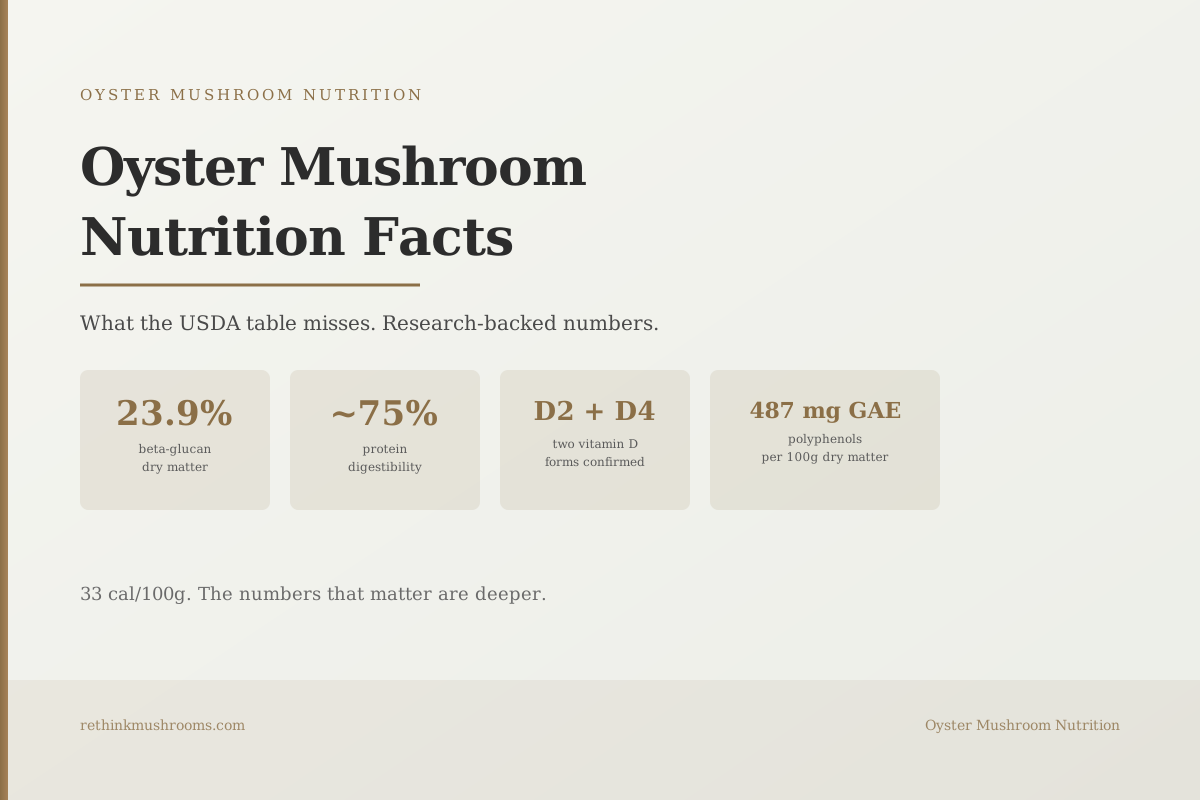
23.9% beta-glucan (dry weight)
The beta-glucan content in raw Pleurotus ostreatus, per Lam and Okello's analytical study: a number rarely mentioned on nutrition labels but the most bioactively significant fraction of the mushroom.
Lam & Okello, International Journal of Medicinal Mushrooms, 2015
~75%
protein digestibility in vivo (Regula et al., 2016)
D2 + D4
two vitamin D forms found in oyster mushrooms
487 mg GAE
polyphenols per 100g dry matter (Lam & Okello, 2015)
Lam & Okello, International Journal of Medicinal Mushrooms, 2015
 View as image ↗
Most nutrition sites list oyster mushroom facts from USDA tables: 33 calories per 100g, 3 grams of protein, small amounts of B vitamins. That's accurate as far as it goes. What those tables don't tell you is that 23.9 percent of the mushroom's dry matter is beta-glucan fiber, that the protein it contains is roughly 75 percent digestible in vivo, that it contains not one but two forms of vitamin D, and that an 8-week trial of king oyster mushrooms improved antioxidant status and metabolic markers in adults.
Those numbers come from peer-reviewed analytical studies and a randomized controlled trial. They're not in the standard USDA database, and they're absent from every major nutrition site.
This is the breakdown that covers both: the standard nutritional data and the research-based numbers that actually explain why oyster mushrooms matter nutritionally. For the broader species overview, see what is oyster mushroom: the world's second most popular mushroom.
Key Takeaways
- Raw Pleurotus ostreatus contains 23.9% beta-glucan by dry matter and 487 mg polyphenols per 100g DM, numbers from analytical chemistry studies that do not appear in USDA tables (Lam & Okello, 2015)
- Protein digestibility is approximately 75% in vivo, with iron, zinc, and copper all showing high apparent bioavailability (Regula et al., 2016)
- Oyster mushrooms contain two forms of vitamin D: ergocalciferol (D2) and 22-dihydroergocalciferol (D4); UV exposure dramatically increases D2 content
- Mushroom-derived vitamin D2 is bioavailable in humans with efficacy comparable to D2 supplements; placing mushrooms gill-side up in midday sunlight for 2 hours raises D2 significantly
- Fruiting bodies consistently outperform mycelium in phenolics, ergothioneine, and polysaccharide levels; whole-food oyster mushroom beats mycelium-based supplements on every measured bioactive
- Lovastatin was not detected in raw P. ostreatus samples in Lam and Okello's study, despite commercial claims; buyers of "oyster mushroom" supplements citing lovastatin should scrutinize the supplier's evidence
The Snapshot: Oyster Mushroom Nutrition Facts Per 100 Grams
Oyster mushrooms (Pleurotus ostreatus) are one of the lowest-calorie edible mushrooms with a meaningful nutrient profile. Per 100 grams raw:
Macronutrients: 33 calories, 3.3g protein, 6.1g total carbohydrates, 2.3g dietary fiber, 0.4g fat.
B vitamins: Niacin (vitamin B3) around 27% of daily value; riboflavin (B2) around 23% DV; pantothenic acid (B5) around 15% DV.
Minerals: Copper around 22% DV; potassium around 8% DV; phosphorus around 10% DV; selenium present in modest amounts.
Vitamin D: Present as D2 (ergocalciferol) and D4 (22-dihydroergocalciferol), with levels highly variable depending on UV exposure during growing or post-harvest treatment.
These are the numbers you'll find in the USDA FoodData Central database. They're accurate but incomplete. The nutritional story of oyster mushrooms involves compounds that standard nutrition tables don't measure: beta-glucan fiber content, total polyphenol load, ergothioneine, and protein digestibility.
A systematic review published in the Journal of Food Biochemistry in 2022 identified oyster mushrooms as among the most nutritionally complete edible fungi, with beta-glucans, ergothioneine, and lovastatin highlighted as key bioactives with validated health effects. Protein quality in Pleurotus species was found to exceed most plant protein sources in amino acid profile completeness.[3]
The Number Nobody Puts on a Label: 23.9% Beta-Glucan
If there is one number that separates the nutritional profile of oyster mushrooms from a generic vegetable, it's the beta-glucan content.
Lam and Okello measured the composition of raw Pleurotus ostreatus in detail and published their findings in the International Journal of Medicinal Mushrooms in 2015.[1] Their analysis found:
- Beta-glucan: 23.9% of dry matter
- Total polyphenols: 487 mg GAE per 100g dry matter
- Lovastatin: not detected in raw samples
The beta-glucan figure is striking. Beta-glucans are the soluble fiber chains that stimulate GLP-1 secretion, slow glucose absorption, bind bile acids, and selectively feed beneficial gut bacteria. At 23.9 percent of dry matter, oyster mushrooms are among the most beta-glucan-dense whole foods available. Oats, the most studied beta-glucan source for heart health, contain roughly 3-8% beta-glucan by dry weight. Oyster mushrooms contain three to eight times more.
The polyphenol number (487 mg GAE per 100g DM) is also significant. Polyphenols are plant compounds with antioxidant activity; 487 mg per 100g DM places oyster mushrooms in the upper range for edible fungi and ahead of many commonly consumed vegetables on a dry-weight basis.
The lovastatin finding is worth flagging directly. Some commercial sources claim oyster mushrooms contain meaningful amounts of lovastatin, the cholesterol-lowering compound found in Pleurotus spp. Lam and Okello found lovastatin was not detectable in raw P. ostreatus samples at all. Anyone purchasing oyster mushroom supplements specifically for lovastatin should scrutinize the supplier's evidence.
What does cooking do to these numbers? Lam and Okello also measured samples after different cooking methods and found deep frying caused the greatest losses in both beta-glucan and polyphenols, while other cooking methods showed more moderate effects. The research on cooking and nutrient retention is covered in full at how to cook oyster mushrooms for maximum nutrient retention and best ways to cook oyster mushrooms for nutrition and flavor.
For a cross-mushroom comparison of how beta-glucan fiber drives postprandial blood sugar effects, see mushroom dietary fiber and postprandial blood sugar spikes: research review.
Protein and Digestibility: Better Than Most Plant Foods
The standard nutrition table says oyster mushrooms contain 3.3g of protein per 100g raw. That's real but not the whole protein story.
Regula and colleagues conducted an in vivo rat study specifically measuring the bioavailability and digestibility of nutrients from dried Pleurotus ostreatus, published in the International Journal of Medicinal Mushrooms in 2016.[2]
Their finding: protein digestibility was approximately 75%. The minerals iron, zinc, and copper all showed high apparent bioavailability. Fat and fiber were also well-utilized.
For context: protein digestibility matters because theoretical protein content and the amount your body actually absorbs can differ significantly. Plant foods often have lower digestibility than animal proteins due to antinutritional factors like phytic acid and tannins. An in vivo digestibility of ~75% for oyster mushroom protein is on the higher end for plant-based protein sources. The Ishara 2022 systematic review reached the same conclusion: protein quality in Pleurotus species exceeds most plant proteins in amino acid completeness.[3]
What this means practically: the 3.3g of protein per 100g fresh mushroom is not all available, but most of it is. Dried oyster mushroom powder is more concentrated (roughly 10:1 fresh-to-dry ratio), making it a meaningfully dense source at that concentration.
For the full amino acid breakdown and species-level comparison, see oyster mushroom as a protein source: amino acid analysis.
Vitamin D: Two Forms, One Unusual Source
Oyster mushrooms are one of the few non-animal foods that contain vitamin D. What makes their vitamin D profile genuinely interesting is the presence of not one but two distinct forms.
Phillips and colleagues published two related studies: a 2011 paper measuring vitamin D and sterol composition in 10 types of mushrooms from US retail suppliers, and a 2012 paper identifying vitamin D4 (22-dihydroergocalciferol) in mushrooms for the first time.[4][5]
Oyster mushrooms were confirmed to contain D2 (ergocalciferol) even without UV treatment, with substantially higher concentrations in UV-exposed samples. The 2012 paper established that oyster mushrooms contain D4 alongside D2, making them a more complex vitamin D source than previously understood.
The practical implication comes from Keegan and colleagues' 2013 systematic review of vitamin D photobiology in mushrooms.[6] Their key findings:
- Mushroom-derived vitamin D2 is bioavailable in humans with efficacy comparable to D2 supplements
- Placing mushrooms gill-side up in midday sunlight for 2 hours is sufficient to produce meaningful D2 levels
- Vitamin D2 in mushrooms is stable through cooking, so you don't lose it by heating
The gill-side-up tip is particularly practical. The gills of a mushroom contain the ergosterol (a vitamin D precursor) that converts to D2 when exposed to UV radiation. Exposing the gills directly to sunlight rather than the cap surface maximizes conversion. This technique works with both fresh and dried oyster mushrooms.
Ergothioneine, Polyphenols, and the Bioactives Beyond the Nutrition Label
Standard nutrition labels have no column for ergothioneine or total polyphenols, but these compounds are central to why researchers and clinicians are interested in oyster mushrooms as functional foods.
Ergothioneine is a sulfur-containing amino acid found almost exclusively in fungi. It accumulates preferentially in human tissues that face high oxidative stress: red blood cells, liver, kidney, and the lens of the eye. Unlike most antioxidants, ergothioneine has a specific transporter protein in human cells (OCTN1), suggesting it has evolved a specific role in human biology. It is sometimes called a "longevity vitamin" for its association with reduced mortality risk in population studies.
The 2022 systematic review by Ishara and colleagues confirmed ergothioneine as one of the key bioactives in oyster mushrooms with validated health effects.[3] Different oyster mushroom species contain different amounts, which is covered in the varieties comparison. Golden oyster (Pleurotus citrinopileatus) in particular shows the highest ergothioneine-related compounds. For the full ergothioneine story, see ergothioneine in oyster mushrooms: the longevity antioxidant you can eat.
On polyphenols: the 487 mg GAE per 100g DM figure from Lam and Okello represents a substantial antioxidant load from a food that is typically thought of as a side dish or topping.[1] Polyphenols reduce oxidative stress that damages insulin receptors, arterial walls, and cell membranes. Their presence at this level positions oyster mushrooms as a meaningful source alongside other polyphenol-rich foods.
The Human Trial: What 8 Weeks of King Oyster Actually Did
The nutritional claims in this article are only as useful as the evidence that eating oyster mushrooms actually delivers these nutrients to people in meaningful amounts.
Kleftaki and colleagues published an 8-week randomized controlled trial in Antioxidants in 2022, testing Pleurotus eryngii (king oyster) mushroom consumption in adults with metabolic disorders.[7]
The trial found that regular king oyster mushroom consumption improved antioxidant status and metabolic markers versus control. Mushroom-derived vitamin D2 was clinically bioavailable and effective. The antioxidant improvement is consistent with the polyphenol and ergothioneine content described above actually reaching systemic circulation.
This is the bridge between nutritional composition data and real-world impact: the compounds are present (Lam, Phillips, Regula), they are bioavailable (Regula, Keegan), and they produce measurable effects in humans over 8 weeks (Kleftaki). That chain of evidence is what separates oyster mushrooms from foods with impressive-sounding nutrient profiles that don't translate to detectable outcomes.
Whole Mushroom vs. Mycelium Supplements: The Composition Gap
One finding from the research is worth highlighting specifically for anyone choosing between whole oyster mushrooms and mycelium-based supplements.
Lo and colleagues conducted a comparative study in 2012 measuring phenolic content, ergothioneine, and polysaccharide levels in both fruiting bodies and mycelia across multiple culinary mushroom species, including Pleurotus.[8]
Fruiting bodies (the actual mushroom caps and stems you eat) consistently outperformed mycelia on all three measures: phenolics, ergothioneine, and polysaccharides. This held across species.
The implication for supplement buyers: products marketed as "oyster mushroom" that contain mycelium grown on grain substrate will have a fundamentally different composition than products made from whole fruiting body. The grain substrate itself contributes carbohydrates to the analysis, often inflating the reported "beta-glucan" figure with grain-derived glucans rather than mushroom-derived ones. Whole fruiting body products, or those that specify fruiting body content, are a safer bet for the bioactive compounds described in this article.
The Bottom Line
The standard nutrition facts for oyster mushrooms (33 cal/100g, 3.3g protein) are accurate but miss the most nutritionally significant numbers: 23.9% beta-glucan by dry matter (Lam & Okello, 2015), approximately 75% protein digestibility in vivo (Regula et al., 2016), the presence of two vitamin D forms (D2 and D4), and 487 mg polyphenols per 100g DM. An 8-week RCT (Kleftaki et al., 2022) confirmed these compounds produce measurable improvements in antioxidant status and metabolic markers in adults. Whole fruiting bodies outperform mycelium on every measured bioactive, per Lo et al. (2012).
Frequently Asked Questions
Sources & References
- 1RTHM-00384·Lam, Yu Shan et al. (2015). “Determination of Lovastatin, β-glucan, Total Polyphenols, and Antioxidant Activity in Raw and Processed Oyster Culinary-Medicinal Mushroom, Pleurotus ostreatus (Higher Basidiomycetes)..” International journal of medicinal mushrooms.Study breakdown →PubMed →↩
- 2RTHM-00443·Regula, Julita et al. (2016). “Bioavailability and Digestibility of Nutrients from the Dried Oyster Culinary-Medicinal Mushroom, Pleurotus ostreatus (Agaricomycetes): In Vivo Experiments..” International journal of medicinal mushrooms.Study breakdown →PubMed →↩
- 3RTHM-01542·Ishara, Jackson et al. (2022). “Nutraceutical potential of mushroom bioactive metabolites and their food functionality..” Journal of food biochemistry.Study breakdown →PubMed →↩
- 4RTHM-00230·Phillips, Katherine M et al. (2011). “Vitamin D and sterol composition of 10 types of mushrooms from retail suppliers in the United States..” Journal of agricultural and food chemistry.Study breakdown →PubMed →↩
- 5RTHM-00261·Phillips, Katherine M et al. (2012). “Vitamin D4 in mushrooms..” PloS one.Study breakdown →PubMed →↩
- 6RTHM-00292·Keegan, Raphael-John H et al. (2013). “Photobiology of vitamin D in mushrooms and its bioavailability in humans..” Dermato-endocrinology.Study breakdown →PubMed →↩
- 7RTHM-00771·Kleftaki, Stamatia-Angeliki et al. (2022). “A Randomized Controlled Trial on Pleurotus eryngii Mushrooms with Antioxidant Compounds and Vitamin D2 in Managing Metabolic Disorders..” Antioxidants (Basel.Study breakdown →PubMed →↩
- 8RTHM-00256·Lo, Yu-Chang et al. (2012). “Comparative study of contents of several bioactive components in fruiting bodies and mycelia of culinary-medicinal mushrooms..” International journal of medicinal mushrooms.Study breakdown →PubMed →↩