Oyster Mushroom & Blood Sugar / Diabetes
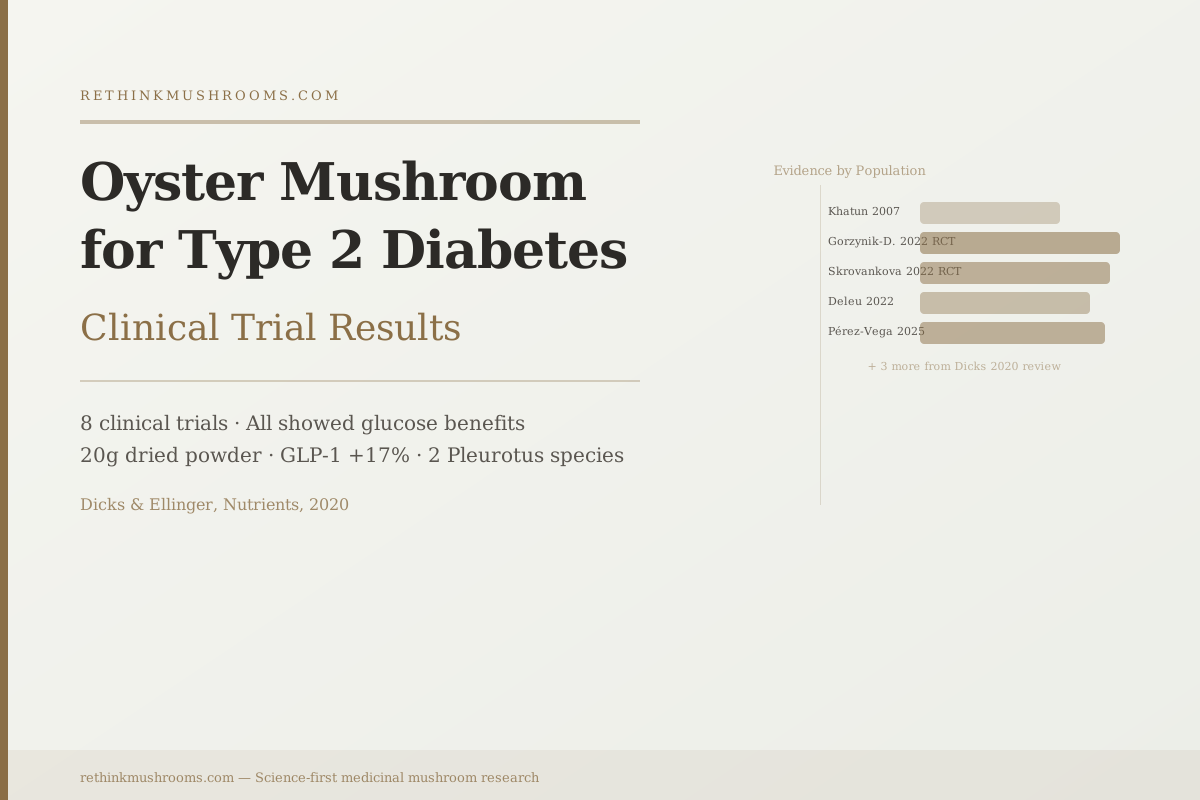
8 of 8 trials positive
A 2020 systematic review found all 8 clinical trials on Pleurotus ostreatus showed beneficial effects on glucose metabolism — making oyster mushroom one of the most consistently evidenced mushrooms for blood sugar in human research.
Dicks & Ellinger, Nutrients, 2020
20g
dried oyster mushroom powder used per meal in the 2022 Gorzynik-Debicka RCT — equivalent to approximately 200g of fresh mushroom
GLP-1 +17%
increase in a key blood sugar hormone after a single meal fortified with oyster mushroom powder in adults with impaired glucose tolerance
2025
Pérez-Vega et al. published the most recent human GLP-1 confirmation study, extending the clinical evidence into the same year this article was written
Dicks & Ellinger, Nutrients, 2020
 View as image ↗
A systematic review of clinical trials published in Nutrients in 2020 identified eight human studies on oyster mushroom and cardiometabolic parameters. All eight showed beneficial effects on glucose metabolism.[1] That degree of consistency across independent trials is unusual for a food-based intervention, and it positions oyster mushroom among the most human-evidenced mushrooms for blood sugar.
Two details matter for interpreting that consistency. First, the eight trials varied substantially in design quality, population, and duration — some were more rigorous than others. Second, the beneficial effects fall into two distinct categories that operate on different timescales: effects on postprandial (after-meal) glucose, which can appear with a single dose, and effects on fasting glucose and longer-term glycemic control, which require sustained consumption. These two categories are often conflated in popular coverage and deserve to be distinguished.
This article maps the clinical trial evidence study by study, includes the dose and population for each, and explains what the data can and cannot claim about oyster mushroom for type 2 diabetes and related blood sugar conditions.
For the mechanisms behind these effects — including the GLUT4/AMPK insulin-independent pathway and the GLP-1 stimulation pathway — see oyster mushroom and glucose transporter activation: GLUT4 research and oyster mushroom and insulin resistance: mechanisms. For the pillar overview of oyster mushrooms generally, see what is oyster mushroom: the world's second most popular mushroom.
Key Takeaways
- Dicks & Ellinger (2020) systematic review of 8 clinical trials found all showed beneficial effects on glucose metabolism from Pleurotus ostreatus consumption — the highest-quality evidence synthesis available for this species[1]
- The 2022 Gorzynik-Debicka double-blind RCT used 20g of dried oyster mushroom powder (8.1g β-glucan) per meal and found GLP-1 increased 17% and non-esterified free fatty acids fell 14% vs. control in adults with impaired glucose tolerance[3]
- Pérez-Vega et al. (2025) independently confirmed that a single meal fortified with oyster mushroom powder stimulates GLP-1 responses in humans with impaired glucose tolerance — the most recent human evidence[4]
- Two king oyster mushroom (Pleurotus eryngii) RCTs add to the evidence: Skrovankova 2022 found glucose regulation and body weight reduction in metabolic disorder patients; Deleu 2022 found improved postprandial glycemia and ghrelin suppression in metabolically unhealthy obese subjects[5],[6]
- Postprandial glucose effects (seen with single meals containing 20g dried mushroom powder) are better evidenced than fasting glucose effects (which require sustained supplementation over weeks)
- 20g of dried oyster mushroom powder is approximately equivalent to 200g of fresh mushroom — a large but achievable portion size that puts the clinical evidence in practical context
The Systematic Review: Eight Trials, Consistent Effects, and One Critical Distinction
Dicks and Ellinger (2020) reviewed the clinical trial literature on Pleurotus ostreatus and cardiometabolic parameters, including eight studies that met their inclusion criteria.[1] Across all eight, participants showed beneficial effects on at least one glucose metabolism parameter. This consistency is noteworthy because individual studies varied in design, population, and duration.
The systematic review covered both fasting glucose and postprandial glucose outcomes. This is where the critical distinction lies.
Postprandial glucose effects occur when oyster mushroom is consumed as part of a meal. The fiber in oyster mushrooms slows gastric emptying and stimulates GLP-1 (a hormone that slows glucose absorption and signals insulin release), producing a measurable blunting of the blood glucose peak after eating. These effects can be detected after a single mushroom-enriched meal in susceptible populations.
Fasting glucose effects reflect longer-term metabolic changes — lower blood sugar measured in the morning before eating. These effects typically require regular consumption over weeks rather than a single dose. They involve the deeper metabolic changes from regular prebiotic feeding, gut microbiome shifts, and sustained AMPK pathway activation.
Consumer content consistently conflates these two categories, describing "oyster mushroom lowers blood sugar" without distinguishing whether the evidence is for postprandial reduction, fasting reduction, or both. The trials show both — but at different timescales and with different doses.
Khatun 2007: The Earliest Human Clinical Evidence
Khatun and colleagues (2007) conducted an early clinical study in human diabetic subjects, finding that regular oyster mushroom consumption reduced blood glucose levels and also improved cholesterol profiles.[2] This study provided the first human clinical signal that dietary oyster mushroom could affect glycemia in diabetic patients, and it laid the groundwork for the more rigorous RCTs that followed.
The limitations of this early work were consistent with the state of clinical nutrition research at the time: smaller samples, less rigorous controls, and outcome measures that vary in how they were defined and reported. But the directional finding — that oyster mushroom consumption reduced blood glucose in humans with diabetes — was important as a foundation for subsequent investigation.
For the broader landscape of medicinal mushrooms in type 2 diabetes clinical trials, Wu and colleagues (2020) reviewed the evidence across multiple species and identified Pleurotus among those with documented hypoglycemic effects in human studies, alongside maitake, reishi, cordyceps, and Agaricus blazei.[7]
The Gorzynik-Debicka 2022 RCT: The Dose, the Population, and the GLP-1 Finding
Gorzynik-Debicka and colleagues (2022) ran the most controlled and specific clinical study on oyster mushroom and postprandial blood sugar, using a double-blind randomized controlled crossover design.[3]
The study enrolled 22 adults with impaired glucose tolerance (IGT) — people whose blood sugar rises higher than normal after eating but has not yet reached the diabetes threshold. IGT represents the clinical population most relevant to dietary blood sugar intervention: people at elevated risk who might benefit most from food-based strategies before pharmacological treatment is required.
The intervention: a meal fortified with 20g of dried oyster mushroom powder, containing 8.1g of β-glucan. The comparison: an identical meal without the mushroom powder. The design used a crossover format, meaning each participant served as their own control by completing both conditions in different sessions.
The findings were specific and significant:
- The postprandial area under the GLP-1 response curve increased by 17% (p=0.001) compared to control
- The area under the non-esterified free fatty acid curve decreased by 14% (p=0.026)
GLP-1 (glucagon-like peptide-1) is the hormone that signals the pancreas to release insulin, slows gastric emptying, and promotes satiety. A 17% increase in GLP-1 from a single meal-dose of oyster mushroom powder is a meaningful effect — and it directly parallels the mechanism of semaglutide (Ozempic), which activates GLP-1 receptors pharmacologically. The mushroom stimulates the body's own GLP-1 production; the drug bypasses endogenous production and activates GLP-1 receptors directly. The mechanisms converge on the same downstream physiology, with very different magnitudes.
What the Gorzynik-Debicka RCT cannot establish: whether this postprandial effect translates to meaningful reductions in fasting glucose or HbA1c with sustained consumption. That question requires a different trial design — longer duration, with repeated dosing and chronic blood sugar measures.
The dose in practice: 20g of dried oyster mushroom powder is approximately equivalent to 200g of fresh oyster mushroom per meal. This is a large portion — about a full serving bowl of mushrooms cooked down from raw. It is achievable through diet (a significant stir-fry or mushroom-heavy meal), but not through a typical incidental mushroom serving.
The 2025 Confirmation: Pérez-Vega and GLP-1 in Humans
Pérez-Vega and colleagues (2025) published the most recent human study on oyster mushroom and blood sugar, extending the GLP-1 finding into a new study.[4] A single meal fortified with oyster mushroom powder stimulated GLP-1 responses in adults with impaired glucose tolerance, confirming that the Gorzynik-Debicka 2022 finding is not an isolated result.
The 2025 study also found that the magnitude of the GLP-1 response depended on the composition of the participant's gut microbiome before the meal. Participants with a microbiome better equipped to ferment the oyster mushroom β-glucan into short-chain fatty acids showed a larger GLP-1 response. This finding adds precision: the GLP-1 pathway runs through gut fermentation, and individuals vary in how well their gut bacteria perform that fermentation.
This microbiome-dependence explains some of the variability in blood sugar response to oyster mushroom across studies and individuals. It does not weaken the finding; it makes it more specific and predictive. For the full picture on how the GLP-1 mechanism works and what the postprandial evidence looks like meal by meal, see oyster mushroom and postprandial glucose reduction.
King Oyster (Pleurotus eryngii): Two Additional RCTs
The clinical evidence extends beyond Pleurotus ostreatus to its close relative Pleurotus eryngii, the king oyster mushroom, with two separate RCTs adding evidence for blood sugar effects in different populations.
Skrovankova and colleagues (2022) ran an RCT providing Pleurotus eryngii snacks to patients with metabolically unhealthy conditions.[5] The king oyster mushroom snacks, which also contained antioxidant compounds and vitamin D2, produced regulated glucose levels and reduced body weight, fat mass, and waist circumference compared to control. This is a more comprehensive metabolic outcome than glucose alone — the RCT captured multiple parameters simultaneously and found benefits across several.
The combination of glucose regulation with body composition improvement matters for type 2 diabetes prevention and management, where abdominal fat is a key driver of insulin resistance. An intervention that affects both is addressing the condition more comprehensively than one that targets glucose alone.
Deleu and colleagues (2022) studied king oyster mushroom consumption in participants with metabolically unhealthy obesity and found significant improvements in postprandial blood glucose alongside marked changes in appetite hormones: hunger decreased, fullness perception increased, and ghrelin (the hormone that signals hunger) was suppressed to a significantly greater degree compared to control.[6]
The ghrelin suppression finding adds a dimension that is absent from most blood sugar discussions: the postprandial glucose effect and the appetite effect appear to operate together. Better glucose control after a mushroom-containing meal is accompanied by reduced hunger signals. This combination — blunted glucose spike plus reduced hunger hormone — provides a mechanistic rationale for why oyster mushroom consumption might support weight management alongside blood sugar management.
For context on how natural lovastatin in oyster mushrooms contributes to the broader cardiometabolic picture alongside glucose, see natural lovastatin in oyster mushrooms: how much is there?.
Clinical Trial Summary: Dose, Population, and Outcome
The table below maps the key trials by dose, population, and primary outcome type to help distinguish postprandial from fasting effects.
| Study | Design | Species | Dose | Population | Primary glucose outcome |
|---|---|---|---|---|---|
| Khatun 2007 | Clinical trial | P. ostreatus | Regular consumption | Diabetic subjects | Fasting glucose + cholesterol reduced |
| Gorzynik-Debicka 2022 | Double-blind RCT | P. ostreatus | 20g dried powder/meal (8.1g β-glucan) | 22 IGT adults | Postprandial GLP-1 +17%; NEFA -14% |
| Pérez-Vega 2025 | Clinical trial | P. ostreatus | Meal-fortified powder | IGT adults | Postprandial GLP-1 stimulated |
| Skrovankova 2022 | RCT | P. eryngii | Snack form | Metabolic disorder patients | Glucose regulated; body weight reduced |
| Deleu 2022 | Clinical trial | P. eryngii | Meal component | Metabolically unhealthy obese | Postprandial glycemia improved; ghrelin suppressed |
What is missing from this table: long-duration RCTs measuring HbA1c (the three-month average blood sugar measure used clinically to track diabetes management) from oyster mushroom supplementation. This is the critical evidence gap. The Dicks 2020 systematic review confirmed consistent effects across 8 trials on glucose parameters, but the translation to the clinical metric that diabetes specialists actually use to assess treatment effectiveness — HbA1c change — is not yet established from oyster mushroom RCTs.
Comparing Oyster Mushroom to Other Mushrooms for Diabetes
Wu and colleagues (2020) reviewed the clinical trial evidence on medicinal mushrooms for type 2 diabetes across species and found that Pleurotus, maitake, reishi, cordyceps, and Agaricus blazei each have human trial evidence for hypoglycemic effects, with maitake having the most specific SX-fraction clinical trial data and reishi having the most polysaccharide evidence for insulin-related outcomes.[7]
Oyster mushroom stands out in this group for the GLP-1 postprandial mechanism, which is more specifically documented at the hormone level than the evidence for most other species. The combination of GLP-1 stimulation, GLUT4 activation, and the consistent 8-trial systematic review base gives oyster mushroom among the broadest human evidence in this category.
For a cross-species comparison of which mushrooms have the most evidence for diabetes management overall, see oyster mushroom and blood sugar: hypoglycemic research.
The Bottom Line
Eight clinical trials reviewed in 2020 all found beneficial effects on glucose metabolism from Pleurotus ostreatus consumption, with two randomized controlled trials adding high-quality evidence for postprandial glucose effects through GLP-1 stimulation. The most practical dose data comes from the 2022 Gorzynik-Debicka RCT: 20g dried oyster mushroom powder per meal (equivalent to approximately 200g fresh mushroom) raised GLP-1 by 17% in adults with impaired glucose tolerance. King oyster mushroom (P. eryngii) adds two further RCTs showing glucose regulation and appetite hormone effects. The critical gap is long-term HbA1c data from sustained oyster mushroom supplementation, which has not been established.
Frequently Asked Questions
Sources & References
- 1. Source details for this reference are not yet available.
- 2. Source details for this reference are not yet available.
- 3. Source details for this reference are not yet available.
- 4. Source details for this reference are not yet available.
- 5. Source details for this reference are not yet available.
- 6. Source details for this reference are not yet available.
- 7. Source details for this reference are not yet available.