Oyster Mushroom & Blood Sugar
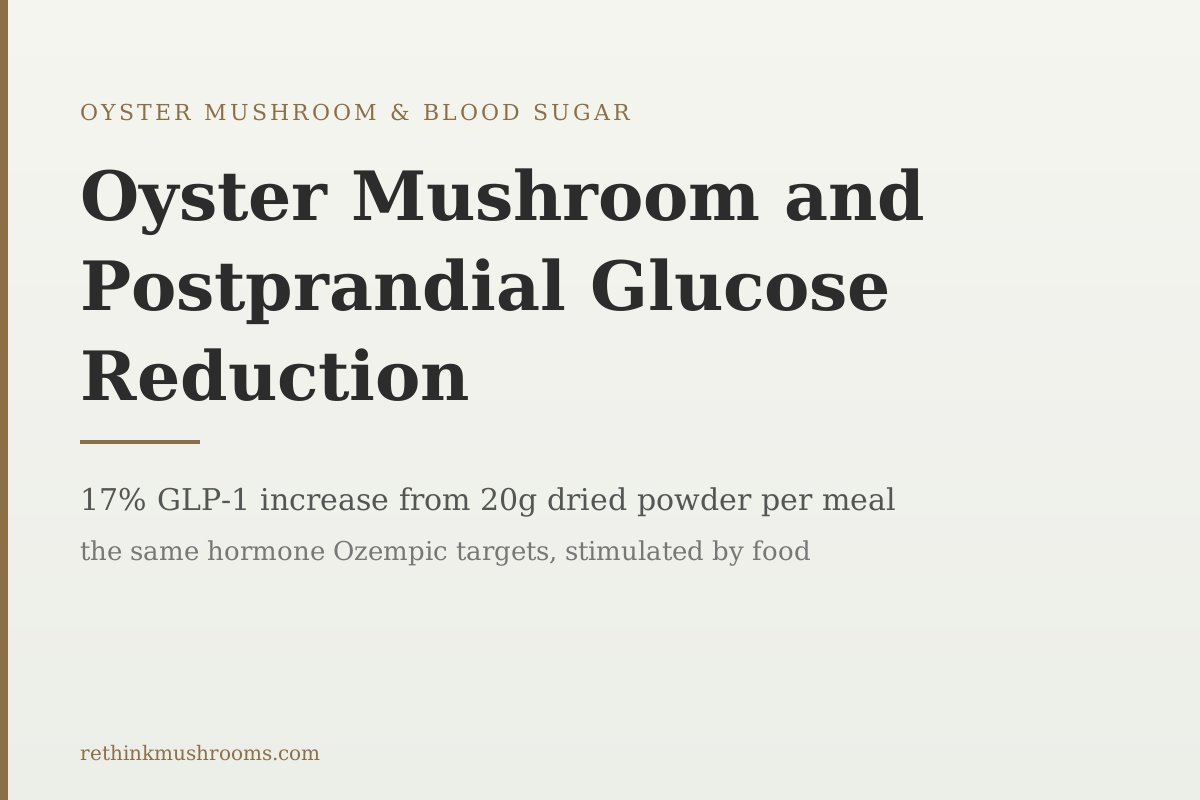
17% GLP-1 increase
Adding 20 grams of dried oyster mushroom powder to a single meal raised postprandial GLP-1 by 17% and reduced circulating free fatty acids by 14% in adults with impaired glucose tolerance, in a 2022 double-blind crossover trial.
Gorzynik-Debicka et al., European Journal of Nutrition, 2022
20g dried powder
the dose used in the RCT, approximately equivalent to 200g of fresh oyster mushroom
GLP-1 +17%
postprandial hormone increase; GLP-1 is the same hormone targeted by semaglutide (Ozempic)
NEFA -14%
free fatty acids in blood also reduced, a secondary metabolic benefit rarely mentioned in popular coverage
Gorzynik-Debicka et al., European Journal of Nutrition, 2022
 View as image ↗
Postprandial glucose (blood sugar in the hours after eating) is where much of the metabolic damage in type 2 diabetes and prediabetes actually accumulates. Fasting glucose gets measured at the doctor's office. Post-meal spikes happen three times a day, quietly, and contribute substantially to HbA1c over time.
The most-studied dietary strategy for blunting these spikes involves oyster mushroom, and the human evidence is specific: adding 20 grams of dried oyster mushroom powder to a meal raised postprandial GLP-1 by 17% in a 2022 double-blind randomized controlled trial in adults with impaired glucose tolerance.[1] That number, and the mechanism behind it, is more interesting than most coverage acknowledges.
For the complete picture of oyster mushroom's nutritional profile including fiber and beta-glucan content, see Oyster Mushroom Nutritional Profile: Complete Breakdown. For the broader species profile, see our article on What Is Oyster Mushroom: The World's Second Most Popular Mushroom.
Key Takeaways
- A 2022 double-blind crossover RCT found that adding 20g of dried oyster mushroom powder (8.1g beta-glucan) to a meal raised postprandial GLP-1 by 17% and reduced circulating free fatty acids by 14% in adults with impaired glucose tolerance (Gorzynik-Debicka et al., 2022)
- GLP-1 (glucagon-like peptide-1) is the gut hormone that semaglutide (Ozempic) and similar drugs pharmacologically activate; oyster mushroom stimulates the body's own GLP-1 production through gut beta-glucan fermentation
- A 2025 study confirmed GLP-1 stimulation from oyster mushroom powder in the same prediabetes population, providing independent replication of the 2022 finding (Pérez-Vega et al., 2025)
- Pleurotus eryngii (king oyster mushroom) also improved postprandial glycemia and significantly suppressed ghrelin (the hunger hormone) in metabolically unhealthy obese participants in a separate trial (Deleu et al., 2022)
- A systematic review of 8 clinical trials found consistent beneficial effects of oyster mushroom consumption on glucose parameters across all trials reviewed (Dicks and Ellinger, 2020)
- The 20g dried powder dose used in the key RCT is approximately equivalent to 200g of fresh oyster mushroom per meal, making the practical application estimable
What Postprandial Glucose Is and Why Meal-Time Spikes Matter More Than You Think
Postprandial glucose refers to blood glucose concentration in the period following a meal, typically measured over two hours. In a person with normal glucose metabolism, blood sugar rises after eating, peaks at around 60-90 minutes, then returns to near-fasting levels by two hours. The total amount of glucose exposure during this window is often measured as the "area under the curve," which captures the full magnitude and duration of the post-meal spike rather than just the peak.
In people with prediabetes or type 2 diabetes, this curve is higher, wider, and slower to return to baseline. Glucose lingers in the bloodstream longer at elevated concentrations. Over hundreds of meals, this cumulative extra exposure drives glycation, the chemical process by which glucose damages proteins, which is what HbA1c measures as a three-month average.
Post-meal glucose management is therefore not a secondary concern. It is a primary target for dietary interventions because it is where the damage accumulates on a daily basis. A food that consistently reduces post-meal glucose area under the curve by even a modest amount, eaten three times a day, can produce a meaningful reduction in HbA1c over months.
A 2020 systematic review by Dicks and Ellinger examined 8 published clinical trials on oyster mushroom and cardiometabolic parameters.[4] All 8 studies observed beneficial effects on glucose metabolism, including both fasting glucose and postprandial glucose reduction. This consistency across independent trials is unusual in functional food research, where results are often mixed.
The 2022 RCT: What Happened When 20 Grams of Oyster Mushroom Powder Was Added to a Meal
The most precisely designed human postprandial study came from Gorzynik-Debicka and colleagues in 2022, published in the European Journal of Nutrition.[1]
The trial was a double-blind randomized controlled crossover study. Twenty-two adults with impaired glucose tolerance (the prediabetes phenotype characterized by elevated post-meal glucose specifically) consumed a standardized meal on two occasions. One meal was fortified with 20 grams of dried oyster mushroom powder, providing 8.1 grams of beta-glucan. The other meal was identical but without mushroom. The order was randomized, and neither participants nor researchers measuring outcomes knew which version was consumed.
The results:
- Postprandial GLP-1 area under the curve: 17% higher after the mushroom meal (P = 0.001)
- Non-esterified fatty acids (NEFAs) area under the curve: 14% lower after the mushroom meal (P = 0.026)
- Hunger sensation: also reported to change, consistent with the GLP-1 response
The GLP-1 increase is the headline finding because GLP-1 is the hormone that most directly affects post-meal glucose management. It signals the pancreas to release insulin proportional to glucose exposure, slows gastric emptying so glucose enters the bloodstream more gradually, and signals satiety to the brain.
The NEFA reduction is less discussed but metabolically significant. Elevated circulating free fatty acids impair insulin signaling and contribute to the insulin resistance that underlies prediabetes. A 14% reduction in NEFAs after a single meal is a meaningful secondary benefit.
The GLP-1 Connection: Food Stimulating the Same Hormone That Ozempic Targets
GLP-1 agonist drugs, including semaglutide (Ozempic, Wegovy) and liraglutide (Victoza, Saxenda), work by binding GLP-1 receptors directly and continuously. They are pharmacological tools that saturate the receptor with synthetic GLP-1 activity independent of meals. This produces the sustained insulin-sensitizing, appetite-suppressing, and gastric-emptying effects that make them effective for both type 2 diabetes management and weight loss.
What the oyster mushroom trial documented is categorically different: a dietary food stimulating the body's own L-cells to produce and release more GLP-1 in response to eating. The mechanism starts with the beta-glucan content of oyster mushroom resisting digestion, reaching the colon, and being fermented by gut bacteria into short-chain fatty acids. These short-chain fatty acids bind to receptors on L-cells in the intestinal lining, triggering GLP-1 secretion.
The result is not pharmacological GLP-1 receptor saturation. It is a meal-timed boost to endogenous GLP-1 production. The magnitude is smaller than what a drug produces, and whether an individual responds depends partly on the gut bacteria available to ferment the beta-glucan. But it is the same biological signal being amplified, through a dietary rather than pharmaceutical route.
A 2025 follow-up study by Pérez-Vega and colleagues confirmed GLP-1 stimulation from oyster mushroom powder in IGT adults, providing independent replication of the 2022 finding.[2] This replication matters: a single trial could reflect luck or sample-specific characteristics. Two independent studies producing consistent results substantially strengthens the finding.
For the full treatment of how mushroom beta-glucan stimulates GLP-1, including the microbiome factors that determine response magnitude, see our dedicated article on Mushrooms and GLP-1: Can Fungi Mimic the Ozempic Effect?.
King Oyster and Ghrelin: When Glucose Control and Hunger Suppression Occur Together
The postprandial glucose story does not end with GLP-1. Ghrelin, produced primarily in the stomach, is the hormone that drives hunger before meals and decreases after eating. In obesity and insulin resistance, this post-meal ghrelin suppression is often blunted, leaving the body signaling hunger even after sufficient calories.
A trial by Deleu and colleagues (published 2022) tested king oyster mushroom (Pleurotus eryngii) in people with metabolically unhealthy obesity.[3] Compared to control, king oyster mushroom significantly improved postprandial blood glucose and produced substantially greater ghrelin suppression. Hunger scores were lower and fullness scores were higher in the mushroom group.
This is relevant to the postprandial glucose story because ghrelin and insulin interact: elevated ghrelin blunts insulin secretion, which worsens post-meal glucose control. A food that simultaneously lowers post-meal glucose AND suppresses ghrelin is addressing the problem from two angles.
King oyster (P. eryngii) is a close relative of oyster mushroom (P. ostreatus) with a similar beta-glucan profile, though differences in polysaccharide structure may produce somewhat different fermentation kinetics and downstream hormone responses. The Deleu findings complement the Gorzynik-Debicka 2022 data with a second species and a second appetite hormone, broadening the picture of how Pleurotus mushrooms affect post-meal metabolic signaling.
What to Know About the Dose: From Research Protocol to Real Food
The Gorzynik-Debicka 2022 trial used 20 grams of dried oyster mushroom powder per meal, providing 8.1 grams of beta-glucan. Converting this to practical food terms: dried oyster mushroom powder is typically produced by drying and grinding fresh mushrooms, with roughly 10:1 mass reduction on drying (fresh mushrooms are approximately 90% water). This suggests 20 grams of dried powder corresponds to roughly 200 grams of fresh oyster mushroom per meal.
A 200-gram serving of oyster mushroom per meal is a substantial portion, not a trace garnish. This is worth stating honestly for two reasons. First, it clarifies what "eating oyster mushrooms" would realistically need to mean to approach the trial conditions. Second, it explains why mushroom powder supplements exist as a more practical format for achieving these beta-glucan doses consistently.
The systematic review by Dicks and Ellinger noted that multiple clinical trials used different oyster mushroom preparations and doses with varying durations of supplementation.[4] The postprandial effects in the 2022 RCT were acute, measured after a single meal. Fasting glucose improvement requires weeks of regular consumption: it appears across trials with longer supplementation periods rather than from a single dose. These are different effects operating on different timescales. The postprandial data supports adding oyster mushroom to individual meals for meal-time glucose management. The fasting glucose data supports regular dietary inclusion over weeks.
For how oyster mushroom's natural lovastatin content contributes to the broader metabolic picture alongside the beta-glucan glucose effects, see Natural Lovastatin in Oyster Mushrooms: How Much Is There?.
What the Evidence Means Together: Consistent Findings Across Independent Studies
Several features of the oyster mushroom postprandial evidence base stand out.
The GLP-1 finding has now been observed in two independent human studies (Gorzynik-Debicka 2022 and Pérez-Vega 2025), both in the same population (adults with impaired glucose tolerance), using the same food format (dried oyster mushroom powder). This is more than single-study evidence.
The Dicks 2020 systematic review finding that all 8 reviewed clinical trials showed beneficial glucose effects is unusual for functional food research, where results are typically mixed across studies.[4] Consistency across 8 independent trials using different protocols and populations suggests the glucose effect is not an artifact of one study's design.
The ghrelin data from the Deleu trial in king oyster mushroom (P. eryngii) adds a separate hormone signal that parallels the GLP-1 effect: both hormones work in the same direction for post-meal metabolic control.
What remains unknown: whether these acute meal-time effects translate to meaningful HbA1c improvement over months of regular consumption, and how much individual variation in gut microbiome composition affects the magnitude of GLP-1 response (the 2025 Pérez-Vega study examined microbiome-response correlations as a secondary analysis). No long-term weight loss study has yet used oyster mushroom powder at these doses in a controlled design.
For how oyster mushroom fits into the broader type 2 diabetes clinical trial literature, see Oyster Mushroom for Type 2 Diabetes: Clinical Trial Results. For the mechanism behind oyster mushroom's effect on blood sugar across multiple pathways, see Oyster Mushroom and Blood Sugar: Hypoglycemic Research.
The Bottom Line
The most direct human evidence for oyster mushroom and postprandial glucose comes from a 2022 double-blind RCT showing that 20g of dried oyster mushroom powder per meal raised GLP-1 by 17% and reduced free fatty acids by 14% in adults with impaired glucose tolerance. The GLP-1 mechanism was confirmed by a 2025 independent study. King oyster mushroom also suppressed ghrelin and improved postprandial glycemia in obese subjects. These acute meal-time effects are well-documented across multiple human studies; long-term HbA1c impact from regular consumption remains an open question.
Frequently Asked Questions
Sources & References
- 1. Source details for this reference are not yet available.
- 2. Source details for this reference are not yet available.
- 3. Source details for this reference are not yet available.
- 4. Source details for this reference are not yet available.