Oyster Mushroom Lovastatin & Cholesterol
8 clinical trials
A 2020 systematic review of 8 clinical trials found oyster mushrooms reduce cholesterol and blood glucose at food-level doses, despite containing far less lovastatin than any pharmaceutical prescription.
Dicks & Ellinger, Nutrients, 2020
2.8–5.4 mg/100g
Typical lovastatin content in dried Pleurotus ostreatus fruiting bodies
200–360g dry daily
Amount of dried oyster mushroom needed to match just 10mg pharmaceutical lovastatin
69–84% destroyed
Lovastatin lost when oyster mushrooms are cooked at 45–65°C (Lam & Okello, 2015)
Dicks & Ellinger, Nutrients, 2020
 View as image ↗
Oyster mushrooms contain a molecule called lovastatin, the same compound sold under the brand name Mevacor as a prescription cholesterol medication. If you have read about oyster mushrooms and cholesterol, you have probably encountered this fact. What you probably have not encountered is the dose math, which tells a much more honest story.
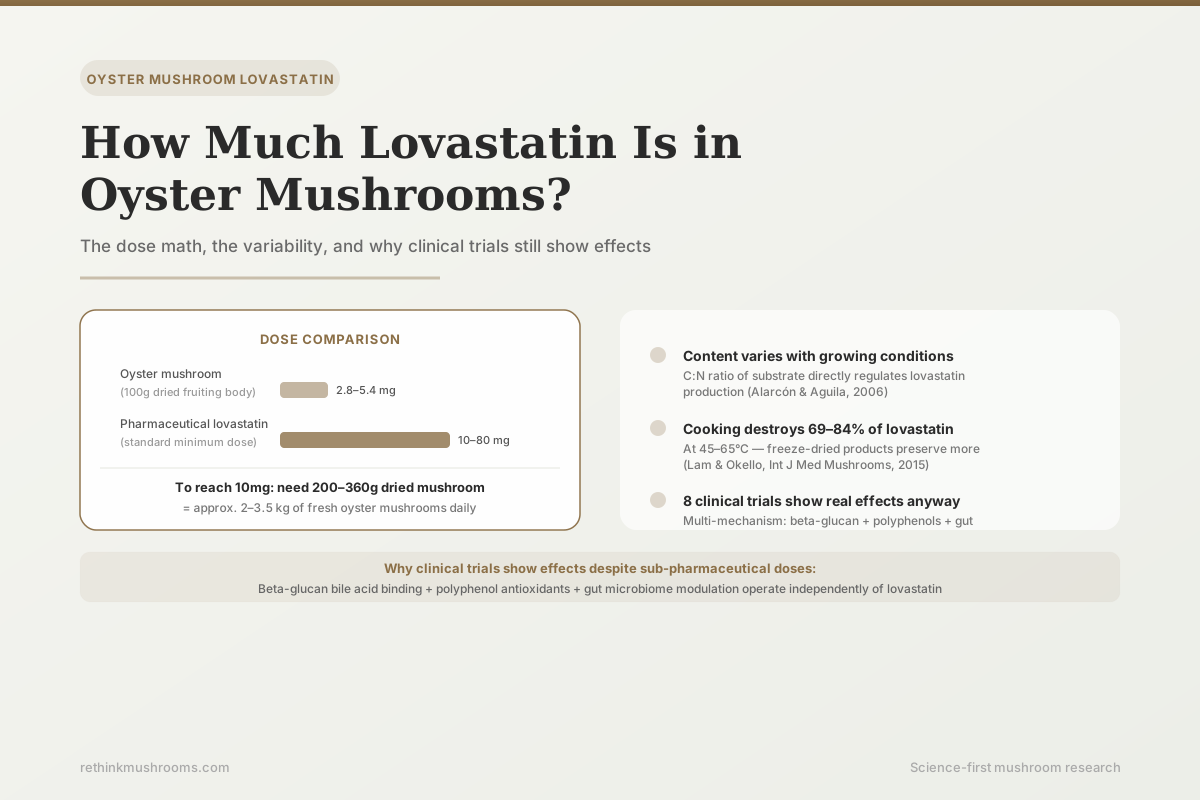
A standard minimum pharmaceutical lovastatin prescription is 10mg per day. Typical dried oyster mushrooms contain 2.8–5.4 mg of lovastatin per 100g of dry weight. To hit a 10mg dose from food alone, a person would need to eat 200–360g of dried oyster mushroom every day. That is roughly 2–3.5 kilograms of fresh mushrooms daily. The lovastatin in food-form oyster mushrooms cannot replicate pharmaceutical statin dosing. Yet a 2020 systematic review found that 8 clinical trials showed real cardiometabolic benefits from oyster mushroom consumption at normal dietary doses. These two facts together are the actual story, and they are covered in depth here. For the full picture of oyster mushroom research, including how lovastatin fits into the broader compound profile, see our complete oyster mushroom guide.
Key Takeaways
- Typical dried Pleurotus ostreatus contains 2.8–5.4 mg lovastatin per 100g dry weight; reaching a 10mg pharmaceutical dose from food alone would require 200–360g of dried mushroom daily
- The same oyster mushroom species can produce vastly different lovastatin amounts depending on growing substrate: the carbon-to-nitrogen ratio of the substrate directly regulates lovastatin biosynthesis (Alarcón & Aguila, 2006)
- Published lovastatin content values vary widely not just because of biology but because different analytical methods produce different numbers for the same sample (Tsiantas et al., 2021)
- Cooking degrades 69–84% of oyster mushroom lovastatin at 45–65°C; clinical trials showing cholesterol benefits primarily used dried powder or freeze-dried mushrooms, not cooked fresh mushrooms (Lam & Okello, 2015)
- Oyster mushrooms contain at least three separate cholesterol-relevant mechanisms beyond lovastatin: beta-glucan bile acid binding, polyphenol antioxidant activity, and gut microbiome modulation
- A 2020 systematic review of 8 clinical trials found consistent reductions in total cholesterol, LDL, and blood glucose from oyster mushroom consumption; this evidence suggests the multi-mechanism effect is real even at food doses (Dicks & Ellinger, 2020)
What Lovastatin Is and How Oyster Mushrooms Make It
Lovastatin is a statin, a class of compounds that work by blocking the enzyme responsible for the liver's internal cholesterol production. The enzyme is called HMG-CoA reductase (3-hydroxy-3-methylglutaryl coenzyme A reductase), which functions as a rate-controlling switch for how much cholesterol the liver makes. When lovastatin binds this enzyme and slows it down, liver cholesterol production drops, which triggers the liver to pull more LDL cholesterol out of the bloodstream.
Pharmaceutical lovastatin is derived from fungal fermentation and has been in clinical use since the 1980s. The discovery that oyster mushrooms contain the same molecule came in 1995, when Bobek and colleagues identified lovastatin in Pleurotus ostreatus fruiting bodies and established its mechanistic identity with the HMG-CoA reductase inhibitor.[1]
Alarcón and colleagues followed in 2003 by extracting and purifying lovastatin from multiple Pleurotus ostreatus strains and confirming that the mushroom-derived molecule was structurally identical to pharmaceutical lovastatin.[2] This is not a "statin-like compound" or an "analog." It is the same molecule.
What remains less discussed is why mushrooms make lovastatin at all. The compound is not evolved for human benefit. Current thinking is that it likely functions as a competitive inhibitor against other fungi or bacteria in the mushroom's environment, a defense or competition compound. The fact that it is identical to pharmaceutical lovastatin is biochemical coincidence, not evolutionary intent.
For a deeper look at the biosynthesis pathway and how substrate conditions regulate lovastatin production, see our article on lovastatin biosynthesis in Pleurotus ostreatus.
Why Published Lovastatin Content Numbers Disagree So Much
Type "lovastatin content oyster mushroom" into any database and you will find values ranging from near zero to several hundred milligrams per hundred grams of dry weight. This range is not just biological variability; it is also a measurement problem.
Tsiantas and colleagues published a 2021 paper in Molecules comparing different analytical approaches to quantifying lovastatin across multiple mushroom species.[4] Their finding: the same mushroom sample produces substantially different lovastatin values depending on which analytical method is used. Different extraction solvents, different chromatography systems, and different calibration standards each introduce their own systematic variance. A reading of 0.1 mg/100g from one lab and 5.4 mg/100g from another lab may reflect methodological differences as much as biological ones.
This matters because it explains why headlines about oyster mushroom lovastatin content are often not comparable to each other. The "2.8% dry weight" figure that circulates widely, and the "2.8–5.4 mg/100g" range that careful reviews report for typical commercial oyster mushrooms, represents a middle of the distribution from consistent analytical methods. Both extremely low and extremely high published values should be read with methodological skepticism.
The biological variability is also real and worth understanding separately.
What Actually Controls How Much Lovastatin a Mushroom Produces
Growing conditions, particularly the carbon-to-nitrogen ratio of the substrate, have a direct and large effect on lovastatin production. Alarcón and Aguila's 2006 study examined this relationship systematically.[3] They found that the carbon-to-nitrogen ratio of the growth substrate, the balance between carbon-rich materials like straw or sawdust and nitrogen-rich materials like bran or supplements, is a primary regulator of how much lovastatin the mushroom produces. Mushrooms grown on high-carbon, low-nitrogen substrates produced more lovastatin than those grown on nitrogen-rich or balanced substrates.
This means the same genetic strain of Pleurotus ostreatus can produce wildly different lovastatin amounts depending on what it was grown on. Wild-foraged oyster mushrooms from a log of decaying hardwood may contain different concentrations than commercially cultivated mushrooms grown on wheat straw, which may differ again from mushrooms grown on supplemented sawdust blocks.
A second biological variable is the form of the mushroom consumed. Lo and colleagues published a 2012 comparative study measuring bioactive components including lovastatin in fruiting bodies versus mycelia (the root-like thread network) across several mushroom species.[5] The lovastatin distribution between fruiting body and mycelium varied by species and growth conditions. For supplement consumers, this matters: mycelium-based products and fruiting body extracts are not interchangeable sources of lovastatin.
The Dose Math: Why Food-Level Lovastatin Cannot Replace a Prescription
With the typical range established, the calculation is straightforward.
Dried Pleurotus ostreatus fruiting bodies average 2.8–5.4 mg of lovastatin per 100g of dry weight under consistent analytical methods. The minimum standard pharmaceutical lovastatin prescription is 10mg per day. To hit that dose from food alone, a person would need to eat 200–360g of dried oyster mushroom every day. Dried mushrooms weigh roughly 10% of their fresh weight. So 200–360g of dried mushroom equates to approximately 2–3.5 kilograms of fresh oyster mushrooms daily.
No one eats 2–3.5 kg of oyster mushrooms every day. The food-form lovastatin dose is simply not competitive with pharmaceutical dosing.
This arithmetic is the honest baseline. But it does not end the story. Clinical trials show real cholesterol effects from oyster mushrooms at far lower doses, which means lovastatin is not the whole mechanism.
What Cooking Does to the Lovastatin (And Why the Clinical Trial Design Matters)
There is a second layer to the dose problem: cooking. Lam and Okello published a 2015 study directly measuring lovastatin content in raw versus processed Pleurotus ostreatus using multiple preparation methods.[6]
Heating oyster mushrooms to 45–65°C destroyed 69–84% of the lovastatin content. The higher the temperature and the longer the cooking time, the greater the loss. Beta-glucan and polyphenol content were also reduced, though less severely than lovastatin.
This finding raises an important methodological point about the clinical trial literature. The 2020 systematic review by Dicks and Ellinger analyzed the results across 8 clinical trials of oyster mushrooms for cardiometabolic outcomes.[7] Their finding was clear: oyster mushroom consumption reduced total cholesterol, LDL cholesterol, and blood glucose across most of the trials. Most of these trials used dried mushroom powder or freeze-dried mushroom products, not cooked fresh mushrooms. Freeze-drying and low-temperature drying methods preserve lovastatin and other bioactives far better than cooking at high heat. The clinical trials showing benefits may have delivered meaningfully more lovastatin per gram than a sauteed oyster mushroom would.
If you are eating oyster mushrooms specifically for their cholesterol-relevant compounds, the cooking method matters. Minimal heat, or supplement forms using low-temperature processing, preserves substantially more lovastatin and beta-glucan. The full cooking stability data is in our article on cooking and lovastatin stability in oyster mushrooms, and practical guidance on preserving nutrients during cooking is in how to cook oyster mushrooms for maximum nutrient retention.
Why Clinical Trials Still Show Effects: The Multi-Mechanism Story
The Dicks 2020 systematic review results require an explanation, because if the food-level lovastatin dose is too low to pharmacologically inhibit HMG-CoA reductase in the way pharmaceutical statins do, something else must be driving the cholesterol reductions seen in 8 clinical trials.
Three additional mechanisms are documented in the preclinical literature.
Beta-glucan and bile acid binding. Beta-glucans from oyster mushrooms bind bile acids (digestive compounds the liver makes from cholesterol and secretes into the gut) in the intestine, preventing their reabsorption. When bile acids are excreted rather than recycled, the liver must make new ones from cholesterol, lowering circulating levels. This is the same mechanism by which psyllium fiber and cholestyramine work. Palanisamy and colleagues established the bile acid-binding capacity of oyster mushroom beta-glucan fractions directly in vitro.
Polyphenol antioxidant activity. Oyster mushrooms contain polyphenols including chrysin (a flavonoid), which contributes antioxidant protection against LDL oxidation, the process by which LDL cholesterol becomes the form most likely to deposit in arterial walls. The cholesterol lowering observed in trials may partly reflect reduced LDL oxidation and improved lipid quality rather than simple concentration reduction.
Gut microbiome modulation. Animal research has documented that oyster mushroom polysaccharides alter gut microbial composition in directions associated with improved lipid metabolism. This mechanism operates over weeks and does not depend on direct absorption of any single compound.
The honest picture: oyster mushrooms at food-level doses cannot deliver pharmacological lovastatin inhibition of HMG-CoA reductase. But they may reduce cholesterol modestly through three additional mechanisms that operate independently of the lovastatin pathway. The clinical trial results are consistent with multi-mechanism effects rather than a statin-equivalent pharmacological action.
For the full evidence comparison between oyster mushrooms and pharmaceutical statins, see Oyster Mushroom vs. Statin Drugs. For the practical consumer question of whether eating oyster mushrooms can help with cholesterol, see Oyster Mushroom Lovastatin: Can Eating Pleurotus Replace a Statin?. For how king oyster (Pleurotus eryngii) compares on the same lovastatin question, see King Oyster Mushroom and Statin-Like Effects.
The Bottom Line
Oyster mushrooms contain genuine lovastatin, confirmed as structurally identical to pharmaceutical lovastatin since 1995. Typical dried fruiting bodies contain 2.8–5.4 mg per 100g, but reaching a 10mg pharmaceutical dose would require eating 200–360g of dried mushroom daily. Cooking destroys 69–84% of that content. Yet 8 clinical trials show real cardiometabolic benefits at food-level doses, explained by additional mechanisms: beta-glucan bile acid binding, polyphenol antioxidant activity, and gut microbiome modulation. Oyster mushrooms cannot pharmacologically replicate statin therapy; they may contribute modestly to cholesterol management through independent pathways.
Frequently Asked Questions
Sources & References
- 1. Source details for this reference are not yet available.
- 2. Source details for this reference are not yet available.
- 3. Source details for this reference are not yet available.
- 4. Source details for this reference are not yet available.
- 5. Source details for this reference are not yet available.
- 6. Source details for this reference are not yet available.
- 7. Source details for this reference are not yet available.