King Oyster & Cholesterol
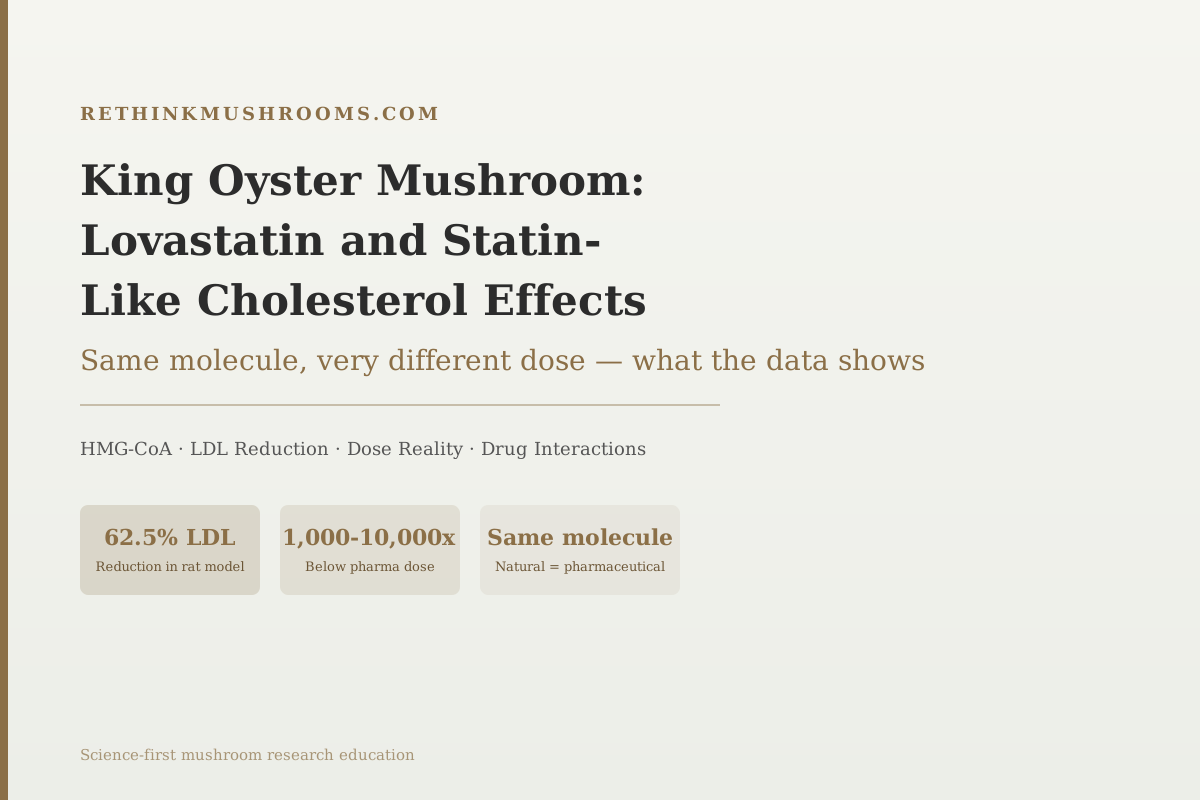
62.5% LDL reduction
Hypercholesterolemic rats fed 5% P. eryngii fruiting body powder showed 62.5% reduction in plasma LDL cholesterol, 46.33% reduction in triglycerides, and 57.14% improvement in LDL/HDL ratio; this is an animal model study that has not been replicated in humans.
Alam et al., Food and Chemical Toxicology, 2011
Same molecule
the relationship between naturally occurring lovastatin in Pleurotus fruiting bodies and the pharmaceutical drug: natural lovastatin is chemically identical to the drug, first identified in Pleurotus species in a 1995 landmark study (Gunde-Cimerman et al.)
Micrograms vs. mg
the dose comparison between mushroom lovastatin content (typically 1-10 micrograms per gram of dried mushroom) and pharmaceutical statin doses (10-80 milligrams per day), a difference of approximately 1,000-fold to 10,000-fold
Interaction risk
the critical safety consideration: natural lovastatin IS chemically identical to pharmaceutical lovastatin and carries the same drug interaction risks, particularly if taken alongside prescribed statins
Alam et al., Food and Chemical Toxicology, 2011
 View as image ↗
King oyster mushroom has become a popular search term in the "natural alternatives to statins" space. The reason has a legitimate scientific foundation: king oyster mushroom (Pleurotus eryngii) contains naturally occurring lovastatin, which is chemically identical to the pharmaceutical statin drug Mevacor. The same HMG-CoA reductase enzyme that pharmaceutical statins block is the target of lovastatin found in the mushroom.
This is a real biological fact, not wellness mythology. It was documented in peer-reviewed literature in 1995 and confirmed repeatedly since. What wellness content typically skips is the part that follows: the amount of lovastatin in king oyster mushroom is roughly 1,000 to 10,000 times lower than pharmaceutical doses, natural lovastatin is chemically identical to the drug and carries the same interaction risks, and the preclinical data, while striking, comes from animal models, not human trials.
This article gives you the full picture: what the research established, what the dose reality looks like, and what medical context matters before drawing conclusions from the statin comparison.
For the broader cholesterol research overview, see king trumpet and cholesterol: lipid-lowering research. For all four cardiovascular protection mechanisms, see king oyster mushroom and cardiovascular health. For the complete king trumpet overview, see what is king trumpet mushroom: the meaty mushroom with health benefits.
Key Takeaways
- King oyster mushroom (Pleurotus eryngii) contains naturally occurring lovastatin, chemically identical to the pharmaceutical statin drug, confirmed in Pleurotus species by Gunde-Cimerman et al. in 1995; this is the same compound that inhibits HMG-CoA reductase to block cholesterol synthesis in the liver
- Validated analytical quantification (Tsiantas et al., 2021) confirmed measurable lovastatin in Pleurotus species alongside ergothioneine; mushroom lovastatin content is typically in the microgram-per-gram range, approximately 1,000-10,000 times lower than pharmaceutical statin doses
- Animal studies show substantial cholesterol-lowering: 5% dietary P. eryngii powder reduced LDL by 62.5% and triglycerides by 46.33% in hypercholesterolemic rats, though multiple mechanisms (not just lovastatin) likely contributed (Alam et al., 2011)
- The closest human evidence comes from Pleurotus ostreatus (a close relative): a 2020 systematic review of 8 clinical trials found beneficial effects on cholesterol, LDL, and triglycerides in humans, rated as low-quality evidence due to small sample sizes (Dicks et al., 2020)
- Natural lovastatin is chemically identical to pharmaceutical lovastatin and carries the same drug interaction risks, particularly the potential for myopathy when combined with other statins or interacting medications
- King oyster mushroom in food quantities cannot replicate pharmaceutical statin doses and should not replace prescribed statin therapy
What Lovastatin Is and Why Finding It in a Mushroom Matters
Statins are among the most prescribed drug classes in the world. They work by inhibiting HMG-CoA reductase, an enzyme that performs an early step in the liver's cholesterol synthesis pathway. Block that enzyme, and the liver produces less cholesterol, reducing circulating LDL levels.
Lovastatin (brand name Mevacor) was discovered in 1979 in a fungal mold called Aspergillus terreus. It was later found in red yeast rice, then in Pleurotus mushrooms.
Gunde-Cimerman and colleagues published the landmark identification study in 1995: Pleurotus fruiting bodies contain lovastatin (then called mevinolin), confirmed by both bioassay and chemical characterization.[1] The compound was not just structurally similar to the pharmaceutical drug; it was the same molecule. The study covered multiple Pleurotus species including eryngii and established the mechanistic foundation for why these mushrooms might affect cholesterol.
This finding gave Pleurotus its "statin-like" reputation. The reputation is scientifically grounded in the chemistry. The next question is whether the amount present is clinically meaningful.
How Much Lovastatin Is Actually in King Oyster Mushroom?
Tsiantas and colleagues addressed the quantification question directly in 2021, using validated analytical methods to measure both lovastatin and ergothioneine across multiple mushroom species including Pleurotus.[2] They confirmed measurable lovastatin content in Pleurotus species and noted that two distinct cardiovascular-relevant bioactives (lovastatin and ergothioneine) coexist in these mushrooms.
The concentration data from multiple analytical studies places mushroom lovastatin content in a typical range of roughly 1-10 micrograms per gram of dried mushroom material. Some analyses have found higher concentrations depending on strain, growth conditions, and extraction method.
Pharmaceutical lovastatin doses are 10-80 milligrams per day. A milligram contains 1,000 micrograms. So a pharmaceutical starting dose of 10mg delivers roughly 10,000 micrograms. At 5 micrograms per gram of dried mushroom, reaching a 10mg "pharmaceutical equivalent" would require eating 2,000 grams (2 kilograms) of dried mushroom material per day.
Fresh king oyster mushrooms are approximately 90% water. A typical serving of 100g fresh contains about 10g dried equivalent. At 5 micrograms per gram: 50 micrograms of lovastatin per serving, or 0.05mg. This is 0.5% of a 10mg pharmaceutical dose.
Concentrated extracts would deliver more than whole mushroom, and some supplement products make specific claims about lovastatin content. But at any reasonable serving size of whole mushroom, the lovastatin fraction is a small fraction of pharmaceutical doses.
This doesn't mean lovastatin in mushrooms is irrelevant. Even partial HMG-CoA inhibition contributes to cholesterol reduction alongside the polysaccharide mechanisms. But it means the "king oyster works like a statin" framing overstates both the concentration parity and the mechanism similarity at normal serving levels.
For more on the multiple mechanisms through which P. eryngii reduces LDL, see Pleurotus eryngii and LDL reduction: mechanisms.
The LDL Reduction Data: What Preclinical Studies Show
The most striking cholesterol data for P. eryngii comes from Alam and colleagues' 2011 study.[3] They fed rats a hypercholesterolemic diet supplemented with 5% P. eryngii fruiting body powder and measured lipid profiles after 8 weeks.
The results at 5% dietary inclusion:
- Plasma LDL reduced by 62.5%
- Triglycerides reduced by 46.33%
- Total cholesterol reduced by 24.05%
- LDL/HDL ratio reduced by 57.14%
- Histological improvement confirmed in liver and arterial tissue
These are substantial effects. They suggest that P. eryngii powder at this dietary proportion significantly redirects lipid metabolism in a cardiovascular-protective direction.
The interpretation requires care. First, 5% of total dietary intake is a high proportion for a supplement; for a 2,000 calorie human diet, this would be roughly 100g of dried mushroom powder daily. Second, rats have different cholesterol metabolism than humans, with higher natural HDL levels. Third, the results reflect combined mechanisms: lovastatin, polysaccharide bile acid binding, beta-glucan fiber effects, and potentially gut microbiota changes. Attributing the 62.5% reduction specifically to lovastatin would be inaccurate.
What the data does establish is that P. eryngii exerts genuine and large-scale effects on lipid profiles in this preclinical model. The magnitude is impressive. Whether any fraction of this translates to humans at realistic intake levels requires human clinical trials.
The Closest Human Evidence: Pleurotus ostreatus Clinical Trials
No randomized controlled trial has tested P. eryngii specifically in humans with cholesterol as the primary outcome. The closest available evidence comes from P. ostreatus (common oyster mushroom), a closely related species that shares lovastatin and beta-glucan chemistry with eryngii.
Dicks and colleagues published a systematic review of P. ostreatus clinical trials in 2020, covering 8 trials that measured cardiometabolic parameters.[4] The trials showed beneficial effects on total cholesterol, LDL, triglycerides, and blood glucose in humans. The reviewers rated the evidence quality as low due to small trial sizes, short duration, and methodological limitations.
This is the honest human evidence benchmark: real but modest in quality, and not species-specific to eryngii. Whether P. eryngii would show similar, stronger, or weaker effects in human trials is genuinely unknown.
For the ergothioneine in king trumpet that adds a second cardiovascular protective compound alongside lovastatin, see king trumpet: the highest ergothioneine source among mushrooms.
Why Natural Lovastatin Is Not a Replacement for Prescribed Statins
Several important points apply before anyone draws conclusions from the statin comparison:
The dose reality. As described above, typical dietary intakes of king oyster mushroom deliver roughly 0.5-2% of the lowest pharmaceutical statin dose. Food-based consumption cannot replicate pharmaceutical HMG-CoA inhibition at normal serving sizes. Concentrated extracts may narrow this gap but do not close it.
The drug interaction risk. This is the critical safety point that wellness content almost never addresses: natural lovastatin IS chemically identical to pharmaceutical lovastatin. If someone taking a prescription statin also consumes concentrated mushroom lovastatin, they are effectively increasing their statin dose. Higher statin doses increase the risk of muscle damage (myopathy) and, in severe cases, rhabdomyolysis (muscle breakdown that can damage kidneys). The risk is real and is not reduced by the natural source.
Additionally, lovastatin is metabolized by the CYP3A4 enzyme system. Drugs that inhibit CYP3A4 (including certain antifungals and some antibiotics) increase lovastatin concentration in the body, amplifying both effect and side effect risk. This applies to natural lovastatin from mushrooms just as it does to the pharmaceutical form.
The clinical management question. People with cardiovascular disease or high cholesterol who are making treatment decisions should do so with their physician. King oyster mushroom as a dietary food is a reasonable food choice with genuine evidence for favorable lipid effects across multiple mechanisms. It is not a substitute for clinically prescribed treatment without physician supervision.
The multiple mechanisms. The LDL reduction seen in preclinical studies likely reflects all three cholesterol-lowering mechanisms working together: lovastatin, polysaccharide bile acid binding, and gut microbiota effects. The statin comparison, while factually grounded, overemphasizes one mechanism and underemphasizes the others. The ergothioneine in king trumpet also protects against LDL oxidation, which is the step that makes elevated LDL cardiovascular-dangerous rather than just numerically elevated.
The Bottom Line
King oyster mushroom contains naturally occurring lovastatin, confirmed by Gunde-Cimerman et al. in 1995 and quantified by Tsiantas et al. in 2021. The compound is chemically identical to the pharmaceutical statin drug. However, mushroom lovastatin content is approximately 1,000-10,000 times lower than pharmaceutical doses at normal serving sizes. Preclinical data in hypercholesterolemic rats showed a 62.5% LDL reduction at 5% dietary P. eryngii powder, reflecting multiple mechanisms. The closest human evidence (Pleurotus ostreatus systematic review, Dicks et al. 2020) shows cholesterol benefits in clinical trials rated as low-quality. Natural lovastatin carries the same drug interaction risks as the pharmaceutical form and should not be combined with prescription statins without physician guidance.
Frequently Asked Questions
Sources & References
- 1RTHM-00016·Gunde-Cimerman, N et al. (1995). “Pleurotus fruiting bodies contain the inhibitor of 3-hydroxy-3-methylglutaryl-coenzyme A reductase-lovastatin..” Experimental mycology.Study breakdown →PubMed →↩
- 2RTHM-00725·Tsiantas, Konstantinos et al. (2021). “On the Identification and Quantification of Ergothioneine and Lovastatin in Various Mushroom Species: Assets and Challenges of Different Analytical Approaches..” Molecules (Basel.Study breakdown →PubMed →↩
- 3RTHM-00204·Alam, Nuhu et al. (2011). “Dietary effect of Pleurotus eryngii on biochemical function and histology in hypercholesterolemic rats..” Saudi journal of biological sciences.Study breakdown →PubMed →↩
- 4RTHM-00614·Dicks, Lisa et al. (2020). “Effect of the Intake of Oyster Mushrooms (Pleurotus ostreatus) on Cardiometabolic Parameters-A Systematic Review of Clinical Trials..” Nutrients.Study breakdown →PubMed →↩