King Trumpet & Cardiovascular Health
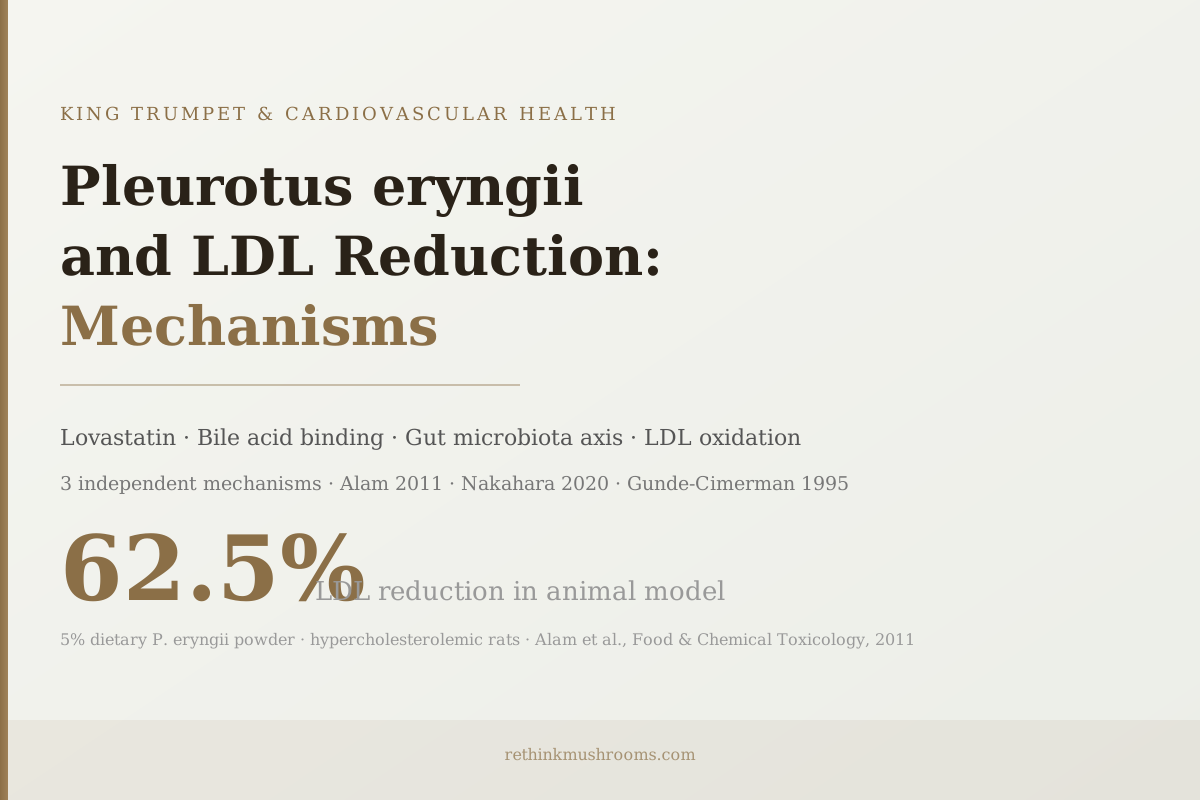
62.5% LDL reduction
Alam et al. (2011) found 5% dietary Pleurotus eryngii powder reduced LDL cholesterol by 62.5% in hypercholesterolemic rats. Three distinct mechanisms explain the effect: lovastatin-mediated HMG-CoA inhibition, beta-glucan bile acid binding, and gut microbiota remodeling.
Alam et al., Food and Chemical Toxicology, 2011
Lovastatin
naturally occurring in Pleurotus fruiting bodies since 1995; same HMG-CoA reductase inhibitor as pharmaceutical statins
Bile acid binding
beta-glucan polysaccharides trap cholesterol-derived bile acids in the gut, forcing the liver to use more cholesterol
Microbiota axis
polysaccharides increase Bifidobacterium and SCFA production, signaling the liver to reduce LDL synthesis
Alam et al., Food and Chemical Toxicology, 2011
 View as image ↗
Most discussions of king trumpet mushroom and cholesterol stop at "it contains lovastatin." That is one mechanism. There are two more, operating through completely different pathways, and the three together explain the scale of LDL reduction documented in animal studies. Alam and colleagues (2011) found that 5% dietary supplementation with P. eryngii powder reduced LDL cholesterol by 62.5% in hypercholesterolemic rats, a reduction larger than any single mechanism could credibly account for alone. This article breaks down each mechanism, what the evidence shows for it, and how they interact to produce the combined effect. This is part of the broader guide to what king trumpet mushroom is and why it's studied.
Key Takeaways
- Three distinct mechanisms drive Pleurotus eryngii's LDL-lowering activity: lovastatin-mediated HMG-CoA reductase inhibition, beta-glucan bile acid sequestration in the gut, and polysaccharide-driven gut microbiota remodeling that signals the liver to reduce cholesterol synthesis
- Alam et al. (2011) found 5% dietary P. eryngii powder reduced LDL by 62.5%, triglycerides by 46.33%, and total cholesterol by 24.05% in hypercholesterolemic rats; histological improvement in liver and arterial tissue was confirmed at the cellular level[2]
- Gunde-Cimerman et al. (1995) first documented lovastatin in Pleurotus fruiting bodies (the same compound as pharmaceutical statin drugs, inhibiting the same HMG-CoA reductase enzyme)[1]
- Nakahara et al. (2020) showed P. eryngii polysaccharides reshaped gut microbiota (increased Bifidobacterium, reduced Clostridium) and improved lipid profiles, demonstrating that the polysaccharide fraction contributes independently of lovastatin[3]
- Choi et al. (2017) documented in vitro LDL oxidation inhibition, a fourth protective pathway preventing oxidized LDL from triggering arterial plaque formation[5]
- Honest limitation: the dramatic LDL reduction numbers are from animal models; P. eryngii-specific human clinical trials are absent; the closest human evidence comes from P. ostreatus (oyster mushroom) clinical trials, a closely related species
The 62.5% Reduction: What Alam 2011 Actually Found
Alam and colleagues (2011) fed hypercholesterolemic rats either a standard diet or one containing 5% Pleurotus eryngii fruiting body powder by weight.[2] The animals on the P. eryngii diet showed striking improvements in lipid profiles:
- LDL cholesterol: down 62.5%
- LDL/HDL ratio: down 57.14%
- Triglycerides: down 46.33%
- Total cholesterol: down 24.05%
Critically, HDL (the "good" cholesterol) was not reduced; the improvement was specific to the harmful lipid fractions. Histological examination confirmed the numbers were not just blood measurements: liver tissue showed reduced fat accumulation, and arterial tissue showed cellular improvement consistent with reduced lipid deposition.
This is the most widely cited P. eryngii cardiovascular study for a reason. The effect size is large, the measurements are validated at the tissue level, and the dietary form (fruiting body powder, not extract) is relevant to how people would actually consume it. That said, 5% of diet by weight is a substantial amount, roughly equivalent to a human eating several hundred grams of mushroom daily, far more than typical dietary consumption.
The scale of the reduction (62.5% LDL reduction) cannot be explained by lovastatin alone at mushroom concentrations. This is how the multi-mechanism picture becomes important.
Mechanism 1: Lovastatin and HMG-CoA Reductase Inhibition
The first mechanism is the most frequently cited and the most well-understood.
In 1995, Gunde-Cimerman and colleagues published the landmark study confirming that Pleurotus fruiting bodies contain lovastatin.[1] The compound was identified using bioassay and chemical characterization. Lovastatin inhibits HMG-CoA reductase (3-hydroxy-3-methylglutaryl-coenzyme A reductase), the enzyme that catalyzes the rate-limiting step in cholesterol synthesis in the liver. When this enzyme is blocked, the liver produces less cholesterol and upregulates LDL receptors on the cell surface to pull more LDL out of the bloodstream. This is the same mechanism used by pharmaceutical statin drugs including atorvastatin, rosuvastatin, and the drug lovastatin itself.
The compound in king trumpet is not "statin-like" in the sense of being analogous or similar. It is chemically identical to pharmaceutical lovastatin, the same molecule, naturally produced by the fungus. This has both therapeutic and safety implications, which are addressed below.
Tsiantas and colleagues (2021) quantified lovastatin content across multiple mushroom species using validated analytical methods, confirming measurable lovastatin in Pleurotus species alongside ergothioneine.[6] The measured concentrations place king trumpet among the higher-lovastatin Pleurotus species. However, the concentrations in fresh mushrooms are substantially lower than pharmaceutical therapeutic doses. A typical 100g serving of fresh king trumpet provides micrograms of lovastatin; pharmaceutical lovastatin starts at 10mg doses. This gap matters for interpreting the clinical relevance of the lovastatin mechanism at dietary consumption levels, though concentrated extracts may achieve higher intakes.
Mechanism 2: Beta-Glucan Bile Acid Sequestration
The second mechanism operates entirely separately from lovastatin, and is likely the larger contributor to LDL reduction at dietary consumption levels.
Beta-glucans, the structural polysaccharides in mushroom cell walls, act as soluble dietary fiber when consumed. In the small intestine, beta-glucans form a viscous gel that traps bile acids, the cholesterol-derived compounds the liver secretes into the digestive tract to emulsify fats. Normally, the vast majority of bile acids are reabsorbed in the lower small intestine and recycled back to the liver. When beta-glucans sequester bile acids, they are carried through to the colon and excreted in stool.
The liver responds to bile acid loss by increasing production of new bile acids. Bile acid synthesis requires cholesterol as the starting material. When the liver needs to produce more bile acids, it upregulates LDL receptors to pull more LDL cholesterol from the blood. The result is reduced circulating LDL.
Zhang and colleagues (2020) published a comprehensive review of P. eryngii polysaccharide structure and bioactivities, documenting the specific polysaccharide fractions responsible for hypolipidemic activity.[4] They identified bile acid binding as a key mechanism, alongside other effects on hepatic cholesterol regulation. Importantly, this mechanism does not require lovastatin at all it is a fiber-based effect that would occur with any beta-glucan-rich food. The reason P. eryngii produces stronger effects than, say, oat beta-glucan, likely reflects both the quantity and the specific branching structure of its polysaccharides.
This mechanism operates at dietary consumption levels. Unlike the lovastatin question, where concentration matters significantly, bile acid sequestration scales with fiber intake and begins working at the amounts of beta-glucan achievable from regular mushroom consumption.
Mechanism 3: The Gut Microbiota Axis
The third mechanism was the last to be characterized and is the most systemically novel.
Nakahara and colleagues (2020) gave high-fat diet mice either a control diet or a diet supplemented with P. eryngii polysaccharides.[3] The polysaccharide-supplemented animals showed improved lipid profiles and reduced obesity. The study measured gut microbiota composition alongside metabolic outcomes and found that P. eryngii polysaccharides significantly reshaped the microbial community: Bifidobacterium increased, Clostridium decreased.
This matters for cholesterol because of short-chain fatty acids (SCFAs). Bifidobacterium and other beneficial gut bacteria ferment beta-glucan polysaccharides into SCFAs, particularly propionate and acetate. Propionate travels from the gut to the liver via the portal vein and inhibits hepatic lipogenesis (fat and cholesterol synthesis). When propionate signals the liver to reduce production, circulating LDL falls.
This is a liver-targeted mechanism operating through a gut-mediated intermediary. It is independent of lovastatin (which works directly on the liver enzyme), and it is independent of bile acid binding (which works in the gut lumen before absorption). The three mechanisms operate simultaneously through parallel pathways on overlapping targets all reducing LDL, but by different routes.
The Nakahara 2020 finding also connects to metabolic outcomes beyond cholesterol: the gut microbiota remodeling reduced obesity and improved metabolic parameters more broadly. For the gut health angle specifically, king trumpet and gut health: prebiotic effects covers how P. eryngii polysaccharides reshape the microbiome.
The Fourth Layer: Preventing LDL Oxidation
Beyond reducing LDL quantity, Pleurotus eryngii also appears to protect LDL from the modification that makes it dangerous.
Choi and colleagues (2017) documented in vitro LDL oxidation inhibition from P. eryngii var. ferulae extract.[5] The significance: oxidized LDL is considerably more atherogenic than native LDL. When LDL particles are oxidized by free radicals in the arterial wall, they are taken up by macrophages that become foam cells the cellular foundation of arterial plaques. A compound that prevents LDL oxidation addresses the arterial damage process upstream, not just cholesterol numbers in the bloodstream.
The mechanism behind LDL oxidation inhibition is antioxidant activity. King trumpet is a rich source of ergothioneine, a cellular antioxidant that accumulates under conditions of oxidative stress and preferentially protects lipid molecules from oxidation. Tsiantas 2021 documented both lovastatin and ergothioneine in the same Pleurotus species analysis, confirming that king trumpet contains two distinct cardiovascular-relevant bioactives working through different pathways. For the ergothioneine content specifically, king trumpet: the highest ergothioneine source among mushrooms covers the antioxidant in detail.
The Lovastatin Dose Question: How Much Is Actually in the Mushroom?
The lovastatin-mechanism discussion requires an honest calibration of what mushroom lovastatin concentrations mean in practice.
Pharmaceutical lovastatin is prescribed at 10-80mg per day. King trumpet mushrooms contain lovastatin in the range of roughly 0.5-2 mg per 100g of dried material (concentrations vary by variety, growing conditions, and preparation). A typical serving of fresh king trumpet (100-150g) contains substantially less on a wet weight basis due to water content. The lovastatin in a realistic food serving is orders of magnitude below therapeutic pharmaceutical doses.
This does not mean the lovastatin is inactive at dietary levels. Partial HMG-CoA reductase inhibition at sub-pharmacological doses could still meaningfully reduce the rate of hepatic cholesterol synthesis, particularly when combined with the bile acid binding and microbiota mechanisms operating simultaneously. But it does mean that the "natural statin" framing requires precision: king trumpet delivers lovastatin, but not at pharmaceutical statin doses, and expecting pharmaceutical statin effects from dietary mushroom consumption is not supported by the available concentration data.
Concentrated P. eryngii extracts may achieve higher lovastatin delivery. And because the same molecule is being delivered, the same drug interaction concerns apply: combining high-dose P. eryngii supplements with prescription statin medications means combining two sources of HMG-CoA reductase inhibitors. This interaction is addressed specifically in king oyster mushroom and statin-like effects on cholesterol.
What the Evidence Hierarchy Shows
The three-mechanism picture for P. eryngii LDL reduction is well-supported mechanistically, with converging evidence across multiple study types. But the evidence levels warrant honest framing.
Animal model evidence (strong): Alam 2011 in hypercholesterolemic rats and Choi 2017 in HFD rats show dramatic lipid improvements with directly measured tissue outcomes. Nakahara 2020 in HFD mice documents the gut microbiota mechanism. These studies use rigorous experimental designs and measure outcomes at the level of actual tissue pathology, not just blood markers.
Mechanistic in vitro evidence (strong): Gunde-Cimerman 1995 confirming lovastatin; Zhang 2020 documenting polysaccharide bile acid binding mechanisms; Tsiantas 2021 quantifying lovastatin and ergothioneine. The biochemical mechanisms are established.
Human clinical evidence for P. eryngii (absent): No randomized controlled trial specifically testing P. eryngii on human cholesterol outcomes has been published. The available human clinical evidence comes from P. ostreatus (oyster mushroom), a closely related species. A systematic review of P. ostreatus clinical trials found consistent cholesterol-lowering effects in 8 studies, rated as "low quality" due to small sizes. This is the closest clinical evidence base available, and it does support the biological plausibility of eryngii effects in humans, but is not a substitute for eryngii-specific trials.
The Bottom Line
Pleurotus eryngii reduces LDL cholesterol through three parallel mechanisms: lovastatin-mediated HMG-CoA reductase inhibition, beta-glucan bile acid sequestration in the gut, and polysaccharide-driven gut microbiota remodeling via SCFA production. A fourth pathway, LDL oxidation inhibition via antioxidants including ergothioneine, prevents the modification that makes LDL atherogenic. Alam et al. (2011) documented 62.5% LDL reduction in animal models. Human clinical trials specific to P. eryngii do not exist; the nearest evidence comes from P. ostreatus trials.
Frequently Asked Questions
Sources & References
- 1RTHM-00016·Gunde-Cimerman, N et al. (1995). “Pleurotus fruiting bodies contain the inhibitor of 3-hydroxy-3-methylglutaryl-coenzyme A reductase-lovastatin..” Experimental mycology.Study breakdown →PubMed →↩
- 2RTHM-00204·Alam, Nuhu et al. (2011). “Dietary effect of Pleurotus eryngii on biochemical function and histology in hypercholesterolemic rats..” Saudi journal of biological sciences.Study breakdown →PubMed →↩
- 3RTHM-00643·Nakahara, Daiki et al. (2020). “Effect of mushroom polysaccharides from Pleurotus eryngii on obesity and gut microbiota in mice fed a high-fat diet..” European journal of nutrition.Study breakdown →PubMed →↩
- 4RTHM-01310·Zhang, Bingru et al. (2020). “Extraction, structure and bioactivities of the polysaccharides from Pleurotus eryngii: A review..” International journal of biological macromolecules.Study breakdown →PubMed →↩
- 5RTHM-00862·Choi, Jun-Hui et al. (2017). “In Vitro Antioxidant and In Vivo Hypolipidemic Effects of the King Oyster Culinary-Medicinal Mushroom, Pleurotus eryngii var. ferulae DDL01 (Agaricomycetes), in Rats with High-Fat Diet-Induced Fatty Liver and Hyperlipidemia..” International journal of medicinal mushrooms.Study breakdown →PubMed →↩
- 6RTHM-00725·Tsiantas, Konstantinos et al. (2021). “On the Identification and Quantification of Ergothioneine and Lovastatin in Various Mushroom Species: Assets and Challenges of Different Analytical Approaches..” Molecules (Basel.Study breakdown →PubMed →↩