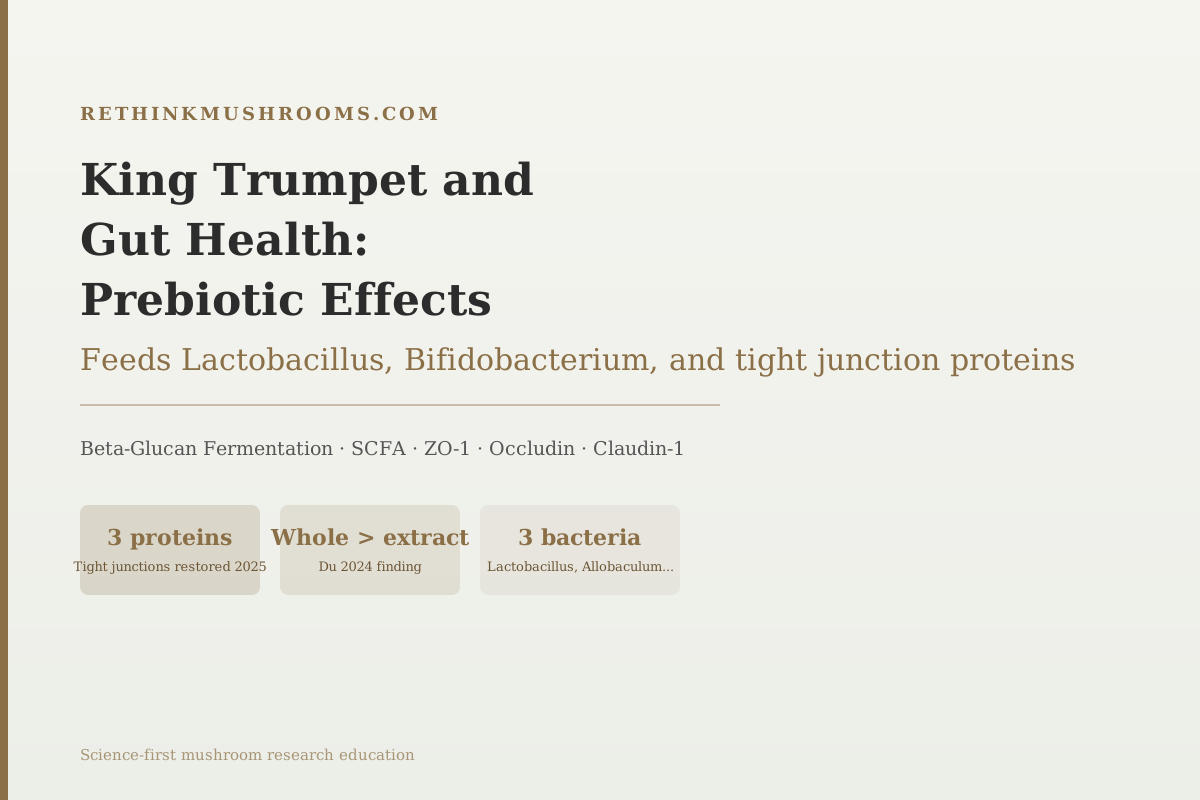
King Trumpet & Gut Health
3 tight junction proteins restored
King trumpet mushrooms fermented with human gut microbiota from healthy older adults produced supernatants that restored ZO-1, occludin, and claudin-1 (the proteins that maintain the intestinal barrier) after bile acid-induced disruption. Whole mushroom outperformed extracted forms.
Kerezoudi et al., Nutrients, 2025
Lactobacillus + Allobaculum
two of the specific gut bacteria significantly promoted by P. eryngii polysaccharides in high-fat diet mice, alongside Phascolarctobacterium and increased SCFA levels (Nakahara et al., 2020)
Whole > extract
the finding from Du et al. (2024): whole king oyster mushroom provided superior gut microbiota dysbiosis reversal compared to isolated polysaccharides, suggesting the full food matrix is more effective than concentrated supplements
1-3% dietary
the effective concentration of P. eryngii in diet that reduced disease activity in DSS-induced colitis mice over 7 weeks, with reduced fecal bleeding and improved stool consistency (Hu et al., 2019)
Kerezoudi et al., Nutrients, 2025
 View as image ↗
King oyster mushroom (Pleurotus eryngii) is better known as a culinary ingredient than a gut health food. But the research picture that has developed over the past several years positions it as one of the more interesting dietary prebiotics among edible mushrooms. Not because it contains a single magic fiber, but because its different polysaccharide fractions appear to act on different aspects of gut biology simultaneously: feeding specific beneficial bacteria, producing short-chain fatty acids, and protecting the intestinal barrier at the tight junction level.
The most recent study, published in Nutrients in 2025, fermented king trumpet mushrooms with gut microbiota from healthy older adults and found that the fermentation products protected intestinal barrier integrity in colonic tissue. No other consumer content on king trumpet has covered this finding.
For the king trumpet pillar article, see what is king trumpet mushroom: the meaty mushroom with health benefits.
Key Takeaways
- P. eryngii polysaccharides significantly altered gut microbiota in high-fat diet mice, specifically increasing Lactobacillus, Allobaculum, and Phascolarctobacterium and raising fecal short-chain fatty acid levels (Nakahara et al., European Journal of Nutrition, 2020)
- The β-1,6-glucan fraction specifically from P. eryngii has distinct gut microbiota-modulating and immunomodulatory effects, separate from the β-1,3-glucan that drives immune activation (Wang et al., Frontiers in Immunology, 2022)
- Dietary P. eryngii at 1-3% of food intake reduced disease activity, fecal bleeding, and stool inconsistency in DSS-induced colitis mice over 7 weeks, providing the gut inflammation protection evidence (Hu et al., MNFR, 2019)
- Whole king oyster mushroom outperformed isolated polysaccharides for gut microbiota dysbiosis reversal and metabolic improvement in HFD mice, with short-chain fatty acid increases being greater in the whole mushroom group (Du et al., Food Research International, 2024)
- In the most recent research, P. eryngii fermented with human gut microbiota from healthy older adults produced fermentation supernatants that restored tight junction proteins ZO-1, occludin, and claudin-1 following bile acid-induced intestinal barrier disruption (Kerezoudi et al., Nutrients, 2025)
- P. eryngii qualifies as a prebiotic not because it simply passes through the gut as fiber, but because its polysaccharides undergo specific colonic fermentation with measurable effects on microbiota composition, SCFA production, and intestinal barrier integrity
What Makes King Trumpet a Prebiotic (Not Just Dietary Fiber)
Fiber and prebiotic are often used interchangeably, but they mean different things. Dietary fiber is any indigestible carbohydrate that reaches the colon. A prebiotic is something more specific: a substrate that is selectively fermented by beneficial gut microorganisms and produces a health benefit as a result.
Not all dietary fiber qualifies as prebiotic. Some fiber passes through the colon with minimal fermentation. Prebiotic qualification requires demonstrating that the fiber actually gets fermented by gut bacteria, that fermentation produces measurable changes in microbiota composition, and that those changes are beneficial rather than neutral.
For P. eryngii polysaccharides, this qualification is satisfied by several studies showing that dietary PE changes microbiota composition, increases SCFA levels, and produces downstream biological effects. Nakahara and colleagues' 2020 study in high-fat diet mice is the clearest demonstration: PE polysaccharides altered microbiota at the genus level and raised fecal SCFA concentrations; both changes require fermentation rather than simple passage through the colon.[2]
This fermentability is the technical foundation for the prebiotic claim. Which bacteria specifically benefit, and what they produce, is where the more interesting research begins.
The Specific Bacteria King Trumpet Feeds
Most gut health content says mushrooms "promote good bacteria" without naming which ones. The Nakahara 2020 study is unusual in providing specific genera.
Nakahara and colleagues fed P. eryngii polysaccharides to mice on a high-fat diet and measured fecal microbiota composition alongside SCFA levels and metabolic parameters.[2] The mushroom polysaccharides significantly increased the relative abundance of three bacterial genera:
Lactobacillus. The most familiar probiotic genus, associated with reduced gut inflammation, lactate production, and competitive exclusion of pathogenic bacteria. Lactobacillus decline in high-fat diet conditions is a hallmark of gut dysbiosis, and its restoration is a recognized marker of microbiome recovery.
Allobaculum. A butyrate-producing genus that is significantly reduced in HFD-associated dysbiosis. Allobaculum is considered a beneficial commensal that contributes to short-chain fatty acid production and anti-inflammatory signaling. Its specific promotion by PE polysaccharides is a finding that doesn't appear in any consumer king oyster content.
Phascolarctobacterium. A propionate-producing genus associated with reduced appetite, improved insulin sensitivity, and anti-inflammatory effects via propionate signaling. Its promotion by PE suggests a potential metabolic benefit pathway beyond simple gut health.
Alongside these bacterial changes, fecal SCFA levels increased, confirming that the bacterial shifts translated into measurable metabolite production. For the SCFA mechanism in detail, see king trumpet and short-chain fatty acid production.
The β-1,6-Glucan Discovery: A Structural Specificity Story
Mushroom beta-glucan is often discussed as though it were a single compound. In reality, king trumpet contains structurally distinct glucan fractions: β-1,3-glucan (the primary immune-activating compound) and β-1,6-glucan (a different linkage structure with different biological properties).
Wang and colleagues published a 2022 study in Frontiers in Immunology specifically investigating the β-1,6-glucan fraction from P. eryngii.[3] They found that this specific structural variant modulates both gut microbiota composition and immune function, establishing that the gut microbiota effects of PE are not simply generic fiber fermentation but involve specific polysaccharide-bacteria interactions.
The practical implication is that different processing methods for P. eryngii will retain different fractions of these glucan structures. Hot water extraction concentrates polysaccharides including both glucan types. Ethanol extraction targets fat-soluble compounds but removes many polysaccharides. Whole mushroom consumption preserves all fractions in their native ratios.
This structural specificity is also why whole mushroom may perform better than isolated extracts for gut health outcomes.
Gut Inflammation: The Colitis Evidence
Hu and colleagues tested P. eryngii in the DSS (dextran sodium sulfate) colitis model, the standard laboratory model for intestinal inflammation research.[1] DSS induces colitis by damaging the intestinal epithelium. Mice fed P. eryngii at 1% and 3% of dietary intake for 7 weeks showed reduced disease activity index, less fecal bleeding, and improved stool consistency compared to controls on the colitis protocol.
The colitis model is relevant to two audiences: people with inflammatory bowel conditions who are curious whether dietary mushrooms might support their gut health, and people without diagnosed conditions who want to understand whether PE contributes to gut inflammation management generally. The preclinical evidence is encouraging in both cases, though no clinical trial in IBD patients has been conducted for P. eryngii specifically.
For the fiber and digestive health angle including the mucus layer evidence, see Pleurotus eryngii fiber and digestive health.
The Intestinal Barrier: What the 2025 Research Adds
The most methodologically advanced research in this cluster comes from Kerezoudi and colleagues' 2025 study, published in Nutrients.[5] Rather than using standard animal models, they fermented PE mushrooms with human fecal microbiota collected from 65 healthy older adult donors. The resulting fermentation supernatants were then applied to colonic tissue to test whether they protected against bile acid-induced intestinal barrier disruption.
Three types of P. eryngii preparations were tested: whole food matrix (PEWS), digested form (PEWB), and beta-glucan extract. All three provided some barrier protection, but the whole food matrix produced the strongest restoration of tight junction proteins.
Tight junction proteins (ZO-1, occludin, and claudin-1) are the molecular "zippers" that hold intestinal epithelial cells together, preventing bacteria and toxins from passing through the gut wall into circulation. Their downregulation is a hallmark of intestinal barrier dysfunction ("leaky gut"). The Kerezoudi 2025 study showed that fermented PE products restored these proteins after experimental disruption, the first evidence that PE's gut effects extend to barrier integrity at the tight junction level.
Using human-derived gut microbiota from real donors (rather than rodent gut bacteria) also makes this evidence more directly relevant to human gut biology than standard mouse studies.
Whole Mushroom vs. Isolated Extract: Why Eating King Trumpet Matters
Du and colleagues' 2024 study provided a practically important comparison for anyone deciding between whole king oyster mushroom in their diet and a concentrated polysaccharide supplement.[4] Whole king oyster mushroom feeding outperformed isolated polysaccharides for gut microbiota dysbiosis reversal, SCFA production, and metabolic improvements in high-fat diet mice.
This finding has a straightforward implication: the full food matrix of P. eryngii (including its complete fiber composition, non-polysaccharide bioactives, and the synergistic interactions between different compounds) produces broader gut benefits than any isolated fraction. This is consistent with the Kerezoudi 2025 finding that whole food matrix outperformed extracts for tight junction restoration.
For consumers choosing between whole mushroom consumption and supplementation, the available evidence favors the whole mushroom for gut-specific outcomes. This aligns with the standard nutritional understanding that whole foods typically outperform isolated nutrients in gut health research.
For how king trumpet compares to other mushroom species as a prebiotic, see which mushrooms are the best prebiotics: a species comparison. For the king oyster microbiome diversity research in more detail, see king oyster mushroom and microbiome diversity.
The Bottom Line
King trumpet mushroom (Pleurotus eryngii) qualifies as a prebiotic because its polysaccharides undergo colonic fermentation and produce measurable microbiota changes. Nakahara et al. (2020) found specific increases in Lactobacillus, Allobaculum, and Phascolarctobacterium alongside elevated SCFA levels. The β-1,6-glucan fraction specifically modulates gut microbiota (Wang et al., 2022). Hu et al. (2019) demonstrated gut inflammation protection in DSS-induced colitis at 1-3% dietary inclusion. The most recent evidence (Kerezoudi et al., 2025) shows fermented PE with human gut microbiota restored tight junction proteins ZO-1, occludin, and claudin-1. Du et al. (2024) found whole mushroom outperformed isolated polysaccharides for gut effects, favoring whole food consumption over supplementation.
Frequently Asked Questions
Sources & References
- 1RTHM-00560·Hu, Qiuhui et al. (2019). “Dietary Intake of Pleurotus eryngii Ameliorated Dextran-Sodium-Sulfate-Induced Colitis in Mice..” Molecular nutrition & food research.Study breakdown →PubMed →↩
- 2RTHM-00643·Nakahara, Daiki et al. (2020). “Effect of mushroom polysaccharides from Pleurotus eryngii on obesity and gut microbiota in mice fed a high-fat diet..” European journal of nutrition.Study breakdown →PubMed →↩
- 3RTHM-00801·Wang, Xue et al. (2022). “β-1,6-Glucan From Pleurotus eryngii Modulates the Immunity and Gut Microbiota..” Frontiers in immunology.Study breakdown →PubMed →↩
- 4RTHM-00876·Du, Hengjun et al. (2024). “Dietary intake of whole king oyster mushroom (Pleurotus eryngii) attenuated obesity via ameliorating lipid metabolism and alleviating gut microbiota dysbiosis..” Food research international (Ottawa.Study breakdown →PubMed →↩
- 5RTHM-02104·Kerezoudi, Evangelia N et al. (2025). “Pleurotus eryngii Mushrooms Fermented with Human Fecal Microbiota Protect Intestinal Barrier Integrity: Immune Modulation and Signalling Pathways Counter Deoxycholic Acid-Induced Disruption in Healthy Colonic Tissue..” Nutrients.Study breakdown →PubMed →↩