King Trumpet & Gut Health
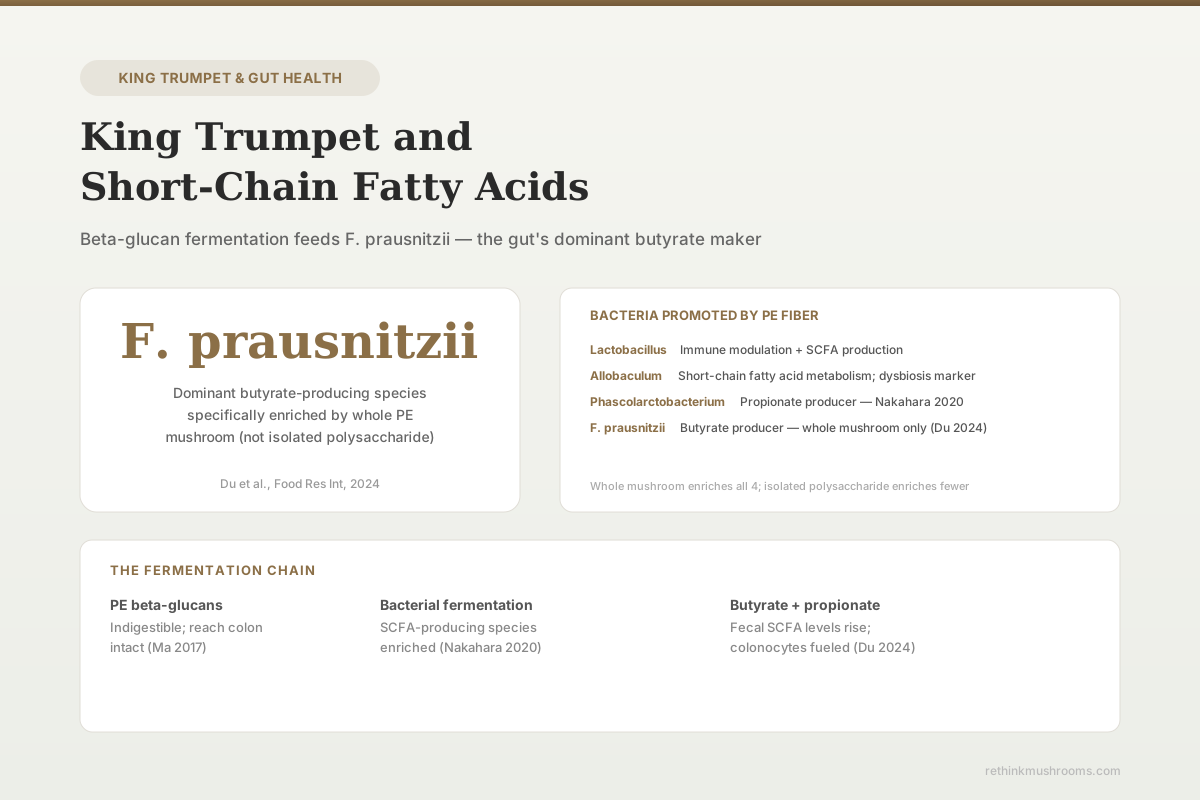
3 SCFA-producing bacteria genera
King trumpet polysaccharides specifically promoted Lactobacillus, Allobaculum, and Phascolarctobacterium while increasing fecal SCFA levels in high-fat diet mice.
Nakahara et al., Eur J Nutr, 2020
F. prausnitzii
dominant butyrate producer enriched by whole PE mushroom (Du 2024)
In vivo confirmed
Ma 2017: PE polysaccharide undergoes actual colonic fermentation
Whole > extract
Du 2024: whole mushroom outperforms isolated polysaccharide for SCFA
Nakahara et al., Eur J Nutr, 2020
 View as image ↗
The cells lining your colon need a constant energy supply, and most of it doesn't come from what you eat. It comes from what your gut bacteria produce. Short-chain fatty acids (SCFAs), primarily acetate, propionate, and butyrate, are produced when gut bacteria ferment dietary fiber, and butyrate in particular is the preferred fuel for colonocytes, the cells that form the gut's inner lining. King trumpet mushroom (Pleurotus eryngii) contains beta-glucan fiber fractions that gut bacteria ferment to produce SCFAs. Three animal studies demonstrate that PE fiber increases fecal SCFA levels and enriches the specific bacterial populations that produce them, including Faecalibacterium prausnitzii, the gut's dominant butyrate-making species.
For an overview of what king trumpet is and what its nutritional profile looks like, see what is king trumpet mushroom. This article focuses specifically on the SCFA production pathway and what the research establishes about it.
Key Takeaways
- King trumpet polysaccharides increased fecal SCFA levels and promoted Lactobacillus, Allobaculum, and Phascolarctobacterium in high-fat diet mice (Nakahara et al., Eur J Nutr, 2020)
- Whole king oyster mushroom increased SCFA levels in high-fat diet mice and specifically enriched Faecalibacterium prausnitzii, the gut's dominant butyrate producer (Du et al., Food Res Int, 2024)
- Whole mushroom outperformed isolated PE polysaccharides for SCFA production and microbiome effects in Du 2024
- In vivo fermentation of PE polysaccharide was confirmed by Ma et al. (2017), establishing that the fiber reaches the colon and is actually fermented by gut bacteria
- Butyrate produced from fiber fermentation is the primary energy source for colonocytes and supports intestinal barrier integrity
- The evidence base is animal studies; no human RCT has specifically measured fecal SCFA levels after PE consumption
What SCFAs Are, and Why Your Colonocytes Depend on Them
Short-chain fatty acids are small organic acids produced when gut bacteria break down dietary fiber in the colon. The three main types are acetate, propionate, and butyrate, each absorbed and used by the body in different ways.
Acetate is the most abundant of the three. It circulates in the bloodstream after absorption through the colon wall, where it participates in fatty acid synthesis and energy metabolism throughout the body. Propionate is taken up primarily by the liver, where it can reduce the rate of cholesterol production and support blood glucose regulation. Butyrate is the one that matters most for the gut lining itself.
Colonocytes, the epithelial cells forming the innermost layer of the colon, use butyrate as their preferred energy source. Unlike most human cells that run primarily on glucose, colonocytes extract around 70% of their energy from butyrate produced by their microbial neighbors. When butyrate availability drops, colonocytes switch to less efficient fuel sources, and the tight junction proteins that control what passes through the gut wall can become disorganized. These tight junction proteins (claudin-1, occludin, and ZO-1) act like the mortar between bricks in the intestinal wall, and butyrate helps maintain them. Covering "tight junction proteins" with your thumb: these are the molecular seals between gut lining cells that prevent bacteria and inflammatory molecules from crossing into the bloodstream.
Beyond energy supply, butyrate has anti-inflammatory effects within the colon. It inhibits the activity of enzymes called histone deacetylases, which in plain terms means it changes which genes colonocytes and immune cells activate. This gene-level effect helps keep the inflammatory response in the colon calibrated rather than chronically elevated.
The production of butyrate depends on two things: the right bacteria being present, and having fiber for them to ferment.
The Fermentation Chain: How King Trumpet Fiber Becomes SCFAs
King trumpet's beta-glucans are long-chain polysaccharides that human digestive enzymes cannot break apart. They pass through the stomach and small intestine intact and reach the colon, where the microbial community becomes the relevant digestive system.
Ma and colleagues (2017) confirmed this fermentation process directly. They showed that in vivo fermentation of PE polysaccharide significantly altered fecal microbiota composition and stimulated immune responses in their model.[1] The fact that PE polysaccharide reached the colon and produced measurable changes in both bacterial populations and immune parameters establishes colonic fermentation as the mechanism, rather than absorption in the upper digestive tract.
The beta-glucan fractions in PE include both beta-1,3-glucan and the less common beta-1,6-glucan. Different bacterial species preferentially ferment different glucan structures. This structural specificity matters because it determines which bacteria are enriched, and therefore which SCFAs are produced in greater quantities.
Once gut bacteria ferment the beta-glucans, they produce acetate, propionate, and butyrate as metabolic byproducts. The ratio of these three SCFAs varies depending on the bacterial community composition and the fiber structure being fermented. Bacteria in the Lachnospiraceae and Ruminococcaceae families are major SCFA producers; F. prausnitzii, which sits within Ruminococcaceae, is the gut's dominant butyrate producer.
When gut bacteria ferment king trumpet beta-glucans and chitin in the colon, they produce short-chain fatty acids primarily including acetate, propionate, and butyrate. Butyrate is the primary energy source for colonocytes, reduces intestinal inflammation, and supports the gut barrier. Research shows PE specifically increases Faecalibacterium prausnitzii, the dominant butyrate-producing species in the human gut.
The Specific SCFA-Producing Bacteria King Trumpet Promotes
Nakahara and colleagues (2020) conducted the most detailed analysis of which bacteria PE polysaccharides promote. In high-fat diet mice, PE polysaccharide supplementation enhanced the abundance of three genera: Lactobacillus, Allobaculum, and Phascolarctobacterium, alongside increased fecal SCFA levels.[2]
Phascolarctobacterium is a propionate-producing bacterium. Its enrichment by PE polysaccharides provides a mechanistic link between PE fiber consumption and increased propionate production specifically. Propionate, as noted above, reaches the liver and supports glucose and cholesterol metabolism there.
Allobaculum is associated with short-chain fatty acid metabolism more broadly and tends to be depleted in gut dysbiosis associated with high-fat diets. Its restoration by PE polysaccharides suggests PE is partly reversing dysbiosis-related bacterial losses.
Lactobacillus is the most familiar genus of the three. Various Lactobacillus species produce lactic acid and short-chain fatty acids, and the genus is associated with intestinal barrier protection and immune regulation.
Du and colleagues (2024) extended this picture significantly by studying whole king oyster mushroom rather than isolated polysaccharides.[3] In high-fat diet mice, whole mushroom consumption significantly increased fecal SCFA levels. Critically, Du's analysis specifically identified Faecalibacterium prausnitzii as one of the species enriched by the whole food matrix. F. prausnitzii is recognized as the gut's dominant butyrate producer. In healthy adults, it accounts for roughly 5% of total fecal bacteria. Its reduction is associated with inflammatory bowel disease, and its enrichment is considered a positive microbiome shift.
The two studies together map different portions of the same pathway: PE fiber reaches the colon (Ma 2017), is fermented by gut bacteria, and the bacteria promoted by that fermentation (Nakahara 2020) include both propionate producers and the dominant butyrate producer (Du 2024).
For context on how PE compares to other edible mushrooms for gut microbiome effects, king oyster mushroom and microbiome diversity covers the species-level microbiota data in more detail.
Why Whole Mushroom Outperforms Isolated Polysaccharide for SCFA Production
The most practically significant finding in the Du 2024 paper isn't the SCFA increase itself; it's the comparison between whole mushroom and isolated polysaccharide.[3] The whole king oyster mushroom produced superior outcomes across multiple measures, including SCFA production and F. prausnitzii enrichment, compared to isolated PE polysaccharides at equivalent doses.
This whole food advantage likely reflects the complexity of the full mushroom matrix. King trumpet contains not just beta-glucans but also chitin (a structural polysaccharide found in fungal cell walls), hemicellulose, ergothioneine, phenolic compounds, proteins, and other bioactive constituents. The prebiotic effect of eating the whole mushroom reflects all of these components acting together, not just the beta-glucan fraction that can be extracted and standardized.
Chitin, the structural fiber of fungal cell walls, is also fermented by some gut bacteria and contributes to the overall SCFA production. If an extraction process targets beta-glucans specifically, chitin and other fiber fractions may be lost or reduced, narrowing the prebiotic substrate available to gut bacteria.
This finding sits within a broader pattern in nutrition research where whole foods frequently outperform isolated extracts of their primary bioactive component. In this case, the full mushroom matrix provides a more diverse prebiotic substrate, supporting a broader bacterial community and more SCFA production than a purified polysaccharide fraction alone.
The practical implication is that culinary consumption of king trumpet mushroom, as food rather than supplement, may provide greater SCFA-related benefits than extracted polysaccharide supplements, even those standardized for beta-glucan content.
What the Animal Models Have and Haven't Established
All three studies underlying this article used animal models. This is worth examining carefully because it affects how confidently the findings can be applied to humans.
High-fat diet mouse models are the standard laboratory tool for studying diet-induced gut dysbiosis. They reliably produce shifts in gut microbiota composition, increased intestinal permeability, and reduced SCFA levels, mimicking aspects of the metabolic and gut health changes associated with poor diet in humans. Interventions that reverse these changes in this model have a reasonable track record of translating to human benefit, but not universally.
The fundamental fermentation biochemistry is conserved between mice and humans: gut bacteria ferment fiber to produce SCFAs in both species. The specific bacteria differ between mouse and human microbiomes, which means the exact genera enriched in mice may not be the same ones enriched in humans. F. prausnitzii exists in both mouse and human microbiomes and is butyrate-producing in both contexts, which makes the Du 2024 finding relatively translatable. Allobaculum and Phascolarctobacterium are mouse-prevalent genera that have human counterparts but are not the same species.
The Ma 2017 fermentation confirmation is the most directly transferable finding: the fact that PE polysaccharide undergoes colonic fermentation rather than being absorbed higher in the gut is a mechanistic fact that applies across species.[1]
No human randomized controlled trial has specifically measured fecal SCFA levels before and after PE consumption. In vitro fermentation studies using human fecal samples are a useful bridge, but they are not equivalent to measuring SCFA production in living humans over time. The evidence is mechanistically coherent and directionally consistent, but the human clinical evidence gap is real.
Where This Fits in the Broader PE Gut Health Research
SCFA production is one part of a larger picture of PE gut health effects. The Kerezoudi 2025 Nutrients study, discussed in Pleurotus eryngii fiber and digestive health, showed that fermented PE products protect intestinal barrier tight junction proteins against bile acid-induced disruption, with the whole mushroom form again outperforming extracts. The mechanism there connects to butyrate: adequate butyrate supports the tight junction proteins that fermented PE products were found to protect.
The Hu 2019 colitis data, showing PE dietary intake reduced disease activity in a DSS-induced colitis mouse model, aligns with the SCFA pathway: improved SCFA production supports the colonocytes and barrier function that protect against colitis development and progression.
The beta-glucan structural specificity documented in Wang 2022, discussed in king trumpet dietary fiber and Bifidobacterium growth, adds another layer: the beta-1,6-glucan fraction specifically modulates gut microbiota composition, suggesting different glucan structures from the same mushroom may promote different bacterial populations with different SCFA outputs.
For comparison with how other mushroom species produce SCFAs through their fiber fractions, enoki and short-chain fatty acid production in the gut covers Flammulina velutipes data, and mushroom dietary fiber and short-chain fatty acid production provides a cross-species overview.
The Bottom Line
Three animal studies establish that king trumpet mushroom fiber is fermented by gut bacteria in the colon and that this fermentation increases fecal SCFA levels while promoting SCFA-producing bacteria, including Faecalibacterium prausnitzii, the dominant butyrate producer. Whole king oyster mushroom outperforms isolated polysaccharide extracts in both SCFA production and bacterial enrichment, a finding consistent with food matrix effects seen across nutritional research. The mechanistic evidence is coherent and directionally consistent, but human clinical trial data for PE-specific SCFA production remains absent.
Frequently Asked Questions
Sources & References
- 1RTHM-00894·Ma, Gaoxing et al. (2017). “In vivo fermentation of a Pleurotus eryngii polysaccharide and its effects on fecal microbiota composition and immune response..” Food & function.Study breakdown →PubMed →↩
- 2RTHM-00643·Nakahara, Daiki et al. (2020). “Effect of mushroom polysaccharides from Pleurotus eryngii on obesity and gut microbiota in mice fed a high-fat diet..” European journal of nutrition.Study breakdown →PubMed →↩
- 3RTHM-00876·Du, Hengjun et al. (2024). “Dietary intake of whole king oyster mushroom (Pleurotus eryngii) attenuated obesity via ameliorating lipid metabolism and alleviating gut microbiota dysbiosis..” Food research international (Ottawa.Study breakdown →PubMed →↩