Mushrooms & Gut Health
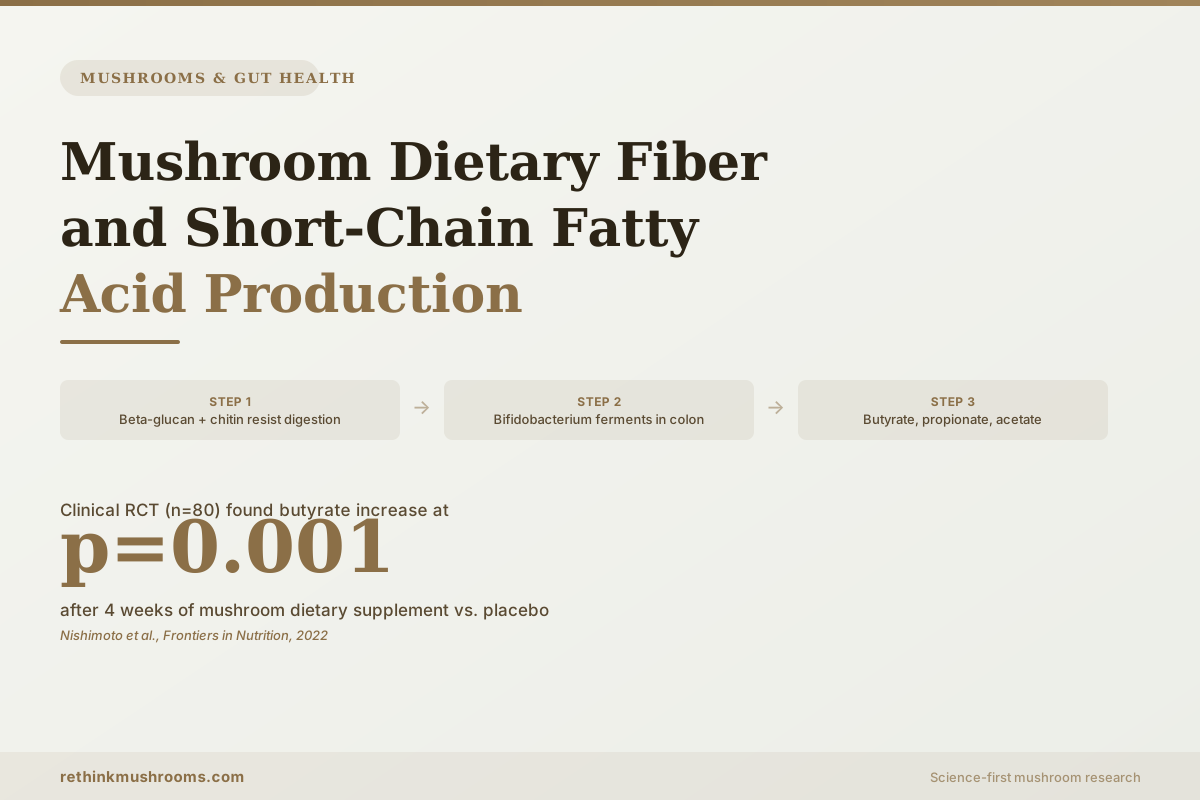
p=0.001 significance for butyrate increase from mushroom supplement in a human RCT
Nishimoto and colleagues' 2022 trial (n=80) is the strongest clinical evidence that mushroom dietary fiber drives SCFA production in humans: butyrate significantly higher at p=0.001 and propionate at p=0.020 after four weeks vs. placebo.
Nishimoto et al., Frontiers in Nutrition, 2022
2x
different SCFA profiles: enoki mushroom fiber increases butyric acid; oyster mushroom increases acetic and propionic acid (Zhang et al., 2020)
4.5g
per day of chitin-glucan improved glycemic response but did NOT significantly increase SCFAs in a human crossover trial (Ranaivo et al., 2022)
2025
ex vivo study showing mushroom blend restored butyrate production in IBS patient microbiomes (Maguire et al., Int J Mol Sci)
Nishimoto et al., Frontiers in Nutrition, 2022
 View as image ↗
The cells lining the inner surface of your colon, called colonocytes, run almost entirely on one fuel: butyrate. Not protein, not fat, not glucose from your meals. The colonocytes that maintain your gut barrier depend primarily on the butyrate their bacterial neighbors make from fermenting dietary fiber. In 2022, a human clinical trial with 80 participants found that a mushroom dietary supplement significantly increased both butyrate and propionate in the gut over four weeks.
Understanding how mushroom dietary fiber produces SCFAs requires understanding what happens after you swallow a mushroom. The nutrients that matter most for this process are not the ones absorbed in the stomach or small intestine. They are the ones that escape digestion entirely and reach your colon intact. For the broader prebiotic context behind this mechanism, see mushrooms as prebiotics: how they feed your gut bacteria.
Key Takeaways
- Mushroom dietary fiber (beta-glucan and chitin) resists digestion and reaches the colon intact, where Bifidobacterium and Faecalibacterium prausnitzii ferment it into SCFAs
- A 2022 human RCT (n=80) found mushroom supplement significantly increased intestinal butyrate (p=0.001) and propionate (p=0.020) vs. placebo after four weeks (Nishimoto et al., Frontiers in Nutrition)
- Different mushroom species produce different SCFA profiles: enoki (Flammulina velutipes) increases total SCFAs including butyric acid; king oyster (Pleurotus eryngii) increases acetic and propionic acid (Zhang et al., 2020)
- 4.5g/day of chitin-glucan improved postprandial glucose response and altered gut bacteria, but did NOT significantly increase SCFA levels in a 3-week crossover trial (Ranaivo et al., 2022; n=15)
- A 2025 ex vivo study found a mushroom blend restored butyrate production in dysbiotic gut microbiomes from IBS patients (Maguire et al., 2025)
- Butyrate is the primary fuel for colonocytes (the cells lining the colon); adequate butyrate production is essential for maintaining the gut barrier that prevents pathogen entry
How Mushroom Dietary Fiber Produces SCFAs: The Three-Step Process
Mushroom fiber's SCFA story unfolds in three stages, each happening in a different part of the digestive tract:
-
Resistance to digestion: Mushroom cell walls contain beta-glucan (a soluble fiber) and chitin (an insoluble structural fiber). Neither is broken down by the human digestive enzymes that work on starch, protein, or standard dietary fats. Both fractions pass through the stomach and small intestine largely intact. This resistance is the prerequisite for everything that follows.
-
Selective fermentation in the colon: When the indigestible fiber reaches the colon, specific bacterial species ferment it selectively. These include Bifidobacterium species, Lactobacillus species, and critically, Faecalibacterium prausnitzii, one of the most important butyrate-producing bacteria in the human gut. Faecalibacterium thrives specifically on the fiber fractions that mushrooms provide. Cheung's 2020 review documents how soluble beta-glucan reaches the mid-colon and activates Bifidobacterium first, while insoluble chitin travels further and activates different fermentation populations in the distal colon.[5]
-
SCFA production and its downstream effects: Fermentation produces three short-chain fatty acids (SCFAs): butyrate, propionate, and acetate. These molecules lower colonic pH, creating an environment that suppresses pathogen growth. Butyrate is absorbed directly by colonocytes and serves as their primary energy source. Propionate travels to the liver and plays a role in glucose regulation and appetite signaling. Acetate enters systemic circulation and reaches the brain, where it acts as a metabolic signal. The mushroom fiber chain, from cell wall to colonocyte fuel, is complete.
A 2017 review by Valverde and colleagues established that this three-step cascade applies across multiple edible mushroom species, with beta-glucan and chitin acting as complementary (not competing) substrates that feed different bacterial populations at different points in the colon.[4]
The Human Clinical Evidence: Butyrate Significantly Higher at p=0.001
The most direct human evidence for mushroom dietary fiber and SCFA production comes from a 2022 clinical study by Nishimoto and colleagues.[1]
The study enrolled 80 participants in a randomized design, with one group receiving a mushroom dietary supplement and the other receiving a placebo, for four weeks. At the end of the intervention period, intestinal butyrate concentrations were significantly higher in the mushroom group versus the placebo group (p=0.001), where p=0.001 means there is less than a 1-in-1000 chance the difference was due to random variation. Intestinal propionate was also significantly higher (p=0.020). The mushroom group also showed a tendency toward higher secretory IgA levels, a mucosal immune marker, though this did not reach statistical significance.
This is the strongest clinical evidence in the published literature specifically linking mushroom consumption to SCFA production in humans. Consumer health sites and even most scientific reviews haven't cited it.
Earlier human evidence comes from Dahl and colleagues (2018), who ran a randomized trial testing the effect of consuming Agaricus bisporus, the common button mushroom, on gut health biomarkers in healthy adults.[8] The study found changes in gut health markers, including markers related to SCFA production and microbiota composition. The Dahl study used whole mushroom food rather than a concentrated supplement, at lower polysaccharide dose, and found smaller effects. Together, Nishimoto 2022 and Dahl 2018 establish that whole mushrooms and mushroom supplements both produce measurable gut fermentation effects in humans, with the concentrated supplement producing a stronger SCFA signal.
For how these bacterial changes connect to gut microbiome composition more broadly, see how mushrooms change your gut microbiome: research review.
Butyrate, Propionate, Acetate: What Each SCFA Does
Knowing that mushroom fiber increases SCFAs is more meaningful if you understand what each molecule does.
Butyrate is the primary energy source for colonocytes. These are the cells that line the colon and form the gut barrier. A healthy gut barrier prevents pathogens, undigested food particles, and bacterial fragments from crossing into systemic circulation. When butyrate production falls (in dysbiotic gut states), colonocytes have inadequate fuel, and the gut barrier becomes leaky. Adequate butyrate from fiber fermentation is one of the main mechanisms by which dietary fiber protects gut barrier integrity. Butyrate also has direct anti-inflammatory effects: it inhibits a protein called NF-κB (the same inflammatory switch that cordycepin targets in the neuroinflammation context), reducing inflammatory gene expression in gut tissue.
Propionate travels to the liver through the portal circulation. In the liver, it acts as a substrate that reduces glucose production (an effect relevant to metabolic health) and as a satiety signal. Propionate is also thought to reduce fat synthesis in liver cells and help regulate cholesterol metabolism.
Acetate is the most abundant SCFA by volume. It enters general circulation and travels throughout the body, including crossing the blood-brain barrier. In the brain, acetate serves as a metabolic substrate and influences neurotransmitter precursor availability, which is part of why gut microbiota composition is linked to brain function. For more on how SCFA production connects to brain function specifically, see how mushroom prebiotics influence brain function through the gut.
The three SCFAs work on different organs through different mechanisms. Mushroom fiber drives all three, but the relative amounts of butyrate, propionate, and acetate depend on which bacteria are fermenting the fiber, which depends on which mushroom species the fiber came from.
Species Differences: Enoki and Oyster Mushrooms Produce Different SCFA Profiles
Not all mushroom fibers produce the same SCFA output. A 2020 review by Zhang and colleagues documented species-specific differences in the SCFA profiles that mushroom dietary fibers generate.[6]
Flammulina velutipes, the thin-stemmed mushroom commonly sold as enoki, produces dietary fibers that specifically increase total SCFA production, including butyric acid (the acid form of butyrate) as a notable component of the increase. Pleurotus eryngii, the king oyster mushroom, produces dietary fibers that preferentially increase acetic acid and propionic acid rather than butyric acid.
This difference is not arbitrary. The fiber composition of each species is distinct: the ratio of beta-glucan to chitin, the molecular weight and branching pattern of the polysaccharides, and the proportion of soluble versus insoluble fiber all differ between mushroom types. These structural differences determine which bacterial species ferment the fiber most actively, which in turn determines the SCFA output.
A 2023 review by Chen and colleagues confirmed this species specificity: different mushroom dietary fibers from different species produce distinct microbiota shifts and SCFA profiles, with the prebiotic activity attributed to both beta-glucan (soluble fraction, mid-colon fermentation) and chitin (insoluble fraction, distal colon fermentation) acting on different populations.[7]
The practical implication is that "mushroom fiber" is not a monolithic category with a single SCFA output. If butyrate production specifically is the target (for gut barrier support), enoki or species with high beta-glucan density are more aligned with the evidence than oyster mushroom varieties. The Nishimoto 2022 clinical study used a multi-species mushroom supplement, so the significant butyrate and propionate increases likely reflect the combined contribution of multiple fiber types across species.
The Dose Problem: When 4.5g Per Day Was Not Enough
An honest treatment of mushroom fiber and SCFA production has to address the dose question directly. A 2022 double-blind crossover trial by Ranaivo and colleagues adds a necessary counterpoint.[2]
The trial tested a chitin-glucan supplement, a combined fiber extracted from mushroom cell walls, at 4.5 grams per day over three weeks in 15 adults at cardiometabolic risk. The chitin-glucan group showed improved postprandial glucose response (the blood sugar rise after meals was attenuated) and measurable changes in gut microbiota composition. These are real effects, consistent with a prebiotic-active fiber.
What the chitin-glucan group did not show was a significant increase in SCFA concentrations. Butyrate, propionate, and acetate outputs were not statistically different from placebo at this dose and duration.
This matters for anyone extrapolating from the Nishimoto 2022 findings to a specific product. Several variables separate the two studies: the dose (Nishimoto used a whole-mushroom supplement rather than isolated chitin-glucan), the duration (four weeks versus three weeks), the population (healthy adults versus cardiometabolic risk), and the fiber composition (whole mushroom encompasses multiple polysaccharide fractions; isolated chitin-glucan does not). The Ranaivo study's chitin-glucan dose was sufficient to change glucose metabolism and shift bacteria, but not sufficient to significantly drive SCFA production. This suggests that either the dose needs to be higher, the duration needs to be longer, or the full complement of mushroom fiber fractions is more effective than isolated chitin-glucan alone.
Mushroom Fiber in Dysbiotic Guts: New Evidence From IBS Microbiomes
The SCFA story is not limited to healthy gut populations. A 2025 study by Maguire and colleagues examined whether mushroom fiber retains its butyrate-promoting activity when the gut microbiome is already disrupted.[3]
The research team used an ex vivo approach: they took gut microbiome samples from IBS patients (whose microbiomes have reduced butyrate-producing bacterial populations compared to healthy controls) and tested a mushroom blend combined with triacetin, a short-chain triglyceride, on those samples outside the body. The mushroom blend restored butyrate production in the dysbiotic IBS microbiomes.
This finding addresses a limitation of the healthy-adult RCT data: it suggests the butyrate-promoting effect of mushroom fiber is not contingent on a pre-existing healthy microbiome. Even in a microbiome with disrupted fermentation capacity, mushroom fiber can help restore the butyrate output that IBS guts characteristically lack.
The study is ex vivo and observational in design, meaning it has lower evidence weight than a human RCT. It doesn't establish dose, duration, or clinical outcomes in IBS patients. But for readers with IBD, IBS, or other conditions associated with reduced gut SCFA production, it provides early mechanistic evidence that the mushroom fiber effect is not exclusive to healthy guts.
For the research on mushroom compounds and gut inflammation specifically, see mushroom beta-glucans and gut inflammation: IBD research.
What the Evidence Adds Up To
The 2017 review by Valverde and colleagues established that mushroom fiber acts as a prebiotic through complementary beta-glucan and chitin fractions.[4] The 2020 Cheung and Zhang reviews mapped the species-specific and segment-specific fermentation patterns.[5] The 2022 clinical study by Nishimoto put the butyrate and propionate increases in humans at statistical significance. And the Ranaivo 2022 null result for isolated chitin-glucan SCFA showed that dose and fiber complexity matter for translating mechanism to measurable output.
What the evidence does not yet establish: the minimum effective dose for SCFA production in humans, the optimal duration for a significant butyrate response, whether specific mushroom species outperform others in human (rather than animal) SCFA trials, and the long-term effects of consistent mushroom fiber consumption on SCFA-dependent health outcomes like gut barrier integrity and metabolic markers.
For a deep dive on the different fiber types responsible for this process, see mushroom fiber: types, digestibility, and health effects. For how cooking affects fiber availability and chitin accessibility, see why cooking mushrooms matters: breaking down chitin. For the cluster articles on chitin specifically, see chitin in mushrooms: indigestible fiber or underrated prebiotic? and chitin in mushrooms: is it a benefit or a barrier?.
The Bottom Line
Mushroom dietary fiber produces short-chain fatty acids through a three-step process: beta-glucan and chitin resist digestion, reach the colon intact, and are selectively fermented by butyrate- and propionate-producing bacteria. A 2022 human RCT (n=80) found mushroom supplement significantly increased butyrate (p=0.001) and propionate (p=0.020). Species matter: enoki and oyster mushrooms produce different SCFA profiles. Dose matters: 4.5g/day isolated chitin-glucan changed bacteria but didn't significantly increase SCFAs. The effective dose and duration for consistent SCFA increases in humans is not yet established.
Frequently Asked Questions
Sources & References
- 1RTHM-01593·Nishimoto, Yuichiro et al. (2022). “Dietary supplement of mushrooms promotes SCFA production and moderately associates with IgA production: A pilot clinical study..” Frontiers in nutrition.Study breakdown →PubMed →↩
- 2RTHM-01604·Ranaivo, Harimalala et al. (2022). “Chitin-glucan supplementation improved postprandial metabolism and altered gut microbiota in subjects at cardiometabolic risk in a randomized trial..” Scientific reports.Study breakdown →PubMed →↩
- 3. Source details for this reference are not yet available.
- 4. Source details for this reference are not yet available.
- 5. Source details for this reference are not yet available.
- 6. Source details for this reference are not yet available.
- 7. Source details for this reference are not yet available.
- 8. Source details for this reference are not yet available.